Last modified:
I know I mentioned in an earlier post that I won’t pretend to guess how God will bring about the world situation described at the onset of the apocalypse. And I continue to maintain that there will be plenty of twists, turns, and hiccups along the way, meaning any attempt at laying out in advance the exact sequence of events leading from each event to the next is doomed to miss something. But in light of recent developments and what I’ve seen some reputable commentators say about their implications on the geopolitical scene for the months and years ahead, I feel it’s worth connecting some dots regarding a select handful of the events–just in case.
Of course, it’s completely possible that the catalysts I’ve been seeing in recent months are false alarms, just as we’ve seen in the past. But in light of how close the doctrine of chiliasm (with the Masoretic numbers for Genesis 5 & 11) places us to the beginning of the 70th “seven”, the window of time within which the events associated with the memed-almost-to-death “four horsemen” could come to pass is closing.
But most importantly, it’s important to bear in mind what Daniel was told just after being given more details (Daniel 11:1-12:3) on the events of the 70 “sevens”:
“But as for you [literally, “And you”], Daniel, conceal these words and seal up the book until the end of time [literally, “until the time of the end”; Hebrew עַד־עֵת קֵץ]; many will go back and forth [LXX “till the appointed time of the together-end, till many may be taught”; the sense seems to be that many would “race back and forth” through the pages of Scripture to “unseal” the information at the proper time–indeed, the Hebrew word for “go back and forth” was often used with a connotation of looking for something (2 Samuel 24:2, Jeremiah 5:1, Amos 8:12, Zechariah 4:10; this may even explain why God began His response to Satan’s use of the term the way He did in Job 1:7-8 & 2:2-3)], and knowledge will increase… Go your way, Daniel, for these words are concealed and sealed up until the end time [עַד־עֵת קֵץ]. Many will be purged, purified [literally, “made white”] and refined, but [literally, “and then”; waw-consecutive perfect] the wicked will act wickedly; and none of the wicked will understand [literally, “and none will discern of all wicked ones”], but those who have insight [literally, “and the ones who are prudent“] will understand [or “will discern“]. (Daniel 12:4,9-10 1995 NASB, boldface added)
The simple truth is, we can’t possibly understand whether any set of events could fulfill the Bible’s prophetic statements about these horses and their riders unless we know what the Bible actually says about them. So the majority of this post will be exegesis of the relevant passages, and the remainder will be me presenting the geopolitical insight I’ve come across so far that could clue us in on what to watch out for over the next 3-4 years (yep, the doctrine of chiliasm places us that close to the Two Witnesses showing up!).
The “Four Horsemen” Passages
There are really only 3 Biblical passages featuring these horses: Zechariah 1:7-17, 6:1-8, & Revelation 6:1-8. Each of the Zechariah passages is a complete minor train of thought in the Masoretic Text. Let’s start this discussion by presenting all three passages and bringing out some extra nuances about them, and then we’ll piece together what they teach when taken altogether.
7 On the twenty-fourth day of the eleventh month, that is, the month Shebat, in the second year of Darius, the word of the LORD came to Zechariah the prophet, the son of Berechiah, the son of Iddo, as follows: [literally, “In day twenty and four for month eleven (properly, “one-teen”), that month being Shebat, in year two for Daryavesh (Darius I, by my chronology; but after the return from the Babylonian Exile, in any case), was (perfect) word of YHWH toward Zekharyah, son of Berekhyahu, son of Iddo the prophet, to say (infinitive construct):”]
8 I saw at night, and behold, a man was riding on a red horse, and he was standing among the myrtle trees which were in the ravine, with red, sorrel, and white horses behind him. [literally, “I saw (perfect) the night, and behold! A man mounted and riding (active participle) upon a red horse, and himself standing (active participle) between the myrtle trees which were in the hollow, and after him red, and bay (LXX “red, and gray and dappled”), and white horses.“] 9 Then I said, “What are these, my lord?” And the angel who was speaking with me said to me, “I will show you what these are.” [literally, “And then I said (waw-consecutive imperfect) ‘What are these, my Lord?’ And then toward me said (waw-consecutive imperfect) the Messenger, the one speaking (active participle) with me, ‘I (included for emphasis) will show (imperfect) you (singular) what these very things are (two words for “these” used back-to-back).'”] 10 And the man who was standing among the myrtle trees responded and said, “These are the ones whom the LORD has sent to patrol the earth.” [literally, “And then testified (waw-consecutive imperfect) the man, the one standing (active participle) between the myrtle trees, and so he said (waw-consecutive imperfect) ‘These are those which YHWH has sent (perfect) to traverse (infinitive construct) among the land (or “earth”).’“] 11 So they responded to the angel of the LORD who was standing among the myrtle trees and said, “We have patrolled the earth, and behold, all the earth is still and quiet.” [literally, “And then testified (waw-consecutive imperfect) a Messenger of YHWH, the one standing (active participle) between the myrtle trees, and so they (plural) said (waw-consecutive imperfect) ‘We have traversed (perfect) among the earth/land, and behold! All the earth/land sitting (active participle) and being quiet (active participle).’“]
12 Then the angel of the LORD said, “LORD of armies, how long will You take no pity on Jerusalem and the cities of Judah, with which You have been indignant for these seventy years?” [literally, “And then testified (waw-consecutive imperfect) a Messenger of YHWH, and so said (waw-consecutive imperfect) ‘YHWH of Hosts/Armies, until when will You not have compassion (imperfect) for Jerusalem and cities of Judah, which You have denounced (perfect) this seventy cycle?’ (every term in the Hebrew phrase normally rendered “these seventy years” is actually singular; hence, the seventy-year Babylonian Exile is being treated as a unit in this passage)”] 13 And the LORD responded to the angel who was speaking with me with gracious words, comforting words. [literally, “And then testified (waw-consecutive imperfect) YHWH to (direct object marker) the Messenger, the one speaking (active participle of dabar, whose noun form is the Hebrew counterpart to the Greek word “Logos”) among me good words, words of comfort.”] 14 So the angel who was speaking with me said to me, “Proclaim, saying, ‘This is what the LORD of armies says: “I am exceedingly jealous for Jerusalem and Zion. [literally, “And then toward me said (waw-consecutive imperfect) the Messenger, the one speaking (active participle of dabar) with me, ‘Proclaim (imperative), to say (infinitive construct) “Thus has said (perfect) YHWH of Hosts/Armies, ‘I have been zealous (perfect) for Jerusalem and for Tsion, with great zeal.” 15 But I am very angry with the nations who are carefree; for while I was only a little angry, they furthered the disaster.” [literally, “And with great wrath, I (emphatic) am angry (active participle) against (properly “down on”) the nations, the haughty ones (or “the ones at ease“; this adjective has connotations of being proud because you feel safe–the many corrupt individuals in our day who believe they’re untouchable are prime examples); since I (emphatic) was (or “have been”) angry (perfect) a little, and they aided (perfect) unto evil.“”16 Therefore the LORD says this: “I will return to Jerusalem with compassion; My house will be built in it,” declares the LORD of armies, “and a measuring line will be stretched over Jerusalem.”’ [literally, “According to such conditions, thus has said (perfect) YHWH, “I have turned (perfect) to Jerusalem with compassion, My house will be built (imperfect) in it.” An utterance of YHWH of Hosts/Armies, “And a measuring line will be stretched out (imperfect) over Jerusalem.””] 17 Again, proclaim, saying, ‘This is what the LORD of armies says: “My cities will again overflow with prosperity, and the LORD will again comfort Zion and again choose Jerusalem.”’” [literally, “Again, proclaim (imperative), to say (infinitive construct), “Thus has said (perfect) YHWH of Hosts/Armies, ‘Again My cities will overflow (imperfect) beyond (the preposition properly means “from”, but “out of”, and “more than” are also in its range of meanings) prosperity, and so YHWH will again comfort (waw-consecutive perfect) Tsion, and so He will again choose (waw-consecutive perfect) Jerusalem.'”‘”]
(Zechariah 1:7-17 2020 NASB)
1 Now I raised my eyes again and looked, and behold, four chariots were going out from between the two mountains; and the mountains were bronze mountains. [literally, “And then I turned (waw-consecutive imperfect), and then I lifted up (waw-consecutive imperfect) my eyes, and then I saw (waw-consecutive imperfect), and behold: four chariots coming forth (active participle of yatsa) from between two of the mountains, and the mountains were mountains of bronze (or “copper”);”; there’s no verb in verses 2 or 3, so they should be treated as a continuation of this sentence.]
2 With the first chariot were red horses, with the second chariot black horses, [literally, “with the chariot, the first, red horses, and with the chariot, the second, black horses,”] 3 with the third chariot white horses, and with the fourth chariot strong spotted horses. [literally, “and with the chariot, the third, white horses, and with the chariot, the fourth, spotted bay horses.”] 4 So I responded and said to the angel who was speaking with me, “What are these, my lord?” [literally, “And then I responded (waw-consecutive imperfect), and so I said (waw-consecutive imperfect) toward the Messenger, the one speaking (active participle of dabar) with me, ‘What are these, my Lord?’“] 5 The angel replied to me, “These are the four spirits of heaven, going out after taking their stand before the Lord of all the earth, [literally, “And then the Messenger responded (waw-consecutive imperfect), and so he said (waw-consecutive imperfect) toward me, ‘These are four winds of the heavens going forth (active participle of yatsa) from stationing themselves (Hithpael infinitive construct, acting as a gerund for a reflexive action) on account of (or “on behalf of”; ʿal) the Lord/Master of all the earth,“] 6 with one of which the black horses are going out to the north country; and the white ones are to go out after them, while the spotted ones are to go out to the south country.” [literally, “which (or “when”, or “since“) with (or “by”, or “through”, or “among“) it (the suffix for “it” is feminine, referring back to the “four winds of the heavens going forth” in the previous verse as a unit), the horses, the black ones, going forth (active participle; note the lack of a timing component!) toward land of the north, and the white ones (waw-disjunctive) will have gone forth (perfect) toward the hinder part of them (i.e., toward the west, which is behind someone facing toward the sunrise; contrast the Hebrew word for “east”, which is derived from a verb meaning “be in front”), and the spotted ones will have gone forth (perfect) toward land of the south.”] 7 When the strong ones went out, they were eager to go to patrol the earth. And He said, “Go, patrol the earth.” So they patrolled the earth. [literally, “And the bay ones (waw-disjunctive) will have gone out (perfect), and then they will have sought (or “desired”, or “requested”; waw-consecutive imperfect) to go (infinitive construct) to traverse (infinitive construct) among (or “in”) the land.‘ And then he said (waw-consecutive imperfect, closing out the parenthetical section indicated by the waw-disjunctives), ‘Go (imperative 2nd-person plural), traverse (imperative) among the land.’ And then they traversed (waw-consecutive imperfect) among the land.”] 8 Then He called out to me and spoke to me, saying, “See, those who are going to the land of the north have appeased My wrath in the land of the north.” [literally, “And then he called out at (waw-consecutive imperfect) me, and then he promised (waw-consecutive imperfect form of dabar‘s Piel stem, indicating something more intensive than a mere statement, for which the Qal stem would’ve sufficed) toward me, to say (infinitive construct): ‘Look (imperative), the ones going forth (active participle of yatsa) toward land of the north will have settled down (perfect) my spirit in land of the north.'”]
(Zechariah 6:1-8 2020 NASB)
1 And I observed when the Lamb opened one of the seven seals, and I heard one of the four creatures, like the sound of thunder, saying: “Come and see.” 2 And I observed, and look, a white horse, and the one sitting on it had a bow. And a wreath was given to him, and he came out conquering, and that he may conquer. 3 And when He opened the second seal, I heard the second creature saying: “Come and see.” 4 Another horse [that was] red went out. And it was granted to the one sitting on it to take peace from the land, and that they will kill one another. And there was given to him a great sword. 5 And when He opened the third seal, I heard the third creature say, “Come and see.” And I observed, and look, a black horse, and the one sitting on it had a yoke in his hand. 6 And I heard a voice in the midst of the four living creatures saying, “A quart of grain for a denarius and three quarts of barley for a denarius, and do not harm the oil and the wine.” 7 And when He opened the fourth seal, I heard the voice of the fourth creature saying, “Come and see.” 8 So I observed, and look, a pale green horse. And the name of the one sitting on it was Death. And the grave accompanied him. And power was given to them over a fourth of the land, to kill with sword, with hunger, with death, and by the wild beasts of the land.
(Revelation 6:1-8 LGV, content in brackets in original, underlining and boldface mine)
First, while most of the imperfect and waw-consecutive perfect actions of the first passage were arguably being fulfilled through Jerusalem’s Second Temple being built in Zechariah’s day, the final phrase of the passage reveals an important exception: “and so He will again choose Jerusalem.” The actions prior to this phrase (cities of Israel in general or Judah specifically overflowing “beyond prosperity”, and God “comforting Zion”) rule out a present-tense rendering (i.e., that these were ongoing realities while Zechariah was encouraging the Jews to rebuild the Temple), since the people of Judah & Benjamin were still getting their country back in order and hadn’t finished rebuilding Jerusalem yet, so their former level of prosperity (much less prosperity comparable to what was experienced during Israel’s golden age under Solomon, which was never achieved during the Second Temple Period) returning to them was still a few more years off. This also can’t be referring to God “again choosing Jerusalem” at the end of the Babylonian Exile, since that would require these statements to be past-tense (i.e., using simple perfect or waw-consecutive imperfect verbs)! Hence, Zechariah 1:17 must be referring to the still-future New Jerusalem and Eternally Restored Israel.
Nonetheless, the rest of the passage must give us details important to the Revelation passage–otherwise, the Revelation passage wouldn’t have alluded to these horses at all! Consider the detail of Zechariah 1:11 that in Zechariah’s time, the horses’ traversing the earth had found “All the earth/land sitting and being quiet.” This sets up a contrast to verse 15, where we’re told that “with great wrath, I am (note well the lack of a timing component for this active participle!) angry against the nations, the haughty ones (or “the ones at ease“; this adjective has connotations of being proud because you feel safe–the many corrupt individuals in our day who believe they’re untouchable are prime examples); since I was (or “have been”) angry a little, and they aided unto evil.” This implies that the activities described in Revelation 6:1-8 are God taking out His wrath against “the nations” and those in them that have become arrogant in their apparent safety and have facilitated evil. If there’s one thing the whole “Epstein files” fiasco has taught us, it’s that we’re living in a time when many powerful individuals (and the nations they’ve manipulated into doing so) have facilitated much evil around the world for decades–and we’re just now reaching the point where the powerful individuals involved are starting to be arrested and investigated.
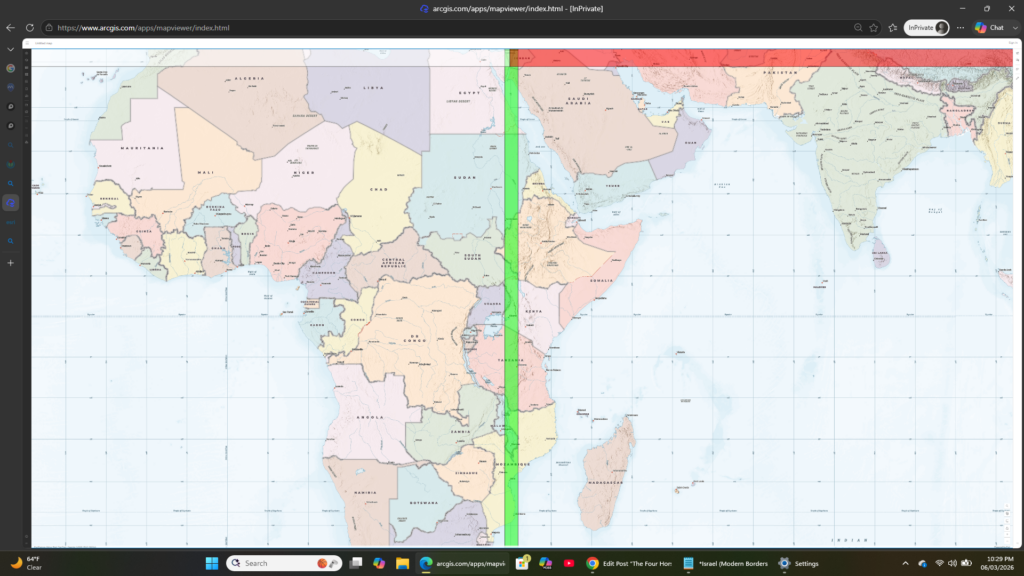
The most obvious details to consider in the second passage are the directions each group of horses heads out to traverse (rendered “walk to and fro” or “patrol” in most English translations) with their chariots and riders. The Black ones go to the North, the White ones go to the West, the Spotted/Bay ones go to the South, and the Red ones go to the East. We can tell the red ones go east even though the text doesn’t explicitly say so because all the horses, the chariots they’re pulling, and the ones riding them are explained to be “four winds of the heavens” (6:6)–“four winds” (with or without the qualifiers “of (the) heaven(s)” or “of the land”) is a figure of speech for the four cardinal compass directions from which God can intervene in His creation (like wind, God’s power usually isn’t visible, but exerts force on things). North, South, & West were already explicitly mentioned, so by process of elimination, the red horses patrol the East. Indeed, the phrase “four winds” is specifically used for the four horsemen in the chapter immediately following the Revelation passage: “And after this I observed four messengers standing at the four corners of the land, holding the four winds of the land, that the wind should not blow on the land, or on the sea, or on any tree.” (Revelation 7:1 LGV {scroll to p. 15 in the PDF}) In fact, the Greek phrase for “four winds” is an inflection of “τέσσαρες ἄνεμος” in both Revelation 7:1 and Zechariah 6:5 LXX. It’s especially noteworthy that while the Hebrew text of Zechariah 6:5 uses ruach, whose actual Greek equivalent is pneuma (both words can mean “breath”, “wind”, or “spirit”, depending on the context), the LXX uses ἄνεμος, which can mean “wind, a violent agitation and stream of air… a very strong tempestuous wind… [or] the four principal or cardinal winds, hence the four corners of heaven” {scroll to “Outline of Biblical Usage“}; this demonstrates the certainty with which the translators of the Septuagint understood ruach as meaning “wind” in this context–and John’s divinely-inspired use of the same phrase for the same entities tells us they nailed it!
Moreover, since Zechariah gave this prophecy during his ministry of encouraging the Judeans to build Jerusalem’s Second Temple, his original listeners would’ve been in Israel at the time, and reckoned the compass directions relative to Israel–hence, the readers of Revelation 6:1-8 were/are to utilize that same convention when interpreting it in light of Zechariah 6. Remember, the Chronological Biblical Precedent hermeneutic is more critical in Revelation than in any other book of the Bible–we have no hope of properly understanding the imagery in Revelation apart from the earlier Biblical passages the imagery was drawn from!
Now consider the intriguing arrangement of verb tenses & participles in verses 6-8. While the second and third groups of horses listed in verse 6 have their “going forth” described with perfect-tense verbs, the first group of horses have their “going forth” indicated with a participle, instead. Why not just use another perfect-tense verb? The answer is found in the “promise” of verse 8: does God’s spirit being settled down in the north refer to an event before or after Zechariah’s ministry? Well, it wouldn’t make any sense to say “before”–there’s no point in promising something that’s already happened! Besides, it can’t be referring to Babylonia’s fall to Medo-Persia, since both those nations were in lands to the east of Israel, not the north! Hence, this must have been referring to a time still in the future from Zechariah’s ministry. This would explain why the “going forth” of the black horses toward the land of the north is a participle, rather than a perfect-tense verb: the participle could be past-tense, present-tense, or future-tense! Had the imperfect been used instead of an active participle, that would’ve confused Zechariah into thinking the black horses’ “going forth” was in the future, but the “goings forth” of the other horses were in the past; and had the perfect been used instead of an active participle, Zechariah could’ve mistakenly thought all the horses had “gone forth” in the past!
However, notice that the bay/spotted horses are singled out in verse 7 as desiring to go forth. This implies that the horseman heading to the south would be more aggressive than the ones going in other directions.
I’ve mapped out what areas are in which directions relative to Israel as follows:
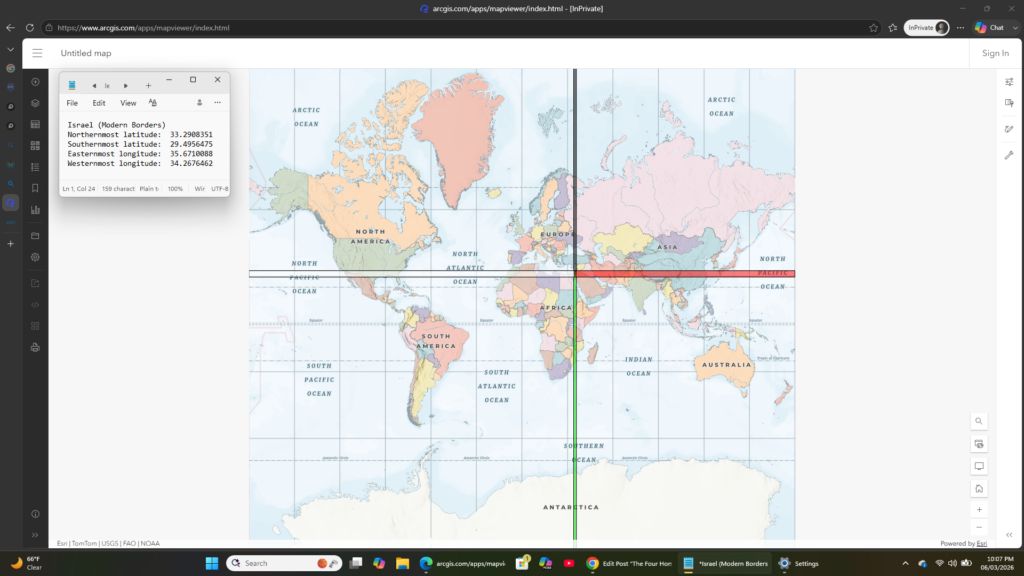
Finally, the Revelation passage tells us not only what activities are associated with each of the horses, but also (thanks to the associated seals being numbered) in what order their respective activities begin (i.e., the corresponding seal is opened). Since the second passage from Zechariah tells us what area each horse traverses, this tells us in what direction relative to Israel each of these activities become prominent. This is absolutely critical: any candidates for the fulfillment of these prophecies must line up flawlessly in terms of the details, where they occur relative to Israel, and in what order relative to each other they begin manifesting.
In Revelation 6, the White horse goes out with its rider first. Since Zechariah 6:6 reveals that the White horse traverses to the West of Israel, Revelation 6:2 tells us the opening of the first seal would be associated with a prominent world figure who starts conquering his enemies, who arises in Northern Africa (modern-day Egypt, Libya, Tunisia, Algeria, or Morocco) or North America (the U.S.A. or Mexico).
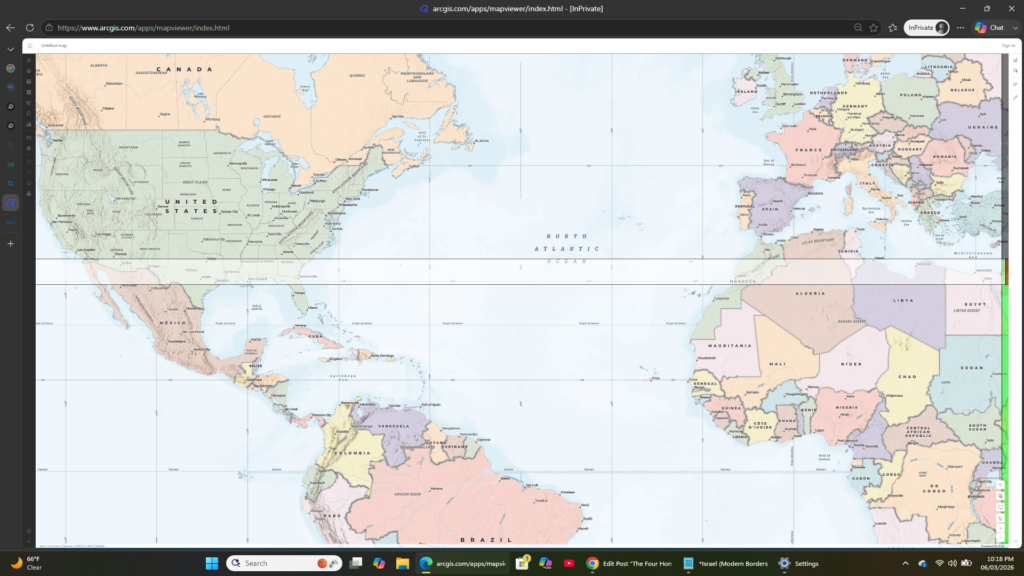
One easy-to-overlook detail here is that the rider on the white horse (representing the conqueror arising from one of the above-named countries) who keeps managing to conquer enemies receives a victor’s wreath (Greek στέφανος), rather than a crown (διάδημα, which gave rise to the English word “diadem”). This suggests that the prominent world figure who’d carry out all of this wouldn’t be royalty. However, note that the final instance of the verb for “conquer” is aorist subjunctive, rather than future indicative (“may conquer”, rather than “will conquer”); this leaves open the possibility that he won’t succeed every time.
Second, the Red horse goes out with its rider. This rider is given a sword, and “take[s] peace” from a land to the East of Israel, “so that they may/will [the verb is aorist active subjunctive in the Textus Receptus, but future active indicative in NA28] slay one another” (my word-for-word translation). Since the Greek word for “one another” is generally used in Scripture of people in a common group, this tells us the opening of the second seal would be associated with civil war breaking out (apparently due to instigation by another prominent figure, represented by the Red horse’s rider) somewhere in Asia that’s directly East of Israel (modern-day Jordan, Iraq, Iran, Afghanistan, Pakistan, India, or China, or possibly the southern tip of Syria, the northern tip of Saudi Arabia, or the Kyushu region of southwestern Japan).
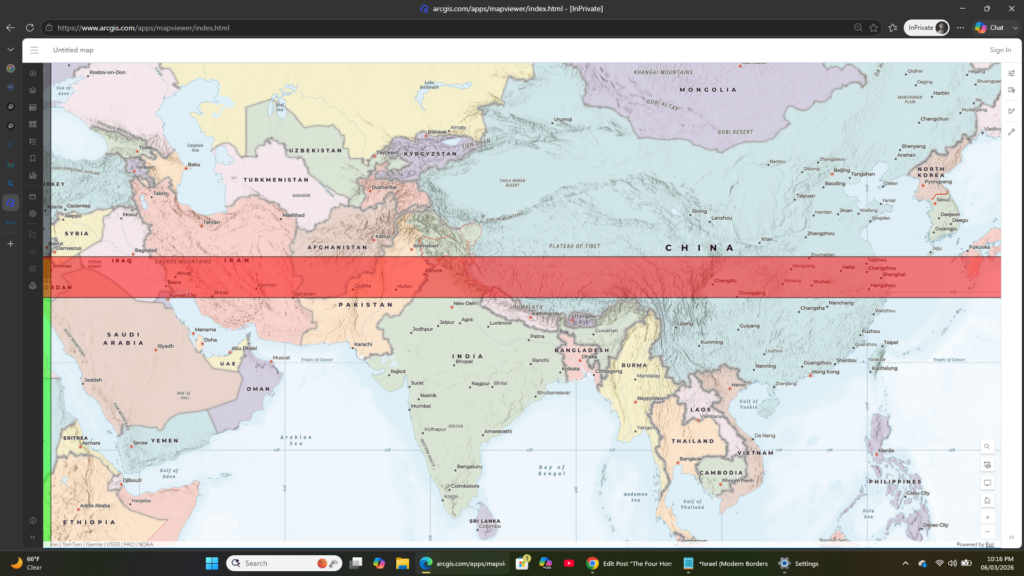
I also can’t rule out the possibility that more than one of these places will be involved in said war, since the “sides” in the conflict could be religious (e.g., Sunni vs Shia) rather than national.
Third, the Black horse goes out with its rider. This rider possesses a yoke, which indicates attachment to a heavy burden. “A quart of grain for a denarius and three quarts of barley for a denarius” is a particularly fearsome prospect when you consider that in John’s day, a denarius was a whole day’s wages! This suggests food prices skyrocketing to the point where the poor can’t afford it–but not necessarily the rich, in light of the add-on “and do not harm the oil and the wine”; oil & wine were commodities of the wealthy in the ancient world, implying that the rich will still be able to barter with those things after this seal has been opened. Taken altogether, the opening of the third seal would be associated with a major famine breaking out somewhere to the North of Israel (what is now Lebanon; possibly Syria, per Daniel 11:6-8,11,13,15,40; Türkiye, formerly known as “Turkey”; Ukraine; and/or Russia), due at least in part to another prominent figure (represented by the Black horse’s rider) imposing burdens that hinder the populace’s ability to grow food.
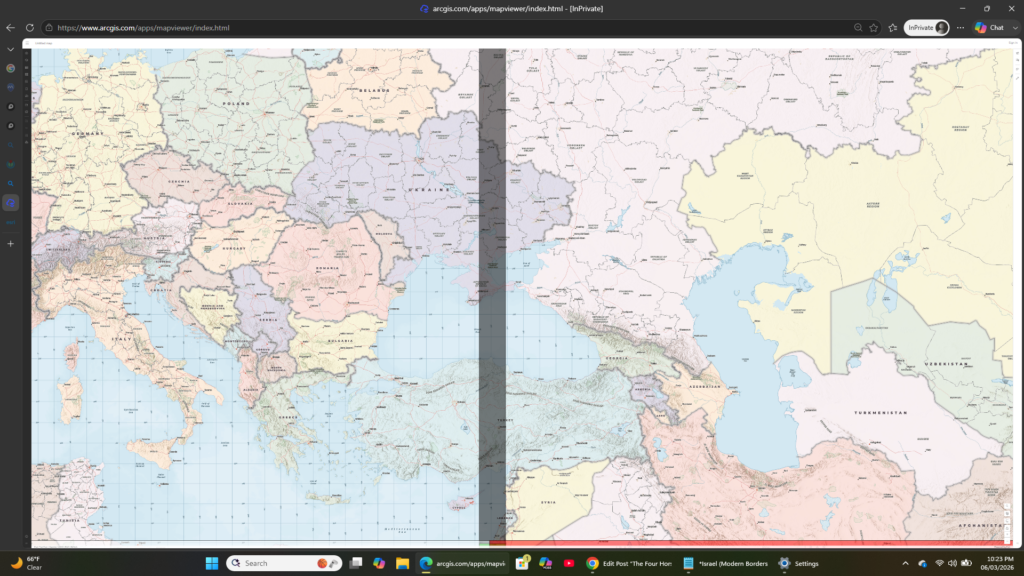
The fourth horse that goes out is Pale Green (χλωρός, from which the chemical element “chlorine” got its name), rather than Bay. However, since we already know the cardinal compass directions for the other 3 horses, and the horsemen are reiterated to be the “four winds” in Revelation 7:1, it’s safe to conclude that the rider of the Pale Green horse also traverses the South. 6:8 specifies power being given “over a fourth of the land”, presumably referring to a fourth of all the land due south of Israel; this implies that the death toll being confined to 25% of the area due south of Israel would be a solid indicator for “the real deal” of this prophecy’s fulfillment. Moreover, that these people are said to be killed “with sword, with hunger, with death, and by the wild beasts of the land” makes it difficult to imagine a singular cause for all these events–underscoring the divine coordination of events involved in this mass die-off. Indeed, the mention of “with death” makes the list of causes of death even more broad, to the point of including natural disasters, animal-borne illnesses–practically anything! However, the rider’s name is said to be “Death” (Greek Thanatos), with “the grave” (Greek Hadēs) accompanying him; and that we’re told that “power was given to them (plural)” implies that “them” refers to “Death” and “the grave” as two distinct entities. Does this indicate that no prominent world figure is involved with the events accompanying the fourth seal? Most likely (in light of the multitude of causes for the events); but also bear in mind that there are quite a few names out there that literally mean “Death” in their languages of origin: Azmaveth (Hebrew for “strong death”), Balor (Irish for “the deadly one”), Dáinn (Old Norse for “dead” or “deceased”), Geeri (Somali for “death”), Javar (a name linked to “death” or “final endings” in many African languages), Jug-eum (Korean for “death”), Lanmo (Haitian Creole for “death”), Letum (Roman personification of death), Maveth (Hebrew for “death”), Mikilis (Nahuatl–a Mayan language–for “death”), Mort (Catalan for “death”), Olim/Olum (Azerbaijani & Kazakh for “death”), Tod (German for “death”), Tuoni (Finnish for “death”), Tuquniq (Inuktut for “death”)–and those are just the boy names! The boldfaced example hails from the region due south of Israel, where this prophecy is to be fulfilled (as do the Swahili “Kifo” & the Amharic “Moti”, which are gender-neutral). So, while the plural “to them” mentioned above makes it unlikely that the rider on the Pale Green horse will be a prominent figure with a name that means “death”, I still think it’s wise to mention the possibility, just in case. In summary, the opening of the fourth seal would be associated with 25% of the land due south of Israel (which includes Egypt, Sudan, Ethiopia, Kenya, Tanzania, Mozambique, and possibly Saudi Arabia and Malawi) experiencing an off-the-charts death toll from a wide variety of causes.
Finally, notice what’s absent from these or any other passages: a clear indicator that these events must begin within the 70th “seven” of Daniel. Hence, it’s feasible for the events associated with the four horsemen to begin before the 70th “seven” does. This would certainly line up with the strong parallels between Revelation 6:1-8 and Matthew 24:6-8 & Mark 13:7-8, in which Jesus refers to these particular signs as “the beginning of birth pains” (Matthew 24:8c & Mark 13:8c 2020 NASB)–the metaphor is that these events are the Braxton-Hicks contractions before childbirth actually starts; childbirth itself is the apocalypse; the Tribulation is the most intense part of labor, when the baby’s head is crowning; and the Kingdom’s arrival is when the labor is finally over and the mother is holding the baby in her arms.
As far as I can tell, the conclusions I boldfaced and underlined in my exegesis above are sound, and lay out the essential criteria that need to be met for Revelation 6:1-8 to be fulfilled. Only if ALL of these details are satisfied can we say it’s NOT a “false alarm”.
Possibilities Based on Current Events (As of June 4, 2026)
Now comes the really controversial part of this post: a decent case can be made that the first seal was opened in the last third of 2025, in which case we should be paying attention to see what might happen next.
Now, fair warning: my discussions on the latter three horses will be considerably less detailed, since the tentative events haven’t started happening yet, and so are neither verifiable nor falsifiable as of this writing. However, if it starts looking more and more like we’re onto something, I WILL write additional posts that hark back to this one to help flesh things out as we go. That way, I can keep the current post entirely unedited after publication, leaving an official record of my educated guesses as of initial publication. Then, if they do turn out to be correct, you’ll know who to come to for more information as the apocalypse begins unfolding!
The White Horse to the West
Consider what Tim Warner pointed out on October 15th, 2025:
The white horse goes forth to the west (possibly the US), indicating the first of the four “spirits of the heaven” being dispatched to intervene in human affairs to bring about the end-time events. I have also speculated in recent posts about the seemingly miraculous rise of Donald Trump, against an onslaught of seemingly demonic opposition, to retake the presidency of the US and how that might potentially relate to Revelation 12 (with the USA or parts of it becoming the place of refuge for the “Woman” during the reign of Antichrist). Yet, more recent events of Trump’s presidency, his making peace among several warring nations, seem to support the possibility that he may in fact be the rider on the white horse, potentially filling both roles.
This peace-making is especially notable when viewed from the Israel-centric perspective and Trump’s recent success in achieving the release of the Hamas hostages. Remarkable events have just taken place during the fall Feast holidays, marked by the two major bookends. On Rosh Hashana, President Trump delivered a scathing speech to the United Nations, essentially steamrolling the globalist (antichrist) agenda. Then, on the last day of the Festival of Sukkot (Tabernacles), ending Israel’s fall feast season, Trump delivered on his commitment to end the war in Gaza and get the hostages released, signing a peace pact between the US, Israel, and Israel’s surrounding (formerly hostile) Muslim nations. President Trump has just become the greatest hero of modern times to the people of Israel during their greatest Festival of national celebration. Trump’s “Abraham Accords” seem to be back on track, yet they will not bring lasting peace (Exod. 23:32; Deut. 7:2; Judges 2:2).
Rulers in ancient times often led a procession of celebration of great victories riding a white horse. President Trump’s apparent victory ending the war and securing the release of the hostages during Israel’s most joyous celebration on the Jewish calendar, Sukkot (Feast of Tabernacles), is extraordinary. It is very difficult to write this off to coincidence. This holiday season is the beginning of the new year, and the chronology of the Bible is reckoned from Rosh Hashanah to Rosh Hashanah. These events fit nicely within the structure of blocks of time on the Biblical Jubilee – Feast calendar. I am not claiming that the first of the seven seals has definitely been opened, only alerting our readers to pay close attention to this possibility as we are prayerfully “watching” the unfolding events, just as Jesus commanded in the Olivet Discourse (Luke 21:36).
Since Warner wrote that, events have unfolded that seem to reinforce this identification. Despite the astroturfed “No Kings” protests, Trump is not royalty, and never has been. His capture of dictator Nicolás Maduro caused most Venezuelans to view Trump as a hero (whether the regime change in the aftermath will work out for once is less certain, as that article I just linked to makes clear). Cuba and Greenland appeared to be next for a while–and he has yet to indicate he’s changed his mind about them. Ultimately, Trump got involved in Iran. In a nutshell, “he came out conquering, and that he may conquer” (Revelation 6:2c LGV). (However, note that the latter instance of “conquer” is in the subjunctive mood; this leaves open the possibility that he won’t succeed every time…)
Indeed, in light of all the campaign promises he worked hard to keep in his first term (and, as seen by the publication date of the original version of this list, which is behind a paywall, that’s just counting up to October of 2018–not even halfway through his first term!), Trump’s reneging on the “no more foreign wars” promise sticks out like a sore thumb. It’s feasible that God planted the thoughts (or, perhaps, permitted some of his aides or even a demon to plant thoughts–I’ll let you take your pick on this one!) to attack other countries in Trump’s head to help set the stage for the apocalypse–accomplishing the will of God, even though it conflicts with the will of the people! Again, the demonic levels of opposition Trump faced in 2020 and especially 2024 makes it clear that the demonic forces didn’t want him in power for some reason. Preventing someone predictably unpredictable enough (cough, posts on X, cough) for God to use as the rider on the white horse from becoming president of the U.S. would certainly be a good enough reason for the demons to pull out all the stops like we saw in the 2024 election cycle!
Yes, the rising prices of gas in the short term and everything else in the coming months sucks for those of us in the U.S. (and it sucks even worse in Asia, Australia, and New Zealand, where gasoline supply has been running out much faster), but remember what I mentioned above: “the activities described in Revelation 6:1-8 are God taking out His wrath against ‘the nations‘ and those in them that have become arrogant in their apparent safety and have facilitated evil”. We in the U.S. have gotten a little too used to having secure lifestyles compared to most of the rest of the world. At least the doctrine of Chiliasm implies that we’ll only have to put up with such consequences until just over another decade from now…
But just to re-emphasize: I’m not ready to be dogmatic that Trump really is the rider on the White horse. If the events in the other three directions occur in the wrong order after this, then it’s not “the real deal”.
Also consider that Trump gave his speech to the UN on September 23rd, 2025. On the Hebrew Calendar, Tishri 1 (Rosh Hashanah) lasted from sunset on September 22nd to sunset on the 23rd, lining up with Warner’s claim (it would’ve been between 4:00 & 4:30 pm in Israel when the speech began, and it only lasted 57 minutes, so it would’ve ended well before sunset that day). While I don’t see strong enough reason to claim that something related to the opening of a seal will happen during the Levitical Fall Feasts every time, I can’t rule out the possibility, either. But if it does end up happening that way, it’ll certainly be more difficult to deny the divine nature of the events! So, while this detail is technically optional, I wouldn’t be surprised if an event related to the Red horse comes to pass on Tishri 1 (sunset on September 11th to sunset on September 12th) of 2026, an event related to the Black horse on Tishri 1 (sunset on October 1st to sunset on October 2nd) of 2027, and an event related to the Pale Green horse on Tishri 1 (sunset on September 20th to sunset on September 21st) of 2028. As a refresher, I predict that the 70th “seven” of Daniel 9:24-27 will begin on Tishri 1 (sunset on September 9th to sunset on September 10th) of 2029, and the Two Witnesses will show up on Cheshvan 1 (sunset on October 9th to sunset on October 10th) of 2029 {HIDMF, p. 759}.
The Red Horse to the East
As I exegeted above, the rider on the Red horse brings civil war somewhere to the east of Israel. As also noted above, the modern-day lands that are due east of Israel include: Jordan, Iraq, Iran, Afghanistan, Pakistan, India, and China, as well as the southern tip of Syria, the northern tip of Saudi Arabia, and the Kyushu region of southwestern Japan. However, Revelation 6:4 mentioning this rider being given a sword after mentioning that he takes peace from the land and leads people into civil war suggests that whoever the rider is will be both responsible for taking peace from the land and a participant in the ensuing civil war.
On February 28, 2026, the U.S. and Israel launched a decapitation strike against Iran. In case you’re unfamiliar with that military term, a “decapitation strike” is intended to take out as much of a nation’s leadership as possible. In this case, they managed to take out 16 of Iran’s top officials on February 28th alone–including Iran’s Supreme Leader, Ayatollah Ali Khamenei. While his son, Ayatollah Mojtaba Khamenei, won the election that was held a few days later to select a new leader, he has yet to make any public appearances as Supreme Leader. Some have speculated that he’s incapacitated (and it has been confirmed that he was injured in the decapitation strike that killed his father), but what’s important for now is that the Islamic Revolutionary Guard Corps (IRGC) has essentially been calling the shots in his stead. Within the Iranian government, fractures are starting to become more prominent and pervasive. If any one of the issues that are currently causing mere infighting among Iran’s leadership boils over into a bigger, more public conflict, this could easily coincide with the second seal being opened, especially since the commoners of Iran are being economically strained through all of this, and Mojtaba Khamenei has a reputation of being even more hardline than his father. Indeed, as of the last week of May, Iran even has “formal intelligence warnings of imminent domestic uprising” and “severe commodity shortages [that] risk igniting immediate nationwide riots.”
In fact, consider what that most recent article had to say about the fragility of Iran’s social cohesiveness and public stability:
An analysis of these fast-moving developments reveals that the Iranian regime has entered an unresolvable existential paradox. The two factions are engaged in a raw “war of thugs” where the execution of one survival strategy instantly nullifies the other. Pezeshkian’s gang recognizes that without immediate sanctions relief and a partial opening of the country’s digital infrastructure, the macroeconomic trajectory guarantees a structural default and a massive social explosion. Yet, the extremist gang correctly calculates that any tactical retreat, diplomatic compromise, or reduction in domestic digital surveillance will be interpreted as systemic weakness, lowering the barrier for public dissent.
…Ultimately, this structural gridlock means the clerical dictatorship is completely incapable of self-preservation or internal reform. The executive branch has no real authority to implement economic lifelines, the legislature is actively sabotaging its own state diplomacy, and the judiciary is functioning as a tool of factional warfare. While the regime’s security forces maintain their brutal baseline of domestic oppression, the central command structure in Tehran is hollowed out. This profound internal breakdown demonstrates that the regime has reached a historical dead end, creating an unprecedented strategic opening for the organized domestic network to mobilize an exhausted and impoverished population.
{Hyperlinks in original. Boldface mine.}
Note well those mentions of “fast-moving developments” and “an unprecedented strategic opening”: remember, John said in the opening verse of Revelation that the future events described in the book, including those of 6:1-8, “must occur swiftly“.
All that being said, it’s also possible that this could be just the start of a more widespread spat between Sunni and Shia Muslims throughout the Muslim nations to the east of Israel, rather than just being confined to Iran. If so, I wouldn’t be surprised if some of the Muslims of Palestine not only wind up backing off of Israel because they’re too busy fighting each other, but accidentally (since no Muslim would dare to do so on purpose!) destroying the Dome of the Rock, clearing what is arguably the biggest hurdle in the way of Israel building a Third Temple on the site of the first two. (In the absence of such a destruction of the Dome of the Rock, my guess is that it will be built against the Western Wall, an ancient retaining wall that constitutes the one portion of the Second Temple complex that’s still standing. In fact, I find this to be the more likely scenario regardless, since Revelation 11:1-2 implies that at the time of the Third Temple’s existence, the Temple Mount will be mostly under Gentile control, with a relatively small portion being dedicated to the Third Temple.)
So will this civil war be restricted to Iran, or will Muslims throughout southern and western Asia be involved?1 God knows (and He also knows whether it’d really be the unsealing of the Red horse). All we can do is wait to find out.
The Black Horse to the North
As for the Black horse that brings famine somewhere to the north of Israel, it’s significant that about one third of the world’s traded fertilizer and half of the world’s traded urea passes through the Strait of Hormuz, which has been closed due to the war in Iran. This is already requiring the nations that source their fertilizer from there to look elsewhere just to ensure their citizens don’t starve; as Mason Sexton, Jr. explained on May 15, 2026 {subscription-exclusive article, unfortunately, so I can’t give you a hyperlink to read the whole thing; but just so you know the quote’s actually from him and I’m not just making it up, here’s a couple of screenshots:}:

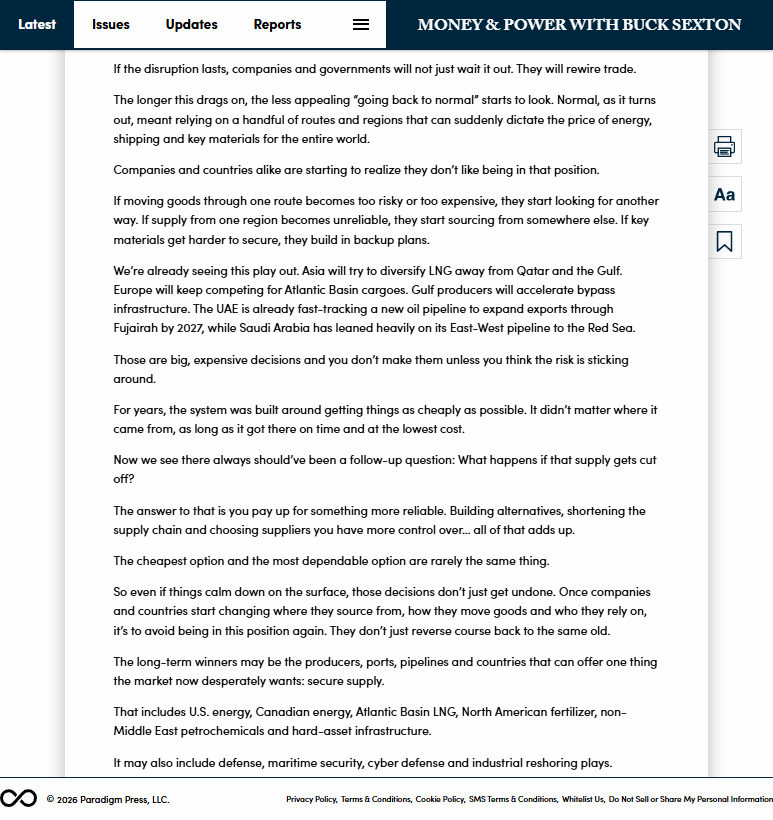
It seems that the parts of the world that will be most vulnerable due to this closure are Sub-Saharan Africa, South & Southeast Asia, and Latin America. Moreover, that article tried to get some perspective on the potential shock of the 2026 Hormuz blockade by comparing it to the fertilizer disruption that occurred when countries started sanctioning Russia for invading Ukraine in 2022.
You see, Russia mostly produces its own fertilizer and reduced or even halted exports of it to the countries that sanctioned it in 2022. So if any of the nations that now need alternatives to the Persian Gulf decide to stop sanctioning Russia out of desperation over their own food supply, it’s possible that Russia could make enough bad decisions to give so much of it to other countries that their own agriculture–and thus, populace–could suffer. Moreover, Russian farmers may not even be able to afford whatever fertilizer they can get: Matt Badiali pointed out in early May that “the price of nitrogen fertilizer rose 22% so far this year…before the Iran war issue.” (And just to clarify–lest I be accused of quoting a statistic out of context–Luminita Toma gets more specific on that statistic: “Even before recent headlines, costs were up over the previous year. According to the Bureau of Labor Statistics, nitrogen-based fertilizers jumped 22% between February 2025 and 2026 due to tight global supplies and high European energy prices.” {Boldface mine.}) Toma adds that “Simultaneously, natural gas — which is essential for making synthetic fertilizers — became much more expensive. This hit the market with a double whammy: less fertilizer available, and higher costs to make what was left.” Russia is also the world’s largest exporter of natural gas. Badiali also points out that the weather patterns will probably shift like crazy this year, which could throw farmers all over the globe for a loop: “Experts look for a strong to extreme El Niño this year. So that’s another headwind for wheat crops.” I have no clue what the details could be, but I suspect Russia and/or Ukraine could make enough policy shifts in response to these developments (and others that aren’t currently on my radar) for their own citizenry to begin having to pay through the nose just to eat within the next couple years. Whichever leader of theirs (Putin, Zelenskyy, or one of their successors) is responsible for these policy shifts will almost certainly be the person represented by the Black horse’s rider. Maybe Türkiye, Syria, or Lebanon could be involved too, but I don’t see any obvious catalysts for them to be involved in a famine big enough to get the whole world’s attention. But hey, as always, God is perfectly capable of surprising me!
Obviously, I don’t have as much info to have such a clear picture on this one, but frankly, that’s to be expected: we’re still further out in time from the Black horse going out than the Red horse going out–regardless of whether the “real deal” for the White horse is presently ongoing.
The Pale Green Horse to the South
I’ve already mentioned the fertilizer disruption coming to Sub-Saharan Africa in the near future due to the closure of the Strait of Hormuz, and among the nations due south of Israel, Ethiopia and Kenya are listed as among those having the greatest risk from fertilizer unavailability {scroll to “The Fertilizer Vulnerability Index”}; in fact, an interactive version of the Fertilizer Vulnerability Index reveals that Tanzania (also due south of Israel) is pretty close behind them (all three are at the “COOKED” level), while Egypt, Malawi, & Mozambique are at the “Critical” level.
Yet the Pale Green horse going out after the other three horses implies that the situation would take a little more time to develop and become as dire as described in Revelation 6:8 (and implied in Zechariah 6:7). Bear in mind that the death toll from the Pale Green horse and its rider is due to a wider variety of causes, so God will probably spend that extra time lining up all the pieces before tipping over the proverbial first domino. Obviously, this is where I’m most clueless on the details, since the text mentions that the people in a quarter of the area due south of Israel would be killed “with sword, with hunger, with death, and by the wild beasts of the land”, but doesn’t specify how those things will be brought about. Plus, this is the furthest-out of the Four Horsemen, so it naturally has the most opportunities for circumstances to change between now and when it comes to pass.
Conclusion
I’m well aware that I’m taking a huge risk by publishing this. Some readers might even accuse me of “giving ideas” to any leaders who’d like to make our lives more miserable. But if the apocalypse will begin as soon as the doctrine of Chiliasm requires, then I won’t be giving them that much of a head start beyond what they would’ve done anyway! After all, I may not be ready to dogmatically claim that God’s already set the process in motion, but the chronology of the Bible, in conjunction with the doctrine of Chiliasm, implies that the time window before the 70th “seven” begins is already under 3.5 years, so the process involving the Four Horsemen has to have initiated by then! But whenever God will have done so, none of us–not even any of the prominent figures He or Satan will be using as pieces in this chess game of history–will be able to stop it. We’re entering a scary period of history–yet for the faithful, an exciting one. Watching God’s plan unfold leading up to His Son’s return to renovate the world order (2 Peter 3:10-13; the word there rendered “elements” refers to the foundational components of human civilization in Galatians 4:3,9 & Colossians 2:8,20) and usher in the Kingdom in full swing (Daniel 7:13-14,18,21-27) will be as utterly amazing as it will be shocking.
Let it be known that once I hit the “Publish” button on this post, I WILL NEVER EDIT IT. This post is for readers in the future to see whether or not I saw it coming. And if it turns out I did, they can reach out to me for sound Biblical advice and directions to additional information on enduring the apocalypse (Matthew 24:9-13) and ensuring they remain steadfast even while a large fraction of Christendom is falling away (Matthew 25:1-13; Luke 18:7-8; 2 Thessalonians 2:3). For now, 1 Timothy 4:1-11 is an excellent place to start.
I’ll post on this topic again as the situation and signs become more clear.
- I was tempted to also pose the possibility of a redux of the “blood trains” between India & Pakistan, in which Muslims fleeing India and Hindus fleeing Pakistan were killed when their trains to the other side of the new border were hijacked. But then I remembered that, since Hindus and Muslims are generally on the “right” sides of the border nowadays, a war between India & Pakistan wouldn’t technically be a civil war! That would be more akin to what happened between the Union and the Confederacy in the U.S. Civil War; it’s important for me to drive this point home for any of my fellow Americans who’d miss the distinction. As Dave Gonigam explains:
The problem with many Americans’ thinking about a second civil war is that it’s warped by the experience of the first.
“We didn’t really have a civil war,” tweets Darryl Cooper, the man behind the extraordinary Martyr Made history podcasts. “We split into two countries and had a regular war.”
Exactly. Most civil wars do not entail set-piece battles by uniformed soldiers. How likely is that now, really?
“Civil war looks like Beirut or Sarajevo,” Cooper continues, “where you couldn’t walk outside for fear of being randomly sniped, and there were no pitched battles, just kidnappings, assassinations and basement torture sessions.”
Again in 2017, we cited the prepper writer John Mosby (which may or may not be a pen name): “This is about people burning down their neighbors’ houses and businesses, to run them out of town, over ideological differences. Look at the Balkans in the early 1990s. This is about a group from one side, murdering the entire family — Dad, Mom, brother and baby Sister — of their neighbors, over political differences.” {Boldface in original.}
↩︎