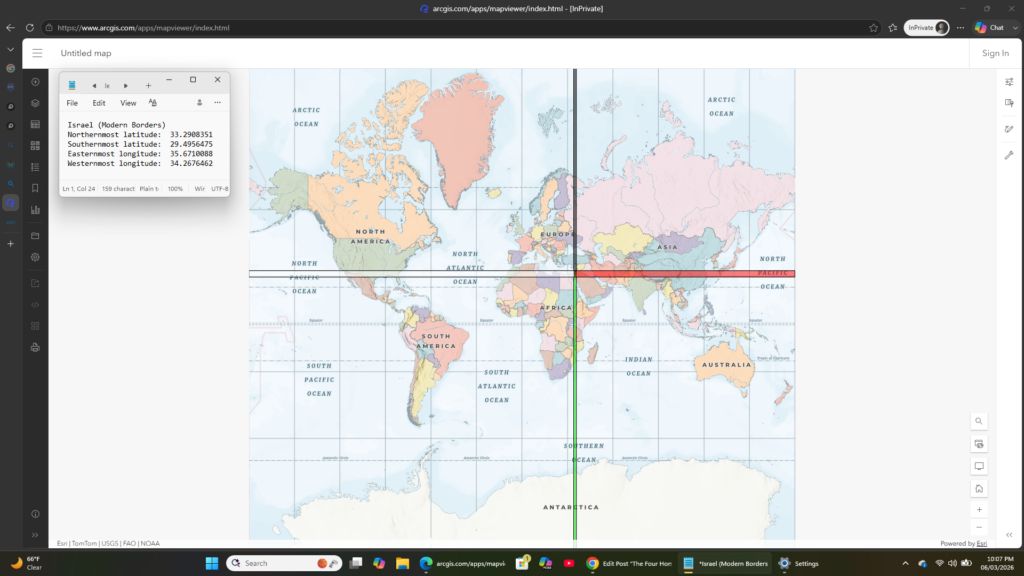
I know I mentioned in an earlier post that I won’t pretend to guess how God will bring about the world situation described at the onset of the apocalypse. And I continue to maintain that there will be plenty of twists, turns, and hiccups along the way, meaning any attempt at laying out in advance the exact sequence of events leading from each event to the next is doomed to miss something. But in light of recent developments and what I’ve seen some reputable commentators say about their implications on the geopolitical scene for the months and years ahead, I feel it’s worth connecting some dots regarding a select handful of the events–just in case.
Of course, it’s completely possible that the catalysts I’ve been seeing in recent months are false alarms, just as we’ve seen in the past. But in light of how close the doctrine of chiliasm (with the Masoretic numbers for Genesis 5 & 11) places us to the beginning of the 70th “seven”, the window of time within which the events associated with the memed-almost-to-death “four horsemen” could come to pass is closing.
But most importantly, it’s important to bear in mind what Daniel was told just after being given more details (Daniel 11:1-12:3) on the events of the 70 “sevens”:
“But as for you [literally, “And you”], Daniel, conceal these words and seal up the book until the end of time [literally, “until the time of the end”; Hebrew עַד־עֵתקֵץ]; many will go back and forth [LXX “till the appointed time of the together-end, till many may be taught”; the sense seems to be that many would “race back and forth” through the pages of Scripture to “unseal” the information at the proper time–indeed, the Hebrew word for “go back and forth” was often used with a connotation of looking for something (2 Samuel 24:2, Jeremiah 5:1, Amos 8:12, Zechariah 4:10; this may even explain why God began His response to Satan’s use of the term the way He did in Job 1:7-8 & 2:2-3)], and knowledge will increase… Go your way, Daniel, for these words are concealed and sealed up until the end time [עַד־עֵתקֵץ]. Many will be purged, purified [literally, “made white”] and refined, but [literally, “and then”; waw-consecutive perfect] the wicked will act wickedly; and none of the wicked will understand [literally, “and none will discern of all wicked ones”], but those who have insight [literally, “and the ones who are prudent“] will understand [or “will discern“]. (Daniel 12:4,9-10 1995 NASB, boldface added)
The simple truth is, we can’t possibly understand whether any set of events could fulfill the Bible’s prophetic statements about these horses and their riders unless we know what the Bible actually says about them. So the majority of this post will be exegesis of the relevant passages, and the remainder will be me presenting the geopolitical insight I’ve come across so far that could clue us in on what to watch out for over the next 3-4 years (yep, the doctrine of chiliasm places us that close to the Two Witnesses showing up!).
The “Four Horsemen” Passages
There are really only 3 Biblical passages featuring these horses: Zechariah 1:7-17, 6:1-8, & Revelation 6:1-8. Each of the Zechariah passages is a complete minor train of thought in the Masoretic Text. Let’s start this discussion by presenting all three passages and bringing out some extra nuances about them, and then we’ll piece together what they teach when taken altogether.
7 On the twenty-fourth day of the eleventh month, that is, the month Shebat, in the second year of Darius, the word of the LORD came to Zechariah the prophet, the son of Berechiah, the son of Iddo, as follows: [literally, “In day twenty and four for month eleven (properly, “one-teen”), that month being Shebat, in year two for Daryavesh (Darius I, by my chronology; but after the return from the Babylonian Exile, in any case), was (perfect) word of YHWH toward Zekharyah, son of Berekhyahu, son of Iddo the prophet, to say (infinitive construct):”] 8 I saw at night, and behold, a man was riding on a red horse, and he was standing among the myrtle trees which were in the ravine, with red, sorrel, and white horses behind him. [literally, “I saw (perfect) the night, and behold! A man mounted and riding (active participle) upon a red horse, and himself standing (active participle) between the myrtle trees which were in the hollow, and after him red, and bay (LXX “red, and gray and dappled”), and white horses.“] 9 Then I said, “What are these, my lord?” And the angel who was speaking with me said to me, “I will show you what these are.” [literally, “And then I said (waw-consecutive imperfect) ‘What are these, my Lord?’ And then toward me said (waw-consecutive imperfect) the Messenger, the one speaking (active participle) with me, ‘I (included for emphasis) will show (imperfect) you (singular) what these very thingsare (two words for “these” used back-to-back).'”] 10 And the man who was standing among the myrtle trees responded and said, “These are the ones whom the LORD has sent to patrol the earth.” [literally, “And then testified (waw-consecutive imperfect) the man, the one standing (active participle) between the myrtle trees, and so he said (waw-consecutive imperfect) ‘These are those which YHWH has sent (perfect) to traverse (infinitive construct) among the land (or “earth”).’“] 11 So they responded to the angel of the LORD who was standing among the myrtle trees and said, “We have patrolled the earth, and behold, all the earth is still and quiet.” [literally, “And then testified (waw-consecutive imperfect) a Messenger of YHWH, the one standing (active participle) between the myrtle trees, and so they (plural) said (waw-consecutive imperfect) ‘We have traversed (perfect) among the earth/land, and behold! All the earth/land sitting (active participle) and being quiet (active participle).’“] 12 Then the angel of the LORD said, “LORD of armies, how long will You take no pity on Jerusalem and the cities of Judah, with which You have been indignant for these seventy years?” [literally, “And then testified (waw-consecutive imperfect) a Messenger of YHWH, and so said (waw-consecutive imperfect) ‘YHWH of Hosts/Armies, until when will You not have compassion (imperfect) for Jerusalem and cities of Judah, which You have denounced (perfect) this seventy cycle?’ (every term in the Hebrew phrase normally rendered “these seventy years” is actually singular; hence, the seventy-year Babylonian Exile is being treated as a unit in this passage)”] 13 And the LORD responded to the angel who was speaking with me with gracious words, comforting words. [literally, “And then testified (waw-consecutive imperfect) YHWH to (direct object marker) the Messenger, the one speaking (active participle of dabar, whose noun form is the Hebrew counterpart to the Greek word “Logos”) among me good words, words of comfort.”] 14 So the angel who was speaking with me said to me, “Proclaim, saying, ‘This is what the LORD of armies says: “I am exceedingly jealous for Jerusalem and Zion. [literally, “And then toward me said (waw-consecutive imperfect) the Messenger, the one speaking (active participle of dabar) with me, ‘Proclaim (imperative), to say (infinitive construct) “Thus has said (perfect) YHWH of Hosts/Armies, ‘I have been zealous (perfect) for Jerusalem and for Tsion, with great zeal.” 15 But I am very angry with the nations who are carefree; for while I was only a little angry, they furthered the disaster.” [literally, “And with great wrath, I (emphatic) am angry (active participle) against (properly “down on”) the nations, the haughty ones (or “the ones at ease“; this adjective has connotations of being proud because you feel safe–the many corrupt individuals in our day who believe they’re untouchable are prime examples); since I (emphatic) was (or “have been”) angry (perfect) a little, and they aided (perfect) unto evil.“”16 Therefore the LORD says this: “I will return to Jerusalem with compassion; My house will be built in it,” declares the LORD of armies, “and a measuring line will be stretched over Jerusalem.”’ [literally, “According to such conditions, thus has said (perfect) YHWH, “I have turned (perfect) to Jerusalem with compassion, My house will be built (imperfect) in it.” An utterance of YHWH of Hosts/Armies, “And a measuring line will be stretched out (imperfect) over Jerusalem.””] 17 Again, proclaim, saying, ‘This is what the LORD of armies says: “My cities will again overflow with prosperity, and the LORD will again comfort Zion and again choose Jerusalem.”’” [literally, “Again, proclaim (imperative), to say (infinitive construct), “Thus has said (perfect) YHWH of Hosts/Armies, ‘Again My cities will overflow (imperfect) beyond (the preposition properly means “from”, but “out of”, and “more than” are also in its range of meanings) prosperity, and so YHWH will again comfort (waw-consecutive perfect) Tsion, and so He will again choose (waw-consecutive perfect) Jerusalem.'”‘”] (Zechariah 1:7-17 2020 NASB)
1 Now I raised my eyes again and looked, and behold, four chariots were going out from between the two mountains; and the mountains were bronze mountains. [literally, “And then I turned (waw-consecutive imperfect), and then I lifted up (waw-consecutive imperfect) my eyes, and then I saw (waw-consecutive imperfect), and behold: four chariots coming forth (active participle of yatsa) from between two of the mountains, and the mountains were mountains of bronze (or “copper”);”; there’s no verb in verses 2 or 3, so they should be treated as a continuation of this sentence.] 2 With the first chariot were red horses, with the second chariot black horses, [literally, “with the chariot, the first, red horses, and with the chariot, the second, black horses,”] 3 with the third chariot white horses, and with the fourth chariot strong spotted horses. [literally, “and with the chariot, the third, white horses, and with the chariot, the fourth, spotted bay horses.”] 4 So I responded and said to the angel who was speaking with me, “What are these, my lord?” [literally, “And then I responded (waw-consecutive imperfect), and so I said (waw-consecutive imperfect) toward the Messenger, the one speaking (active participle of dabar) with me, ‘What are these, my Lord?’“] 5 The angel replied to me, “These are the four spirits of heaven, going out after taking their stand before the Lord of all the earth, [literally, “And then the Messenger responded (waw-consecutive imperfect), and so he said (waw-consecutive imperfect) toward me, ‘These are four winds of the heavens going forth (active participle of yatsa) from stationing themselves (Hithpael infinitive construct, acting as a gerund for a reflexive action) on account of (or “on behalf of”; ʿal) the Lord/Master of all the earth,“] 6 with one of which the black horses are going out to the north country; and the white ones are to go out after them, while the spotted ones are to go out to the south country.” [literally, “which (or “when”, or “since“) with (or “by”, or “through”, or “among“) it (the suffix for “it” is feminine, referring back to the “four winds of the heavens going forth” in the previous verse as a unit), the horses, the black ones, going forth (active participle; note the lack of a timing component!) toward land of the north, and the white ones (waw-disjunctive) will have gone forth (perfect) toward thehinder part of them (i.e., toward the west, which is behind someone facing toward the sunrise; contrast the Hebrew word for “east”, which is derived from a verb meaning “be in front”), and the spotted ones will have gone forth (perfect) toward land of the south.”] 7 When the strong ones went out, they were eager to go to patrol the earth. And He said, “Go, patrol the earth.” So they patrolled the earth. [literally, “And the bay ones (waw-disjunctive) will have gone out (perfect), and then they will have sought (or “desired”, or “requested”; waw-consecutive imperfect) to go (infinitive construct) to traverse (infinitive construct) among (or “in”) the land.‘ And then he said (waw-consecutive imperfect, closing out the parenthetical section indicated by the waw-disjunctives), ‘Go (imperative 2nd-person plural), traverse (imperative) among the land.’ And then they traversed (waw-consecutive imperfect) among the land.”] 8 Then He called out to me and spoke to me, saying, “See, those who are going to the land of the north have appeased My wrath in the land of the north.” [literally, “And then he called out at (waw-consecutive imperfect) me, and then he promised (waw-consecutive imperfect form of dabar‘s Piel stem, indicating something more intensive than a mere statement, for which the Qal stem would’ve sufficed) toward me, to say (infinitive construct): ‘Look (imperative), the ones going forth (active participle of yatsa) toward land of the north will have settled down (perfect) my spirit in land of the north.'”] (Zechariah 6:1-8 2020 NASB)
1 And I observed when the Lamb opened one of the seven seals, and I heard one of the four creatures, like the sound of thunder, saying: “Come and see.” 2 And I observed, and look, a white horse, and the one sitting on it had a bow. And a wreath was given to him, and he came out conquering, and that he may conquer. 3 And when He opened the second seal, I heard the second creature saying: “Come and see.” 4 Another horse [that was] red went out. And it was granted to the one sitting on it to take peace from the land, and that they will kill one another. And there was given to him a great sword. 5 And when He opened the third seal, I heard the third creature say, “Come and see.” And I observed, and look, a black horse, and the one sitting on it had a yoke in his hand. 6 And I heard a voice in the midst of the four living creatures saying, “A quart of grain for a denarius and three quarts of barley for a denarius, and do not harm the oil and the wine.” 7 And when He opened the fourth seal, I heard the voice of the fourth creature saying, “Come and see.” 8 So I observed, and look, a pale green horse. And the name of the one sitting on it was Death. And the grave accompanied him. And power was given to them over a fourth of the land, to kill with sword, with hunger, with death, and by the wild beasts of the land. (Revelation 6:1-8 LGV, content in brackets in original, underlining and boldface mine)
First, while most of the imperfect and waw-consecutive perfect actions of the first passage were arguably being fulfilled through Jerusalem’s Second Temple being built in Zechariah’s day, the final phrase of the passage reveals an important exception: “and so He will again choose Jerusalem.” The actions prior to this phrase (cities of Israel in general or Judah specifically overflowing “beyond prosperity”, and God “comforting Zion”) rule out a present-tense rendering (i.e., that these were ongoing realities while Zechariah was encouraging the Jews to rebuild the Temple), since the people of Judah & Benjamin were still getting their country back in order and hadn’t finished rebuilding Jerusalem yet, so their former level of prosperity (much less prosperity comparable to what was experienced during Israel’s golden age under Solomon, which was never achieved during the Second Temple Period) returning to them was still a few more years off. This also can’t be referring to God “again choosing Jerusalem” at the end of the Babylonian Exile, since that would require these statements to be past-tense (i.e., using simple perfect or waw-consecutive imperfect verbs)! Hence, Zechariah 1:17 must be referring to the still-future New Jerusalem and Eternally Restored Israel.
Nonetheless, the rest of the passage must give us details important to the Revelation passage–otherwise, the Revelation passage wouldn’t have alluded to these horses at all! Consider the detail of Zechariah 1:11 that in Zechariah’s time, the horses’ traversing the earth had found “All the earth/land sitting and being quiet.” This sets up a contrast to verse 15, where we’re told that “with great wrath, Iam(note well the lack of a timing component for this active participle!) angryagainstthe nations, the haughty ones (or “the ones at ease“; this adjective has connotations of being proud because you feel safe–the many corrupt individuals in our day who believe they’re untouchable are prime examples); since Iwas (or “have been”) angrya little, and they aidedunto evil.” This implies that the activities described in Revelation 6:1-8 are God taking out His wrath against “the nations” and those in them that have become arrogant in their apparent safety and have facilitated evil. If there’s one thing the whole “Epstein files” fiasco has taught us, it’s that we’re living in a time when many powerful individuals (and the nations they’ve manipulated into doing so) have facilitated much evil around the world for decades–and we’re just now reaching the point where the powerful individuals involved are starting to be arrested and investigated.
The most obvious details to consider in the second passage are the directions each group of horses heads out to traverse (rendered “walk to and fro” or “patrol” in most English translations) with their chariots and riders. The Black ones go to the North, the White ones go to the West, the Spotted/Bay ones go to the South, and the Red ones go to the East.We can tell the red ones go east even though the text doesn’t explicitly say so because all the horses, the chariots they’re pulling, and the ones riding them are explained to be “four winds of the heavens” (6:6)–“four winds” (with or without the qualifiers “of (the) heaven(s)” or “of the land”) is a figure of speech for the four cardinal compass directions from which God can intervene in His creation (like wind, God’s power usually isn’t visible, but exerts force on things). North, South, & West were already explicitly mentioned, so by process of elimination, the red horses patrol the East. Indeed, the phrase “four winds” is specifically used for the four horsemen in the chapter immediately following the Revelation passage: “And after this I observed four messengers standing at the four corners of the land, holding the four winds of the land, that the wind should not blow on the land, or on the sea, or on any tree.” (Revelation 7:1 LGV {scroll to p. 15 in the PDF}) In fact, the Greek phrase for “four winds” is an inflection of “τέσσαρες ἄνεμος” in both Revelation 7:1 and Zechariah 6:5 LXX. It’s especially noteworthy that while the Hebrew text of Zechariah 6:5 uses ruach, whose actual Greek equivalent is pneuma (both words can mean “breath”, “wind”, or “spirit”, depending on the context), the LXX uses ἄνεμος, which can mean “wind, a violent agitation and stream of air… a very strong tempestuous wind… [or] the four principal or cardinal winds, hence the four corners of heaven” {scroll to “Outline of Biblical Usage“}; this demonstrates the certainty with which the translators of the Septuagint understood ruach as meaning “wind” in this context–and John’s divinely-inspired use of the same phrase for the same entities tells us they nailed it!
Moreover, since Zechariah gave this prophecy during his ministry of encouraging the Judeans to build Jerusalem’s Second Temple, his original listeners would’ve been in Israel at the time, and reckoned the compass directions relative to Israel–hence, the readers of Revelation 6:1-8 were/are to utilize that same convention when interpreting it in light of Zechariah 6. Remember, the Chronological Biblical Precedent hermeneutic is more critical in Revelation than in any other book of the Bible–we have no hope of properly understanding the imagery in Revelation apart from the earlier Biblical passages the imagery was drawn from!
Now consider the intriguing arrangement of verb tenses & participles in verses 6-8. While the second and third groups of horses listed in verse 6 have their “going forth” described with perfect-tense verbs, the first group of horses have their “going forth” indicated with a participle, instead. Why not just use another perfect-tense verb? The answer is found in the “promise” of verse 8: does God’s spirit being settled down in the north refer to an event before or after Zechariah’s ministry? Well, it wouldn’t make any sense to say “before”–there’s no point in promising something that’s already happened! Besides, it can’t be referring to Babylonia’s fall to Medo-Persia, since both those nations were in lands to the east of Israel, not the north! Hence, this must have been referring to a time still in the future from Zechariah’s ministry. This would explain why the “going forth” of the black horses toward the land of the north is a participle, rather than a perfect-tense verb: the participle could be past-tense, present-tense, or future-tense! Had the imperfect been used instead of an active participle, that would’ve confused Zechariah into thinking the black horses’ “going forth” was in the future, but the “goings forth” of the other horses were in the past; and had the perfect been used instead of an active participle, Zechariah could’ve mistakenly thought all the horses had “gone forth” in the past!
However, notice that the bay/spotted horses are singled out in verse 7 as desiring to go forth. This implies that the horseman heading to the south would be more aggressive than the ones going in other directions.
I’ve mapped out what areas are in which directions relative to Israel as follows:
The areas due north, south, east, and west of modern Israel, shaded in with the colors of the horses associated with those areas in Zechariah 6:6 (except the south, which is colored Pale Green, per Revelation 6:8).
Finally, the Revelation passage tells us not only what activities are associated with each of the horses, but also (thanks to the associated seals being numbered) in what order their respective activities begin (i.e., the corresponding seal is opened). Since the second passage from Zechariah tells us what area each horse traverses, this tells us in what direction relative to Israel each of these activities become prominent. This is absolutely critical: any candidates for the fulfillment of these prophecies must line up flawlessly in terms of the details, where they occur relative to Israel, and in what order relative to each other they begin manifesting.
In Revelation 6, the White horse goes out with its rider first. Since Zechariah 6:6 reveals that the White horse traverses to the West of Israel, Revelation 6:2 tells us the opening of the first seal would be associated with a prominent world figure who starts conquering his enemies, who arises in Northern Africa (modern-day Egypt, Libya, Tunisia, Algeria, or Morocco) or North America (the U.S.A. or Mexico).
The lands due west of Israel, with which the white horse could be associated. Just off the coast of Morocco, the rectangle covers some islands belonging to Portugal, but misses a few more belonging to Spain. Further west, the rectangle misses the Northwestern Hawaiian islands.
One easy-to-overlook detail here is that the rider on the white horse (representing the conqueror arising from one of the above-named countries) who keeps managing to conquer enemies receives a victor’s wreath (Greek στέφανος), rather than a crown (διάδημα, which gave rise to the English word “diadem”). This suggests that the prominent world figure who’d carry out all of this wouldn’t be royalty. However, note that the final instance of the verb for “conquer” is aorist subjunctive, rather than future indicative (“may conquer”, rather than “will conquer”); this leaves open the possibility that he won’t succeed every time.
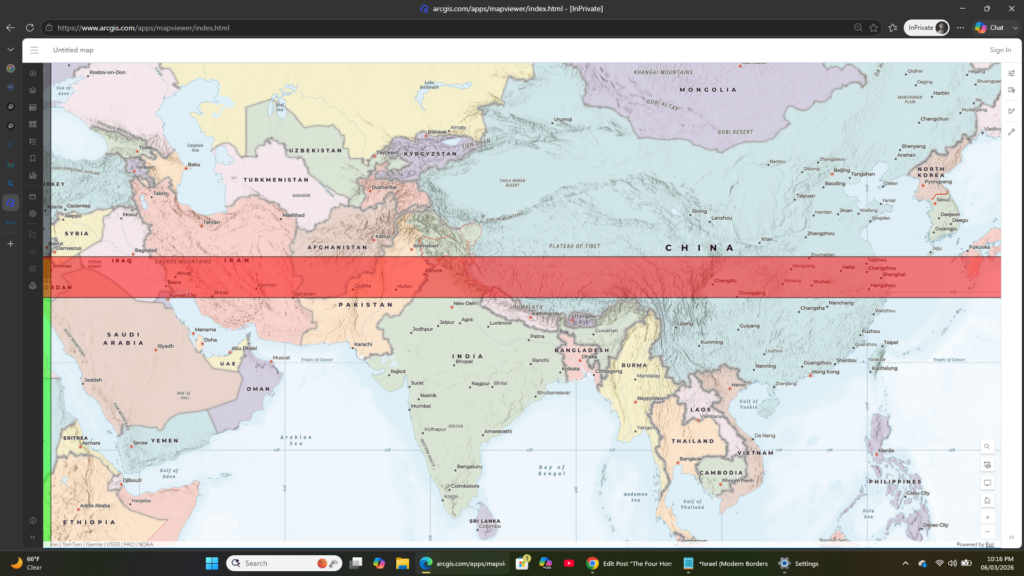
Second, the Red horse goes out with its rider. This rider is given a sword, and “take[s] peace” from a land to the East of Israel, “so that they may/will [the verb is aorist active subjunctive in the Textus Receptus, but future active indicative in NA28] slay one another” (my word-for-word translation). Since the Greek word for “one another” is generally used in Scripture of people in a common group, this tells us the opening of the second seal would be associated with civil war breaking out (apparently due to instigation by another prominent figure, represented by the Red horse’s rider) somewhere in Asia that’s directly East of Israel (modern-day Jordan, Iraq, Iran, Afghanistan, Pakistan, India, or China, or possibly the southern tip of Syria, the northern tip of Saudi Arabia, or the Kyushu region of southwestern Japan).
The lands due east of Israel, with which the red horse could be associated. Between China and Japan, the rectangle passes just south of Mara Island, the southernmost point belonging to South Korea.
I also can’t rule out the possibility that more than one of these places will be involved in said war, since the “sides” in the conflict could be religious (e.g., Sunni vs Shia) rather than national.
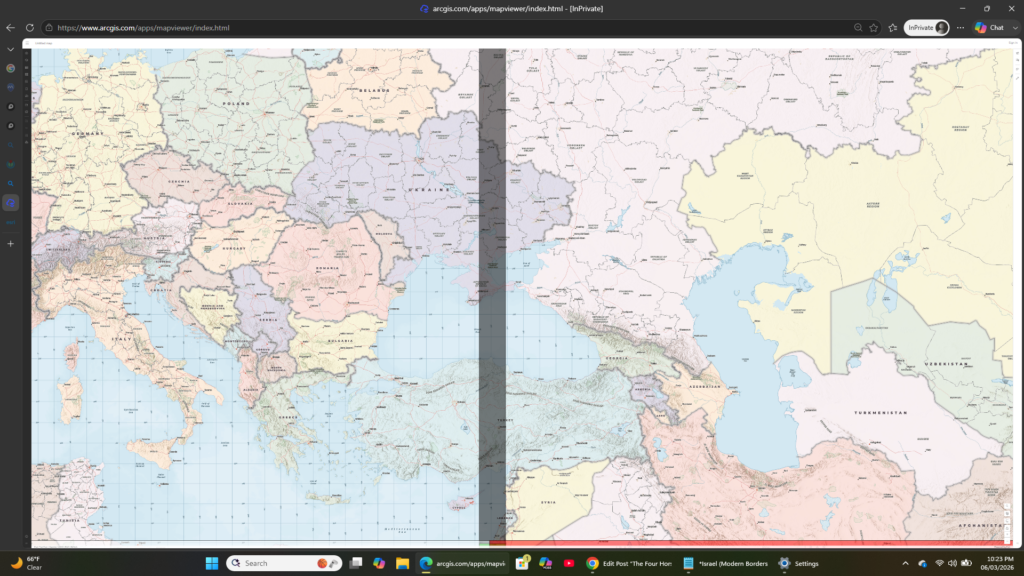
Third, the Black horse goes out with its rider. This rider possesses a yoke, which indicates attachment to a heavy burden. “A quart of grain for a denarius and three quarts of barley for a denarius” is a particularly fearsome prospect when you consider that in John’s day, a denarius was a whole day’s wages! This suggests food prices skyrocketing to the point where the poor can’t afford it–but not necessarily the rich, in light of the add-on “and do not harm the oil and the wine”; oil & wine were commodities of the wealthy in the ancient world, implying that the rich will still be able to barter with those things after this seal has been opened. Taken altogether, the opening of the third seal would be associated with a major famine breaking out somewhere to the North of Israel (what is now Lebanon; possibly Syria, per Daniel 11:6-8,11,13,15,40; Türkiye, formerly known as “Turkey”; Ukraine; and/or Russia), due at least in part to another prominent figure (represented by the Black horse’s rider) imposing burdens that hinder the populace’s ability to grow food.
The lands due north of Israel, with which the black horse could be associated. Further north, the rectangle just misses the Svalbard islands, which belong to Norway.
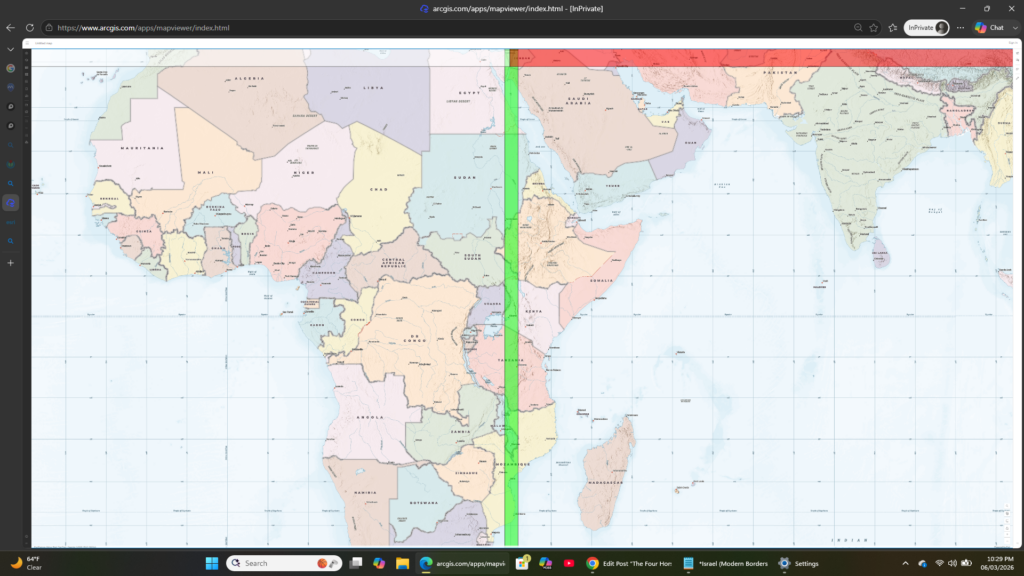
The fourth horse that goes out is Pale Green (χλωρός, from which the chemical element “chlorine” got its name), rather than Bay. However, since we already know the cardinal compass directions for the other 3 horses, and the horsemen are reiterated to be the “four winds” in Revelation 7:1, it’s safe to conclude that the rider of the Pale Green horse also traverses the South. 6:8 specifies power being given “over a fourth of the land”, presumably referring to a fourth of all the land due south of Israel; this implies that the death toll being confined to 25% of the area due south of Israel would be a solid indicator for “the real deal” of this prophecy’s fulfillment. Moreover, that these people are said to be killed “with sword, with hunger, with death, and by the wild beasts of the land” makes it difficult to imagine a singular cause for all these events–underscoring the divine coordination of events involved in this mass die-off. Indeed, the mention of “with death” makes the list of causes of death even more broad, to the point of including natural disasters, animal-borne illnesses–practically anything! However, the rider’s name is said to be “Death” (Greek Thanatos), with “the grave” (Greek Hadēs) accompanying him; and that we’re told that “power was given to them (plural)” implies that “them” refers to “Death” and “the grave” as two distinct entities. Does this indicate that no prominent world figure is involved with the events accompanying the fourth seal? Most likely (in light of the multitude of causes for the events); but also bear in mind that there are quite a few names out there that literally mean “Death” in their languages of origin: Azmaveth (Hebrew for “strong death”), Balor (Irish for “the deadly one”), Dáinn (Old Norse for “dead” or “deceased”), Geeri (Somali for “death”), Javar (a name linked to “death” or “final endings” in many African languages), Jug-eum (Korean for “death”), Lanmo (Haitian Creole for “death”), Letum (Roman personification of death), Maveth (Hebrew for “death”), Mikilis (Nahuatl–a Mayan language–for “death”), Mort (Catalan for “death”), Olim/Olum (Azerbaijani & Kazakh for “death”), Tod (German for “death”), Tuoni (Finnish for “death”), Tuquniq (Inuktut for “death”)–and those are just the boy names! The boldfaced example hails from the region due south of Israel, where this prophecy is to be fulfilled (as do the Swahili “Kifo” & the Amharic “Moti”, which are gender-neutral). So, while the plural “to them” mentioned above makes it unlikely that the rider on the Pale Green horse will be a prominent figure with a name that means “death”, I still think it’s wise to mention the possibility, just in case. In summary, the opening of the fourth seal would be associated with 25% of the land due south of Israel (which includes Egypt, Sudan, Ethiopia, Kenya, Tanzania, Mozambique, and possiblySaudi Arabia and Malawi) experiencing an off-the-charts death toll from a wide variety of causes.
The lands due south of Israel, with which the pale green horse could be associated. Further south, Antarctica has no permanent inhabitants.
Finally, notice what’s absent from these or any other passages: a clear indicator that these events must begin within the 70th “seven” of Daniel. Hence, it’s feasible for the events associated with the four horsemen to begin before the 70th “seven” does. This would certainly line up with the strong parallels between Revelation 6:1-8 and Matthew 24:6-8 & Mark 13:7-8, in which Jesus refers to these particular signs as “the beginning of birth pains” (Matthew 24:8c & Mark 13:8c 2020 NASB)–the metaphor is that these events are the Braxton-Hicks contractions before childbirth actually starts; childbirth itself is the apocalypse; the Tribulation is the most intense part of labor, when the baby’s head is crowning; and the Kingdom’s arrival is when the labor is finally over and the mother is holding the baby in her arms.
As far as I can tell, the conclusions I boldfaced and underlined in my exegesis above are sound, and lay out the essential criteria that need to be met for Revelation 6:1-8 to be fulfilled. Only if ALL of these details are satisfied can we say it’s NOT a “false alarm”.
Possibilities Based on Current Events (As of June 4, 2026)
Now comes the really controversial part of this post: a decent case can be made that the first seal was opened in the last third of 2025, in which case we should be paying attention to see what might happen next.
Now, fair warning: my discussions on the latter three horses will be considerably less detailed, since the tentative events haven’t started happening yet, and so are neither verifiable nor falsifiable as of this writing. However, if it starts looking more and more like we’re onto something, I WILL write additional posts that hark back to this one to help flesh things out as we go. That way, I can keep the current post entirely unedited after publication, leaving an official record of my educated guesses as of initial publication. Then, if they do turn out to be correct, you’ll know who to come to for more information as the apocalypse begins unfolding!
The White Horse to the West
Consider what Tim Warner pointed out on October 15th, 2025:
The white horse goes forth to the west (possibly the US), indicating the first of the four “spirits of the heaven” being dispatched to intervene in human affairs to bring about the end-time events. I have also speculated in recent posts about the seemingly miraculous rise of Donald Trump, against an onslaught of seemingly demonic opposition, to retake the presidency of the US and how that might potentially relate to Revelation 12 (with the USA or parts of it becoming the place of refuge for the “Woman” during the reign of Antichrist). Yet, more recent events of Trump’s presidency, his making peace among several warring nations, seem to support the possibility that he may in fact be the rider on the white horse, potentially filling both roles.
This peace-making is especially notable when viewed from the Israel-centric perspective and Trump’s recent success in achieving the release of the Hamas hostages. Remarkable events have just taken place during the fall Feast holidays, marked by the two major bookends. On Rosh Hashana, President Trump delivered a scathing speech to the United Nations, essentially steamrolling the globalist (antichrist) agenda. Then, on the last day of the Festival of Sukkot (Tabernacles), ending Israel’s fall feast season, Trump delivered on his commitment to end the war in Gaza and get the hostages released, signing a peace pact between the US, Israel, and Israel’s surrounding (formerly hostile) Muslim nations. President Trump has just become the greatest hero of modern times to the people of Israel during their greatest Festival of national celebration. Trump’s “Abraham Accords” seem to be back on track, yet they will not bring lasting peace (Exod. 23:32; Deut. 7:2; Judges 2:2).
Rulers in ancient times often led a procession of celebration of great victories riding a white horse. President Trump’s apparent victory ending the war and securing the release of the hostages during Israel’s most joyous celebration on the Jewish calendar, Sukkot (Feast of Tabernacles), is extraordinary. It is very difficult to write this off to coincidence. This holiday season is the beginning of the new year, and the chronology of the Bible is reckoned from Rosh Hashanah to Rosh Hashanah. These events fit nicely within the structure of blocks of time on the Biblical Jubilee – Feast calendar. I am not claiming that the first of the seven seals has definitely been opened, only alerting our readers to pay close attention to this possibility as we are prayerfully “watching” the unfolding events, just as Jesus commanded in the Olivet Discourse (Luke 21:36).
Since Warner wrote that, events have unfolded that seem to reinforce this identification. Despite the astroturfed “No Kings” protests, Trump is not royalty, and never has been. His capture of dictator Nicolás Maduro caused most Venezuelans to view Trump as a hero (whether the regime change in the aftermath will work out for once is less certain, as that article I just linked to makes clear). Cuba and Greenland appeared to be next for a while–and he has yet to indicate he’s changed his mind about them. Ultimately, Trump got involved in Iran. In a nutshell, “he came out conquering, and that he may conquer” (Revelation 6:2c LGV). (However, note that the latter instance of “conquer” is in the subjunctive mood; this leaves open the possibility that he won’t succeed every time…)
Indeed, in light of all the campaign promises he worked hard to keep in his first term (and, as seen by the publication date of the original version of this list, which is behind a paywall, that’s just counting up to October of 2018–not even halfway through his first term!), Trump’s reneging on the “no more foreign wars” promise sticks out like a sore thumb. It’s feasible that God planted the thoughts (or, perhaps, permitted some of his aides or even a demon to plant thoughts–I’ll let you take your pick on this one!) to attack other countries in Trump’s head to help set the stage for the apocalypse–accomplishing the will of God, even though it conflicts with the will of the people! Again, the demonic levels of opposition Trump faced in 2020 and especially 2024 makes it clear that the demonic forces didn’t want him in power for some reason. Preventing someone predictably unpredictable enough (cough, posts on X, cough) for God to use as the rider on the white horse from becoming president of the U.S. would certainly be a good enough reason for the demons to pull out all the stops like we saw in the 2024 election cycle!
Yes, the rising prices of gas in the short term and everything else in the coming months sucks for those of us in the U.S. (and it sucks even worse in Asia, Australia, and New Zealand, where gasoline supply has been running out much faster), but remember what I mentioned above: “the activities described in Revelation 6:1-8 are God taking out His wrath against ‘the nations‘ and those in them that have become arrogant in their apparent safety and have facilitated evil”. We in the U.S. have gotten a little too used to having secure lifestyles compared to most of the rest of the world. At least the doctrine of Chiliasm implies that we’ll only have to put up with such consequences until just over another decade from now…
But just to re-emphasize: I’m not ready to be dogmatic that Trump really is the rider on the White horse. If the events in the other three directions occur in the wrong order after this, then it’s not “the real deal”.
Also consider that Trump gave his speech to the UN on September 23rd, 2025. On the Hebrew Calendar, Tishri 1 (Rosh Hashanah) lasted from sunset on September 22nd to sunset on the 23rd, lining up with Warner’s claim (it would’ve been between 4:00 & 4:30 pm in Israel when the speech began, and it only lasted 57 minutes, so it would’ve ended well before sunset that day). While I don’t see strong enough reason to claim that something related to the opening of a seal will happen during the Levitical Fall Feasts every time, I can’t rule out the possibility, either. But if it does end up happening that way, it’ll certainly be more difficult to deny the divine nature of the events! So, while this detail is technically optional, I wouldn’t be surprised if an event related to the Red horse comes to pass on Tishri 1 (sunset on September 11th to sunset on September 12th) of 2026, an event related to the Black horse on Tishri 1 (sunset on October 1st to sunset on October 2nd) of 2027, and an event related to the Pale Green horse on Tishri 1 (sunset on September 20th to sunset on September 21st) of 2028. As a refresher, I predict that the 70th “seven” of Daniel 9:24-27 will begin on Tishri 1 (sunset on September 9th to sunset on September 10th) of 2029, and the Two Witnesses will show up on Cheshvan 1 (sunset on October 9th to sunset on October 10th) of 2029 {HIDMF, p. 759}.
The Red Horse to the East
As I exegeted above, the rider on the Red horse brings civil war somewhere to the east of Israel. As also noted above, the modern-day lands that are due east of Israel include: Jordan, Iraq, Iran, Afghanistan, Pakistan, India, and China, as well as the southern tip of Syria, the northern tip of Saudi Arabia, and the Kyushu region of southwestern Japan. However, Revelation 6:4 mentioning this rider being given a sword after mentioning that he takes peace from the land and leads people into civil war suggests that whoever the rider is will be both responsible for taking peace from the land and a participant in the ensuing civil war.
In fact, consider what that most recent article had to say about the fragility of Iran’s social cohesiveness and public stability:
An analysis of these fast-moving developments reveals that the Iranian regime has entered an unresolvable existential paradox. The two factions are engaged in a raw “war of thugs” where the execution of one survival strategy instantly nullifies the other. Pezeshkian’s gang recognizes that without immediate sanctions relief and a partial opening of the country’s digital infrastructure, the macroeconomic trajectory guarantees a structural default and a massive social explosion. Yet, the extremist gang correctly calculates that any tactical retreat, diplomatic compromise, or reduction in domestic digital surveillance will be interpreted as systemic weakness, lowering the barrier for public dissent. …Ultimately, this structural gridlock means the clerical dictatorship is completely incapable of self-preservation or internal reform. The executive branch has no real authority to implement economic lifelines, the legislature is actively sabotaging its own state diplomacy, and the judiciary is functioning as a tool of factional warfare. While the regime’s security forces maintain their brutal baseline of domestic oppression, the central command structure in Tehran is hollowed out. This profound internal breakdown demonstrates that the regime has reached a historical dead end, creating an unprecedented strategic opening for the organized domestic network to mobilize an exhausted and impoverished population.
{Hyperlinks in original. Boldface mine.}
Note well those mentions of “fast-moving developments” and “an unprecedented strategic opening”: remember, John said in the opening verse of Revelation that the future events described in the book, including those of 6:1-8, “must occur swiftly“.
All that being said, it’s also possible that this could be just the start of a more widespread spat between Sunni and Shia Muslims throughout the Muslim nations to the east of Israel, rather than just being confined to Iran. If so, I wouldn’t be surprised if some of the Muslims of Palestine not only wind up backing off of Israel because they’re too busy fighting each other, but accidentally (since no Muslim would dare to do so on purpose!) destroying the Dome of the Rock, clearing what is arguably the biggest hurdle in the way of Israel building a Third Temple on the site of the first two. (In the absence of such a destruction of the Dome of the Rock, my guess is that it will be built against the Western Wall, an ancient retaining wall that constitutes the one portion of the Second Temple complex that’s still standing. In fact, I find this to be the more likely scenario regardless, since Revelation 11:1-2 implies that at the time of the Third Temple’s existence, the Temple Mount will be mostly under Gentile control, with a relatively small portion being dedicated to the Third Temple.)
So will this civil war be restricted to Iran, or will Muslims throughout southern and western Asia be involved?1 God knows (and He also knows whether it’d really be the unsealing of the Red horse). All we can do is wait to find out.
The Black Horse to the North
As for the Black horse that brings famine somewhere to the north of Israel, it’s significant that about one third of the world’s traded fertilizer and half of the world’s traded urea passes through the Strait of Hormuz, which has been closed due to the war in Iran. This is already requiring the nations that source their fertilizer from there to look elsewhere just to ensure their citizens don’t starve; as Mason Sexton, Jr. explained on May 15, 2026 {subscription-exclusive article, unfortunately, so I can’t give you a hyperlink to read the whole thing; but just so you know the quote’s actually from him and I’m not just making it up, here’s a couple of screenshots:}:
You see, Russia mostly produces its own fertilizer and reduced or even halted exports of it to the countries that sanctioned it in 2022. So if any of the nations that now need alternatives to the Persian Gulf decide to stop sanctioning Russia out of desperation over their own food supply, it’s possible that Russia could make enough bad decisions to give so much of it to other countries that their own agriculture–and thus, populace–could suffer. Moreover, Russian farmers may not even be able to afford whatever fertilizer they can get: Matt Badiali pointed out in early May that “the price of nitrogen fertilizer rose 22% so far this year…before the Iran war issue.” (And just to clarify–lest I be accused of quoting a statistic out of context–Luminita Toma gets more specific on that statistic: “Even before recent headlines, costs were up over the previous year. According to the Bureau of Labor Statistics, nitrogen-based fertilizers jumped 22% between February 2025 and 2026 due to tight global supplies and high European energy prices.” {Boldface mine.}) Toma adds that “Simultaneously, natural gas — which is essential for making synthetic fertilizers — became much more expensive. This hit the market with a double whammy: less fertilizer available, and higher costs to make what was left.” Russia is also the world’s largest exporter of natural gas. Badiali also points out that the weather patterns will probably shift like crazy this year, which could throw farmers all over the globe for a loop: “Experts look for a strong to extreme El Niño this year. So that’s another headwind for wheat crops.” I have no clue what the details could be, but I suspect Russia and/or Ukraine could make enough policy shifts in response to these developments (and others that aren’t currently on my radar) for their own citizenry to begin having to pay through the nose just to eat within the next couple years. Whichever leader of theirs (Putin, Zelenskyy, or one of their successors) is responsible for these policy shifts will almost certainly be the person represented by the Black horse’s rider. Maybe Türkiye, Syria, or Lebanon could be involved too, but I don’t see any obvious catalysts for them to be involved in a famine big enough to get the whole world’s attention. But hey, as always, God is perfectly capable of surprising me!
Obviously, I don’t have as much info to have such a clear picture on this one, but frankly, that’s to be expected: we’re still further out in time from the Black horse going out than the Red horse going out–regardless of whether the “real deal” for the White horse is presently ongoing.
Yet the Pale Green horse going out after the other three horses implies that the situation would take a little more time to develop and become as dire as described in Revelation 6:8 (and implied in Zechariah 6:7). Bear in mind that the death toll from the Pale Green horse and its rider is due to a wider variety of causes, so God will probably spend that extra time lining up all the pieces before tipping over the proverbial first domino. Obviously, this is where I’m most clueless on the details, since the text mentions that the people in a quarter of the area due south of Israel would be killed “with sword, with hunger, with death, and by the wild beasts of the land”, but doesn’t specify how those things will be brought about. Plus, this is the furthest-out of the Four Horsemen, so it naturally has the most opportunities for circumstances to change between now and when it comes to pass.
Conclusion
I’m well aware that I’m taking a huge risk by publishing this. Some readers might even accuse me of “giving ideas” to any leaders who’d like to make our lives more miserable. But if the apocalypse will begin as soon as the doctrine of Chiliasm requires, then I won’t be giving them that much of a head start beyond what they would’ve done anyway! After all, I may not be ready to dogmatically claim that God’s already set the process in motion, but the chronology of the Bible, in conjunction with the doctrine of Chiliasm, implies that the time window before the 70th “seven” begins is already under 3.5 years, so the process involving the Four Horsemen has to have initiated by then! But whenever God will have done so, none of us–not even any of the prominent figures He or Satan will be using as pieces in this chess game of history–will be able to stop it. We’re entering a scary period of history–yet for the faithful, an exciting one. Watching God’s plan unfold leading up to His Son’s return to renovate the world order (2 Peter 3:10-13; the word there rendered “elements” refers to the foundational components of human civilization in Galatians 4:3,9 & Colossians 2:8,20) and usher in the Kingdom in full swing (Daniel 7:13-14,18,21-27) will be as utterly amazing as it will be shocking.
Let it be known that once I hit the “Publish” button on this post, I WILL NEVER EDIT IT. This post is for readers in the future to see whether or not I saw it coming. And if it turns out I did, they can reach out to me for sound Biblical advice and directions to additional information on enduring the apocalypse (Matthew 24:9-13) and ensuring they remain steadfast even while a large fraction of Christendom is falling away (Matthew 25:1-13; Luke 18:7-8; 2 Thessalonians 2:3). For now, 1 Timothy 4:1-11 is an excellent place to start.
I’ll post on this topic again as the situation and signs become more clear.
I was tempted to also pose the possibility of a redux of the “blood trains” between India & Pakistan, in which Muslims fleeing India and Hindus fleeing Pakistan were killed when their trains to the other side of the new border were hijacked. But then I remembered that, since Hindus and Muslims are generally on the “right” sides of the border nowadays, a war between India & Pakistan wouldn’t technically be a civil war! That would be more akin to what happened between the Union and the Confederacy in the U.S. Civil War; it’s important for me to drive this point home for any of my fellow Americans who’d miss the distinction. As Dave Gonigam explains:
The problem with many Americans’ thinking about a second civil war is that it’s warped by the experience of the first. “We didn’t really have a civil war,” tweets Darryl Cooper, the man behind the extraordinary Martyr Made history podcasts. “We split into two countries and had a regular war.” Exactly. Most civil wars do not entail set-piece battles by uniformed soldiers. How likely is that now, really? “Civil war looks like Beirut or Sarajevo,” Cooper continues, “where you couldn’t walk outside for fear of being randomly sniped, and there were no pitched battles, just kidnappings, assassinations and basement torture sessions.” Again in 2017, we cited the prepper writer John Mosby (which may or may not be a pen name): “This is about people burning down their neighbors’ houses and businesses, to run them out of town, over ideological differences. Look at the Balkans in the early 1990s. This is about a group from one side, murdering the entire family — Dad, Mom, brother and baby Sister — of their neighbors, over political differences.” {Boldface in original.} ↩︎
As you undoubtedly guessed from the post title and the fact that this is part of my series critiquing Bob Pulliam’s book “In the Days of Those Kings”, there are several points in “In the Days of Those Kings” where Pulliam redefines the word “resurrection” to mean something other than coming back to life in a new physical body. I could’ve addressed one of those (his reinterpretation of Daniel 12) in a Part 3 to my “In the Days of … WHICH Kings?” posts, but it seemed best to me to deal with all of them in a single post, for your convenience when dealing with amillennialists in general (I’ve found that they tend to use most if not all of these same arguments). While it’s obvious that he’s doing so in order to avoid certain eschatological implications that contradict his views (namely, that there will be 2 mass resurrections and that we will spend the rest of eternity in physical — though glorified — bodies), I personally find it interesting that his tactics for explaining away these implications are very different from one occasion to the next! So let’s consider them, in the order he brings them up.
Daniel 12
Let’s start with what he had to say at the end of Lesson 18:
This chapter [Daniel 12] begins with four words that most people seem to ignore: “Now at that time.” These four words should direct our attention to the time in progress at the end of Daniel 11. Never forget that Daniel did not divide his prophecies into chapters. Daniel 11 and 12 belong together in point of time. This period leading up to the Messiah has already been described as “the time of the end.” It included the activities of the kings of the North and South. It was the end before the Messiah came, and His arrival is precisely what we have come to in chapter twelve. Don’t forget what we learned in Lesson 6, the cross of Christ was the end of forever. In verse three, we are told that “those who have insight will shine brightly…” Who does the word those refer to? Back in the preceding chapter, we read about those who have insight among the people (Dan 11:33). “Those” is the logical antecedent in the context. “Those” are the people listening to God “in the end,” and suffering as a result. All of this tells us that Daniel 12 is not about a future resurrection, but about past events following the events in Daniel 11. We are told, “at that time” your people “will be rescued.” What comes after the tribulations of the times of the Grecians? At “that time” the people would be rescued. You don’t have to skip forward thousands of years to make up a fulfillment here. There was something that took place which would be characterized as a rescue of God’s people. Jesus came! What did Jesus do? He came to take away the sins of the world (Jn 1:29). It was not a political rescue operation. It was a rescue mission to save them from eternal loss. That is actually what the Bible is all about. As we come to verse two, people tend to assume that the final resurrection is being discussed, but this discussion is of awakening through insight to serve God (v3). It is the same figure of speech used by Paul in Ephesians 5:14. There, Paul admonished living people to “awake” and “arise from the dead,” not at the final resurrection, but by their faithful submission to the gospel.The “dust of the ground” (v2) does not refer to the grave. The time will be one of despondency. Tribulation will conquer the hearts of those without “insight.” Those with insight will “awaken” (by submission) to attain everlasting life. The figure of speech used here is much like the one found in “Our bones are dried up, and our hope has perished. We are completely cut off.” (Ezek 37:11). This was the cry of Israel in Babylonian captivity. The Lord’s answer was, “Behold, I will open your graves and cause you to come up out of your graves, My people: and I will bring you into the land of Israel.” (v12) They were physically alive, but they felt like their nation was dead. Here in Daniel 12, we have a different situation that is over 500 years later than the Babylonian captivity, but it has the same kind of description. By the time Antiochus Epiphanes finished with Israel, they would feel like they had died and been buried. But then hope awakened, and was thriving as Jesus came with the good news about the kingdom. In concluding this prophecy, the messenger says, “Go your way Daniel, for these words are concealed and sealed up until the end time.” (12:9) This is the “end time” in which the “abomination of desolation” will be set up (12:11). The phrase “abomination of desolation” is only used twice in the book of Daniel. The first time is in chapter 11 (11:31), and that referred to the actions of Antiochus IV Epiphanes in 168 B.C. But Jesus tells us that Daniel spoke of an “abomination of desolation” that would accompany the destruction of Jerusalem in AD 70 (studied in lesson 16). Since Jesus cannot be talking about the one in Daniel 11, He must be talking about the abomination of desolation in Daniel 12. We should also associate this with the “desolations” of Daniel 9:26 (cf. pp202-203). Daniel is told that there will be 1,290 days “from the time that the regular sacrifice is abolished, and the abomination of desolation is set up.” Various interpretations have been presented, but it is important that they apply to Christ’s warning in Matthew 24:15 and Luke 21:20.The number may be symbolic of the extent of Roman persecution before the city of Jerusalem falls. After the destruction of the city, persecution did continue for a short time, possibly symbolized by the 1,335 days. Anyone who listened to Jesus and consulted this prophecy would know that the faithful would see the conclusion of these sufferings. Daniel was told that he would “rise again” (Dan 12:13 – NASB). The Hebrew word in this text does not refer to a “resurrection.” It means to “stand.” Daniel is simply being told that he will die (enter into rest) and “stand for his lot at the end.” If we keep the word “end” in the context of the events ending with the destruction of Jerusalem in AD 70, we find a logical conclusion to the previous four verses. Daniel was to seal up the prophecy because it pertained to the distant future (12:9; cf. v4). During that time, the prophecies would unfold, and only the wise would accept them (12:10). The climax of tribulation would come, and the faithful must have hope (12:11-12; compare Christ’s warning in Matthew 24:15-22). Daniel’s work is done, but this sealed prophecy will stand as a testimony of his work for God. Darby translated this text well with “… and thou shalt rest, and stand in thy lot at the end of the days.” We assume that “thy lot” would mean Daniel’s final heavenly home, but that is not the point. This verse isn’t about whether Daniel will be saved. This is about the status of Daniel’s work when the time of fulfillment arrives. This is actually about Daniel’s “lot” as a prophet. His work will be confirmed by the fulfillment of these very distinct and specific prophecies about “the end.” …There is nothing in the latter chapters of Daniel about a future period of tribulation on the earth. A great deal of history can be found in these chapters. None of it addresses our future. Daniel provides a great deal of encouragement to the Bible believer. Many events are prophesied, and it all came to pass without fail. In Daniel’s prophecies we can see God’s omniscient power at work. But we also see that God always keeps His promises. God never fails.
{“In the Days of Those Kings: A 24 Lesson Adult Bible Class Study on the Error of Dispensationalism”. Pulliam, Bob. 2015. Houston, TX: Book Pillar Publishing. 193-195. Italics and boldface in original. Underlining mine.}
You would not believe how much anger I had to hold back as I typed these quotes. The sheer number of fabrications, bald assertions, and outright falsehoods Pulliam utilizes when trying to convince his readers to just take his word for it and not investigate these passages any further is enough to make my blood boil. Once again, he’s being sickeningly allegorical in order to convince his readers to ignore the obvious. Well, time to expose the lies point-by-point.
“‘Now at that time.’ These four words should direct our attention to the time in progress at the end of Daniel 11.” Yeah, but that should in turn be interpreted in light of the phrase “And at the time of the end” (KJV) at the beginning of verse 40, which Pulliam’s interpretation completely ignores! Consider what I pointed out in my earlier post discussing this Lesson: verses 36-39 were fulfilled in Herod the Great, yet Pulliam interprets verses 40-43 as being fulfilled in the final days of Ptolemaic Egypt {Ibid. 193.}. This would require backtracking between verses 39 & 40–no hint of which is in the text (how utterly hypocritical–Pulliam has the gall to call out Dispensationalists on reading a forward time jump into verses 35 & 36, while having the audacity himself to read a backward time jump into verses 39 & 40)!
“This period leading up to the Messiah has already been described as ‘the time of the end.’ It included the activities of the kings of the North and South. It was the end before the Messiah came, and His arrival is precisely what we have come to in chapter twelve.” Then why does Daniel 11:40 open with the phrase “And at the time of the end”–implying that everything in verses 2-39 occurs before “the time of the end”?! That “the king of the south” and “the king of the north” are mentioned again in verse 40 is therefore more consistent with rulers of Egypt & Syria being involved in events of the apocalypse, just as they were involved in events impacting Israel in the 4th-2nd centuries B.C. (note that verse 36 mentions “the king” with no qualifier, consistent with this king being of neither Egypt nor Syria–as was the case with Herod the Great)!
“Don’t forget what we learned in Lesson 6, the cross of Christ was the end of forever.” Are you confused by this statement? Well, here’s Pulliam’s Conclusion to Lesson 6, to give you some context for what he means:
In summary, we have learned that the land promise had a duration attached to it. When the patriarchs were told that the land would be theirs forever, God was referring to the great span of time up until the New Testament.Forever simply refers to an age of time whose duration is undetermined. Context, or in the case of prophecies, the fulfillment, must be consulted to know the actual duration of the Hebrew word forever. After God fulfilled every promise of the covenant, a new covenant went into effect (to be studied in our next lesson). When we understand the meaning of forever, and keep the theme of the Bible in view, the cross of Jesus Christ becomes the end of that duration. The cross of Christ is the end of forever. God gave the full extent of the land promised to Abraham, and Scripture provides no further promise of Israel’s return to that land.
{Ibid. 68. Italics in original. Underlining mine.}
As you’re probably guessing, I take issue with all the phrases I underlined here. Pulliam sure knows how to slow down call-outs of his claims by forcing you to go down multiple rabbit holes in the process!
First, which land promise “had a duration attached to it”? Pulliam’s talking about the Abrahamic land promise outlined in Genesis, but the land promise with a duration attached to it was actually the Mosaic land promise made from the burning bush:
The LORD said, “I have surely seen the affliction of My people who are in Egypt, and have given heed to their cry because of their taskmasters, for I am aware of their sufferings. 8 So I have come down to deliver them from the power of the Egyptians, and to bring them up from that land to a good and spacious land, to a land flowing with milk and honey, to the place of the Canaanite and the Hittite and the Amorite and the Perizzite and the Hivite and the Jebusite. 9 Now, behold, the cry of the sons of Israel has come to Me; furthermore, I have seen the oppression with which the Egyptians are oppressing them. 10 Therefore, come now, and I will send you to Pharaoh, so that you may bring My people, the sons of Israel, out of Egypt.” (Exodus 3:7-10 1995 NASB, boldface added)
These are two different land promises! That the Mosaic land promise was conditioned on obedience is clear not only from the fact that the Israelites’ progress at obtaining the land was hindered whenever they started rebelling, but also from Leviticus 26:14-45, where God threatens in verse 32 to “make the land desolate” (1995 NASB) if they don’t repent after all the punishments mentioned in the earlier verses–“desolate” being a fancy word for “without inhabitant”. This fact alone differentiates this land promise from the Abrahamic one, which was unconditional: “For if the inheritance is based on law, it is no longer based on a promise; but God has granted it to Abraham by means of a promise.” (Galatians 3:18 1995 NASB, boldface added) In contrast, “When the patriarchs were told that the land would be theirs forever” refers to the Abrahamic land promise. “[I]n the case of prophecies, the fulfillment[] must be consulted to know the actual duration of the Hebrew word forever.” The problem with this statement is that Pulliam constantly misinterprets how these prophecies were/will be fulfilled!
“After God fulfilled every promise of the covenant, a new covenant went into effect”. Ironically, the author of Hebrews told us that the prophet who told us of the New Covenant denied that himself!
For finding fault, He saith to them, ‘Lo, days come, saith the Lord, and I will complete with the house of Israel, and with the house of Judah, a new covenant, not according to the covenant that I made with their fathers, in the day of My taking them by their hand, to bring them out of the land of Egypt — because they did not remain in My covenant, and I did not regard them, saith the Lord, — because this is the covenant that I will make with the house of Israel, after those days, saith the Lord, giving My laws into their mind, and upon their hearts I will write them, and I will be to them for a God, and they shall be to Me for a people; and they shall not teach each his neighbour, and each his brother, saying, Know thou the Lord, because they shall all know Me from the small one of them unto the great one of them, because I will be merciful to their unrighteousness, and their sins and their lawlessnesses I will remember no more;’ [Quoting Jeremiah 31:31-34 LXX] — in the saying ‘new,’ He hath made the first old, and what doth become obsolete and is old is nigh disappearing.
(Hebrews 8:8-13 YLT, boldface and underlining added)
In verse 13, the perfect active indicative verb for “He hath made old” relative to the present active infinitive verb for “saying” tells us that the old (Mosaic) covenant became “old” as soon as God spoke this to Jeremiah! Tim Warner presents some implications of this in a note on the word “new” in Hebrews 8:13 LGV:
By referring to the coming “New Covenant” through Jeremiah, God declared the Mosaic Covenant to become “old” or obsolete in Jeremiah’s day. It did not become “old” when the New Covenant arrived. Note that the Mosaic Covenant was still in force upon Israel even after Christ came, which is why Israel is under the curse of the Law predicted in Deut. 28-30, which included the destruction of Jerusalem and a second exile until the end times. {Scroll to p. 20 in the PDF. Boldface added.}
He goes on to add in his note on the phrase “what is being made old and growing old”: “Notice that becoming old and obsolete was a process over a long period of time, not a single event when Christ brought the New Covenant. It will not become entirely obsolete for Israel until the Kingdom arrives (Matt. 5:17-18)” Indeed, Jesus made this crystal-clear early on in the Sermon on the Mount: “Do not think that I came to abolish the Law or the Prophets; I did not come to abolish but to fulfill. For truly I say to you, until [ἕωςἂν, “till whenever”] heaven and earth pass away, not the smallest letter or stroke shall pass from the Law until [ἕωςἂν] all is accomplished.” (Matthew 5:17-18 1995 NASB, boldface added)
“In verse three, we are told that ‘those who have insight will shine brightly…’ Who does the word those refer to? Back in the preceding chapter, we read about those who have insight among the people (Dan 11:33). ‘Those’ is the logical antecedent in the context. ‘Those’ are the people listening to God ‘in the end,’ and suffering as a result. All of this tells us that Daniel 12 is not about a future resurrection, but about past events following the events in Daniel 11.” No, it tells us that the Jews’ suffering under Antiochus Epiphanes was a type of the suffering that will happen under the Antichrist, and so the two periods of history will have similar requisites for God’s people to remain steadfast through them. Jesus himself invokes a similar concept in Luke 21 when telling the general public at Jerusalem’s second temple (verses 5-8) that escaping its destruction and persevering through the events leading up to it (verses 12-24) and evading/enduring the devastations of the apocalypse (verses 8-11,25-33) will require similar actions on the part of those living through each: “watch ye, then, in every season, praying that ye may be accounted worthy to escape all these things that are about to [or “, the ones that inevitably”; present (obviously a “completely futuristic present”, in light of the context) active participle of μέλλω1] come to pass, and to stand before the Son of Man.” (verse 36 YLT, boldface and underlining added)
“It was not a political rescue operation.” Jesus’ first coming wasn’t, but his second certainly will be, in light of another passage Pulliam consistently avoids dealing with:
I kept looking, and that horn [the Antichrist] was waging war with the saints and overpowering them until the Ancient of Days came and judgment was passed in favor of the saints of the Highest One, and the time arrived when the saints took possession of the kingdom. …Then the sovereignty, the dominion and the greatness of all the kingdoms under the whole heaven will be given to the people of the saints of the Highest One; His kingdom will be an everlasting kingdom, and all the dominions will serve and obey Him. (Daniel 7:21-22,27 1995 NASB, boldface added)
I ask Pulliam yet again: how was “the sovereignty, the dominion, and the greatness of all the kingdoms under the whole heaven” “given to the people of the saints of the Highest One” at any time since Jesus arrived?!
“As we come to verse two, people tend to assume that the final resurrection is being discussed, but this discussion is of awakening through insight to serve God (v3). It is the same figure of speech used by Paul in Ephesians 5:14. There, Paul admonished living people to “awake” and “arise from the dead,” not at the final resurrection, but by their faithful submission to the gospel. The ‘dust of the ground’ (v2) does not refer to the grave. The time will be one of despondency. Tribulation will conquer the hearts of those without ‘insight.’ Thosewith insight will ‘awaken’ (by submission) to attain everlasting life.” In Ephesians 5:14, Paul wasn’t quite saying what Pulliam seems to think he was:
For you used to be darkness, but now [you are] light in the Master. Live like children of light, 9 (for the fruit of the light is in all goodness and righteousness and truth), 10 discerning what is acceptable to the Master. 11 And have no co-participation with the barren deeds of darkness, but instead condemn them. 12 For it is shameful to even mention what is done by those in private. 13 But everything condemned by the light is exposed, for the light is what exposes. 14 That is why He says: “Awake, you who sleep, arise from the dead, and the Anointed One will give you light.” (Ephesians 5:8-14 LGV, italics and content in brackets in original, boldface mine)
Warner points out a divergence of opinion among scholars regarding where “He says” the italicized phrase in verse 14: “Some scholars have suggested that this quotation was from an ancient hymn. Others suggest that it is a paraphrase and adaption of Isaiah 60:1-3.” {Scroll to note indicated at the end of verse 14. Boldface added.} If the latter interpretation is the correct one, then this statement is referring to the still-future Kingdom in its fullness, and Paul was using it as an incentive to submit to the gospel. Since Pulliam’s case depends on this latter interpretation being incorrect, he must provide evidence that the former interpretation Warner mentioned (or some third explanation) is more viable than this one. Otherwise, his interpretation of this verse is just as inconclusive as any alternative one.
“The figure of speech used here is much like the one found in ‘Our bones are dried up, and our hope has perished. We are completely cut off.’ (Ezek 37:11). This was the cry of Israel in Babylonian captivity. The Lord’s answer was, ‘Behold, I will open your graves and cause you to come up out of your graves, My people: and I will bring you into the land of Israel.’ (v12) They were physically alive, but they felt like their nation was dead.” I’ve already extensively rebutted this excuse here.
“By the time Antiochus Epiphanes finished with Israel, they would feel like they had died and been buried. But then hope awakened, and was thriving as Jesus came with the good news about the kingdom.” At best, this is a type of what will be the case during the 10-day period between the end of the Tribulation and Jesus’ return (1 Corinthians 15:52 cf. Leviticus 25:8-10). Remember, Antiochus Epiphanes will be resuscitated to become the Antichrist, so strong parallels between them are to be expected!
“The phrase ‘abomination of desolation’ is only used twice in the book of Daniel. The first time is in chapter 11 (11:31), and that referred to the actions of Antiochus IV Epiphanes in 168 B.C. But Jesus tells us that Daniel spoke of an ‘abomination of desolation’ that would accompany the destruction of Jerusalem in AD 70 (studied in lesson 16). Since Jesus cannot be talking about the one in Daniel 11, He must be talking about the abomination of desolation in Daniel 12. We should also associate this with the ‘desolations’ of Daniel 9:26 (cf. pp202-203).” As just noted, strong parallels between Antiochus Epiphanes & the Antichrist are to be expected, since they’re the same person! And as noted further above, the waw-consecutive construction at the start of Daniel 9:27 places everything in the 70th “seven” after the second destruction of Jerusalem! Moreover, the Hebrew text of verse 26c literally reads “and until the end, war is determined, causing desolations”. As noted above, “desolation” is a state of being devoid of inhabitants; since the prophecy of Daniel 9:24-27 pertains to God’s dealings with Israel over the 70 “sevens”, this phrase is referring to Israelites having trouble resettling the land due to wars in the area from the second destruction of Jerusalem “until the end”. In what way is this an inaccurate description of what’s actually happened in the Promised Land over the last two millennia?! We can’t even conclusively say the Israelites won’t lose at least part of that land they have in our day in the foreseeable future, due to the political situation in the Middle East!
“Daniel is told that there will be 1,290 days ‘from the time that the regular sacrifice is abolished, and the abomination of desolation is set up.’ Various interpretations have been presented, but it is important that they apply to Christ’s warning in Matthew 24:15 and Luke 21:20. The number may be symbolic of the extent of Roman persecution before the city of Jerusalem falls. After the destruction of the city, persecution did continue for a short time, possibly symbolized by the 1,335 days.” “[S]ymbolic of the extent of Roman persecution?” “[S]ymbolized by the 1,335 days”? The way Pulliam’s talking here makes it sound like he doesn’t think these numbers refer to literal days. I must say, I find it intriguing that Pulliam isn’t willing to just outright claim “The Jewish-Roman Wars had been ongoing for 1,290 days when Jerusalem was destroyed”. The only reason I can imagine for why he wouldn’t do so is that he knows that such a claim wouldn’t be historically true. Ditto for the 1,335 days. Moreover, if these are to symbolize the extent of Roman persecution during the Jewish-Roman Wars without referring to literal calendar days, then what’s the significance of the two different values? And since the destruction of Jerusalem was (from a “covenant people” standpoint) a much bigger deal than the destruction of Masada (widely regarded as the last battle of the Jewish-Roman Wars), why would the larger number be after the destruction of Jerusalem, rather than before? Until Pulliam can answer these sorts of questions, he needs to quit trotting out all this unsubstantiated garbage! I, of course, take the 1,290 days as referring to the time from when the Antichrist shows up and kills the Two Witnesses (Revelation 11:7; note the phrase “the beast that is coming up out of the abyss”–YLT, boldface added–implying in conjunction with the word “when” that the Antichrist rises from the dead right before he kills them) until Jesus returns, with the 1,335 days implying a yet-undisclosed event (probably included among the seven thunders or little scroll of Revelation 10:2-4,8-11) occurring 45 days after Jesus returns.
I should also highlight the fact that Pulliam assumed that Matthew 24:15 and Luke 21:20 were both referring to the second destruction of Jerusalem. The contexts reveal that these were two different speeches (compare Luke 21:1-8,37 with Matthew 24:1-3); but the similarities in language certainly do make it easy for people to assume they’re the same speech, or at the very least, confuse the two speeches. This very mistake (or perhaps ploy?) was also committed by the first known preterist, Eusebius, in one of the earliest statements in all of church history that explicitly teaches preterism (the few earlier ones were also written by Eusebius, and those only go back to A.D. 310):
It is fitting to add to these accounts the true prediction of our Saviour in which he foretold these very events. His words are as follows: “Woe unto them that are with child, and to them that give suck in those days! But pray that your flight be not in the winter, neither on the Sabbath day. For there shall be great tribulation, such as was not since the beginning of the world to this time, no, nor ever shall be.” [Quoting Matthew 24:19-21] The historian, reckoning the whole number of the slain, says that eleven hundred thousand persons perished by famine and sword, and that the rest of the rioters and robbers, being betrayed by each other after the taking of the city, were slain. But the tallest of the youths and those that were distinguished for beauty were preserved for the triumph. Of the rest of the multitude, those that were over seventeen years of age were sent as prisoners to labor in the works of Egypt, while still more were scattered through the provinces to meet their death in the theaters by the sword and by beasts. Those under seventeen years of age were carried away to be sold as slaves, and of these alone the number reached ninety thousand. These things took place in this manner in the second year of the reign of Vespasian, in accordance with the prophecies of our Lord and Saviour Jesus Christ, who by divine power saw them beforehand as if they were already present, and wept and mourned according to the statement of the holy evangelists, who give the very words which he uttered, when, as if addressing Jerusalem herself, he said: “If you had known, even you, in this day, the things which belong unto your peace! But now they are hid from your eyes. For the days shall come upon you, that your enemies shall cast a rampart about you, and compass you round, and keep you in on every side, and shall lay you and your children even with the ground.” [Quoting Luke 19:42-44] And then, as if speaking concerning the people, he says, “For there shall be great distress in the land, and wrath upon this people. And they shall fall by the edge of the sword, and shall be led away captive into all nations. And Jerusalem shall be trodden down of the Gentiles, until the times of the Gentiles be fulfilled.” [Quoting Luke 21:23-24] And again: “When you shall see Jerusalem compassed with armies, then know that the desolation thereof is near.” [Quoting Luke 21:20]
The three quotes from Luke were indeed completely fulfilled by the end of the Bar Kochba Rebellion (A.D. 132-135), but mostly in the Jewish-Roman Wars (A.D. 66-73). However, notice that Eusebius substituted a quote from the speech in Luke with one from the speech in Matthew. Had his first quote been simply “Woe unto them that are with child, and to them that give suck in those days!”, then it would be a quotation from Luke 21:23–which was indeed referring to the second destruction of Jerusalem. But by adding everything I boldfaced in this quote, he turned it into a quote from Matthew 24:19-21 instead–which was referring to the second half of the apocalypse! But Eusebius’ use of Matthew’s quote instead of Luke’s gives his readers the false impression that Matthew’s speech was talking about the same thing as Luke’s! The boldfaced sentences are nowhere to be found in the Great Temple Discourse (the speech in Luke), so they don’t apply to the second destruction of Jerusalem. The fact that preterists still use this quote from Eusebius (among others) as if he wasn’t misrepresenting what Jesus was saying in Matthew is nothing short of scandalous, if you ask me. This is the same tactic false teachers (the clever ones, at least) use to promote their heresies: they include just enough truth to make their audience miss the lies they throw into the mix.
“Daniel was told that he would ‘rise again’ (Dan 12:13 – NASB). The Hebrew word in this text does not refer to a ‘resurrection.’ It means to ‘stand.’ Daniel is simply being told that he will die (enter into rest) and ‘stand for his lot at the end.’” That underlined sentence, while technically correct, doesn’t disprove as much as Pulliam seems to think it does. The LXX translators rendered that Hebrew word with the verb ἀναστήσῃ, the future middle indicative 2nd-person singular form of ἀνίστημι (anistēmi, G450), which properly means “stand up” or “stand again” (the prefix ἀνά could mean “up” or “again”). However, JP Holding (himself a preterist) points out that this word is used multiple times in the NT in contexts that are, in point of fact (in hindsight, at the very least), referring to resurrections! The word is used thus in: Matthew 12:41, 17:9, 20:19; Mark 8:31, 9:9-10,31, 10:34, 12:23,25, 16:9; Luke 11:32, 16:31, 18:33, 24:7,46; John 6:39,40,44,54, 11:24, 20:9; Acts 2:24, 10:41, 13:33-34, 17:3,31; Romans 14:9, Ephesians 5:14, & 1 Thessalonians 4:14,16 (and this only includes the examples that aren’t debatable!). In fact, the actual Greek word for “resurrection” is the noun form ofanistēmi, ἀνάστασις (anastasis, G386)–which thus properly means “a standing up again”. So while anistēmi does have more mundane connotations, it’s completely disingenuous for Pulliam to rule out the idea of “resurrection” just because he doesn’t like it in this context.
“If we keep the word “end” in the context of the events ending with the destruction of Jerusalem in AD 70, we find a logical conclusion to the previous four verses. Daniel was to seal up the prophecy because it pertained to the distant future (12:9; cf. v4). During that time, the prophecies would unfold, and only the wise would accept them (12:10). The climax of tribulation would come, and the faithful must have hope (12:11-12; compare Christ’s warning in Matthew 24:15-22).” Note the conditional nature of that opening statement. Since the condition that these events were to end with the second destruction of Jerusalem is false, the whole line of reasoning is predicated on a false premise. To quote my response to Pulliam’s claim on p. 230 that “They were ‘future’ when John wrote about them, but that was 2,000 years ago. The time was ‘near’ in the first century, and we must look for a fulfillment of these events in the immediate future of its first readers.”:
Then why did every patristic writer of the 1st and 2nd centuries who said anything about eschatology regard events of Revelation 4-22 as still future from their own time? As a representative sampling, see Chapter 16 of the Didache (written in the late 1st or early 2nd century), Chapters 4, 15, & 16 of the Epistle of Barnabas (written sometime between the second destruction of Jerusalem in A.D. 70 and the end of the Bar Kochba Rebellion in A.D. 135), the Fourth Vision in Book 1 of the Shepherd of Hermas (written in the 2nd century), Chapters 80 & 81 in Justin Martyr’s “Dialogue with Trypho” (mid-2nd century), and Chapters 25-30 in Book 5 of Irenaeus’ “Against Heresies” (circa A.D. 180). Why would these people have entertained the idea that something even worse than what Christians had already been experiencing under the Romans was still to come, unless that’s what John himself had actually taught? Moreover, since all of these people (with the probable exception of Irenaeus, whose then-deceased teacher Polycarp had been a disciple of John himself) were writing within living memory of John’s own oral teaching, how could they possibly haveall departed from his teaching, in the same direction, starting when John died (if not even earlier), despite their geographic separation throughout the Roman empire (the Epistle of Barnabas was written near Alexandria, Egypt, the Shepherd of Hermas in Rome, Dialogue with Trypho in Asia Minor, and Against Heresies in what is now France), and with no trace of any resistance or rebuttal from any of the elders or apologists in contemporary Christendom? In light of all the checks and balances of 1st- and 2nd-century Greco-Roman society (whether inside or outside the church), that’s impossible. {Scroll to “{Also from Lesson 21:}”. Italics, boldface, hyperlinks, and underlining in original.}
As noted above, the earliest patristic writer who espoused any teachings we would now class as “preterist” was Eusebius—and that webpage I just linked to acknowledges that the earliest work in which he does so only dates to A.D. 310. Hence, it’s a later invention, totally foreign to the teachings the Apostles passed on to their own students. Moreover, many if not most of Eusebius’ preterist quotes were written in A.D. 325 or later–and thus were prone to including ideas that flattered Constantine’s preferences. Among these were the idea that the Roman Catholic Church (Christianity as Rome’s state church) was Christ’s Kingdom on Earth. That idea couldn’t possibly be correct if Christ’s Kingdom was still to come—this is the primary reason why Constantine chose amillennialism as the Roman Catholic Church’s official position. It’s likely that Constantine chose Eusebius to write his state-sanctioned history of Christianity in part because Eusebius believed OT prophecies about the Kingdom had already been fulfilled (in the second destruction of Jerusalem)–making it easier to scrounge up support for the view that the Roman Catholic Church was the final manifestation of that Kingdom! Either way, preterists seriously need to be asked: “Why should we trust Eusebius’ interpretation of the Olivet Discourse over that of every last Church Father who came before him?”
“Daniel’s work is done, but this sealed prophecy will stand as a testimony of his work for God. Darby translated this text well with ‘… and thou shalt rest, and stand in thy lot at the end of the days.’ We assume that ‘thy lot’would mean Daniel’s final heavenly home, but that is not the point. This verse isn’t about whether Daniel will be saved. This is about the status of Daniel’s work when the time of fulfillment arrives. This is actually about Daniel’s ‘lot’ as a prophet. His work will be confirmed by the fulfillment of these very distinct and specific prophecies about ‘the end.’” Whoa! The Bible never mentions such a distinct concept of one’s “lot as a prophet”! Now Pulliam is resorting to making up concepts out of thin air just to salvage his preconceived notions! He must’ve been desperate to come up with a good-sounding interpretation other than the straightforward one! In truth, this is indeed referring to Daniel’s inheritance in the Kingdom. The use of “lot” in this way derives from how the land of Canaan was divided among the people of Israel by casting lots (Numbers 26:52-56, 33:50-54, 34:13-15; Joshua 13:6, 14:2, 15:1, 16:1, 17:1-2,14-18, 18:6,8,10,11, 19:1,10,17,24,32,40,51, 21:4-6,8,10,20,40; 23:4).
“There is nothing in the latter chapters of Daniel about a future period of tribulation on the earth. A great deal of history can be found in these chapters. None of it addresses our future. Daniel provides a great deal of encouragement to the Bible believer. Many events are prophesied, and it all came to pass without fail. In Daniel’s prophecies we can see God’s omniscient power at work. But we also see that God always keeps His promises. God never fails.” So this time, Pulliam tried to give an excuse for why God would keep a book that supposedly has zero relevance for Christians in the Bible–at least that’s better than he usually does! Of course, he still hasn’t explained how the 2,300 days of Daniel 8:13-14 “came to pass without fail.” As I demonstrated here, the time for which Antiochus Epiphanes “trod[ the 2nd temple] under foot” (verse 13c KJV) wasn’t even half that amount of time! Therefore, more than half of those 2,300 days must still be future from our own time–when the Antichrist does the same with the 3rd temple! Likewise, how can Daniel 9:26-27 be said to have “[come] to pass without fail” if verse 27 was fulfilled chronologically before verse 26, but the Hebrew text explicitly indicates that it was to be the other way around? In truth, verse 27 is referring to the 7-year apocalypse (including the Tribulation in the latter half of it) and Jesus’ return “[i]mmediately after” it (Matthew 24:29a KJV), “the day of the LORD’S vengeance” kicking off “the year of recompences for the controversy of Zion” (Isaiah 34:8 KJV). Pulliam’s idea of “without fail” is pretty messed up, if you ask me.
Revelation 13:3 & 17:11
In Lesson 22, Pulliam wrote the following:
Of great interest in the description of Revelation 17:10-11 is the king who seems to be raised from the dead. How can a king be described as if he “was and is not, is himself also an eighth”? As we look for an explanation, we must remember that who was on the throne only had an effect on the saints in Asia by policies enforced. The best explanation seems to be found in Nero. Nero had severely persecuted Christians. In fact, Nero was the first of the emperors to mount a concerted effort to persecute the people of God. At his death, imperial laws calling for the persecution and death of Christians were abandoned, but were later resurrected in Domitian’s reign. In Domitian, the “fatal wound” would seem to be healed [referencing Revelation 13:3,12] by a revival of persecution. Domitian was the eighth king, but was also one of the seven in the sense that he picked up the persecutions that Nero had previously set in place. It was as if Nero himself had been raised from the dead. Strictly speaking, the “beast” is not the emperor or empire so much as it is the power (dominion) of the empire exerted against Christ’s rule in the hearts of His subjects. So, to summarize: Nero had led the first great persecution against God’s people, and Domitian would lead the second great persecution. Nero’s policy (laws) of cruelty toward God’s people would be resurrected in Domitian. {“In the Days of Those Kings”. 238-239. Boldface and italics in original. Content in brackets mine.}
Once again, Pulliam’s hermeneutic is sickeningly allegorical. It’s so much simpler to just conclude that the Antichrist will be a resuscitation of one of 5 major kings who Satan exploited to the fullest extent possible in efforts to thwart God’s purposes (Revelation 17:3). (Note that I said “5” instead of “7”: Revelation 17:11 refers to the 8th king as someone who already in John’s day “was, and is not”, implying that he was one of the “five [who] did fall”–YLT–by then.) Set aside the fact that Domitian was the 11th emperor of Rome, not the 8th. Pulliam’s making a lot of assertions here about what the Bible was “really” saying in these passages, but let’s remember what Jeff Hamilton of the La Vista Church of Christ in La Vista, Nebraska drove home in an email to me: “an assertion is not a fact.” In light of the Church Fathers before Eusebius unanimously espousing futurism, the burden of proof is on Pulliam to show why they should be totally ignored in favor of Eusebius on this issue. Moreover, can he find a flaw in what I’m teaching through exegesis? After all, the eisegesis he’s giving here–such as reading the notion of policies being revived into statements about the Antichrist’s “deadly wound [being] healed” (Revelation 13:3,12 KJV)–is hardly a legitimate substitute for exegesis.
Moving on to Lesson 23:
The worship of rulers was nothing new to empires at the time of Rome. From ancient times, the Egyptians had considered their pharaohs to be gods. The Macedonian Empire was slow to accept this practice, but eventually came to make it common practice. This made the practice far more natural for Roman emperors and, most importantly, for society in general. Loyalty to the king ended up being proven by participating in the worship of that king. This would become a big problem for Christians who could not worship anyone other than God through Jesus Christ. Augustus did not build temples for his own worship, but this activity was not discouraged in the provinces away from the city of Rome. At the same time, another king was being born in a distant land. Augustus would never know of this King, but the rule of his successors would collide with the rule of the Judean King of the next world empire – Christ. The first of the Roman persecutions was in the reign of Nero. “…Nero was a cruel man. He murdered two wives, a step-brother and a mother, and condemned others to exile or suicide.” He accused Christians of starting the fire in Rome. As a result, mass executions of Christians took place. His activities left laws on the books which paved the way for later kings. Cornelius Tacitus wrote:
“Nero substituted as culprits, and punished with the utmost refinements of cruelty, a class of men, loathed for their vices, whom the crowd styled Christians. Christus, from whom the name had it’s [sic] origin, suffered the extreme penalty during the reign of Tiberius. … Vast numbers were convicted, not so much of the crime of arson as for hatred of the human race. And derision accompanied their end: they were covered with wild beasts’ skins and torn to death by dogs; or they were fastened on crosses, or were doomed to the flames to illuminate the night when daylight failed. Nero had thrown open his gardens for the spectacle …”
Since emperors were increasingly being viewed as gods, the potential for the collision of power seemed limitless. Ferguson observed:
“The provincial ruler cult showed some diversity from province to province, but was particularly promoted by Vespasian. The vitality of the imperial cult in the province of Asia during the reign of Domitian provides the setting for the Book of Revelation.”
Domitian was a cruel tyrant, not only to Christians, but also to all who stood in the way of his political goals. By the time he ascended the throne, the emperor cult was a powerful force in Asia, promoting the worship of the emperor by the people. The power of the imperial cult of Domitian’s day is further shown by Ferguson as he points out what later emperors would experience. As the “Christian emperors,” beginning with Constantine, made Christianity acceptable, they still couldn’t seem to hold citizens back from worshiping them. The result became popes who received honors in much the same way Roman emperors did, including the high standing of being God’s direct representative on earth. This result actually had its beginnings in the days of Domitian. All of this becomes significant to us because Domitian becomes the beast of Revelation. He would have counted out in the line of kings as the beast of Revelation 17:10-11. Of Domitian, Eusebius tells us:
“Many were the victims of Domitian’s appalling cruelty. At Rome great numbers of men distinguished by birth and attainments were for no reason at all banished from the country and their property confiscated. Finally, he showed himself the successor of Nero in enmity and hostility to God. He was, in fact, the second to organize persecution against us, though his father Vespasian had had no mischievous designs against us.”
Eusebius’ observation that Domitian “showed himself the successor of Nero” is an interesting observation when we think about the head of the beast that was slain, and then came back to life (Rev 13:3 and 17:11).
{Ibid. 243-245. Italics and indentation in original. See also sources cited therein.}
Granted, Pulliam is mostly presenting historical facts this time, rather than his usual bald assertions. However, the way he presents these facts is inconclusive: they’re just as compatible with the already-past persecutions of Nero and the then-current persecutions of Domitian giving the original readers of Revelation some background knowledge for understanding what things would be like during the apocalypse. Moreover, the last italicized quote in the above excerpt comes from Chapter 17 of Book 3 of Eusebius’ “Church History” (as Pulliam cites in his footnotes, albeit with the alternate title “Ecclesiastical History”). We saw above that only 10 chapters earlier in the same book, Eusebius inappropriately mixed quotations from the Olivet Discourse with quotations from the Great Temple Discourse to present the prototype for preterism; moreover, Eusebius had started developing the prototype for preterism over the 15 years before writing “Church History”. So of course he’s going to say things that reinforce the notion of preterism, especially since they simultaneously gave Constantine (who commissioned the writing of “Church History”!) ammunition for claiming that the Roman Catholic Church was Christ’s Kingdom on Earth in its fullest form! (After all, that couldn’t be the case if Jesus was still to come and establish His Kingdom later!)
But let’s give Eusebius the benefit of the doubt here, assuming that he’s talking about history and not eschatology. Pulliam has quote-mined him nonetheless. Notice that Eusebius actually wrote that Domitian “showed himself the successor of Nero in enmity and hostility to God”–not as the resuscitated ruler of Revelation 17:10-11! Ironically, Eusebius goes on immediately after the quote Pulliam mined here to give a detail that undermines Pulliam’s own case for when Revelation was written!
It is said that in this persecution the apostle and evangelist John, who was still alive, was condemned to dwell on the island of Patmos in consequence of his testimony to the divine word. Irenæus, in the fifth book of his work Against Heresies, where he discusses the number of the name of Antichrist which is given in the so-called Apocalypse of John, speaks as follows concerning him: “If it were necessary for his name to be proclaimed openly at the present time, it would have been declared by him who saw the revelation. For it was seen not long ago, but almost in our own generation, at the end of the reign of Domitian.” To such a degree, indeed, did the teaching of our faith flourish at that time that even those writers who were far from our religion did not hesitate to mention in their histories the persecution and the martyrdoms which took place during it. And they, indeed, accurately indicated the time. For they recorded that in the fifteenth year of Domitian Flavia Domitilla, daughter of a sister of Flavius Clement, who at that time was one of the consuls of Rome, was exiled with many others to the island of Pontia in consequence of testimony borne to Christ.
But after Domitian had reigned fifteen years, and Nerva had succeeded to the empire, the Roman Senate, according to the writers that record the history of those days, voted that Domitian’s honors should be cancelled, and that those who had been unjustly banished should return to their homes and have their property restored to them. It was at this time that the apostle John returned from his banishment in the island and took up his abode at Ephesus, according to an ancient Christian tradition.
{Eusebius. “Church History”. Book 3, Chapter 20, Sections 10-11. Boldface and underlining mine.}
Let’s examine the possibility that Revelation was written during the reign of Emperor Vespasian (which is an unpopular view). What if Polycarp had accurately stated that Domitian banished John to Patmos, but Irenaeus assumed that it was during Domitian’s reign as emperor? It is possible that Domitian did that during Emperor Vespasian’s reign. Being told that Nerva released John could have easily led to the assumption that it took place at the end of Domitian’s reign. Domitian exiled John, and Nerva released him, but were the details transmitted accurately? Upon the death of Nero, the empire was thrown into civil war, as three men quickly rose and fell in their attempts to hold the throne. Vespasian was still out of the country fighting the Jewish War when he was proclaimed king in July, AD 69. He left Jerusalem soon afterward and traveled to Alexandria, possibly to stop grain shipments supplying Rome, where Vitellius was still holding out against fierce opposition. When the power of Vitellius was broken, Vespasian’s younger son (Domitian) took the reigns of the empire with Mucianus. They governed jointly, and Domitian, at one point, even wrote to his older brother (Titus) saying, “I thank you, my son, for permitting me to hold office and that you have not yet dethroned me.” Please notice that Domitian did use the word “dethroned.” Shortly after Vespasian returned to Rome, Domitian headed to Germany to attempt military conquests of his own, and Nerva was appointed to the consularship (AD 71 – Nerva would later reign as emperor from AD 96-98). If Domitian banished John at the beginning of Vespasian’s reign, it would have been sometime between December 70 to June 71.Eusebius tells us that, according to tradition, John returned to Ephesus “under Nerva.” Would that be during Nerva’s later reign as emperor, or in his position as consul? The two offices could easily have become confused by relating details imprecisely. If Polycarp spoke of Domitian’s and Nerva’s actions without specifying their offices when taking those actions, Irenaeus could easily have assumed their later positions as emperors. Hegesippus may have also been the victim of assumptions. When we put this together with the details of Revelation 17, there is a case to make for dating Revelation to the reign of Vespasian. The student can find many authors defending the early and late date. This study has chosen to present the unpopular “middle date.” It is more consistent with the literal nature of the explanation given in Revelation 17, but the student must never forget that every view on the exact date is built on a certain amount of assumption. The late date may still be more likely.
{“In the Days of Those Kings”. 228-229. Italics and boldface in original. Underlining mine.}
First off, I’ve already explained that Pulliam’s understanding of Revelation 17 is flat-out wrong, and he even outs himself on this by bringing up that “three men quickly rose and fell in their attempts to hold the throne”, yet completely omitting these men from his “You Are Here” chart! But more importantly, if Pulliam is correct that Polycarp meant Domitian’s time governing jointly with Mucianus, which began in July of A.D. 69, then “the fifteenth year of Domitian” (Eusebius’ words!) would’ve been in A.D. 83-84–at which point the Emperor of Rome wouldn’t have been Vespasian, but Domitian himself! Also notice that his remark that “Eusebius tells us that, according to tradition, John returned to Ephesus ‘under Nerva.’” references that last quote from Eusebius I just brought out above. This is particularly damning: Pulliam is accepting Eusebius’ “It was at this time” claim in Section 11 of Chapter 20, while rejecting the “fifteen years” figure and the qualification of Nerva’s succession as “to the empire” in Section 10 of that same chapter! Those details in Section 10 make it clear that the “fifteen years” Eusebius spoke of were Domitian’s reign as Emperor in A.D. 81-96, ending when Nerva became Emperor. There’s no way around it: Pulliam is arbitrarily cherry-picking historical statements that can be twisted to support preterism, while ignoring the mountain of data against it–including statements from the immediate contexts of the quotes he twists!
A couple of quotes from Tim Warner seem very appropriate to repeat here. The former highlights that there was never any debate over the date of Revelation until preterism started becoming a mainstream view (because the presumption of preterism is the only reason anyone has to date Revelation earlier!), and the latter highlights an example of the late Dr. Leslie McFall utilizing the same kinds of methodologies Pulliam does:
The date of the writing of Revelation has been hotly disputed by preterists. Until the last century, Christian tradition has placed John’s exile to Patmos during the reign of the emperor Domitian (AD 81-96). … All ancient sources, both Christian and secular, place the banishment of Christians to Patmos during the reign of Domitian (AD81-96). Not a single early source (within 500 years of John) places John’s banishment under the reign of Nero [including Eusebius, the only ante-Nicene preterist!], as preterists claim.All modern attempts to date Revelation during Nero’s reign rely exclusively on alleged internal evidence, and ignore or seek to undermine the external evidence and testimony of Christians who lived about that time, some of whom had connections to John. … While Eusebius quoted Irenaeus’ statement, notice that he also indicated that other secular histories at his disposal accurately indicated the banishment of Christians to Patmos occurred during Domitian’s reign. [Look again at the above quote from Chapter 18 of Book 3 of “Church History”] … From this account [recorded by Clement of Alexandria] we see that upon John’s release from exile on Patmos, he was a feeble old man. John could have been in his teens or twenties when Jesus called him. He and his brother James were working with their father as fishermen (Matt. 4:21-22). Assuming John was in his twenties, he would have been in his eighties in AD96. If he was in his teens when Jesus called him, he would have been in his seventies at the end of Domitian’s reign. However, if the “tyrant” referred to by Clement was Nero, then John would have still been fairly young by the time of Nero’s death, perhaps in his forties, fifties, or early sixties. He would hardly be spoken of as a feeble old man by Clement. That John lived until after the reign of Domitian is also shown by Irenaeus’ repeated references to his own mentor, Polycarp, being John’s disciple. Polycarp was born in AD65, and died in AD155. He was five years old when Jerusalem was destroyed. He was two years old when Nero died. His being tutored by John therefore must have been at least a decade after the destruction of Jerusalem, and more likely two or three decades afterward. More than one early writer mentioned the persecution of the Apostles under Nero.They spoke of the martyrdom of Peter and Paul, but made no mention of John’s exile during this persecution. As is obvious to the unbiased reader, the early external evidence that Revelation was written under the reign of Domitian is indisputable. No evidence exists, from the first three centuries of Christian tradition, placing the composition of Revelation during the reign of Nero. Nor is there any evidence (Christian or secular) that Nero exiled any Christians to Patmos. … The preterist’s attempts to date Revelation before the destruction of Jerusalem fail on both internal and external evidence. This failure is indicative of their whole system, which is forced upon the Scriptures, and in this case, upon history as well. Preterist scholarship on this question is clearly agenda driven.
{Content in parentheses in original. Boldface and content in brackets mine. Excerpts are from throughout the article at the first hyperlink, which also contains numerous patristic quotations reinforcing the point (including some from Victorinus & Clement of Alexandria that I haven’t quoted elsewhere), and a discussion about why the mentions of the Temple throughout Revelation don’t require it to have still been standing when the book was written.}
Not only does Dr. McFall disagree with all of these “first time readers,” [expert sources on the topic under discussion–including the vast majority of Rabbis throughout history, the Jewish Encyclopedia, the International Standard Bible Encyclopedia, and the Keil & Delitzsch Commentary on the Old Testament–who agree with the very thing McFall was criticizing Warner for claiming] but it is apparent that he is using a double standard. He argues that the “calendar year” always begins in the Spring. Yet, in his own work on the chronology of the kings of Israel and Judah he acknowledged that the calendar year for kings of Judah was autumn to autumn.
“First, Israel and Judah did not use the same calendar. The New Year began in September (Tishri) in Judah, but in Nisan (March/April) in Israel. Because their New Year’s days were six months apart this will often account for the synchronisms between them being one year out.”
Dr. McFall has no problem arguing for two distinct, overlapping calendars 6 months apart when it suits him. Yet, he claims just the opposite in his critique of my work: “There was not a separate civil calendar running side by side with the religious calendar in Israel [in the original context, McFall was referring to the northern and southern kingdoms], with a six-month difference between their commencements. There was only one calendar.”
… Dr. McFall, in supporting the work of Edwin R. Thiele in dating the kings, insists that the autumn to autumn year was used in the southern kingdom of Judah, but a spring to spring calendar was used in the northern kingdom of Israel. Nothing in Scripture directly indicates that the northern kingdom ever used a spring to spring calendar. This is a scheme used by Thiele to try to bring forced harmony between the reigns of the kings of Judah and Israel and align the secular dates. However, the new spring to spring calendar adopted at the time of the exodus was clearly intended for calculating all the Feasts, when all males were required to return to Jerusalem to worship three times a year. It was a special calendar for use by the priests at the Temple in Jerusalem. Yet, when the dispute over Solomon’s successor began, and the northern kingdom split away from Judah, Jeroboam immediately abandoned all Temple worship at Jerusalem, the Levitical priesthood, and all of the festivals delivered by Moses. Jeroboam instituted his own sacred feast in November (1 Kings 12:25-33). In order to consolidate his power over the northern kingdom, he did everything in his power to keep his people from observing the sacred year (spring to spring). Why then would his government use that very calendar to date his reign and the kings that followed him? It seems that Dr. McFall is simply juggling his calendars in whatever way suits his purposes at the moment.
{Scroll to p. 3 & Footnote 9 on p. 5 of the PDF at the second hyperlink. Indentation, italics and content in parentheses in original. Boldface, underlining, and content in brackets mine.}
Anyone who uses selective history and double standards to make their case is not to be taken seriously. This is the kind of intellectually-dishonest garbage that evolutionists pounce on to caricature creationists in general as quote-miners. And to think Pulliam had the balls to say I’m “not qualified to teach… about this”.
Revelation 20 & 6
Next, we get to Lesson 24, where Pulliam tackles the passage that amillennialists are so called for their attempts to explain away:
Before we discuss the 1,000 year reign of Revelation, it is important that we understand the resurrections involved. In particular, we are told:
“4 ¶ And I saw thrones, and they sat upon them, and judgment was given to them. And I saw the souls of those who had been beheaded because of the testimony of Jesus and because of the word of God, and those who had not worshiped the beast or his image, and had not received the mark upon their forehead and upon their hand; and they came to life and reigned with Christ for a thousand years. 5 The rest of the dead did not come to life until the thousand years were completed. This is the first resurrection. 6 Blessed and holy is the one who has a part in the first resurrection; over these the second death has no power; but they will be priests of God and of Christ and will reign with Him for a thousand years.”
(Revelation 20:4-6)
{“In the Days of Those Kings”. 228-229. Italics and indentation in original. Boldface and underlining mine.}
Sorry to interrupt Pulliam’s diatribe here, but as long as he just quoted the key passage from the 1995 NASB, I think it’s wise to quote it from the LGV for comparison, along with Warner’s Notes that expose the problems it poses for amillennialism and dispensationalism alike:
4 And I observed thrones and those seated on them, and authority to judge was given to them. And the souls448of those having been beheaded because of the testimony of Jesus, even because of the Logos of God,449 who did not worship the beast or his image and did not receive the mark on their forehead or on their hand, they also come to life450 and reign with the Anointed a thousand years.451 5 (But the rest of the dead do not come to life until the thousand years should expire). This is the first resurrection.452 6 Blessed and holy is the one having a part in the first resurrection. Over these the second death has no power, but they shall be priests453 of God and of the Anointed, and shall reign with Him a thousand years.
448The martyrs, see Rev. 6:9-11 449 Rev. 19:13 450 The verb translated “came to life” is used both of the dead (beheaded) raised before the 1000 years and those raised after the 1000 years (v. 5), indicating a resurrection of the body in both cases. Amillennialists claim that the “first resurrection” is spiritual and refers to conversion, but the repetition of the verb (came to life) requires the same kind of action both before and after the millennium. If the “first resurrection” refers to conversion, then this passage speaks of dead (beheaded) people being converted after death, after resisting the Beast“because of the testimony of Jesus,”meaning they did so while unconverted. Likewise it requires universal salvation because “the rest of the dead” leaves none out of the second event of coming to life. 451 Many translations give the impression that only the martyrs are raised at the first resurrection. However, the text distinguishes the martyrs of the tribulation from the larger group of faithful holy ones who John saw seated on thrones. 452This statement rules out a pretribulation resurrection. (Compare 1 Cor. 15:22-25). 453 Peter stated that believers are now being prepared for a future priesthood, so they may offer sacrifices to God on behalf of the people. “You also, as living stones, are being constructed [into] a spiritual house, a holy priesthood, to offer up spiritual sacrifices acceptable to God through Jesus the Anointed one.” (1 Peter 2:5 LGV). Hebrews concurs: “How much greater the blood of the Anointed one, Who offered Himself flawless to God through the age-enduring Breath, will cleanse your conscience from dead acts unto what is to be divine service to the living God!” (Heb. 9:14 LGV).
{Scroll to p. 42-43 in the PDF. Superscript and italics in original. Boldface mine.}
First off, it’s important to note that the second instance of the phrase “I saw” in the 1995 NASB (and most other English translations, for that matter!) of verse 4 was added by the translators; this addition changes the English sentence structure in a way that makes it more natural to render the phrase καὶ ἔζησαν into English as “and they came to life” (giving the impression that only Tribulation martyrs are resurrected at this time) instead of “they also came to life” (which makes it more explicit that these martyrs are a subset of all the people resurrected at that time). The claim that the “first resurrection” refers to conversion seems to be the majority interpretation among amillennialists, and I’d like to add that the additional claim that “Over these the second death has no power” would imply the false doctrine of Once Saved Always Saved, because the mere event of conversion would then make them immune to the second death! Dispensationalism doesn’t fare any better, since verse 5’s ruling out of a pretribulation resurrection also rules out a pretribulation rapture, since the rapture includes the resurrection of already-deceased saints (1 Thessalonians 4:15-16)!
However, to Pulliam’s credit, he’s come up with an alternative interpretation that manages to avoid all these problems:
The first resurrection is described in verse 4. A specific group comes to life and reigns with Christ. Verse five calls this the “first resurrection,” and pronounces its participants blessed, because the second death has no power over them. Since we have a “first resurrection” described, we should expect another resurrection. Verse five tells us of this one, saying the rest of the dead do not come to life until after the 1,000 year reign, so there are two resurrections being considered. One is at the beginning of the thousand year reign, and the other is at the end. The question before us is, should we understand these resurrections to be literal or symbolic resurrections? The admonition of Revelation is, “Overcome!” It closes the message to each of the seven churches in Revelation 2 and 3. The enemies of the Lamb will have that same goal as they war against the saints. The beast will seem to have overcome the witnesses (Rev 11:7), but they will rise (Rev 11:11f). The beast will war against the saints in an effort to overcome them (Rev 13:7). In Revelation 19, the Lamb overcomes His enemies, and it is on this basis that the saints may overcome to inherit God’s blessings. Someone will overcome before this book is finished. Revelation 20:4 is presenting the outcome for the saints, not the outcome for the Lamb. You must assume that Christ is not yet reigning before the battle of chapter 19 to conclude that He begins to reign in this text. Jesus had already overcome and sat down with His Father on His throne before the events of Revelation began. The reader is admonished to overcome so he also may sit with Jesus on His throne (Rev 3:21). This same concept is stated in other terms that involve authority and life (Rev 2:7, 11, 17, 26f; 3:5, 11f). This is about the saints getting to the throne. This is about the saints reigning. And all of it is dependent on the defeat of Satan’s ally — Rome. For this reign to begin, the saints who will reign must come to life. In what way do they come to life? If Revelation was like Paul’s epistles, we might be justified in thinking this was a bodily (physical) resurrection. But the great amount of symbolism in Revelation must make us cautious. In Revelation 6:9, these saints who come to life were portrayed as beneath an altar. There, they are described as having “been slain because of the word of God, and because of the testimony which they had maintained.” They cried out for a judging and an avenging (Rev 6:10). The cry of the martyrs is the same concept as that expressed by God in Genesis 4:10. Justice must be served. We are not being told that the saints are out for their own comfort, nor is it an avenging of themselves. They were slain “because of” something bigger than themselves – the cause of the Lamb. This great cause to which they had committed their lives cried out for vengeance. This altar in heaven becomes a connecting point between the death of the saints and heavenly justice (see Rev 8:3, 5; 9:13; 11:1; 14:18; 16:7). When John sees the “souls of those who had been beheaded” (Rev 20:4), he is seeing “the souls of those who had been slain because of the word of God, and because of the testimony which they had maintained” (Rev 6:9). They had overcome. Smyrna was told that overcoming would spare them from “the second death” (Rev 2:11). At the end of the book, “the second death” has no power over the one who is a partaker in the first resurrection (Rev 20:6). In some way, the first resurrection must be related to overcoming. The same may be said of reigning with Christ. We all would agree that they come to life to reign with Christ. Laodicea was assured that overcoming would grant the blessing of reigning with Christ (Rev 3:21). The first resurrection is directly related to those who had died because of their faithful service to Jesus. The logical conclusion would be, the first resurrection is the resurrection of the Lamb’s cause by the defeat of Satan’s cause. If the first resurrection is the resurrection of a cause, then we should expect the same for “the rest of the dead” (Rev 20:5). After 1,000 years, Satan will be released and bring a final concerted effort against God’s cause (20:7f). He had previously been restrained from deceiving the nations (Rev 20:3). Now he will be capable of doing so again. In what way are “the rest of the dead raised”? They are “raised” in the resurrection of Satan’s cause, for which they had died. The dead raised at this time are the forces from Revelation 19:21, but it is not a bodily resurrection. Satan’s initial cause was defeated and God’s cause prevailed. At the end of the thousand years, Satan will be allowed to revive his evil cause (portrayed as a resurrection), by deceiving the nations as he once did. To summarize, the first resurrection is the revival of the Lamb’s cause by the defeat of Satan’s assault on the Lamb’s kingdom. Satan used Rome to seduce the saints, which was an attack on the hearts of the saints. Remember that the hearts of the saints is the kingdom over which Christ rules. The second resurrection is the resurrection of Satan’s cause, which will be a final effort to defeat the Lamb’s kingdom. Satan will be loosed, and in some way set out to deceive the nations. This will bring human history to a conclusion, as the Lord ushers in eternity with his faithful subjects.
{“In the Days of Those Kings”. 258-261. Italics and boldface in original.}
Well, I’ll give Pulliam this much: he’s actually putting forth a good attempt at exegesis for once! It’s almost like he put more thought into Lesson 24 than the other 23 Lessons combined! However, while it avoids all the problems Warner points out with the mainstream interpretations, it still has its own problems.
As they stand, I agree with everything in the first two paragraphs. It’s not until the third paragraph that we start running into problems. The first sentences I want to deal with here are as follows: “You must assume that Christ is not yet reigning before the battle of chapter 19 to conclude that He begins to reign in this text. Jesus had already overcome and sat down with His Father on His throne before the events of Revelation began.” This would be a problem for someone who claims Jesus isn’t reigning at all yet, but that’s a straw-man as far as my position is concerned. I’ve lost count of how many times in this series I’ve pointed out that the Hebrew text of Psalm 110:1 makes it clear that Jesus isn’t sitting on the throne of David while at his Father’s side, but will acquire it once he’s left the Father’s side! Then again, the Apostles themselves quoted this verse more times than any other in their writings, so at least I’m in good company!
“The reader is admonished to overcome so he also may sit with Jesus on His throne (Rev 3:21). This same concept is stated in other terms that involve authority and life (Rev 2:7, 11, 17, 26f; 3:5, 11f).” However, Pulliam has overlooked something important in that first verse he cites: “The one being victorious, I will permit him to sit with Me on My throneas I also was victorious and sat down with My Father on His throne.” (Revelation 3:21 LGV, red text in original, boldface and underlining added {scroll to p. 9 in the PDF.}) This tells us that Jesus meant the one who would overcome would sit on Jesus’ throne in the same way that Jesus is presently seated on his Father’s throne! If believers aren’tto sit on literal thrones in the Kingdom, then neither is Jesussitting on a literal throne at his Father’s right side! And, of course, the contrapositive is also true (because that’s how it works in the world of logic): If Jesus issitting on a literal throne at his Father’s right side at present, then the faithful will also beallowed to sit on literal thrones once the Kingdom arrives! Good luck allegorizing your way out of this one, Pulliam (oops, I don’t believe in luck; too bad for Pulliam)!
“This is about the saints getting to the throne. This is about the saints reigning. And all of it is dependent on the defeat of Satan’s ally — Rome. For this reign to begin, the saints who will reign must come to life.” Despite his deliberate ignorance of how “the saints [are] reigning”, I pretty much agree with these statements as worded, except the part where he seemingly limits Satan’s allies to Rome, while ignoring everyone else Satan takes advantage of to lead people astray–whether at present, or during the apocalypse. “In what way do they come to life? If Revelation was like Paul’s epistles, we might be justified in thinking this was a bodily (physical) resurrection. But the great amount of symbolism in Revelation must make us cautious.” Ah, Pulliam’s busting out the old “symbolism exists in the Bible; therefore, I’ll play fast-and-loose with which parts to take symbolically” excuse. A classic among amillennialists (not that dispensationalists are that much better at resisting the urge to use it).
“In Revelation 6:9, these saints who come to life were portrayed as beneath an altar. There, they are described as having ‘been slain because of the word of God, and because of the testimony which they had maintained.’ They cried out for a judging and an avenging (Rev 6:10). The cry of the martyrs is the same concept as that expressed by God in Genesis 4:10. Justice must be served. We are not being told that the saints are out for their own comfort, nor is it an avenging of themselves. They were slain ‘because of’ something bigger than themselves – the cause of the Lamb. This great cause to which they had committed their lives cried out for vengeance. This altar in heaven becomes a connecting point between the death of the saints and heavenly justice (see Rev 8:3, 5; 9:13; 11:1; 14:18; 16:7).” Apart from the underlined phrases, I completely agree with what Pulliam has said here, although there are a couple other details I’d like to bring out. I mentioned in an earlier post that every proof-text offered for the Heavenly Destiny concept makes at least one of three basic mistakes: (1) they read more into the text than is warranted, (2) they overlook key prepositions, or (3) they otherwise overlook nuances of the Greek phrasing. I can see someone using Revelation 6:9-11 as such a proof-text, so I might as well kill two birds with one stone here by refuting attempts to use it as such while explaining what Pulliam is getting wrong in those phrases I underlined.
The notion that this passage is teaching a Heavenly Destiny for the faithful falls into the first category I just mentioned: reading more into the text than is warranted. Notice that Revelation 6:1-8 is allegorical (which we can tell by cross-referencing it with Zechariah 1:8-17 & 6:1-8–where the imagery is drawn from, and in which the imagery is explicitly said to represent things; i.e., they’re allegorical). So we shouldn’t be surprised if verses 9-11 turn out to also be allegorical! Hence, this passage doesn’t teach that Christians go to Heaven between their death and their resurrection! On the contrary, the allegory is, as Pulliam acknowledges, harking back to Genesis 4:10; yet, he seems to have overlooked a critical detail in that verse: “He said, ‘What have you done? The voice of your brother’s blood is crying to Me from the ground.’” (1995 NASB, boldface and underlining added)–Not “your brother”, but “your brother’s blood”. Likewise, Genesis 4:10 LXX has the phrasing φωνὴ αἵματος τοῦ ἀδελφοῦ σου (“A voice of blood of the brother of yours”). Why’s the Septuagint’s phrasing relevant? Because Pulliam starts his quotation of Revelation 6:9 just after John mentions that he saw “underneath the altar the souls of those who had…” (1995 NASB, boldface added). The Greek word for “souls”, ψυχὰς, is the accusative plural feminine form of ψυχή, which means “life” in its literal sense or “soul” in its figurative sense. And this word is explicitly linked with blood (Greek αἷμα) in some critical passages in the Septuagint:
But flesh with blood of life (αἵματι ψυχῆς) ye shall not eat. For your blood of your lives (τὸ ὑμέτερον αἷμα τῶν ψυχῶν ὑμῶν) will I require at the hand of all wild beasts, and I will require the life of man at the hand of his brother man. (Genesis 9:4-5 BLXX, boldface added)
For the life (ψυχὴ) of flesh is its blood (αἷμα), and I have given it to you on the altar to make atonement for [literally, “concerning”; the preposition is περὶ] your souls (τῶν ψυχῶν ὑμῶν); for its blood (αἷμα) shall make atonement for [literally, “in place of”; the preposition is ἀντὶ] the soul (ψυχῆς). … For the blood of all flesh is its life [literally, “For the life (ψυχὴ) of all flesh is blood (αἷμα) of it]; and I said to the children of Israel, Ye shall not eat the blood (αἷμα) of any flesh, for the life (ψυχὴ) of all flesh is its blood (αἷμα): every one that eats it shall be destroyed. (Leviticus 17:11,14 BLXX, boldface added)
Hence, it wasn’t “This great cause to which they had committed their lives” that “cried out for vengeance”–it was the martyrs’ blood! Leviticus also gives us some insight into why the martyrs’ blood is portrayed as being “underneath the altar”. As Warner explains:
The altar mentioned here is the bronze altar of sacrifice which was outside the Temple. In Heb. 9:11-15, 23-28, Jesus is portrayed as the once-for-all sacrifice, shedding His blood on the land but afterwards entering the celestial Temple with His own blood, just as the High Priest entered the Holy of Holies on Yom Kippur. In Temple imagery, the martyrs follow in Jesus’ footsteps, shedding their blood on the bronze altar (on the land). The blood both [sic] man and beast is called their “souls” (Gen. 9:4-5; Lev. 17:11-14). Jesus offered His own “soul” as a sacrifice for our sins (Isa. 53:10,11,12). Animal sacrifices were killed in the Temple courtyard by having their throats cut, and the ψυχὴ (soul/blood) was caught and poured out at the base of the altar (Lev. 4:7,18,34; Lev. 5:9). Thus, the “soul/blood” belonging to the martyrs is portrayed as “under the altar.” {Boldface added. Scroll to the Note for the word “altar” on p. 14 of the PDF.}
We now see that it’s the blood of the martyrs throughout history (after all, Abel himself was being included here–remember, Jesus portrayed Abel as the prototype martyr in Matthew 23:35) that’s crying out for vengeance in Revelation 6 (as Pulliam himself acknowledges just a few pages later–“These martyrs are told to rest a little while longer until their blood is avenged. There are fellow servants who will also be slain for the word of God before their cry can be answered. This is the principle of God avenging the blood of the saints. …The point is that justice must eventually prevail. Their blood cries out for vengeance.” {“In the Days of Those Kings”. 265. Boldface in original.}!), rather than “the cause of the Lamb”. So, as far as Pulliam’s claim that “The logical conclusion would be, the first resurrection is the resurrection of the Lamb’s cause by the defeat of Satan’s cause” is concerned: this conclusion isn’t “logical”, it’s a non-sequitur! Pulliam is trying to impose a connection between blood and “causes” that isn’t even hinted at in the text.
“When John sees the ‘souls of those who had been beheaded’ (Rev 20:4), he is seeing ‘the souls of those who had been slain because of the word of God, and because of the testimony which they had maintained’ (Rev 6:9). They had overcome.” This is the problem with the phrase “these saints who come to life” I underlined above. The “souls of those who had been beheaded” in Revelation 20:4 refers only to the faithful who are beheaded during the Tribulation, in light of all the other qualifiers of those referred to as “beheaded” in Revelation 20:4, “those having been beheaded because of the testimony of Jesus, even because of the Logos of God, [and] who did not worship the beast or his image and did not receive the mark on their forehead or on their hand” (LGV, boldface added; the word in brackets is present in the Greek text, but Warner omitted it for some reason). The Greek phrase for what I boldfaced here opens with καὶ οἵτινες οὐ προσεκύνησαν (“and which worshiped [literally, “kissed in reverence”; the verb could be used for a dog licking its master’s hand] not”); there’s no definite article here, so rendering it “and those who”, as if what follows refers to a distinct group, is unwarranted.
“Smyrna was told that overcoming would spare them from ‘the second death’ (Rev 2:11). At the end of the book, ‘the second death’ has no power over the one who is a partaker in the first resurrection (Rev 20:6). In some way, the first resurrection must be related to overcoming. The same may be said of reigning with Christ. We all would agree that they come to life to reign with Christ. Laodicea was assured that overcoming would grant the blessing of reigning with Christ (Rev 3:21). The first resurrection is directly related to those who had died because oftheir faithful service to Jesus. The logical conclusion would be, the first resurrection is the resurrection of the Lamb’s cause by the defeat of Satan’s cause.” I’ve refuted the claims in the last two sentences in the course of the foregoing, so no need to rehash those points. As for “We all would agree that they come to life to reign with Christ”, I’m seriously starting to wonder just how much more disingenuous Pulliam can get. What will reigning with Christ look like? Pulliam never says, not even in the section of Lesson 24 that’s straight-up titled “Reigning With Christ” (which I’ll get to below, just for kicks)!
“If the first resurrection is the resurrection of a cause, then we should expect the same for “the rest of the dead” (Rev 20:5). After 1,000 years, Satan will be released and bring a final concerted effort against God’s cause (20:7f). He had previously been restrained from deceiving the nations (Rev 20:3). Now he will be capable of doing so again. In what way are “the rest of the dead raised”? They are “raised” in the resurrection of Satan’s cause, for which they had died. The dead raised at this time are the forces from Revelation 19:21, but it is not a bodily resurrection. Satan’s initial cause was defeated and God’s cause prevailed. At the end of the thousand years, Satan will be allowed to revive his evil cause (portrayed as a resurrection), by deceiving the nations as he once did.” Since we’ve already seen that the “cause” language he’s trying to force into the text is based on a false premise, the claims I’ve underlined here are dead on arrival. Hence, Pulliam’s claim that “The dead raised at this time are the forces from Revelation 19:21, but it is not a bodily resurrection” is a mere assertion. Once again, an assertion is not a fact.
Moreover, Revelation 19:21 occurs at the start of the Millennium, not the end of it. We can tell this from the context and the earlier passages it harks back to:
And I observed one messenger, standing in {front of} the sun. And he called with a loud voice to all the birds flying in mid–sky, saying: “Come, assemble together for the great feast from God, {Ezekiel 39:17-20} 18 so that you may eat flesh of kings, flesh of captains, flesh of strong men, flesh of horses and their riders, and flesh of all, free and slave, small and great.” 19 And I observed the beast and the kings of the land and their armies having been brought together {cf. Revelation 16:12-16} to do battle against the One sitting on the horse and against His army. 20 And the beast was captured, and [along] with it the false prophet {cf. Revelation 13:11-18} who performed signs before it, by which he deceived those who received the mark of the beast and those who worshipped its image. These two were thrown alive {2 Thessalonians 2:8} into the lake of fire burning with sulfur. 21 And the rest {2 Thessalonians 1:9-10} were slain with the sword proceeding from the mouth of the One sitting on the horse. And all the birds gorged themselves with their flesh. (Revelation 19:17-21 LGV {scroll to p. 41-42 in the PDF}, content in brackets in original, boldface and content in curly brackets mine)
This clearly times Revelation 19:21 to when the Antichrist is thrown in the Lake of Fire, which happens when Jesus returns (Joel 2:20, 2 Thessalonians 2:3-4,8-9).
And another thing: what’s the revival of Satan’s cause supposed to be in Pulliam’s system? While he simply says on p. 261 that “Satan will be loosed, and in some way set out to deceive the nations”, he says more about this near the end of the Lesson–but not that much more!
Details concerning the end of the great period called 1,000 years are lacking. Satan will be released, he will deceive the nations, they will come up against the saints, God will destroy them, and Satan will be cast into the lake of fire. In what way will they come up against the saints? What form will the deception take? Are the forces drawn up in physical battle array, or are they waging a spiritual warfare? Will the “first shot” be “fired” before the Lord stops everything? Are we justified in relating this event with the description of II Thessalonians 2? Will it be obvious that this passage is fulfilled while it is occurring, or will it only become obvious in looking back upon those events? There are many questions and most people have definite opinions. We must not forget that the book of Revelation is not about clearly describing final events for us to recognize them. The book of Revelation was about the conflict which would soon take place. If God had wanted us to have signs to watch for, He would have described this future time in greater detail. Instead, He has given a simple and brief description of Satan’s final effort, and most importantly, the fact that it cannot prevail. Whatever may take place at the end, God’s people can trust Him to accomplish His will, and provide for their salvation. {“In the Days of Those Kings”. 265-266. Boldface and italics in original. Underlining mine.}
So, Pulliam’s response to all the legitimate questions he raises is… to not respond?! He leaves all these questions open, as if the Bible doesn’t answer them and all attempts at answering them are “definite opinions”, but this is supremely disingenuous. The key is in verse 8 of Revelation 20 mentioning “Gog and Magog” (KJV), which Scripture only mentions together elsewhere in Ezekiel 38-39. Remember, the readers of Revelation were expected to be well-versed in Old Testament prophecies, so they could interpret all the allusions to them in light of their original contexts as well as how John’s vision connected them together. So, while Pulliam concedes that “If God had wanted us to have signs to watch for, He would have described this future time in greater detail”, the fact of the matter is that God DID describe “this future time in greater detail”! Pulliam’s willful ignorance of that fact is exclusively due to his acceptance of the mistakenpremise that no prophecies in the OT remain unfulfilled. And, even more embarrassingly for Pulliam, ALL the questions I underlined in the quote above are answered in the Ezekiel passage!
“In what way will they come up against the saints?” “Son of man, set your face toward Gog of the land of Magog, the prince of Rosh [better, “of the land of Magog, chief prince of”], Meshech and Tubal, and prophesy against him… After many days you will be summoned; in the latter years you will come into the land that is restored from the sword, whose inhabitants have been gathered from many nations [literally, “from many peoples”] to the mountains of Israel which had been a continual waste; but its people were [literally, “it was”] brought out from the nations [literally, “from peoples”], and they are living securely, all of them. You will go up, you will come like a storm; you will be like a cloud covering the land, you and all your troops, and many peoples with you.” (Ezekiel 38:2,8-9 1995 NASB, boldface added) Verse 9 speaks for itself.
“What form will the deception take?” “Thus says the Lord GOD, ‘It will come about on that day, that thoughts [literally, “words”] will come into your mind and you will devise an evil plan, and you will say, “I will go up against the land of unwalled villages [or “open regions”]. I will go against those who are at rest, that live securely, all of them living without walls and having no bars or gates, to capture spoil and to seize plunder, to turn your hand against the waste places which are now inhabited, and against the people who are gathered from the nations, who have acquired cattle and goods, who live at the center of the world [literally, “living upon the navel of the land”; this likely refers to the river of the water of life flowing out of Jesus’ throne in Jerusalem’s Temple (Ezekiel 47:1-12, Revelation 22:1), the physical wellspring of the restored Earth’s nourishment, like a baby’s umbilical cord feeding it and sustaining it in the womb through its navel].” ‘Sheba and Dedan and the merchants of Tarshish with all its villages [following ancient versions; MT has “Tarshish and all her young lions”] will say to you, “Have you come to capture spoil? Have you assembled your company to seize plunder, to carry away silver and gold, to take away cattle and goods, to capture great spoil?”’” (Ezekiel 38:10-13 1995 NASB, boldface added) Satan will plant thoughts in these people’s heads, deceiving them into thinking the restored Jerusalem and everyone in it are sitting ducks ripe for plunder, just because they have no physical security measures whatsoever!
“Are the forces drawn up in physical battle array, or are they waging a spiritual warfare?” “Therefore prophesy, son of man, and say to Gog, ‘Thus says the Lord GOD, “On that day when My people Israel are living securely, will you not know it? You will come from your place out of the remote parts of the north, you and many peoples with you, all of them riding on horses, a great assembly and a mighty army; and you will come up against My people Israel like a cloud to cover the land. It shall come about in the last days that I will bring you against My land, so that the nations may know Me when I am sanctified through you before their eyes, O Gog.” (Ezekiel 38:14-16 1995 NASB, boldface added) Sure sounds like physical battle array!
“Will the “first shot” be “fired” before the Lord stops everything?” “It will come about on that day, when Gog comes against the land of Israel,” declares the Lord GOD, “that My fury will mount up in My anger. In My zeal and in My blazing wrath I declare that on that day there will surely be a great earthquake [or “shaking”] in the land of Israel. The fish of the sea, the birds of the heavens, the beasts of the field, all the creeping things that creep on the earth, and all the men who are on the face of the earth will shake at My presence; the mountains also will be thrown down, the steep pathways will collapse [literally, “fall”] and every wall will fall to the ground. I will call for a sword against him [Gog] on all My mountains,” declares the Lord GOD. “Every man’s sword will be against his brother. With pestilence and with blood I will enter into judgment with him; and I will rain on him and on his troops, and on the many peoples who are with him, a torrential [literally, “an overflowing”] rain, with hailstones, fire and brimstone. I will magnify Myself, sanctify Myself, and make Myself known in the sight of many nations; and they will know that I am the LORD.” (Ezekiel 38:18-23 1995 NASB, boldface added) Apparently, the “first shot” will be fired at a fellow evildoer, after YHWH begins intervening, but before He “stops everything”!
“Are we justified in relating this event with the description of II Thessalonians 2?” Absolutely not. The deception mentioned in 2 Thessalonians 2:8-12 occurs under the Antichrist, who will be thrown in the Lake of Fire when Jesus returns (Revelation 19:11,20) at the start of the Millennium (Revelation 21:1-5, cf. 20:1-6)2. In contrast, Ezekiel 38:8 refers to “the land that is restored from the sword, whose inhabitants have been gathered from many [peoples] to the mountains of Israel which had been a continual waste; but [it was] brought out from the [peoples], and they are living securely, all of them”, and verse 11 has Gog referring to it as “the land of unwalled villages. I will go against those who are at rest, that live securely, all of them living without walls and having no bars or gates”–this can only be Christ’s Kingdom in full swing! Moreover, even within Revelation 20, the context opens by telling us that this happens “When the thousand years are completed” (verse 7a 1995 NASB)! Come to think of it, doesn’t Pulliam think the Antichrist is a past individual, rather than a future one? And that the Millennium is happening now, not in the future? How could this future deception of Revelation 20:7-10 possibly be linked with the past deception of 2 Thessalonians 2 under his scheme? Isn’t Pulliam contradicting himself (yet again) by claiming that the Bible gives us no way to answer the question of whether they’re linked? Pulliam seriously should’ve put more thought into which statements he chose to keep in his final publication!
“Will it be obvious that this passage is fulfilled while it is occurring, or will it only become obvious in looking back upon those events?” “It shall come about in the last days that I will bring you against My land, so that the nations may know Me when I am sanctified through you before their eyes, O Gog. … The fish of the sea, the birds of the heavens, the beasts of the field, all the creeping things that creep on the earth, and all the men who are on the face of the earth will shake at My presence; the mountains also will be thrown down, the steep pathways will collapse and every wall will fall to the ground. … With pestilence and with blood I will enter into judgment with him; and I will rain on him and on his troops, and on the many peoples who are with him, [an overflowing] rain, with hailstones, fire and brimstone. I will magnify Myself, sanctify Myself, and make Myself known in the sight of many nations; and they will know that I am the LORD.”’ (Ezekiel 38:16,20,22-23 1995 NASB, boldface and underlining added) Yeah, the fulfillment is gonna be pretty obvious in the moment!
Six questions about these events that Pulliam claims the Bible doesn’t answer. All six answered in Ezekiel 38. If Pulliam was trying to highlight something about the future that the Bible leaves us in the dark about, he could hardly have chosen a worse example!
Then again, Pulliam also includes a discussion on the passage from Revelation 19 I used to answer his 5th question. Since he brings it up in the course of his discussion titled “Reigning With Christ”, let’s tackle it all at once here:
When people read this passage, they automatically read “a reign of Christ upon the earth” into the message. This text is not about the reign of Christ, however. If you will read that text very carefully, you will see that it is actually about the reign of the martyrs with Christ. That is very important. That is exactly where this entire book has been headed from the beginning. It is obvious that Jesus Christ is reigning, but that is not the point! Jesus Christ was already reigning. Of vital importance, is the way this whole affair has turned out for cause [sic] of the Lamb. That is most easily seen by reading Revelation 2 and 3, then skipping straight to Revelation 20. When you do that, it helps focus this book on the results for the saints, rather than allow Revelation to become a “textbook” on Jesus getting a millennial throne. There is no doubt that Revelation 20 told early saints that a thousand year reign would take place. No one denies that. The debate begins when we start talking about what the thousand year reign refers to. Dispensationalism wants to make it a literal reign of Jesus upon earth, in the city of Jerusalem, for a future period of 1,000 years. I believe it is helpful to consider what is not mentioned in this passage. Here are a few things that are commonly read into this text:
The Beginning of Christ’s reign.
Second coming of Jesus.
The bodily resurrection (especially in the greater context).
A 1,000 year reign on earth.
The literal throne of David.
The literal city of Jerusalem.
Jesus on earth.
Anyone other than martyrs.
Fulfillment of Abrahamic promises.
Fulfillment of Davidic promises.
That these cannot be in Revelation 20:4 is made clear at the very beginning of Revelation. Revelation 20:4 was about to take place in the near future of the saints first reading this book. The Dispensationalist places these items in our future, 2,000+ years beyond the lives of those first readers. Revelation 20:4 is about none of the items in this list, so let’s see what it is about. Just before this scene of victory in chapter 20, is a scene of warfare. In that battle, a sword comes from the Lord’s mouth. Is He smiting the nations in a future, physical conflict, or is this a judgment where the sword of the Lord’s mouth (His word) is victorious? The entire army, other than the beast and false prophet, are killed “with the sword which came from the mouth of Him who sat upon the horse” (Rev 19:21). I am told about the “wine press” of God’s wrath (Rev 19:15). As the birds of prey are filled with flesh, we are being shown the total defeat of the Lamb’s enemies. The people who reign with Jesus for 1,000 years are the ones who come to life. They were martyred for the Lord, but are now raised to reign with Him. These victors will not be on earth. These souls were previously under the altar in heaven (Rev 6:9; 14:17f). Would coming back to earth really be a “step up” for them? Victory is with the Lamb. We are also told that this resurrection is the first resurrection. The fact that “the rest of the dead” will not be raised until after the 1,000 years should make us pause and think. Jesus and Paul taught that there would be one resurrection at which all would be raised (lessons 14 & 20). Since all will be raised at one resurrection, there must be something else going on in this passage, because it involves more than one resurrection. Remember that the Bible does not contradict itself. Making this resurrection physical is a huge mistake. In the context of Revelation’s symbolism, it becomes natural to view this as a different resurrection than the physical resurrection that will take place at Christ’s second coming. We must not miss who these people are. They aren’t just anyone who has died while serving the Lord.7 [sic; there is no footnote 7 in Pulliam’s Lesson 24] These are the martyrs from Revelation 6.
9 “And when He broke the fifth seal, I saw underneath the altar the souls of those who had been slain because of the word of God, and because of the testimony which they had maintained; 10 and they cried out with a loud voice, saying, ‘How long, O Lord, holy and true, wilt Thou refrain from judging and avenging our blood on those who dwell on the earth?’11 And there was given to each of them a white robe; and they were told that they should rest for a little while longer; until the number of their fellow servants and their brethren who were to be killed even as they had been, should be completed also.”
(Revelation 6:9-11)
These martyrs are told to rest a little while longer until their blood is avenged. There are fellow servants who will also be slain for the word of God before their cry can be answered. This is the principle of God avenging the blood of His saints. It was stated by Jesus in Matthew 23:34-39, concerning the destruction of Jerusalem. Here it is justice for saints who died at the hands of Roman oppressors. The point is that justice must eventually prevail. Their blood cries out for vengeance. Ten chapters later we read:
5 “And I heard the angel of the waters saying, ‘Righteous art Thou, who art and who wast, O Holy One, because Thou didst judge these things; 6 for they poured out the blood of saints and prophets, and Thou hast given them blood to drink. They deserve it.’ 7 And I heard the altar saying, ‘Yes, O Lord God, the Almighty, true and righteous are Thy judgments.’”
(Revelation 16:5-7)
I can see an angel saying something, but when an altar starts speaking, I have to stop and think for a moment. I’ve just put two passages together for you that should help you see the point. Where were those souls in Revelation 6 when we heard them crying out for vengeance? They were under the altar in heaven. Why does the altar speak in this text? Because the altar represents the sacrifice of those who were slain for the word of God. John’s vision presents these martyrs as an offering which had gone up before God as a pleasing sacrifice. Their sacrifice was in continual remembrance. God was not forgetting them. How comforting to a people who were facing death for the cause of Christ every day! The book of Revelation is about the cause of God becoming victorious, and His intention to avenge the blood of His saints (Rev 19:2). That was a battle being fought in the hearts of the Lamb’s subjects. How can the victory of this cause be expressed any better than in the resurrection of those who lost their lives for that cause? They shall overcome!
{Ibid. 263-265. Italics, boldface, bullet points, & indentation in original.}
Alright, now that you’ve read all that nauseating garbage, let’s address it point-by-point.
“When people read this passage, they automatically read ‘a reign of Christ upon the earth’ into the message.” And why shouldn’t they? After all, Hebrews 2:5 implied as much: “For He did not subject to angels [the inhabited earth] to come, concerning which we are speaking.” (1995 NASB, boldface added; words in brackets are the literal rendering given in the NASB margin notes) The phrase “concerning which we are speaking” harks back to the previous chapter, which packs a whopping 7 quotes from the LXX (Psalm 2:7, 1 Chronicles 17:13, Deuteronomy 32:43, Psalm 104:4, Psalm 45:6-7, Psalm 102:25-27, & Psalm 110:1) into only 9 verses (Hebrews 1:5-13)—all of which except Psalm 104:4 came from OT contexts talking about Christ’s Kingdom! Speaking of which…
“This text is not about the reign of Christ, however. If you will read that text very carefully, you will see that it is actually about the reign of the martyrs with Christ. That is very important. That is exactly where this entire book has been headed from the beginning. It is obvious that Jesus Christ is reigning, but that is not the point! Jesus Christ was already reigning.” Christ is already reigning over the Heavenly Dominions; he is not reigning over the earth, much less all the enemies he still has on it, as seen in the last OT quotation of Hebrews 1: “But to which of the angels said he at any time, Sit on my right hand, until I make thine enemies thy footstool?” (verse 13 KJV, quoting Psalm 110:1) The Hebrew text of Psalm 110:1 makes it clear that Jesus’ enemies haven’t become his footstool yet, since the imperfect verb for “make” portrays the process as not even starting until he’s no longer at the Father’s right side–a place we all agree Jesus occupies at present! Indeed, the author of Hebrews consistently portrayed Jesus’ priesthood as present, but his kingship as future!
“Of vital importance, is the way this whole affair has turned out for cause [sic] of the Lamb. That is most easily seen by reading Revelation 2 and 3, then skipping straight to Revelation 20. When you do that, it helps focus this book on the results for the saints, rather than allow Revelation to become a ‘textbook’ on Jesus getting a millennial throne.” So now Pulliam is teaching his readers how to selectively proof-text by telling them to skip over the details of chapters 4-19? Talk about saying the quiet part out loud.
“There is no doubt that Revelation 20 told early saints that a thousand year reign would take place. No one denies that. The debate begins when we start talking about what the thousand year reign refers to. Dispensationalism wants to make it a literal reign of Jesus upon earth, in the city of Jerusalem, for a future period of 1,000 years.” Dispensationalists aren’t the only ones to reach that conclusion. The earliest church fathers who said anything on the matter did the same!
The Sabbath is mentioned at the beginning of the creation [thus]: And God made in six days the works of His hands, and made an end on the seventh day, and rested on it, and sanctified it. Attend, my children, to the meaning of this expression, He finished in six days. This implies that the Lord will finish all things in six thousand years, for a day is with Him a thousand years. And He Himself testifies, saying, Behold, today will be as a thousand years. Therefore, my children, in six days, that is, in six thousand years, all things will be finished. And He rested on the seventh day. This means: when His Son, coming [again], shall destroy the time of the wicked man, and judge the ungodly, and change the-sun, and the moon, and the stars, then shall He truly rest on the seventh day. {”Epistle of Barnabas”. Chapter 15. Boldface mine.}
For in as many days as this world was made, in so many thousand years shall it be concluded. And for this reason the Scripture says: Thus the heaven and the earth were finished, and all their adornment. And God brought to a conclusion upon the sixth day the works that He had made; and God rested upon the seventh day from all His works. This is an account of the things formerly created, as also it is a prophecy of what is to come. For the day of the Lord is as a thousand years; and in six days created things were completed: it is evident, therefore, that they will come to an end at the sixth thousand year. {Irenaeus. “Against Heresies”. Book 5. Chapter 28. Section 3. Boldface mine.}
But when this Antichrist shall have devastated all things in this world, he will reign for three years and six months, and sit in the temple at Jerusalem; and then the Lord will come from heaven in the clouds, in the glory of the Father, sending this man and those who follow him into the lake of fire; but bringing in for the righteous the times of the kingdom, that is, the rest, the hallowed seventh day; and restoring to Abraham the promised inheritance, in which kingdom the Lord declared, that many coming from the east and from the west should sit down with Abraham, Isaac, and Jacob. {Irenaeus. “Against Heresies”. Book 5. Chapter 30. Section 4. Boldface mine.}
“I believe it is helpful to consider what is not mentioned in this passage. Here are a few things that are commonly read into this text:
The Beginning of Christ’s reign.
Second coming of Jesus.
The bodily resurrection (especially in the greater context).
A 1,000 year reign on earth.
The literal throne of David.
The literal city of Jerusalem.
Jesus on earth.
Anyone other than martyrs.
Fulfillment of Abrahamic promises.
Fulfillment of Davidic promises.”
First off, one phrase that should immediately raise a red flag is “I believe…”–Pulliam is tacitly admitting that he’s being subjective here. Indeed, he’s using the same tactic that pre-Tribulationists use to try to separate the rapture from Christ’s second coming: fixating on details that aren’t mentioned in an isolated Biblical passage about certain events, while ignoring other Biblical passages that do link the events of that passage with those details! So why don’t I set the record straight by going through a bunch of passages that do mention these things alongside the details that are mentioned in Revelation 20?
I mentioned above that the Hebrew text of Psalm 110:1 links “The Beginning of Christ’s reign” in time to the “Second coming of Jesus”. 1 Thessalonians 4:15-17 places the resurrection of the righteous (“The bodily resurrection”, since the very concept of resurrection in Jewish belief–the understanding of resurrection that Paul would’ve used–requires a physical body for the one being resurrected!), which includes people “other than martyrs”, at the time of Jesus’ parousia (“Second coming of Jesus”). 1 Chronicles 17:10-14 lays out the Davidic promises, and we saw above that Hebrews 1:5c quoted this passage as applying to Jesus’ rule over “the inhabited earth to come” (2:5), which in turn would place “Jesus on earth”. And since Revelation 20:6c does mention that the righteous “will reign with Him for a thousand years”, this also places that “1,000 year reign on earth”. This is reinforced in Daniel 7, which has the saints receiving authority to judge at the time Jesus takes the Kingdom: “I kept looking, and that horn was waging war with the saints and overpowering them until the Ancient of Days came and judgment was passed in favor of [literally, “was given to”] the saints of the Highest One, and the time arrived when the saints took possession of the kingdom. (Daniel 7:21-22 1995 NASB, boldface added). The saints and Jesus reigning on Earth is reinforced in the same chapter: “Then the sovereignty, the dominion and the greatness of all the kingdoms under the whole heaven will be given to the people of the saints of the Highest One; His kingdom will be an everlasting kingdom, and all the dominions will serve and obey Him.” (Daniel 7:27 1995 NASB, boldface added) I demonstrated in the previous post that Isaiah 9:4-7 is meant in a straightforward manner, talking about the Messiah’s Kingdom, and not only do verses 3-4 refer to “the nation” (obviously Israel, in light of the context) being delivered from an oppressive ruler (the Antichrist, in light of the parallels with Isaiah 14:25-26; note that this connects the fulfillment of this passage with the fulfillment of Daniel 7:21, where “that horn” refers to the Antichrist), but the ending to that passage explicitly mentions “The literal throne of David”: “For a youth was begotten for us, a son was given for us. And so the empire will be upon his shoulder. Therefore his name will be called ‘Wonderful Counselor to the Mighty God who is Father of Perpetuity and of the Prince of Peace’. Unto abundance of the empire and unto peace, without end, upon the throne of David and upon his kingdom, to arrange her, to sustain her, with judgment and with righteousness, from this time and as far as an age, zeal of YHWH of hosts will fashion this empire.” (Isaiah 9:6-7, my right-to-left translation of the Great Isaiah Scroll). I also demonstrated in the previous post that since Revelation 21-22 harks back to OT passages (like Isaiah 54, 60, 62, 65-66; Ezekiel 43, 47, & 48) whose contexts are unambiguously referring to a restored version of the Jerusalem that was familiar to their authors, Revelation 21-22 (which I demonstrated above is referring to the state of affairs during the Millennium, as well as after it) is indeed referring to “The literal city of Jerusalem”. As for the Abrahamic promises, I’ve pointed out repeatedly in this series that Abraham never received the land in his lifetime, so that must occur when he’s resurrected with the rest of the righteous–which, again, will occur when Jesus returns.
See? All of those details are linked with the righteous ruling with Jesus in the Kingdom in other passages! What Pulliam needed to do was show that these details are mutually-exclusive to the details of Revelation 20. I’ve just demonstrated that any attempt to do that is doomed to fail.
And just in case you take issue with my claim that “the very concept of resurrection in Jewish belief–the understanding of resurrection that Paul would’ve used–requires a physical body for the one being resurrected”, consider this exchange Lee Strobel recorded himself having with William Lane Craig:
“While the [1 Corinthians 15] creed says Jesus was crucified, buried, and then resurrected, it doesn’t specifically say the tomb was empty,” I pointed out. “Doesn’t this leave room for the possibility that the Resurrection was only spiritual in nature and that Jesus’ body was still in the tomb?” “The creed definitely implies the empty tomb,” Craig countered. “You see, the Jews had a physical concept of resurrection. For them, the primary object of the resurrection was the bones of the deceased—not even the flesh, which was thought to be perishable. After the flesh rotted away, the Jews would gather the bones of their deceased and put them in boxes to be preserved until the resurrection at the end of the world, when God would raise the righteous dead of Israel and they would come together in the final kingdom of God. “In light of this, it would have been simply a contradiction of terms for an early Jew to say that someone was raised from the dead but his body still was left in the tomb. So when this early Christian creed says Jesus was buried and then raised on the third day, it’s saying implicitly but quite clearly: an empty tomb was left behind.”
{Strobel, Lee. “The Case for Christ”. 1998. Grand Rapids, MI: Zondervan. 283. Boldface and content in brackets mine.}
Remember, Jesus’ resurrection body was the prototype for ours (Philippians 3:21)!
“That these cannot be in Revelation 20:4 is made clear at the very beginning of Revelation. Revelation 20:4 was about to take place in the near future of the saints first reading this book. The Dispensationalist places these items in our future, 2,000+ years beyond the lives of those first readers. Revelation 20:4 is about none of the items in this list, so let’s see what it is about.” I’ve already addressed Pulliam’s ad nauseum claims about a 1st-century fulfillment of Revelation in exhausting (no, that’s not a typo!) detail here. And again, there’s no evidence that anyone held a preterist view of Revelation until Eusebius wrote Περι Θεοφανια (the title literally means “Concerning Theophany”, but the English title is usually given as “The Divine Sunrise” or “Divine Manifestations”) in A.D. 310.
“Just before this scene of victory in chapter 20, is a scene of warfare. In that battle, a sword comes from the Lord’s mouth. Is He smiting the nations in a future, physical conflict, or is this a judgment where the sword of the Lord’s mouth (His word) is victorious?” False dichotomy. Jesus will speak (the figurative sword coming out of his mouth) to cause literal swords to pierce his enemies (per “Day of the Lord” prophecies that speak of literal swords slaying the wicked, like Isaiah 13:15–not to be confused with the prophecy of the Medo-Persian conquest of Babylon in verses 16-18, per the waw-disjunctive at the beginning of verse 16 and the waw-consecutive at the start of verse 19 indicating that those verses are parenthetical, and not tied to the chronology of the rest of the passage–Jeremiah 46:10, & Ezekiel 30:1-5). “The entire army, other than the beast and false prophet, are killed ‘with the sword which came from the mouth of Him who sat upon the horse’ (Rev 19:21). I am told about the ‘wine press’ of God’s wrath (Rev 19:15). As the birds of prey are filled with flesh, we are being shown the total defeat of the Lamb’s enemies.” Yes, the winepress of God’s wrath is a metaphor taken from Joel 3:13, but that doesn’t disqualify the winepress from being a metaphor for a literal bloodbath, as it clearly is in the context that introduced the metaphor (Joel 3:9-17)!
“The people who reign with Jesus for 1,000 years are the ones who come to life. They were martyred for the Lord, but are now raised to reign with Him. These victors will not be on earth. These souls were previously under the altar in heaven (Rev 6:9; 14:17f). Would coming back to earth really be a ‘step up’ for them? Victory is with the Lamb.” Again, the Greek sentence structure of Revelation 20:4 makes it clearer that the martyrs are a subset of all the people who come to life at that time. As explained earlier, the souls under the altar in Revelation 6:9 refer to the shed blood of the martyrs, not the martyrs themselves. This passage in no way supports the “Heavenly Destiny” concept that Pulliam merely assumes when he asks whether “coming back to earth [would] really be a ‘step up’ for them”.
“The fact that ‘the rest of the dead’ will not be raised until after the 1,000 years should make us pause and think. Jesus and Paul taught that there would be one resurrection at which all would be raised (lessons 14 & 20). Since all will be raised at one resurrection, there must be something else going on in this passage, because it involves more than one resurrection. Remember that the Bible does not contradict itself.” Indeed, that statement in Revelation 20:5 “should make [Pulliam] pause and think”. And indeed, the Bible, in its original phrasing, never contradicts itself, just as we’d expect from a book ultimately written by One who “cannot deny himself” (2 Timothy 2:13c NKJV). And Paul taught that there would be exactly two mass resurrections in Philippians 3:11. As I emphasized further into that post I just linked to:
I’ve explained in the present post how John 5:28-29 can be interpreted (without clashing with its context) as being consistent with two mass resurrections, and that Philippians 3:11 only makes sense if there will be exactly two mass resurrections. The onus is therefore on Pulliam to show how Philippians 3:11 can be interpreted (without clashing with its context) as being consistent with only one mass resurrection, which he seems to think is clearly taught by John 5:28-29. Until he can demonstrate why it makes just as much sense (let alone more sense) to interpret Philippians 3:11 in light of John 5:28-29 instead of vice versa, he has no case. {Scroll to the fourth paragraph under the first blockquote from Pulliam under the section ““What Jesus Said About the End”?”. Italics, boldface, and underlining in original.}
“Making this resurrection physical is a huge mistake. In the context of Revelation’s symbolism, it becomes natural to view this as a different resurrection than the physical resurrection that will take place at Christ’s second coming. We must not miss who these people are. They aren’t just anyone who has died while serving the Lord. These are the martyrs from Revelation 6.” So far, Pulliam has given us no unequivocal reason why “[m]aking this resurrection physical is a huge mistake.” He can play fast-and-loose with what parts of Revelation to take symbolically versus literally all day, but until he adopts a consistent, non-arbitrary way to decide which is which, all proclamations on that front are mere assertions. Once again: an assertion is not a fact. And, as I just reiterated, the martyrs are a subset of all the people resurrected when Jesus returns.
“These martyrs are told to rest a little while longer until their blood is avenged. There are fellow servants who will also be slain for the word of God before their cry can be answered. This is the principle of God avenging the blood of His saints. It was stated by Jesus in Matthew 23:34-39, concerning the destruction of Jerusalem. Here it is justice for saints who died at the hands of Roman oppressors. The point is that justice must eventually prevail. Their blood cries out for vengeance.” Pulliam is correct that Matthew 23:34-39 applies to the second destruction of Jerusalem, but there’s something I should highlight here. Pulliam is assuming that the phrase “this generation” refers to Jesus’ contemporaries. In reality, everywhere this phrase (and related ones Jesus is recorded as using) occurs in the Bible, it refers to those who are nominally God’s people, yet reject God’s word (in the one instance where it definitely doesn’t refer to wicked Israelites, Genesis 7:1, it refers to the Antediluvian “Sons of God”, of whom Noah was the last righteous member). Since such people still exist today, they also have the blood of history’s martyrs on their heads–or they would, if Jesus hadn’t specified punishments exclusive to Israelites in verse 34 and narrowed the scope of the martyrs whose blood they had on their heads to the ones who died from Abel through Zechariah son of Berechiah in verse 35. So, at best, those living since Jesus’ time who are supposedly God’s people, yet reject His word, have on their heads the blood of all martyrs since Jesus. Hence, it’s not just Roman oppressors, but all oppressors throughout history who’ve martyred Christians–including, e.g., the Roman Catholic Church (Revelation 18:20,24)! Hang on, does Pulliam think all the martyrs of the second century onward are chopped liver?!
“Ten chapters later we read:
5 “And I heard the angel of the waters saying, ‘Righteous art Thou, who art and who wast, O Holy One, because Thou didst judge these things; 6 for they poured out the blood of saints and prophets, and Thou hast given them blood to drink. They deserve it.’ 7 And I heard the altar saying, ‘Yes, O Lord God, the Almighty, true and righteous are Thy judgments.’”
(Revelation 16:5-7)
I can see an angel saying something, but when an altar starts speaking, I have to stop and think for a moment.” Well, that last point is moot, because the Greek text doesn’t require that at all. The key phrase is “καὶ ἤκουσα ἄλλου ἐκ τοῦ θυσιαστηρίου λέγοντος” (Revelation 16:7 TR), meaning “and I heard another [angel] out from the midst of the altar, saying”. Granted, NA28 has “καὶ ἤκουσα τοῦ θυσιαστηρίου λέγοντος”, which more simply means “and I heard [a voice] from the altar, saying”, but neither phrasing requires that the altar do the speaking–they’re equally compatible with an angel other than the one mentioned in verse 5 doing the speaking, while he’s at the altar. Either of these views of Revelation 16:7a requires eisegesis (reading things into the text that aren’t there), so we shouldn’t be dogmatic either way.
“I’ve just put two passages together for you that should help you see the point. Where were those souls in Revelation 6 when we heard them crying out for vengeance? They were under the altar in heaven. Why does the altar speak in this text? Because the altar represents the sacrifice of those who were slain for the word of God. John’s vision presents these martyrs as an offering which had gone up before God as a pleasing sacrifice. Their sacrifice was in continual remembrance. God was not forgetting them. How comforting to a people who were facing death for the cause of Christ every day!” Setting aside the fact that it’s the blood of the martyrs under the altar in heaven (not the martyrs themselves), it should also be comforting to those who’ve faced death for the cause of Christ down through the centuries up to and including our day, as well. See how preterism deprives us Christians living after the 1st century of this assurance of being included? Deprives us of the payoff for our suffering (to the point of death or otherwise)?
“The book of Revelation is about the cause of God becoming victorious, and His intention to avenge the blood of His saints (Rev 19:2). That was a battle being fought in the hearts of the Lamb’s subjects. How can the victory of this cause be expressed any better than in the resurrection of those who lost their lives for that cause? They shall overcome!” Having dealt with the bogus logic Pulliam used to reach this point, that rhetorical question amounts to a bald assertion. Say it with me now: an assertion is not a fact.
Additional Examples of Figurative Resurrections?
In addition to Pulliam’s claims, I’ve also been presented with the following claim in a Facebook comment by a certain Barrack Ongaro in the course of responding to my critiques of his amillennialist views: “The Scripture speaks of figurative resurrections as well as literal ones (see Isaiah 26:19; Ezekiel 37:12; Romans 11:15).” {I can’t find a link to the original Facebook post (he made it sometime in 2024), but I did save the full text of both his comment containing the sentence quoted here and my comment that he was responding to. So if you’d like to see the whole thing, along with the response I’d give to it now after additional research, let me know in the comments!}
I’ve already addressed the claim about Ezekiel 37:12 here (and in vastly greater detail here), showing that it is indeed referring to the literal, bodily resurrection of the righteous at Jesus’ return. The same is true of Romans 11:15, as I explain here. So that just leaves Isaiah 26:19.
Your [singular] dead will live; Their corpses [following “some ancient versions”, as the NASB margin note puts it–I’ve already determined that this includes Targum Jonathan & the Syriac {scroll to p. 1467 in the PDF}; LXX has “those in the tombs”; MT, Great Isaiah Scroll {Click on the scan, then scroll to the top of Column 21}, and Latin Vulgate have “My corpse”–in light of Isaiah being the speaker throughout the chapter (note the lack of any phrase akin to “Thus says the LORD”), this would refer to Isaiah’s corpse] will rise. You [plural] who lie in the dust, awake and shout for joy, For your [singular] dew is as the dew of the dawn [literally, “of lights”], And the earth will give birth to the departed spirits [literally, “And Earth will let drop the shades”].
(1995 NASB, boldface added)
Since the LXX of Isaiah & the Great Isaiah Scroll are pretty close together in terms of antiquity, I’d consider it legitimately debatable whether the third-person plural (“those in the tombs”) or the first-person singular (“my corpse”) was the original reading for the second phrase. Fortunately, I don’t see any doctrines these textual variants would have any implications for.
the opening phrase of the chapter, “In that day” (verse 1a BLXX) refers back to the phrase “And in that day” in Isaiah 25:9a (BLXX). Which day is that? The one that was summarized in the previous major train of thought (Isaiah 25:8 has the solitary letter פ at the end of it in the Masoretic Text), which contains a statement Paul referenced in 1 Corinthians 15:54c: Paul quotes the phrase as Κατεπόθη ὁ θάνατος εἰς νῖκος (TR, boldface added) – “The Death was swallowed up — to victory” (YLT, boldface added). While the LXX of Isaiah 25:8a has κατέπιεν ὁ θάνατος ἰσχύσας (“The Death which had strength swallowed men up”–seeming to contradict the point Paul was making!), Paul’s phrasing is a legitimate Greek translation of what we see in the Masoretic Text: בִּלַּע הַמָּוֶת לָנֶצַח (“He will have swallowed up the death unto a goal”). This tells us that Paul linked Isaiah 25:8 (and by implication, the following major train of thought, which the petuha-cetuma test tells us doesn’t end until Isaiah 28:13!) with the resurrection of the righteous (which 1 Thessalonians 4:15-16 places at the time of Jesus’ parousia)! Also note that verses 20-21 are talking about faithful Israelites surviving the Tribulation by going into hiding: “Go, my people, enter into thy closets, shut thy door, hide thyself for a little season, until the anger of the Lord have passed away. For, behold, the Lord is bringing wrath from his holy place upon the dwellers on the earth: the earth also shall disclose her blood, and shall not cover her slain.” (Isaiah 26:20-21 BLXX) Indeed, a sermon in the Apocalypse of Pseudo-Ephraem (a sermon collection dating to the 600s A.D.) references this very passage when talking about people fleeing from the Antichrist’s wrath; see p. 4 of this PDF.
{Boldface, underlining, italics, and hyperlink in original.}
Long story short: if Isaiah 25:8 was referring to the resurrection of the righteous (as Paul clearly indicated in 1 Corinthians 15:54), then so was Isaiah 26:19. Hence, this verse is also referring to the literal, bodily resurrection of the righteous at Jesus’ return.
The Closest Thing the Bible Gives Us to a Figurative Resurrection
The strongest case that can be made for any Biblical mention of dead people coming back to life being meant figuratively is for John 5:25.
25 Truly, truly, I say to you, an hour is coming and now is, when the dead will hear the voiceof the Sonof God, and those who hear will live. 26 For just as the Father has life in Himself, even so He gave to the Son also to have life in Himself; 27 and He gave Him authority to execute judgment, because He is the Son of Man. 28 Do not marvel at this; for an hour is coming, in which allwho are inthe tombs will hear His voice, 29 and will come forth; those who did the good deeds toa resurrectionof life, those who committed the evil deeds to a resurrection of judgment. (John 5:25-29 1995 NASB, boldface and underlining added)
The resurrections referred to in verses 28 & 29 are obviously literal, but the phrase “and now is” in verse 25 seems to imply that Jesus was talking there about something that was coming to pass at the point in his ministry when he said it. But even here, a literal interpretation of “the dead will hear the voice of the Son of God, and those who hear will live” does fit the textual and historical context. Aside from all the people Jesus resuscitated (brought back to life in their original bodies, as opposed to resurrecting them in glorified bodies) in the course of his earthly ministry, consider what happened when he died:
And Jesus cried out again with a loud voice, and yielded up His spirit. And behold, the veil of the temple was torn in two from top to bottom; and the earth shook and the rocks were split. The tombswereopened,and many bodies of the saints who had fallen asleep were raised; and comingoutofthetombs after [or “amidst” {scroll to entry II.1. under “Thayer’s Greek Lexicon”}] His resurrection [literally, “the rousing of his,” or better, “the rousing caused by him,”; the Greek noun is egersis, not anastasis; this implies something qualitatively different from a resurrection–a resuscitation; this would also fit better with the consistent teaching of the rest of the NT that Jesus was the first person to be resurrected] they entered the holy city and appeared to many. (Matthew 27:50-53 1995 NASB, boldface added)
Yet, that mass resuscitation occurred at least two more Passovers after the events of John 5 (cf. John 6:4 & 11:55). So, wouldn’t this interpretation still violate the “and now is” statement in John 5:25? Not quite. Consider what Jesus had said to the Samaritan woman at the well in the prior chapter:
The woman said to Him, “Sir [literally, “Lord”], I perceive that You are a prophet. 20 Our fathers worshiped in this mountain, and you people say that in Jerusalem is the place where men ought to worship.” 21 Jesus said to her, “Woman, believe Me, an hour is coming when neither in this mountain nor in Jerusalem will you worship the Father. 22 You worship what you do not know; we worship what we know, for salvation is from the Jews. 23 But anhouriscoming,and nowis,when the true worshipers will worship the Father in spiritandtruth;forsuchpeopletheFatherseeks to be His worshipers. 24 God is spirit, and those who worship Him must worship in spirit and truth.” (John 4:19-24 1995 NASB, boldface and underlining added)
The same Greek phrase for “and now is” (καὶ νῦν ἐστιν) is used in John 4:23 and 5:25. Yet this remark about worshiping “the Father in spirit and truth” wouldn’t be fulfilled until the Holy Spirit was poured out at Pentecost of A.D. 30 (John 15:26, Acts 19:2-3 cf. Luke 3:16)–52 days after Jesus’ crucifixion and the mass resuscitation of Matthew 27:52-53 (by inclusive reckoning)! If the Pentecost following Jesus’ crucifixion was close enough in time to the events of John 4 to be described as a time that “now is”, then how much more would that go for the mass resuscitation at Jesus’ death and the events of John 5? You might capture the sense of “and now is” in these verses by treating ἐστιν as a futuristic present: “an hour is coming, and now is inevitable/imminent“.
So even in this case, a literal resurrection does make sense!
Conclusion
See how neatly everything fits together when we just take all Scriptural references to resurrections or dead people coming to life literally? The fact that amillennialists have to pull out an entire eisegetical “bag of tricks” and use those tricks in very different ways to come up with very different interpretations of “resurrection” or “dead ones coming to life” from one passage to the nextis extremely telling. It underscores just how many ad hoc devices they’re willing to bust out just to contort the Bible to their preconceived notions! Pulliam seems to be a fan of Occam’s Razor, but who is Occam’s Razor siding with on this one? Clearly, it’s so much simpler (not to mention more respectful to God’s word) to just take all such references at face value and let the exegetical chips fall where they may. And if that means discarding our preconceived notions about what the Bible teaches, then so be it; at least that way we end up with a more accurate understanding of what the Bible teaches.
Dan Wallace wrote the following in his now-standard Greek Grammar textbook: “Only an examination of the context will help one see whether this use of the present stresses immediacy or certainty. In this respect, the ambiguity of the semantic nuance of the completely futuristic present is akin to the ambiguity of the lexical nuance of μέλλω (which usually means either “I am about to” [immediacy] or “I will inevitably” [certainty]). {“Greek Grammar Beyond the Basics: An Exegetical Syntax of the New Testament”. Wallace, Daniel B. 1996. Grand Rapids, MI: Zondervan Academic. 536. Italics and content in parentheses and brackets in original.} ↩︎
Revelation 21 & 22 describe the time that begins with the Millennium and continues into eternity future, not just the time after the Millennium. This is conclusively demonstrated from the opening verse: “And I saw a new heaven and a new earth: for the first heaven and the first earth were passed away; and there was no more sea.” (Revelation 21:1 KJV, boldface added) The Greek word for the boldfaced words is πρῶτος (prōtos, G4413), meaning “foremost”; it’s a superlative form of πρό (pro, G4253), which would mean “former” if used as a comparative. If the sin-cursed world we inhabit now is the first, the Millennium of Revelation 20:2-7 with the Curse being removed at the start of it will be the second, and eternity future will be the third (as would be required by assuming that Revelation 21-22 chronologically follows Revelation 20, instead of starting alongside it), then John would’ve written pro (to indicate that the second had given way to the third) or even inflections of δεύτερος (deuteros, G1208, the actual Greek word for “second”), rather than the inflections of prōtos he actually used. Hence, Revelation 21:1 is referring to the present sin-cursed world giving way to the Curse-free world of the Millennium and beyond. And before you suggest that God could annihilate and recreate the universe at the end of the Millennium, with the Millennium and all spacetime before it being the “first”, God says in Revelation 21:5, “Behold, refreshed I am making all things” (my word-for-word translation of “ἰδοὺ καινὰ ποιῶ πάντα”); the boldfaced word is from the root καινός (kainos, G2537), connoting freshness—not νέος (neos, G3501), connoting youth. ↩︎
Finally, it’s time to look at “Lesson 15: A Literal Earthly Utopia”, which contains Pulliam’s attempts to explain away some of the major prophecies that prove he’s misunderstanding the Apostles. After all, that essentially is what’s going on with Pulliam. As I pointed out in the previous post, newer divine revelation supplements and clarifies older divine revelation, but never contradicts it. So, when your understanding of an NT quotation of an OT passage contradicts the OT passage’s own context, there’s only two possibilities: either (a) you’ve misunderstood what the original OT context is saying, or (b) you’ve misunderstood what the NT passage was using the OT passage to teach (of course, skeptics prefer to opt for: (c) the Bible contradicts itself, and therefore isn’t infallible–of course, this requires one to forfeit 2 Timothy 2:13 as the basis for thinking contradictions must be wrong; so unless they can come up with at least as good of a justification for thinking contradictions must be false, they wind up with a logical system in which contradictions can be true, in which case logic is rendered worthless because they can prove literally anything!). We Christians (especially teachers) should be humble enough to consider the possibility that we’ve done (b), while Pulliam (and amillennialists in general, for that matter) seem content to persistently assume that (a) is what’s going on and try to resolve the issue by interpreting the OT context mystically (and to clarify, I’m here using Merriam-Webster’s definition 1a of “mystical”: “having a spiritual meaning or reality that is neither apparent to the senses nor obvious to the intelligence” {boldface mine}). Paul said that God “cannot deny himself” (2 Timothy 2:13c 1995 NASB), so any interpretation that requires one passage of Scripture to contradict another passage of Scripture is automatically wrong. In the same vein, an interpretation of multiple passages of Scripture that is internally self-consistent and contradicts no other relevant passages is more likely to be correct (I say “more likely”, because we can–and almost certainly will, quite often–easily still fall short of the full truth; e.g., our interpretation as worded may be correct, but it’s also possible that analyzing still other passages will reveal we’ve misunderstood a key term we’re using in our interpretation). I’ve shown throughout this critique series that Pulliam contradicts himself over and over again in his book, but I challenge the reader to find one example where I’m contradicting myself; if you can find one, bring it to my attention and I will consider it, give a response, and reconsider my positions if necessary, because the infallibility (which includes internal consistency) of God’s word is an extremely serious matter to me.
This, then, is the approach we’ll be taking throughout this post: we’ll discuss Pulliam’s interpretation of a passage, go over its full OT context (which Pulliam, without fail, avoided doing to any substantial degree) and the NT context he’s using to justify his interpretation (if any!), and determine whether he’s misunderstood the OT context, the NT context, or both.
(This is my longest post yet–over 46,000 words!–so rather than the usual Outline, I decided to experiment with WordPress’ Accordion feature, so you don’t have to scroll as far to skip to the passage you’re interested in!)
Pulliam’s Lead-In to the Passages
But before we get into the specific examples, let’s consider what he has to say leading up to it:
The Bible does use descriptions that some believe prophecy a future paradise on earth. Wouldn’t it be wonderful if all warfare ceased? And wouldn’t it be perfect if famines and calamities never occurred again? Best of all, wouldn’t it be bliss if Jesus were here on earth reigning over that perfect kingdom of peace? Believing that God planned something because we want it is not a reliable basis for our interpretation. It isn’t difficult to read a Bible passage and think it makes sense for it to be fulfilled the way we want it fulfilled. We must beware of the “it makes sense” approach to Bible study. Ultimately, God’s word will make sense, but not because it agrees with the way we would do things. It is easy to draw a conclusion hastily by the “it makes sense” method. We all would love for the world to embrace peace under the rule of Jesus. What we would love to happen is not a valid criteria [sic; it should be “criterion”, but that’s just nitpicking] for Bible interpretation, however. It is important that we come to an understanding of what God really had in mind when He spoke of peace.
{“In the Days of Those Kings: A 24 Lesson Adult Bible Class Study on the Error of Dispensationalism”. Pulliam, Bob. 2015. Houston, TX: Book Pillar Publishing. 155. Italics and boldface in original.}
I agree, but Pulliam doesn’t seem to realize that this also goes for his own view: as I explained at the end of Part 1, the primary (if not only) reason for thinking passages about “A Literal Earthly Utopia” weren’t really referring to such is the presumption that believers will spend eternity in Heaven, not on Earth. As I’ve already explained, not only is that never actually taught in Scripture, but the reason the Alexandrian school under Clement and Origen went out of its way to incorporate it into Christianity was because the Greek intellectuals they were trying to reason with and convert didn’t want an earthly eternity; this was because they believed matter was inherently evil, so to them, spending eternity in a physical universe sounded like an eternal Hell–to them, it didn’t matter if the Curse was removed; the matter would still be evil! The correct response to this line of reasoning is to recognize that the premise that matter is inherently evil is simply false: it didn’t come from Scripture, but was imposed on it.
What is being described when Old Testament passages refer to peace in the Messiah’s kingdom? Is it the world at peace, or is it the Messiah’s kingdom at peace in the world? The world at peace would necessitate the Millennium expected by the Dispensationalist. All world governments (as the political entities that they are) would have to throw away their weapons and live in harmony. Kingdom peace, on the other hand, requires peace simply limited to the boundaries of the kingdom. Whether or not the nations of the world wage war, only the citizens of Christ’s kingdom need to be at peace. The chart at the top of the next page illustrates this point. While people out of all nations become citizens of the kingdom (the circle in the center), that kingdom does not make war with the kingdoms of the world. Unlike ancient Israel, the Messiah’s present kingdom does not go to war (physically cf. II Cor 10:3-5). The boundaries of the kingdom are not expanded by warfare, and yet kingdom boundaries are expanded. It is accomplished by the conquest of hearts for the king through God’s word (Mt 13:18-23). The kingdom is not defended by physical weapons, or fleshly strength. If it were, the King Himself would have been defended from the purpose of the Jews (Jn 18:36). Since His kingdom is not of this world, we can expect His citizens to be fighting a different kind of warfare (Eph 6:10-18). And when the world does fight against the kingdom, its citizens remain at peace with the world, their King, and each other (e.g. Acts 7:54-8:4). This is the nature of the kingdom established by the Messiah. Is it supposed to be the first thing we think of when we think of a kingdom? Probably no more than the death of Jesus on the cross was supposed to be the first thing expected by Jews in the first century. We are accustomed to political governments established in the context of wars and treaties. Because we are accustomed to that, the language of prophecy will use familiar concepts to foretell the Messiah’s kingdom, but will not necessarily be fulfilled with our expectations of those descriptions. Does that mean it is not literally fulfilled? Not in the least! Something literal fulfills these prophecies, it just isn’t the physical kingdom that some people expect.
{Ibid. 155-156. Italics and boldface in original.}
Of course, right at the end, Pulliam exploited the weasel-words tactic on the word “literal” that I called out two Parts ago. But more to the point, he’s conflating the present kingdom of Jesus, which is limited in scope to the Heavenly Dominions (which also limits the domains in which the “different kind of warfare” is divinely-authorized to occur, adding nuance to his claim about Ephesians 6:10-18), with the kingdom in its fullness, despite the implication of Hebrews 10:12-13 that Jesus’ authority will someday expand to include everything presently outside it! As I discussed earlier in this critique series, verses 14 & 27 of Daniel 7 shut down the idea that the present kingdom is the kingdom in its fullness with a couple of details that Pulliam says absolutely nothing about in his book. Daniel 7:27 alone is particularly devastating for his position, which may explain why he never once quotes it in his book, despite quoting the verse just before it {p. 181}: “Then the kingdom and dominion, And the greatness of the kingdoms under the whole heaven, Shall be given to the people, the saints of the Most High. His kingdom is an everlasting kingdom, And all dominions shall serve and obey Him.” (1995 NASB, boldface added) In one fell swoop, this verse demonstrates that (a) the Saints will receive the sovereignty and dominion of kingdoms (plural), (b) these kingdoms will be on Earth, per the phrase “under the whole heaven”, and (c) that all dominions (without qualification; i.e., politics, economics, art, science, etc. are included here) will serve and obey Christ from then into eternity future.1
Also notice the analogy Pulliam gave of Christ’s kingdom including a subset of every political nation. Here’s his “chart at the top of the next page”:
{“In the Days of Those Kings: A 24 Lesson Adult Bible Class Study on the Error of Dispensationalism”. Pulliam, Bob. 2015. Houston, TX: Book Pillar Publishing. 157.}
This analogy may work for the present kingdom, but the Aramaic phrasing of Daniel 7:14 implies that the circle in the middle of the diagram will one day expand all the way to the outer edge of the pie!
And to him was forcibly given [the Peil stem indicates a more intensive form of giving; i.e., what had belonged to the world is being repossessed by the Father and given to His Son] dominion and honor and a kingdom. And all the peoples, the nations, and the tongues: to him they will pay reverence. His dominion is a dominion age-enduring, that which never will pass away, and his kingdom that which never will be destroyed. [End major train of thought] (Daniel 7:14, my right-to-left translation, boldface and underlining added)
Sure, Pulliam’s preferred translation, the 1995 NASB, includes the phrase “men of every” before “tongue” (which would be somewhat consistent with his chart); but it also puts those words in italics because they’re not in the Aramaic text (as my translation here demonstrates). I suspect Pulliam would agree that a nation is a distinct entity from the individuals comprising it; he arguably even makes this distinction in the caption to his chart when saying “Unlike ancient Israel, this kingdom does not go to war, nor do individual saints within each nation go to war with each other.” {Boldface and underlining added.} He doesn’t rule out the possibility of individual saints within a nation being sent to war against another nation on behalf of their own nation, which would be consistent with this distinction. Remember, Jesus said “blessed are the peacemakers” (Matthew 5:9a ASV), not “blessed are the pacifists”; there are times where war is necessary in this sin-Cursed world (Ecclesiastes 3:1,8), if only to keep fellow sinful humans in check! Likewise, 2 Corinthians 10:3-5 is discussing spiritual warfare specifically, and verse 5 even more specifically refers to the work of a Christian apologist; the passage doesn’t prohibit Christians from getting involved in worldly wars when the situation requires it (e.g., if they wind up getting drafted and having to kill people to survive; Christians are obligated to obey government orders as long as they don’t involve disobeying God (Acts 5:29), and killing in self-defense doesn’t qualify as murder (Exodus 22:2), so neither of these would be sinful). Hence, Daniel 7:14 prophesies national-level worship of Christ by all nations, not individual-level worship of Christ by individuals within every nation. How has this been fulfilled at any point up to the present day?
To argue their case for a literal, earthly Millennium, Dispensationalists will try to argue a need from Scripture. They tell us that a Millennium must arise to accomplish certain necessary things in God’s program. Mark Hitchcock offers a list of three reasons a Millennium is necessary. Let’s study these, and see if his list has any validity. REASON ONE: The Millennium is where God rewards the faithful. A mixture of passages dealing with the current kingdom (Dan 7:18, 22, 27; Lk 19:11-26; Rev 2:26-28; 20:4-6) and the final judgment (I Cor 6:2-3) are used to defend this point. This position argues that the eventual authority of the faithful in the Millennial kingdom is being determined by the lives they live now. When I read this approach taken by Millenarians to encourage people to be faithful now, it begins to sound like heaven becomes a consolation prize. People are urged, “You need to live your life valiantly for the Lord, so you eventually receive authority in the Millennium.” I thought we were living this life for the heavenly “prize.” I can’t find anything about a Millennial prize in the passages they use. And here we should ask, “Is heaven the lesser of two rewards?” Although not intended, this reward concept of the Millennium is a back-handed slap at the true glory that awaits the redeemed. Carnal reward should never be the primary incentive for faithful service.
{“In the Days of Those Kings”. 156-158. Italics, boldface, and all-caps in original.}
Notice that Pulliam claims Daniel 7:18, 22, & 27 deal with “the current kingdom”, without even attempting to explain how those verses cohere with his position. He doesn’t address these verses in his discussion of Daniel 7 in Lesson 17, either. In fact, despite all his allegorizing in Lesson 24 to explain away the two resurrections of Revelation 20 (which I’ll address in the next post of this series), he never once, anywhere in his book, even SUGGESTS what “reigning with Christ” means. It’s as if he deliberately avoided dealing with this issue! And little wonder, since it’s difficult to imagine how they (especially verse 27) can be true in our day, even metaphorically:
“But the saints [literally, “But saints”; plural, no definite article] of the Highest One will receive [plural] the kingdom and possess [plural] the kingdom forever, for all ages to come [literally, “the kingdom unto the age, and/even unto an age of the ages”]… until the Ancient of Days came and judgment was passed in favor of the [literally, “and the judgment (definite article present) was given for”] saints of the Highest One, and the time arrived when the [literally, “time was reached, and”] saints [plural] took possession of [plural] the kingdom…Then the sovereignty, the dominion and the greatness [literally, “And the sovereignty, and the dominion, and the majesty”] of all the kingdoms [literally, “of kingdoms”; no definite article] under the whole heaven will be given to the people [literally, “to a people”; singular, no definite article] of the saints [literally, “of saints”; plural, no definite article] of the Highest One; His kingdom will be an everlasting [or “age-enduring”] kingdom, and all the dominions (plural) will serve and obey [literally, “will pay reverence (plural) and show themselves obedient (plural) to”] Him. (Daniel 7:18,22,27 1995 NASB, boldface and underlining added)
Also notice that in the Aramaic, every verb with “saints” as its subject is plural, as is “saints” itself–this demonstrates that these statements were meant on the individual level, not the collective level (thus ruling out the idea that Christians already have these things because they are in Christ, who presently rules the Heavenly Dominions). This also rules out the idea that “saints of the Highest One” have already “possessed the kingdom unto the age, even unto an age of the ages” ever since Pentecost of A.D. 30, since that would imply the false teaching of “Once Saved Always Saved”–hence, this must be referring to a time when each believer’s salvation is finalized, which won’t be the case until they’re judged upon being resurrected (Daniel 12:2, Matthew 19:28-30, Mark 10:30, Romans 2:5-10, Titus 1:2, 3:7).
I find it interesting that Pulliam is implying that Revelation 2:26-28 is referring to the present kingdom, and not the future one. Consider how those verses and the one immediately following them go (I’m sure Pulliam is familiar with how they go in the 1995 NASB, so I’ll quote them from the LGV here for comparison):
And the one being victorious, and keeping My works until the end, I will give him authority over the nations — ‘He shall shepherd them with a rod of iron; As the vessels of pottery are crushed’ — as I also have received from My Father. And I will give him the morning star. The one having an ear, listen to what the Breath is saying to the assemblies. (Revelation 2:26-29 LGV, italics and red text in original.)
I ask again: how has Christ given Christians “authority over the nations” at present? That italicized portion in the middle is a quotation of Psalm 2:9 LXX, which prophesied Jesus ruling the nations; the quotation is immediately followed by a promise that just as Jesus is given this authority by his Father, he’ll in turn give such authority to his followers who remain steadfast till the end (after all, is that not what Jesus means by “being victorious, and keeping My works until the end”?). Likewise, “the morning star”, typically used in the ancient world for the planet Venus (remember, the word “star” was used in the ancient world for any luminous, point-like object in the sky, which would’ve also included planets, meteors, comets, etc.–pretty much anything except the sun & moon, which don’t appear point-like), is also a title for Christ in Scripture (2 Peter 1:19, Revelation 22:16), intended to invoke certain properties Venus has in the sky (to the naked eye, Venus is the brightest object in the sky other than the sun and moon, and it’s only visible within 43 degrees of the sun–its orbit is closer to the sun than Earth’s, so it appears to be “tethered” to the sun in the sky when observed from Earth over time–so when it appears above the eastern horizon at night, you know daylight is coming shortly afterward!). Finally, notice that the LGV puts all this text in red, because Jesus himself was the one telling John what to write; this tells us that “what the Breath [i.e., the Holy Spirit] is saying” was in fact the words of Jesus himself! Also bear in mind that each of the other 6 letters Jesus dictated to the assemblies of Asia Minor in John’s day has a similar section near the end:
The one having an ear, listen to what the Breath is saying to the assemblies: ‘To the one being victorious, I will give to him to eat from the Tree of Life, which is in the midst of the Garden of God.’…
The one having an ear, listen to what the Breath says to the assemblies: ‘The one being victorious shall not be injured by the second death.’…
The one having an ear, listen to what the Breath is saying to the assemblies: ‘To the one being victorious, I will give some of the manna to eat that has been hidden. And I will give him a white pebble, and on the pebble a new name inscribed which no one has perceived except the one receiving it’.…
The one being victorious shall be dressed in white clothing. And I will not erase his name from the Book of Life, but I will acknowledge his name before My Father and before His messengers. The one having an ear, listen to what the Breath is saying to the assemblies.…
The one being victorious I will make him a column in the Temple of My God, which he should not leave thereafter. And I will write on him the name of My God, and the name of the city of My God, (the New Jerusalem, the one descending out of the sky from My God), and My new name. The one having an ear, listen to what the Breath is saying to the assemblies.…
The one being victorious, I will permit him to sit with Me on My throne as I also was victorious and sat down with My Father on His throne. The one having an ear, listen to what the Breath is saying to the assemblies
(Revelation 2:7,11,17; 3:5-6,12-13,21-22 LGV, red text in original. See also notes therein.)
Last I checked, the prohibition against humans accessing the Tree of Life (instituted in Genesis 3:22-24) has yet to be overturned! Whatever you think of my discussion on life and death in the previous post, isn’t the second death supposed to be something nobody can come back from? How can Revelation 2:11 be a promise pertaining to the present, rather than the future? I, for one, don’t recall receiving a new name that only I have perceived, much less receiving it inscribed on a white pebble. “In the ancient courts, the accused was condemned by judges giving him black pebbles, and acquitted by receiving white pebbles. Here, the sense seems to be not only acquittal, but a new beginning (new name).” {See Note 65 on p. 7 in the PDF} Geography professor Gary Fuller observed that “Place names change, and when they do, it usually means that a major upheaval has occurred” {“The Trivia Lover’s Guide to the World: Geography for the Lost and Found”. Fuller, Gary. 2012. Lanham, MD: Rowman & Littlefield. 236.}; why should we expect anything different when a person’s name changes? If the bodies of the living faithful are presently temples of the Holy Spirit (1 Corinthians 6:19), then how can each of us presently be “a column in the Temple of [Jesus’] God”? Don’t these statements clash with each other if they’re both to be true in the present?2 In what sense have the faithful had the name of God, the name of His city, and Jesus’ new name (that new name being what, exactly?) “written on them”? And since we all agree that Jesus is physically present beside his Father, then shouldn’t the same go for Jesus permitting the faithful who remain steadfast “to sit with Me on My throne as I also was victorious and sat down with My Father on His throne”?
In short, these statements are promises about the still-future, not the now-present (and due to the sheer parallelism of these 7 letters, that goes for all 7 of the statements in red text quoted above!). If Pulliam thinks they’re all fulfilled at present, then let him give his explanation of how they’re fulfilled. Include the specifics, Pulliam!
As for 1 Corinthians 6:2-3, this is another reference to Christians “reigning with Christ” in the future: “Or do you not know that the saints will judge [future active indicative 3rd-person plural] the world [kosmos; the world order]? If the world [kosmos] is judged [present passive indicative 3rd-person singular; futuristic present in light of the previous sentence, here emphasizing certainty] by you, are you not competent toconstitute the smallest law courts? Do you not know that we will judge [future active indicative 1st-person plural] angels? How much more matters of this life?” (1995 NASB, boldface added) Where does Pulliam get the idea that this refers to the final judgment? Won’t the judgments dished out then be solely the Father’s call, except in cases where the Son intervenes (after all, only the Father3 has full knowledge of everything each of them did throughout their entire lives!)? How will “the saints” be doing that judgment (the two instances of “will judge” are in the active voice, implying “we”, “the saints” will be executing the judgment referred to here)? The only reasonable conclusion is that this is instead referring to the saints acting as judges and rulers in the Kingdom once it’s fully arrived, in the same vein as what we saw with 2 Timothy 4:1 in the previous post.
Finally, Pulliam’s favorite false premise has reared its ugly head again: “This position argues that the eventual authority of the faithful in the Millennial kingdom is being determined by the lives they live now.” I should think that’s a natural conclusion to draw from Biblical premises. Does Pulliam think that heaven is a place where all of the faithful will receive the exact same prizes, despite all the NT passages that teach otherwise (e.g., Matthew 25:14-30, especially verses 20-25 & 28; Luke 19:11-27, especially verses 16-21 & 24)? “When I read this approach taken by Millenarians to encourage people to be faithful now, it begins to sound like heaven becomes a consolation prize.” Once again, Pulliam is merely assuming that Heaven itself is the prize. Let me be clear: Heaven isn’t a consolation prize, because heaven itself isn’t the prize at all! Rather,a restored universe entirely under the Heavenly Dominions is the prize. “People are urged, ‘You need to live your life valiantly for the Lord, so you eventually receive authority in the Millennium.’” Granted, authority over the still-mortal people among the nations in the New Heavens and New Earth is hardly the only thing the faithful will inherit, but aside from a belief that there will be no nations after Jesus returns (a belief contradicted by the numerous prophecies of the Kingdom that mention nations by name), what reason is there for Christians to ignore it altogether? “I thought we were living this life for the heavenly ‘prize.’” Well, you thought wrong, Pulliam. Such a prize is never promised in Scripture, plain and simple. Well, unless by “heavenly prize”, Pulliam meant “a prize under heaven’s authority and influence” (i.e., following the actual definition of the Greek word epouranios, often rendered “heavenly places” when it should be rendered “heavenly dominions”). “I can’t find anything about a Millennial prize in the passages they use.” Maybe not a Millennial prize, but certainly an earthly prize (e.g., Daniel 7:27; Hebrews 2:5)! And that’s actually quite appropriate, because the authority of the redeemed will continue beyond the Millennium into eternity future: “they have no need of a lamp and light of a sun, because the Lord God doth give them light, and they shall reign — to the ages of the ages.” (Revelation 22:5c YLT, boldface and underlining added)
“And here we should ask, ‘Is heaven the lesser of two rewards?’” Again, heaven itself isn’t the reward at all. However, Pulliam’s question here does raise an important point about the dispensationalist dichotomy between Israel and “the Church”: dispensationalists hold that Israelites will receive the earthly destiny promised throughout the Scriptures, while Christians will receive the heavenly reward that Pulliam seems to be looking forward to. As Tim Warner pointed out in his debate with traditional dispensationalist Mal Couch:
Darby’s system [Darby is regarded as “the father of modern dispensationalism and futurism”] was a hybrid formed from the “heavenly destiny” ideas of amillennialism (which he continued to apply to the Church), and the literal earthly Kingdom – chilaism of the early Church Fathers – for Israel. Yes, Darbyism gives Israel back her ancient hope. That is certainly progress in the right direction. But, it is hardly fair, in my opinion, to portray Darbyism as being wholly loving to the Jews, when in fact his system made them second-class citizens, an “earthly people,” while the Church is supposed to be a “heavenly people.” Why is this not “apartheid of the elect?” Why would segregating the people of God into “earthly” and “heavenly” races be any less repulsive to Jews than segregation in the south was to blacks in the 1950s? {Boldface and content in brackets mine. Scroll to p. 2 in the PDF.}
“Although not intended, this reward concept of the Millennium is a back-handed slap at the true glory that awaits the redeemed.” But again, Pulliam has incorrectly assumed that nothing physical is involved in “the true glory that awaits the redeemed”! “Carnal reward should never be the primary incentive for faithful service.” I could be mistaken (and Pulliam is free to correct me if so), but it seems to me that Pulliam is using the word “carnal” as a synonym for “physical”; i.e., any reward involving something physical is a “carnal” reward. But the definition of the Greek word for “carnal” or “fleshly”, σαρκικός (sarkikos G4559; an adjective derived from the noun σάρξ–sarx–meaning “flesh”), is considerably more specific than that: “having the nature of flesh, i.e. under the control of the animal appetites… governed by mere human nature not by the Spirit of God… having its seat in the animal nature or aroused by the animal nature… human: with the included idea of depravity” {Scroll to “Outline of Biblical Usage”. Boldface and underlining mine.}. Just as the adjective pneumatikos (the Greek word typically rendered “spiritual”) refers tobeing driven by the spirit, sarkikos refers to being driven by the flesh. Hence, rewards sought under motivation of the Holy Spirit, whether physical or non-physical, are not carnal, by definition.
Of course, if Pulliam continues to insist that Christians shouldn’t want authority in Christ’s Kingdom (not even for spiritually-sound reasons; e.g., a desire for a political system that can’t be sinfully manipulated), then God will give Pulliam what he wants once the Kingdom arrives… That’s not a threat (after all, I’m not the one in a position to carry it out; only God is)–it’s a statement of fact.
REASON TWO: The curse on creation must be lifted so it can fulfill God’s original purpose. We all agree that God placed a curse upon the earth (Gen 3:17-19). Subjective arguments are offered (like everything in creation being out of harmony) to prove that the Millennium will bring everything into harmony. But when have we been told that the physical creation was God’s highest prize, and that He has been trying to get it back ever since Genesis 3? Illustrating the subjective nature of this, Hitchcock quotes James Boice: “To my mind, however, the best and ultimate reason why there must be a literal millennium is that only in a literal millennium do we have a meaningful culmination of world history.” That is a telling statement. It is subjective from the standpoint of what Mr. Boice believes “world history” in the Bible to be about. We have already shown that the Dispensationalist has that wrong. World history is the result of sin committed by man and solved by the death of a Savior. This quote is also an admission of subjective opinion, because in his own words the best argument is “to my mind.”
{“In the Days of Those Kings”. 158. All-caps, italics, and boldface in original.}
If Pulliam’s willing to dish out the question, then he must be willing to take the opposite question in return: “When have we been told that heaven was God’s highest prize, and that God has no intention to restore the physical creation?” I challenge Pulliam to give me a single Biblical passage–book, chapter, and verse–that incontrovertibly indicates the redeemed are to spend eternity in heaven. Remember, I demonstrated in the previous post that his proof-texts for the idea that the physical creation will be annihilated when Jesus returns say nothing of the sort. On the other hand, I can answer his question conclusively by simply pointing to a passage he seems to have overlooked:
18 For I consider that the sufferings of this present time are not worthy to be compared with the glory which shall be revealed in us. 19 For the earnest expectation of the creation eagerly waits for the revealing of the sons of God. 20 For the creation was subjected to futility, not willingly, but because of Him who subjected itin hope; 21 because the creation itself also will be delivered from the bondage of corruption into the glorious liberty of the children of God. 22 For we know that the whole creation groans and labors with birth pangs together until [achri, emphasizing the period between the starting and ending points] now. 23 Not only that, but we also who have the firstfruits of the Spirit, even we ourselves groan within ourselves, eagerly waiting for the adoption, the redemption of our body. 24 For we were saved in this hope, but hope that is seen is not hope; for why does one still hope for what he sees? 25 But if we hope for what we do not see, we eagerly wait for it with perseverance. (Romans 8:18-25 NKJV, boldface and underlining added)
As for the notion that “the physical creation was God’s highest prize”: maybe some (or even most) dispensationalists sincerely believe that, but it’s a straw-man as far as my position is concerned. I believe that God’s highest prize will be realized in the physical creation, but the prize certainly includes much more than just the physical! Indeed, Daniel 12:12 implies that Tribulation survivors will receive something even better 45 days after Jesus returns than they’ll already receive when Jesus returns (cf. verse 11)! But as far as I can tell, the Bible never tells us what that even better thing is; so strictly speaking, the Bible leaves open the possibility that the “highest prize” will be something immaterial after all!
The only real argument of substance is Mr. Hitchcock’s third argument: REASON THREE: The Biblical covenants of the Old Testament must be fulfilled. These are the covenants to Abraham and David, and the new covenant in Jeremiah 31. [Dispensationalists split off the land covenant to Israel in Deuteronomy to offer an additional covenant. That covenant really offers no additional substance to what was already offered to Abraham’s “descendants” (Gen 12:7). It simply focuses the fulfillment on the nation of Israel.] This has been adequately answered in Chapters 5-13 of this book. We have found abundant evidence that those covenants have been fulfilled in Israel’s past, and in Jesus Christ.
{Ibid. 158. Italics, all-caps, and boldface in original. Content in brackets comes from Pulliam’s footnote indicated at that point in the text.}
So now, finally, we arrive at the section of Lesson 15 that he titled “Important Millennial Passages” {Ibid. p. 158.}, which contains his attempts to force-fit OT promises to the “Heavenly Destiny” concept (and all the other false conclusions he’s drawn from accepting said concept).
Isaiah 11:1-16
Here’s Pulliam’s explanation for how this passage was supposedly fulfilled:
As this chapter is surveyed in its entirety, we find three sections. Verses 1-5 deal with the character of the Messiah, verses 6-10 deal with the nature of His rule, and verses 11-16 depicts the return of God’s people to the land for the accomplishment of the Messiah’s work. The section focused upon by the Dispensationalist (and Premillennialists in general) is verses 6-10. Here we find the animal kingdom in perfect harmony, and no one hurting or destroying. When we interpret this section, seeing a peace between specific animals (where wolves actually dwell with lambs) makes as much sense as seeing an actual rod come out of the Messiah’s mouth (v4). The question we should be asking is, “Does this passage comprehend the condition of the future world, or the Messiah’s present kingdom?” This passage was fulfilled in Paul’s day. In Romans 15:12, he quotes from this passage to show how prophecy had been fulfilled in Jesus drawing the Gentiles into God’s purpose. If this passage is fulfilled now, then the description of verses 6-9 are fulfilled now. The New Testament becomes a commentary on what God intended in these symbols. Isaiah is seeing peace in the coming kingdom, not the “animal kingdom.”
{Ibid. 158-159. Italics and boldface in original.}
First of all, the word “rod” occurs in the Masoretic Text of verse 4, but not in the Septuagint. And I’ve already established here that the Septuagint version of Isaiah 11 preserves the original, divinely-inspired reading. So Pulliam’s point about “rod” being used metaphorically for Jesus’ words (in order to claim everything in verses 6-9 is metaphorical) is moot. How do I know that “the rod of his mouth” (verse 4 1995 NASB) refers to Jesus’ words? Because the Septuagint for this phrase explicitly refers to “the word of his mouth” (verse 4 BLXX, boldface added), instead. So now I’m going to do what Pulliam failed to do for any of the passages he’s trying to explain away in this Lesson: actually quote the passage in full.
1 And there shall come forth a rod out of the root of Jesse, and a blossom shall come up from his root: 2 and the Spirit of God shall rest upon him, the spirit [literally, “and a breath of God will repose upon him, a breath”] of wisdom and understanding, the spirit [literally, “and of understanding, a breath”] of counsel and strength, the spirit [or “and of force/might, a breath”] of knowledge and godliness shall fill him [literally, “and of piety”; the verb for “shall fill him” opens verse 3]; 3 the spirit of the fear of God [literally, “A breath of fear of God will fill him up”]. He shall not [or “neither”] judge according to appearance [or “opinion”], nor reprove [or “convict”] according to report [or “dialect”, or “mode of speech”]: 4 but he shall judge the cause of the lowly [literally “judge judgment for the lowly”], and shall reprove [or “convict”] the lowly of the earth: and he shall smite the earth [literally, “he will smite earth”; no definite article] with the word of his mouth [literally, “with word of the mouth of his”], and with the breath of his lips shall he destroy the ungodly one [literally, “and with breath through lips he will do away with irreverent ones”]. 5 And he shall have his loins girt with righteousness [literally, “And he will be with righteousness bound about the loins of his”], and his sides clothed with truth [literally, “and with truth of shutting in (genitive singular neuter present middle participle) the sides”]. 6 And the wolf shall feed with the [literally, “And wolf will be fed {scroll to “βοσκηθήσεται”} together with (συμ- is prefixed to the verb)”] lamb, and the leopard shall lie down with the kid; and the young calf [literally, “and leopard (or “panther”) will rest together with kid (young goat) and calf (“calf” is accusative, not nominative; hence, it’s an object of “will rest together with”, not a subject of “will be fed”);”] and bull and lion shall feed [literally, “will be fed”; the verb is passive, not active] together [or “at the same time”]; and a little child shall lead them. 7 And the ox [literally, “And ox”; no definite article] and bear shall feed [literally, “will be fed”; passive, not active] together; and their young shall be together [literally, “and together the children of theirs will be”; thought-for-thought, “and their children will coexist”]: and the lion shall eat straw like the ox [literally, “and lion and ox at the same time will eat chaff”]. 8 And an infant [literally, “And a non-speaking child,”; i.e., a baby too young to talk] shall put his hand on the holes of asps, and on the nest of young asps [literally, “upon a den of asps, and upon a couch of offsprings (i.e., bedchamber) of asps, will cast the hand”]. 9 And they shall not hurt [literally, “And they may absolutely not do harm”; subjunctive-mood verb with a double negative], nor shall they at all be able [literally, “nor at all (double negative) are potentially having power in themselves (present middle subjunctive 3rd-person plural)] to destroy any one on my holy mountain [literally, “upon the mountain, the holy one of mine”]: for [or “because”] the whole [literally, “the all-together”] world is filled [literally, “was filled”; aorist passive indicative] with the knowledge [or “with the knowing”; genitive singular neuter definite article before an aorist active infinitive verb] of the Lord, as much water covers the seas [literally, “water to cover seas”; aorist active infinitive verb, no definite article].
10 And in that day there shall be a [literally, “And there will be in the day, that very one, the”] root of Jesse, and he that shall arise to rule over the Gentiles [literally, “and the one standing up (nominative singular masculine present middle participle) to rule (present active infinitive) nations”]; in him shall the Gentiles trust [literally, “on the basis of him (epi with a dative-case object) nations will hope”], and his rest shall be glorious [literally, “and the recreation (i.e., ceasing from work) of his will be for preciousness (BLB’s text parsing says this last noun is nominative singular feminine, which wouldn’t make sense in light of all the other nominative-case words in the phrase; however, before accent marks were added to the Greek text, the dative singular feminine form would’ve been spelled identically; therefore, I’ve rendered it as a dative by adding the preposition “for”)”].
11 And it shall be in that day [literally, “it will be in the day, that very one], that the Lord shall again shew his hand [literally, “the Lord will add with the disclosing (genitive singular neuter definite article before an aorist active infinitive verb) of the hand of His”], to be zealous for [literally, “with burning zeal (genitive singular neuter definite article before an aorist active infinitive verb) for”] the remnant that is left [literally, “the remainder being left (present active participle)”] of the people [literally, “the ethnic group”], which shall [literally, “whosoever may”] be left [aorist passive subjunctive 3rd-person singular; hence my rendering of the nominative singular masculine form of ὅς as “whosoever” (decidedly singular) instead of “which” (which can be plural)] by [literally, “from”] the Assyrians [plural with a definite article; I would identify this with modern-day Syria, but I’m hesitant to do so because the Masoretic Text of this verse mentions Assyria distinctly from “Hamath”, which specifically referred to Syria], and that from Egypt [singular], and from the country of Babylon [literally, “and from Babylonia”, singular; i.e., modern-day Iraq], and from Ethiopia [singular], and from the Elamites [literally, “and from Elamites”–plural, but no definite article; i.e. Persia, modern-day Iran], and from the rising of the sun [literally, “from risings (plural) of a sun”; no definite article–i.e., multiple nations east of Israel], and out of [literally, “out from among”] Arabia [singular]. 12 And he shall lift up a standard [literally, “a sign”] for [or “unto”] the nations, and he shall gather [literally, “he will lead together”] the lost ones [literally, “the perished ones”; accusative plural masculine aorist middle participle] of Israel, and he shall gather the dispersed [the Greek word is the root of the English word “diaspora”] of Juda [literally, “and the ones having sown themselves abroad (accusative plural masculine perfect middle participle) of Judah he will lead together] from [literally, “out from among”] the four corners [literally, “wings”] of the earth. 13 And the envy [or “zeal”, or “jealousy”] of Ephraim shall be taken away, and the enemies of Juda shall perish: Ephraim shall not envy Juda, and Juda shall not afflict [or “will not trouble”] Ephraim. 14 And they shall fly [literally, “they will be flown”; future passive indicative 3rd-person plural] in the ships of the Philistines [literally, “in foreign vessels”]: they shall at the same time spoil the sea [literally, “a sea at the same time they will plunder”], and them that come from the east [literally, “and the ones away from sun risings”], and Idumea: and they shall lay their hands on Moab first [literally, “and upon Moab the hands will be laid first”]; but the children [literally, “sons”] of Ammon shall first obey [or “hearken”; the verb literally means “hear under”, implying subordination] them. 15 And the Lord shall make desolate [literally, “And the Lord will lay waste”] the sea of Egypt; and he shall lay [literally, “he will lay upon/over”] his hand [literally, “the hand of his”] on the river [or “the running stream”] with a strong wind [or “with a forcible breath”], and he shall smite [or “he will knock” this verb could be used for anything from a gentle knock to a fatal strike] the seven channels [literally, “seven ravines”; no definite article], so that men shall pass through it dry-shod [literally, “so too, to travel through (present middle infinitive) it (accusative singular neuter demonstrative pronoun) in sandals”]. 16 And there shall be a passage [literally, “there will be a way through”] for my people that is left [literally, “for the left-behind ethnic group of mine”] in Egypt: and it shall be to Israel as the day when he came forth [literally, “when he emanated”] out of the [literally, “out from among the”] land of Egypt.
(Isaiah 11:1-16 BLXX, boldface added; paragraphs divided according to distinct major trains of thought in the MT; Brenton divides them as verses 1-5, 6-14, & 15-16; Great Isaiah Scroll divides them as verses 1-9 & 10-16)
Pulliam might be right that dispensationalists focus on verses 6-10, but the real clues pointing to a straightforward fulfillment (not wooden literal; note verse 5) are in verses 11-16. How does Pulliam think verses 11-16 were fulfilled? He never says in his book, despite a robust interpretation requiring one’s understanding of the details to be specified! Would he suggest Pentecost of A.D. 30? Well, this map of all the nations from which Jews had come to be present in Jerusalem for Pentecost in A.D. 30 (as named in Acts 2:9-11) poses a couple of problems for that idea. First of all, even granting that the term “Ethiopia” was sometimes used more generically in Biblical times for sub-Saharan Africa, not a single one of the nations on that map extended into sub-Saharan Africa–ruling out the idea that Isaiah 11:11 was fulfilled at Pentecost of A.D. 30! Even if we’re more generous and count the Ethiopian eunuch of Acts 8 as fulfilling that, and take “the four wings of the earth” as referring exclusively to the known world, even more evidence against the idea that Isaiah 11 was fulfilled by the time Paul wrote Romans 15:12 is found in that very same chapter of Paul’s epistle!
20 And thus I aspired to preach the gospel, not where Christ was already named, so that I would not build on another man’s foundation; 21 but as it is written,
“THEY WHO HAD NO NEWS OF HIM SHALL SEE, AND THEY WHO HAVE NOT HEARD SHALL UNDERSTAND.” [Quoting Isaiah 52:15 LXX]
22 For this reason I have often been prevented from coming to you; 23 but now, with no further place for me in these regions, and since I have had for many years a longing to come to you 24 whenever I go to Spain—for I hope to see you in passing, and to be helped on my way there by you, when I have first enjoyed your company for a while— 25 but now, I am going to Jerusalem serving the saints. 26 For Macedonia and Achaia have been pleased to make a contribution for the poor among the saints in Jerusalem [compare 1 Corinthians 16:1-6]. 27 Yes, they were pleased to do so, and they are indebted to them. For if the Gentiles have shared in their spiritual things, they are indebted to minister to them also in material [literally, “fleshly”] things. 28 Therefore, when I have finished this, and have put my seal on [literally, “and sealing to them”] this fruit of theirs, I will go on by way of you to Spain. 29 I know that when I come to you, I will come in the fullness of the blessing of Christ. (Romans 15:20-29 1995 NASB, boldface added)
Romans was written after Paul had collected the donations from the Macedonian assemblies and from Corinth in Achaia.[Rom. 15:22-28; Acts 20:3-4] After leaving Corinth, Paul backtracked through Macedonia (Berea, Thessalonica) and then spent Passover with the Philippian assembly[Acts 20:5-11] and picked up Luke from there.[Acts 20:6] When writing Romans, Paul was still intending to visit Rome as a free man right after he delivered the donation to the Jerusalem assembly on Pentecost.[Rom. 15:28-29] He was not yet aware that he would be arrested at Jerusalem and detained in Caesarea. However, when he spoke to the Ephesian elders shortly after leaving Philippi, he had become aware of his impending arrest at Jerusalem, saying: “now I go bound in the spirit to Jerusalem, not knowing the things that will happen to me there, except that the Holy Spirit testifies in every city, saying that chains and tribulations await me.”[Acts 20:22-23] Therefore, “in every city” where he was warned concerning what he would face at Jerusalem had to be those cities of Macedonia through which Paul backtracked (Berea, Thessalonica, Philippi). Consequently, Romans was written either just before or after Paul left Corinth, before hearing these warnings in the Macedonian assemblies. He desired to continue pushing west from Corinth all the way to Rome, but hand-delivering the donations from the Gentile assemblies to the Jerusalem assembly prevented him from doing so at that time.
{Scroll to p. 9-10 in this PDF. Boldface and italics in original. Underlining mine. Content in brackets are Warner’s footnotes indicated at that point in the text.}
Remember, this was near the tail end of Paul’s third missionary journey–the last one recorded in the book of Acts. However, just as early church tradition tells us that the Apostle Thomas (yes, the same “Doubting Thomas” from John 20) brought the Gospel to India in A.D. 52, early church tradition also tells us that Paul went on a fourth missionary journey after his house arrest in Rome ended, during which he wrote Titus and 1 Timothy; he was arrested and sentenced to death when getting back from this journey, since Nero’s persecution of Christians was in full swing by then (and Paul wrote 2 Timothy while in prison awaiting his execution). And where had that missionary journey taken him? Spain. Indeed, according to Clement of Rome, who knew Paul personally (Philippians 4:3), Paul “reached the farthest bounds of the West” {1 Clement 5:5-6}–which, as far as anyone in the Roman empire was concerned, was Spain. And, get this, Spain isn’t mentioned in Acts 2:9-11, either. Hence, by the time Paul wrote Pulliam’s proof-text, neither Jews nor the Gospel were anywhere to be found in Spain! Since “the four corners of the earth” would have included Spain in 1st-century reckoning, this rules out a fulfillment of Isaiah 11:12 by the time Paul wrote his epistle to the Romans!
But by the time of Ferdinand and Isabella (the monarchs who funded Christopher Columbus’ first expedition), there were indeed Jews in Spain–after all, Ferdinand and Isabella banished Jews who wouldn’t convert to Catholicism from Spain with the Edict of Expulsion, which went into effect on July 31, 1492. In fact, a friend of mine whose family immigrated to the U.S. from Mexico has told me that this edict was one of the things that led some of his ancestors to wind up in Mexico! Some Sephardic Jews (so called from the Hebrew name for the Iberian Peninsula–on which modern-day Spain and Portugal are located–Sepharad) were allowed to reclaim Spanish citizenship in 1924, and the edict was formally revoked in 1968, so there are Jews there today.
In fact, this same point goes for the mention of “Ethiopia” in Isaiah 11:11, whether the term was meant in its specific or generic sense. Israelites are present among the Beta Israel of Ethiopia and the Lemba of southern Africa. Hence, it’s completely feasible for Isaiah 11:11 to be fulfilled at a time shortly in the future from our own.
Furthermore, not only are “Assyrians” and “Elamites” the only nations in verse 11 whose names are in a plural form (implying the general populace of these nations, rather than just their land holdings), but “Assyrians” is the only one with a definite article attached to it. This suggests that at the time of this verse’s fulfillment, the Assyrian empire (or countries that were formerly part of it) will somehow have been playing the most prominent role in keeping Israelites from returning to the land. This is intriguing, considering that Isaiah refers to the Antichrist as the “Assyrian” (using singular masculine terms for him) only 3 chapters later (Isaiah 14:25 Masoretic Text; the Septuagint uses plural terms at all the relevant points, but the Great Isaiah Scroll {click on “Click to examine the scroll.”, then scroll leftward along the bottom to Column 12 (labelled below the scan as “Col XII – Is.14:1-29”), then hover over the text starting two complete lines above the large gash at the bottom of the column} sides with the Masoretic Text on this one).
Verse 12 is also intriguing, due to the categories of Israelites that would be covered by it: “the perished ones of Israel and the ones having sown themselves abroad of Judah”. The root verb for “perished ones” is the verb for “destroy” or “perish”, yet the participle is aorist-tense–allowing the results to not continue to the time of the prophecy’s fulfillment; hence, “the perished ones of Israel” must be referring to freshly-resurrected Israelites! Also notice that “the ones having sown themselves abroad” is in the middle voice, implying that these people or their ancestors (again, the underlying verb is a compound word meaning “to sow seed across”) played a part in their own migration, rather than being totally passive in it. This is consistent with how Jewish migrations have generally occurred over the last 19.5 centuries, and perhaps even with modern Jewish individuals who’ve chosen to stay where they’ve settled, rather than return to Israel. The statement that these types of Israelites “will [be led] together out from among the four wings of the earth” is perfectly consistent with the rapture on the Day of the Lord!
However, that last point seems at first glance to clash with verses 15-16, which prophesy that “the Lord will lay waste the sea of Egypt; and he will lay over the hand of his on the running stream with a forcible breath/wind, and he will smite/knock seven ravines, so too, to travel through it in sandals. And there will be a way throughfor the left-behind ethnic group of mine in Egypt: and it shall be to Israel as the day when he emanated out from among the land of Egypt.” However, this drying up of the Red Sea is alluded to just before John describes the New Jerusalem: “and the sea is no more.” (Revelation 21:1c ASV) The comparison to Israel’s Red Sea crossing simply refers to how the seabed became dry ground during that event (Exodus 14:16,21-22,29). This is intended to enable Israelites and Egyptians to go back and forth between each other’s land, facilitating the tight relationship Isaiah prophesied them to have once the Kingdom is underway:
1 The burden of Egypt.
Behold, Jehovah rideth upon a swift cloud [compare Matthew 24:30 & Revelation 14:14-16], and cometh unto Egypt: and the idols of Egypt shall tremble at his presence; and the heart of Egypt shall melt in the midst of it. 2 And I will stir up the Egyptians against the Egyptians: and they shall fight every one against his brother, and every one against his neighbor; city against city, and kingdom against kingdom. 3 And the spirit of Egypt shall fail in the midst of it; and I will destroy the counsel thereof: and they shall seek unto the idols, and to the charmers, and to them that have familiar spirits, and to the wizards. 4 And I will give over the Egyptians into the hand of a cruel lord; and a fierce king shall rule over them, saith the Lord, Jehovah of hosts.
5 And the waters shall fail from the sea, and the river shall be wasted and become dry. 6 And the rivers shall become foul; the streams of Egypt shall be diminished and dried up; the reeds and flags shall wither away. 7 The meadows by the Nile, by the brink of the Nile, and all the sown fields of the Nile, shall become dry, be driven away, and be no more. 8 And the fishers shall lament, and all they that cast angle into the Nile shall mourn, and they that spread nets upon the waters shall languish. 9 Moreover they that work in combed flax, and they that weave white cloth, shall be confounded. 10 And the pillars of Egypt shall be broken in pieces; all they that work for hire shall be grieved in soul.
11 The princes of Zoan are utterly foolish; the counsel of the wisest counsellors of Pharaoh is become brutish: how say ye unto Pharaoh, I am the son of the wise, the son of ancient kings? 12 Where then are thy wise men? and let them tell thee now; and let them know what Jehovah of hosts hath purposed concerning Egypt. 13 The princes of Zoan are become fools, the princes of Memphis are deceived; they have caused Egypt to go astray, that are the corner-stone of her tribes. 14 Jehovah hath mingled a spirit of perverseness in the midst of her; and they have caused Egypt to go astray in every work thereof, as a drunken man staggereth in his vomit. 15 Neither shall there be for Egypt any work, which head or tail, palm-branch or rush, may do. 16 In that day shall the Egyptians be like unto women; and they shall tremble and fear because of the shaking of the hand of Jehovah of hosts, which he shaketh over them. 17 And the land of Judah shall become a terror unto Egypt; every one to whom mention is made thereof shall be afraid, because of the purpose of Jehovah of hosts, which he purposeth against it. 18 In that day there shall be five cities in the land of Egypt that speak the language of Canaan, and swear to Jehovah of hosts; one shall be called The city of destruction.
19 In that day shall there be an altar to Jehovah in the midst of the land of Egypt, and a pillar at the border thereof to Jehovah. 20 And it shall be for a sign and for a witness unto Jehovah of hosts in the land of Egypt; for they shall cry unto Jehovah because of oppressors, and he will send them a saviour, and a defender, and he will deliver them. 21 And Jehovah shall be known to Egypt, and the Egyptians shall know Jehovah in that day; yea, they shall worship with sacrifice and oblation, and shall vow a vow unto Jehovah, and shall perform it. 22 And Jehovah will smite Egypt, smiting and healing; and they shall return unto Jehovah, and he will be entreated of them, and will heal them.
23 In that day shall there be a highway out of Egypt to Assyria, and the Assyrian shall come into Egypt, and the Egyptian into Assyria; and the Egyptians shall worship with the Assyrians.
24 In that day shall Israel be the third with Egypt and with Assyria, a blessing in the midst of the earth; 25 for that Jehovah of hosts hath blessed them, saying, Blessed be Egypt my people, and Assyria the work of my hands, and Israel mine inheritance.
(Isaiah 19:1-25 ASV, boldface and underlining added)
Isaiah 11:13 not only mentions that the northern and southern tribes will be reunited and reconciled with each other at the time of the prophecy’s fulfillment, but also that all of Judah’s enemies will have perished at the time! The sheer number of people and groups who still demonize or harass Jews in our day should make it clear that this hasn’t happened yet.
Verse 14 likewise mentions the perks that Israel will receive from other nations and lands at the time of this prophecy’s fulfillment. I say “and lands” because, as far as we know, Idumea, Moab, & Ammon are all extinct nations; their lands still exist (modern-day western Jordan), but they’re inhabited by people who aren’t descended from Edom, Moab, or Ammon. Of particular interest is the claim that Israelites “will be flown in foreign vessels”. The verb for “flown” is indeed the ancient Greek verb for “to fly” (e.g., the same verb occurs in Genesis 1:20 LXX, which contains the first Biblical mention of “flying”); hence, this passage could be referring to Israelites getting to fly around on foreigners’ aircraft–a type of “vessel” that didn’t even exist until the early 20th century (well, A.D. 1783 if you count manned hot air balloons)!
So, if the context of Isaiah 11:10 rules out a fulfillment in Paul’s time, then Pulliam must have misunderstood how Paul was using this passage in Romans 15:12. I already explained this two posts ago, but the short answer is that Paul was quoting Isaiah 11:10 as an example of a prophecy that said Gentiles were to participate in the Kingdom. Nothing in the context of Romans 15 indicates that Paul was saying the prophecies he was quoting had been fulfilled by his time; this is the point that Pulliam consistently overlooks when making these sorts of claims, as, again, I demonstrated two posts ago.
Isaiah 32:1-20
My discussion of Isaiah 11:1-16 was considerably longer that you might’ve liked–and be warned that the discussions on Zechariah 14 and (especially) Ezekiel 37 will be even longer! So after all that, it’s rather fortunate that Pulliam’s attempt to explain away Isaiah 32 is extremely flimsy!
As with many other Messianic prophecies, if you look for a fulfillment in the physical world around us, you are looking in the wrong place. Instead of a future time when God’s people return from captivity, Isaiah speaks of the captivity those people would experience. When they came back from this captivity, the blessings would flourish in the coming Messiah. A kingdom that could once be carried off into captivity will no longer entertain that danger, not because it would be in an earthly Millennium of peace, but because it would be a spiritual kingdom of peace. This is the present spiritual kingdom of Christ.
{“In the Days of Those Kings”. 159. Boldface and italics in original.}
I’ve already dealt with this passage in my upcoming analysis of the “Day of the Lord” passages, so I’ll just copy-and-paste some relevant points from that work-in-progress here:
The final mention of the Day of the Lord in Isaiah occurs most of the way through a major train of thought spanning almost 4 chapters of the book–the solitary letter פ occurs at the end of Isaiah 32:8 {in the Masoretic Text}, and doesn’t occur again until the end of Isaiah 35:10 (the last verse of Isaiah 35)! The minor trains of thought in between (demarcated by the solitary letter ס at the end of the closing verse of each {in the Masoretic Text}) are 32:9-20, 33:1, 2-6, 7-12, 33:13-34:17 (the one mentioning the Day of the Lord), 35:1-2, & 3-10. Don’t worry, I won’t drag you through the slog of a fresh translation of all of these minor trains of thought! I’ll just do so for the one mentioning the Day of the Lord and highlight some details of the others.
Isaiah 32:9-20 is directed to the complacent people of Judah, especially women of Jerusalem (verse 9), telling them that their complacency will get them in trouble for a little more than a year from when Isaiah spoke this (the Hebrew text of verse 10a literally says “Days over a year you will be perturbed”). This was fulfilled in a poor harvest — Isaiah 32:10-12 (note especially that the penultimate verb in verse 10 is the only simple perfect verb in these verses: “for the grape crop has been exhausted”–my right-to-left translation”); contrast with the sign given to Hezekiah in 2 Kings 19:29-31 that they will nonetheless have food to eat in Hezekiah’s 14th & 15th year (which were a Sabbatical year and a Jubilee year, respectively), the declaration that the remnant of “Judah will again take root downard and bear fruit upward” (verse 30c 1995 NASB), and reassurance that “The zeal of the LORD of hosts will do this” (NKJV), a phrase that only occurs elsewhere in the parallel passage of Isaiah 37:30-32 and in Isaiah 9:7c (a fascinating discussion of these passages is available here) — leading up to Sennacherib’s invasion of the fortified cities of Judah (2 Kings 18:13, Isaiah 36:1), which occurred in Hezekiah’s 14th year, only 8 years (compare 2 Kings 17:6, 18:1, 9-10) after Ephraim was exiled to Assyria by Shalmaneser (two kings of Assyria before Sennacherib, with Sennacherib’s father Sargon II ruling in between). Verse 14 mentions that “Hill and watch-tower have become caves forever” (1995 NASB), but the word for “Hill” is the proper name “Ophel”, the word for “watch-tower” (H975) occurs only here in the Bible (although Nehemiah 3:26-27 seems to refer to this tower at Ophel), and the term “forever” was translated from the phrase עַד־עוֹלָם (“till an age”). That last point coheres with the opening of verse 15: “Till is poured out upon us a Breath from a height” (my right-to-left translation). Could this be referring to what we saw back in Joel 2:28? “And so it will be after this [i.e., after God “restore[s] the years” that the locust[s] ate, cf. verses 25-27] That I will pour outMy Spirit onall flesh”. Well, there are no waw-consecutives in this entire passage until verse 15b (“And then a wilderness becomes a planted garden”), and while the only verb in verse 13 is imperfect-tense, all the verbs of verse 14 are perfect tense, suggesting that while all the events of verse 14 occur before the events of verse 13, the timing of verse 14 relative to verses 10-12 is ambiguous. So while verses 10-12 are clearly tied to Sennacherib’s invasion, the timing of the events of verses 13-14 need not be–that is, they could occur sometime between Sennacherib’s invasion of Judah and the Day of the Lord. On the other hand, note all the waw-consecutive perfect verbs in verses 15-19, the last of which is “And so it will hail”. But since this statement is immediately preceded by a description of God’s people living in peace and safety, the “forest” must refer to one that isn’t being cultivated (i.e., a wilderness; this is reinforced by the Hebrew word coming “from an unused root probably meaning to thicken with verdure” {scroll to “Strong’s Definitions”}), and the “city” referred to in the second half of verse 19 can’t be Jerusalem, but must be a city that deserves to be destroyed. This shouldn’t surprise us, since passages like Joshua 10:11 and Revelation 16:21 (although the context of the latter places the events at the same time as the earthquake associated with the Day of the Lord) show that God sometimes uses hail (or, in the case of Revelation 16:21, more likely shrapnel from comets–it’s still falling ice!) to judge the wicked. Verse 20 concludes the train of thought by returning to those who will get to enjoy the blessings of verses 15-18.
I find it telling that Bob Pulliam’s attempt at explaining how this passage was fulfilled by the first century (he wrongly insists that all OT prophecy was fulfilled by A.D. 70, so only NT prophecies have any possibility of being fulfilled in the future; hence, he’s obligated to explain how every blatantly-unfulfilled OT prophecy actually was fulfilled–although he doesn’t seem willing to try his hand at Isaiah 65-66 or Ezekiel 40-48!) merely asserts an interpretation without even attempting to exegete it from the text:
{Quotation of the above snippet from Pulliam’s book omitted for brevity}
Set aside the fact that Pulliam is using an incorrect, dualistic definition for the word “spiritual” here (i.e., that the “physical” and the “spiritual” are mutually-exclusive). In addition to the points above about verses 1-8 closing out a separate train of thought from the one verses 9-20 start; the details of verses 10-12 indeed being fulfilled literally in the 13th & 14th years of Hezekiah; and the timing details brought out by comparing the simple imperfects, simple perfects, and waw-consecutive perfects; it’ll suffice to respond to this with a quip I’ll never forget Jeff Hamilton of the La Vista Church of Christ teaching me in an email: “an assertion is not a fact.”
{Italics, boldface, capitalization, hyperlinks, and content in brackets in original. Content in curly brackets added.}
In case it’s not obvious from the snippets of my analysis I’ve quoted here, I conclude that Isaiah 32:15-20 is describing how things will be once Jesus has returned. I’ve said it before, and I’ll say it again: if Pulliam wants to claim this whole passage is an allegory, then he’s obligated to explain the allegorical significance of every last detail, just as Warner did with the details in the story of the Rich Man & Lazarus. Unless and until he does so, he hasn’t exegeted this passage at all, but has merely asserted a conclusion without giving any arguments to support it.
Isaiah 35:1-10
What does Pulliam have to say about this passage?
Again, we have a poetic description of abundant blessings. Are the first two verses about a barren land blossoming, or about a barren people blossoming? These verses introduce the profusion of blessing described in verses 3-6. It is about a nation (Israel) that has become a desert and a wilderness. These people will be visited by their God, bringing about a spiritual awakening (vv5-6a). The chapter returns to metaphor in the last half of verse six, with the chapter ending in the clear vision of a ransomed people who find “gladness and joy.” The magnificent poetry of this chapter is destroyed in the Dispensationalist’s effort to turn these poetic descriptions into God’s concern for the environment.
{“In the Days of Those Kings”. 159. Italics added.}
At least Pulliam tried to offer some allegorical significance for this passage. He claimed that “a barren land blossoming” is a metaphor for “a barren people blossoming”. However, as long as I’ve recently finished translating this chapter, let’s consider the whole thing, starting off with the context that verses 1-2 are linked to in our oldest surviving copy of the book of Isaiah (the paragraph divisions below are as seen in the Great Isaiah Scroll {click on “Click to examine the scroll.”, then scroll leftward along the bottom to Column 28 (labelled below the scan as “Col XXVIII – Is.34:1-36:2”), then hover over the text about halfway down the scan}):
16 You [plural] should enquire [imperative] from the words upon a scroll of YHWH, and cry out [2nd-person plural imperative]. Each of these [the animals listed in Isaiah 34:11-15 as inhabiting the greater land of Edom during the Millennium] will not have been lacking [perfect], female [‘ishshah] or her companion; none will have sought in vain [perfect], because my [the Son’s] mouth, it has commanded [perfect], and His [the Father’s] breath, it will have gathered together [perfect tense with a Paragogic Nun, emphasizing the action’s intensity] [the Septuagint ends this verse with: “because the Lord gave command to them, and the breath of His brought them together”, both verbs being aorist indicative; notice that the Hebrew phrasing suggests the Son’s mouth and the Father’s breath (people can hear the Son’s voice directly, but not the Father’s; hence, the first-person must be referring to the Son–who was speaking this prophecy to Isaiah as the Father’s representative–and the third-person to the Father), while the Greek phrasing is compatible with either of them (but more likely the Father, in light of His breath being able to gather things together) being meant in both places]. 17 And He [waw-disjunctive] has cast [i.e., appointed; perfect] a lot for them, and His hand has assigned [perfect] her [feminine; “the land of Edom” from Isaiah 34:6] to them with the cord [same word from verse 11]; till [or “during”]an age [ʿowlam] they will inherit [imperfect] her, for generation and generation they will abide [imperfect] in her. 1 Wilderness and desert will be bright [i.e., cheerful; imperfect], and Arabah [a desert valley that included at least some of greater Edom] will rejoice [waw-conjunctive imperfect] and she will sprout [or “blossom”; waw-conjunctive imperfect 3rd-person feminine singular] like a crocus [or “a meadow saffron”]. 2 Blossoming it will blossom [absolute infinitive followed by an imperfect of the same verb], and will rejoice [same word from verse 1, including the vowel points]; yea, with rejoicing [noun form of the verb for “rejoice”] and ringing crying [infinitive construct], glory of the Lebanon [a mountain range on Israel’s northern border, renowned for its forests] will have been given [perfect] to it, splendor of the Carmel [a promontory on the Mediterranean with fertile slopes] and the Sharon [a fertile maritime plain on the Mediterranean]. They [3rd-person masculine plural pronoun, included for emphasis {scroll to “Strong’s Definitions”}; referring to both the animals of Isaiah 34:11-15 and the additional wildlife and foliage to inhabit greater Edom after the Millennium as indicated in Isaiah 35:1-2] will see [imperfect] glory of YHWH, splendor of our God.
3 Slack hands you must make strong [imperative 2nd-person plural], and tottering [active participle] knees you must make firm [imperative 2nd-person plural]. 4 You must say [imperative 2nd-person plural] to ones with a hastening [plural active participle] heart [singular]: “You must be strong [imperative 2nd-person plural]; fear [jussive 2nd-person plural] not. Behold! Your God with vengeance will come [imperfect]; recompense of God Himself will come [imperfect], and He will deliver [waw-conjunctive imperfect] you [2nd-person masculine plural]. 5 At that time, eyes of blind ones will be opened [imperfect], and ears of deaf ones will be let loose [imperfect; these are two different verbs, but both have “open” in their range of meanings]. 6 At that time a lame one will spring [imperfect] like the deer, and a tongue of a mute one will give a ringing cry [waw-conjunctive imperfect]. For in the wilderness will have been cleft [plural perfect] waters, and wadis {same word from Joel 3:18 & Isaiah 34:9} in the Arabah. 7 And then [waw-consecutive perfect, picking up from “will give a ringing cry”] the mirage-inducing ground will become [literally, “will be to”] a marsh, and a thirsty place will be to fountains of waters; in an abode of dragons, her resting place, a grasswill give way to a reed and a bulrush. 8 And then there will be [waw-consecutive perfect] there a way embanked {scroll to “Gesenius’ Hebrew-Chaldee Lexicon”}, and a road [or “way”]. And the Road [or “Way”] of the Holiness [or “the Holy One”], it will be called [imperfect]. An unclean one [the same adjective rendered “unclean” in the Levitical Laws] will never pass over it [imperfect]; and it [included for emphasis] will be for him walking [active participle] that way [same word for “road” earlier in the verse], and foolish ones never will go astray [imperfect; the Hebrew verb was used for the concepts of “wandering”, “erring”, “misleading”, or even “staggering drunkenly”] on it. 9 Never will be [imperfect] there a lion, and violence [singular construct] of beasts [plural absolute] will climb it [imperfect] not at all. Never will it be found [imperfect] there, and so will walk [waw-consecutive perfect] there ones having been redeemed [plural passive participle]. 10 And ransomed [plural passive participle; construct form] of YHWH will turn back with vigor [imperfect; the usual verb for “turn back” with a Paragogic Nun, indicating emphasis] and so will come [waw-consecutive perfect] to Zion, with a shrill sound and joy of an age [or “and an age-enduring joy”; the Hebrew word is ʿowlam] upon their heads. Cheerfulness and joy will reach them [imperfect], and so sorrow and sighing will flee [waw-consecutive perfect].
(Isaiah 34:16-35:10 my right-to-left translation of the Masoretic Text, hyperlinks in original, boldface adjusted for the present discussion, underlining added)
So, to answer Pulliam’s question, Isaiah 35:1-2 is about the land of Edom blossoming! Did you notice that Pulliam claimed that the chapter “returns to metaphor” partway through verse 6? It’s probably because Jesus himself quoted the events of verses 5-6a as literally occurring during his ministry, but verses 6b-10 obviously weren’t fulfilled at that time; hence, Pulliam feels he has no choice but to claim that the way Jesus fulfilled this prophecy switchedfrom literal to metaphorical partway through the train of thought! In contrast, my understanding of Jesus’ application of verses 5-6 to himself (Luke 7:20-23) requires no such hermeneutical gymnastics: Jesus literally performed the actions described in verses 5-6a to provide a taste of what things would be like in his Kingdom; once the Kingdom arrives, verses 5-10 will all be fulfilled literally! (And notice that the term “At that time” at the beginning of verses 5 & 6 points back to the second half of verse 4, which is clearly alluding to the judgment by fire at Jesus’ return.) This is reinforced by how the author of Hebrews quoted verse 3 when encouraging his Jewish Christian readers to endure God’s chastening in the present. Here’s my discussion on that passage in my “Day of the Lord” analysis:
and all chastening for the present, indeed, doth not seem to be of joy, but of sorrow, yet afterward the peaceable fruit of righteousness to those exercised through it — it doth yield. Wherefore, the hanging-down hands and the loosened knees set ye up; and straight paths make for your feet, that that which is lame may not be turned aside, but rather be healed; peace pursue with all, and the separation, apart from which no one shall see the Lord, looking diligently over lest any one be failing of the grace of God, lest any root of bitterness springing up may give trouble, and through this many may be defiled; lest any one be a fornicator, or a profane person, as Esau, who in exchange for one morsel of food did sell his birthright, for ye know that also afterwards, wishing to inherit the blessing, he was disapproved of, for a place of reformation he found not, though with tears having sought it [see Genesis 27:34,38]. (Hebrews 12:11-17 YLT, boldface added)
The implication is that the context Isaiah 35:3 was taken from is talking about “the blessing” (which Isaac gave to Jacob, which blatantly included the Abrahamic Land promise—after all, Isaac himself defined “the blessing of Abraham” this way in Genesis 28:4, when encouraging Jacob to flee Esau’s wrath by going to Laban) in which “that which is lame [or “maimed”, or “deprived of a foot”] may not be turned aside, but rather be healed”—implying the author of Hebrews expected a literal fulfillment of Isaiah 35:6a at a time still future from when he was writing! Also note well that the author of Hebrews compares the faithful who fall away to Esau, who initially had the birthright (being the firstborn among Isaac’s twins), but sold it for food (Genesis 25:29-34; the Hebrew verb does in fact mean “to sell”). This warning will be especially pertinent for believers living in the Antichrist’s future dominion who don’t flee at the start of the Tribulation, and thus may be tempted to forfeit their salvation by getting the mark of the beast to buy food (Revelation 13:16-17; 14:9-12; 20:4).
As an aside, the mention of a “root of bitterness springing up… through [which] many may be defiled” harks back to a warning against apostasy in the suzerainty treaty of Deuteronomy:
And I do not appoint to you alone this covenant and this oath; but to those also who are here with you to-day before the Lord your God, and to those who are not here with you to-day. For ye know how we dwelt in the land of Egypt, how we came through the midst of the nations through whom ye came. And ye beheld their abominations, and their idols, wood and stone, silver and gold, which are among them. Lest there be among you man, or woman, or family, or tribe, whose heart has turned aside from the Lord your God, having gone to serve the gods of these nations; lest there be in you a root springing up with gall and bitterness. And it shall be if one shall hear the words of this curse, and shall flatter himself in his heart, saying, Let good happen to me, for I will walk in the error of my heart, lest the sinner destroy the guiltless with him: God shall by no means be willing to pardon him, but then the wrath of the Lord and his jealousy shall flame out against that man; and all the curses of this covenant shall attach themselves to him, which are written in this book, and the Lord shall blot out his name from under heaven. And the Lord shall separate that man for evil of all the children of Israel, according to all the curses of the covenant that are written in the book of this law.
(Deuteronomy 29:14-21 BLXX, boldface added)
Compare this with the promise of the very next chapter that, if the nation of Israel (not individual Israelites) returns to YHWH with all its heart and soul and faithfully obeys the Mosaic Law (Deuteronomy 30:10), “Jehovah thy God will put all these curses upon thine enemies, and on them that hate thee, that persecuted thee.” (verse 7 ASV) Again, this lines up with not only wicked Israelites, but also every nation that ever persecuted Israel being judged on the Day of the Lord!
{Indentation, boldface, italics, hyperlinks, and content in brackets in original. Underlining added.}
Moreover, the Hebrew text of this prophecy keeps switching between imperfects, perfects, and waw-consecutive perfects. These verb tenses give us an order in which the events are prophesied to occur; and the order these verb tenses yield seems counterintuitive for a mere allegory. For example, the portions Jesus quoted in Luke 7:20-23 (Isaiah 35:5-6a) use simple imperfect verbs, but then the verb in the second half of verse 6 (the part of the verse mentioning events that didn’t literally happen during Jesus’ ministry) is simple perfect—hence, the waters being cleft in the wilderness is here prophesied to happen before the blind receive sight, the deaf hear, etc. That doesn’t line up with Jesus’ ministry at all, reinforcing the notion that Jesus was using the healings of his then-present ministry to point forward to the fulfillment of this passage! Likewise, verse 7 (describing deserts becoming marshes and well-watered environments) opens with a waw-consecutive perfect verb, meaning it picks up sequentially from or is a consequence of the last imperfect or waw-consecutive perfect verb prior; in this case, that would be the “tongue of a mute one [giving] a ringing cry”, closing out the first half of verse 6. Hence, the healings Jesus pointed to as a characteristic of the Kingdom are to begin before deserts become well-watered, which in turnis to start no later than the Highway of the Holy One is established (per the waw-consecutive perfect verb at the start of verse 8)! This lines up well with people having access to the Tree of Life as soon as the judgment on the Day of the Lord has ended, but with the blessings of the Kingdom taking some time afterward to manifest in the environment and in human society. This is reinforced by Ezekiel 47:8, which mentions the waters of the River of Life “issuing forth [active participle] toward the territory, the eastern, and then they descend [waw-consecutive perfect] over the Arabah [compare Isaiah 35:7] and then they enter [waw-consecutive perfect] the sea, toward the sea being made to go forth [Hophal passive participle], and then the waters are healed [waw-consecutive perfect]”–my right-to-left translation).
In short, the Hebrew text of Isaiah 32:9-35:10 (remember, that entire stretch of Scripture is one major train of thought!) presents a back-and-forth on the timing of the events that would be totally unnecessary for a mere allegory; these must have been included because the events are to literally occur in that order! (Again, I go into much more detail in my upcoming analysis of the “Day of the Lord” passages.)
For that matter, what do each of the animals in Isaiah 34:11-15 represent? What do the specific plants mentioned in 35:1-2 represent? Why do the former get to inhabit Edom during the Millennium while the latter don’t show up until the Millennium is over? Shall I go on? A robust allegorical understanding must offer an explanation for these details!
Can Pulliam (or any other amillennialist for that matter) come up with an allegorical explanation for each of these verses (let alone every verse from Isaiah 32:9-35:10!), including the specifics of each and the timing of each verb relative to the others? Unless and until they try (much less succeed), they are being intellectually lazy at best and deceptively cherry-picking Scripture at worst.
Isaiah 60:1-22
This time, Pulliam actually tries to interpret the passage in light of its context, but still neglects to explain why chapter 60 is to be understood metaphorically if chapters 57-59 make sense when interpreted in a straightforward manner (i.e., the figures of speech in these 3 chapters are obvious when they occur, so why treat chapter 60 any differently?):
God has just brought accusations against Israel for her sins in chapters 57-59. The last verse of chapter 59 is spoken to the coming Servant (the Messiah), and chapter 60 presents the great blessings God will pour out upon His people. A great deal of metaphor is presented in the poetry of this chapter. Through these powerful pictures, Israel could see a brighter day on the horizon. These are fulfilled.
{“In the Days of Those Kings”. 159-160.}
Unfortunately, the major train of thought extends much further in either direction than Pulliam let on. And I mean much further. The solitary Hebrew letter פ last occurred at the end of Isaiah 50:11, and doesn’t occur again until the end of Isaiah 65:12! So, the full context of Isaiah 60 is Isaiah 51:1-65:12! In fact, Revelation 21-22 draws heavily on several sections of this major train of thought, and then some (Isaiah 54, 60, 62, & 65-66, and Ezekiel 43, 47, & 48; that article presents the text of the OT passages side-by-side with the verses in Revelation that reference particular sections of them!), making it crystal-clear that all these OT chapters are talking about the New Jerusalem–and by virtue of the contexts of these chapters unambiguously referring to the Jerusalem that’s been on earth (albeit destroyed twice since the chapters in Isaiah were written and once since the ones in Ezekiel were written) since Biblical times, it’s crystal-clear that the New Jerusalem is Restored Jerusalem!
Sure, Pulliam could object that the solitary letter ס occurs plenty of times in between to mark off minor trains of thought, but that argument would also apply to the portion he focused on: in the vicinity of Isaiah 57-60, this letter occurs at the end of 56:9, 57:14, 57:21, 58:14, 59:21, 60:22, & 61:9. That first minor train of thought just after the portion Pulliam focuses on is especially significant, since we just saw above that Jesus applied Isaiah 61:1-3 to his own ministry in Luke 7:21-22. Indeed, Jesus quotes Isaiah 61:1-2a in Luke 4:18-19, then makes it clear that he was fulfilling those verses just by him teaching in the synagogue at Nazareth!
And he came to Nazareth, where he hath been brought up, and he went in, according to his custom, on the sabbath-day, to the synagogue, and stood up to read; and there was given over to him a roll of Isaiah the prophet, and having unfolded the roll, he found the place where it hath been written: ‘The Spirit of the Lord is upon me, Because He did anoint me; To proclaim good news to the poor, Sent me to heal the broken of heart, To proclaim to captives deliverance, And to blind receiving of sight, To send away the bruised with deliverance, To proclaim the acceptable year of the Lord.’ And having folded the roll, having given it back to the officer, he sat down, and the eyes of all in the synagogue were gazing on him. And he began to say unto them — ‘To-day hath this writing been fulfilled in your ears;’ (Luke 4:16-21 YLT, boldface added)
While amillennialists seem to think this is a slam-dunk that Isaiah 61 (and by implication, its greater context, including Isaiah 60) was entirely fulfilled in the first century, they overlook how Isaiah 61:4 (which occurs after the portion Jesus quoted, but that his Jewish listeners would’ve recalled in their heads while he was teaching from it–as they did when rabbis in general were teaching) begins: “And then they will build [waw-consecutive perfect] the age-enduring desolations…” (my right-to-left translation, boldface added). The events of verses 4-9 were to take place after the events Jesus said were fulfilled in the synagogue that day, cohering perfectly with the miracles of Jesus’ ministry giving people tastes of a Kingdom that was yet to fully manifest! This reinforces a point I’ve been making over and over again: amillennialists can only claim that OT prophecies about the kingdom are already fulfilled by ignoring their original contexts!
Indeed, it’s as if God saw fit to show them up in this regard after all these centuries by reinforcing that Isaiah 61:1-9 is contextually connected with Isaiah 60 through the discovery of the Dead Sea Scrolls: the Great Isaiah Scroll has Isaiah 60:1-61:9 all in a single paragraph {click on “Click to examine the scroll.”, then scroll leftward along the bottom to Column 50 (labelled below the scan as “Col L – Is.61:4-63:4”), then hover over the text between the paragraph breaks near the top of columns 49 & 50}!
Finally, while Pulliam claims that the last verse of Isaiah 59 is spoken to the Messiah, it’s actually spoken to Israelites who survive the Day of the Lord, as I’ve already demonstrated from Paul’s use of this passage in Romans 11:26-27.
Jeremiah 33:1-26
This time, Pulliam actually manages to bring up some substantial points:
The bulk of this chapter deals with Israel’s return after 70 years of captivity (cf. Jer 25:11f). The portion of this chapter most relied upon is at the end (vv19-26), where God promises not to break His covenant with Israel. This concept is discussed along with the New Covenant on pages 73-75, and the unchangeable nature of the covenant on pages 130-131. Without an understanding of the duration of the Abrahamic covenant and its fulfillment, one cannot accurately interpret this prophecy. The New Covenant is fulfilled in the New Testament
{Ibid. 160. Italics in original.}
“Without an understanding of the duration of the Abrahamic covenant and its fulfillment, one cannot accurately interpret this prophecy”? Okay, I’ll bite. We know the Abrahamic covenant is not yet fulfilled, because God told Abraham that “I will give unto thee, and to thy seed after thee, the land of thy sojournings, all the land of Canaan, for an everlasting [Hebrew ʿowlam] possession” (Genesis 17:8 ASV, boldface added); yet two divinely-inspired men said, after the New Covenant had already been ushered in with Christ’s atonement (see Romans 7:1-4, which likens the transition from the Mosaic Covenant to the New Covenant to a woman being released from her marriage contract with her dead husband and entering into another marriage contract with a new husband), that Abraham never received the land that was promised to him (Acts 7:5, Hebrews 11:8-10,13-16), not even enough of it to set his foot on (Acts 7:5)! While Pulliam rightly observes that the meaning of the Hebrew word ʿowlam depends on its context {Ibid. 52-56.}, these NT statements make it clear that the instance in Genesis 17:8 is meant in the sense of “age-enduring”: that is, the promise is to endure past the age in which Abraham lived, through the ages that have occurred since, and into the age when Abraham will be resurrected to receive it, and will then get to enjoy it in his glorified body for all ages throughout the rest of eternity.
I’ll have more to say about pages 73-75 in a future post, and I already addressed his remarks on pages 130-131 in sections of two other posts. However, Pulliam has somewhat misrepresented (or more likely, simply misunderstood) how much of the passage is about what (and it doesn’t help that an especially critical aspect of it is getting lost in translation, as you’re about to see!). In the Masoretic Text, the solitary Hebrew letter פ occurs at the end of Jeremiah 32, and then doesn’t occur again until the end of Jeremiah 34:7, implying that Jeremiah 33:1-34:7 is a complete major train of thought, and the solitary letter ס occurs at the end of Jeremiah 33:3,9,11,13,16,18,22,24,26, & 34:5. So now I’ll present the whole passage from the 1995 NASB, while breaking up the paragraphs according to the minor trains of thought:
1 Then the word of the LORD came to Jeremiah the second time, while he was still confined in the court of the guard, saying, 2 “Thus says the LORD who made the earth [literally, “it”], the LORD who formed it to establish it, the LORD is His name, 3 ‘Call to Me and I will answer you, and I will tell you great and mighty things, which you do not know.’
4 For thus says the LORD God of Israel concerning the houses of this city, and concerning the houses of the kings of Judah which are broken down to make a defense against the siege ramps and against the sword, 5 ‘While they are coming to fight with the Chaldeans and to fill them with the corpses of men whom I have slain in My anger and in My wrath, and I have hidden My face from this city because of all their wickedness: 6 Behold, I will bring to it health and healing, and I will heal them; and I will reveal to them an abundance of peace and truth. 7 I will restore thefortunes [literally, “captivity”]of Judah and the fortunes [literally, “captivity”] of Israel and will rebuild them as they were at first. 8 I will cleanse them from all their iniquity by which they have sinned against Me, and I will pardon all their iniquities by which they have sinned against Me and by which they have transgressed against Me. 9 It will be to Me a name of joy, praise and glory before all the nations of the earth which will hear of all the good that I do for them, and they will fear and tremble because of all the good and all the peace that I make for it.’
10 “Thus says the LORD, ‘Yet again there will be heard in this place, of which you say, “It is a waste, without man and without beast,” that is, in the cities of Judah and in the streets of Jerusalem that are desolate, without man and without inhabitant and without beast, 11 the voice of joy and the voice of gladness, the voice of the bridegroom and the voice of the bride, the voice of those who say, “Give thanks to the LORD of hosts, For the LORD is good, For His lovingkindness is everlasting”; and of those who bring a thank offering into the house of the LORD. For I will restore the fortunes [literally, “captivity”] of the land as they were at first,’ says the LORD.
12 “Thus says the LORD of hosts, ‘There will again be in this place which is waste, without man or beast, and in all its cities, a habitation of shepherds who rest their flocks. 13 In the cities of the hill country, in the cities of the lowland, in the cities of the Negev, in the land of Benjamin, in the environs of Jerusalem and in the cities of Judah, the flocks will again pass under the hands of the one who numbers them,’ says the LORD.
14 ‘Behold, days are coming,’ declares the LORD, ‘when I will fulfill the good word which I have spoken concerning the house of Israel and the house of Judah. 15 In those days and at that time I will cause a righteous Branch of David to spring forth; and He shall execute justice and righteousness on the earth. 16 In those days Judah will be saved and Jerusalem will dwell in safety; and this is the name by which she will be called: the LORD is our righteousness.’
17 For thus says the LORD, ‘David shall never lack [literally, “Never will be cut off for David”] a man to sit on the throne of the house of Israel; 18 and the Levitical priests shall never lack [literally, “And never will be cut off for priests, those of Levi”] a man before Me to offer burnt offerings, to burn grain offerings and to prepare sacrifices continually [literally, “all the days”].’”
19 The word of the LORD came to Jeremiah, saying, 20 “Thus says the LORD, ‘If you can break My covenant for the day and My covenant for the night, so that day and night will not be at their appointed time, 21 then My covenant may also be broken with David My servant so that he will not have a son to reign on his throne, and with the Levitical priests, My ministers. 22 As the host of heaven cannot be counted and the sand of the sea cannot be measured, so I will multiply the descendants [literally, “seed” singular] of David My servant and the Levites who minister to Me.’”
23 And the word of the LORD came to Jeremiah, saying, 24 “Have you not observed what this people have spoken, saying, ‘The two families which the LORD chose, He has rejected them’? Thus they despise My people, no longer are they as a nation in their sight [literally, “to their faces”; i.e., “before them”].
25 Thus says the LORD, ‘If My covenant for day and night stand not, and the fixed patterns [literally, “and statutes”, KJV “the ordinances”] of heaven and earth I have not established, 26 then I would reject [or “refuse”] the descendants [literally, “a seed” singular] of Jacob and David My servant, not [literally, “from”] taking from his descendants [literally, “seed” singular] rulers [plural active participle] over [better, “in addition to”] the descendants [literally, “a seed” singular] of Abraham, Isaac and Jacob. But [or “Because”] I will restore their fortunes [literally, “their captivity”] and [literally, “and so”; waw-consecutive perfect] will have mercy on them.’”
1 The word which came to Jeremiah from the LORD, when Nebuchadnezzar king of Babylon and all his army, with all the kingdoms of the earth that were under his dominion and all the peoples, were fighting against Jerusalem and against all its cities, saying, 2 “Thus says the LORD God of Israel, ‘Go and speak to Zedekiah king of Judah and say to him: “Thus says the LORD, ‘Behold, I am giving this city into the hand of the king of Babylon, and he will burn it with fire. 3 You will not escape from his hand, for you will surely be captured and delivered into his hand; and you will see the king of Babylon eye to eye, and he will speak with you face to face [literally, “mouth to mouth”], and you will go to Babylon.’”’ 4 Yet hear the word of the LORD, O Zedekiah king of Judah! Thus says the LORD concerning you, ‘You will not die by the sword. 5 You will die in peace; and as spices were burned for your fathers, the former kings who were before you, so they will burn spices for you; and they will lament for you, “Alas, lord!”’ For I have spoken the word,” declares the LORD.
6 Then Jeremiah the prophet spoke all these words to Zedekiah king of Judah in Jerusalem 7 when the army of the king of Babylon was fighting against Jerusalem and against all the remaining cities of Judah, that is, Lachish and Azekah, for they alone remained as fortified cities among the cities of Judah.
(Boldface and hyperlinks mine.)
I’ll grant that Jeremiah 34:1-7 is referring to the immediate historical situation, the upcoming first destruction of Jerusalem, and Zedekiah’s ensuing fate–not the distant future. But even if we take 33:6-13 as being fulfilled in the Second Temple Period, it wasn’t fulfilled at the end of the Babylonian Exile. People from the tribes of Judah, Benjamin, & Levi who’d been living in Babylon were allowed to return to Jerusalem in the 1st year of Cyrus (Ezra 1:1-4), but Israelites from the other ten tribes throughout the rest of the Persian empire weren’t given permission to return to Judea until the 7th year of Artaxerxes (Ezra 7:8; the full decree is given in verses 11-26–note especially verses 11 & 13). Even by my chronology (laid out in Appendix D of my upcoming book), which identifies this “Artaxerxes” as Darius the Great (per Ezra 6:14-15), these decrees would’ve been given about 23 years apart–meaning that Ephraim wasn’t restored to the land for the first 23 years following the Babylonian exile.
But despite Pulliam’s remark that dispensationalists mostly rely on verses 19-26, I already see some goodies in verses 14-18. We all (presuming you’re a Christian, dear reader) agree that the “Branch of David” mentioned in verse 15 is Jesus, but the claim that “He shall execute justice and righteousness on the earth” has yet to be fulfilled, since Jesus has yet to be in a position (namely, King of Kings) to execute both justice and righteousness; the fact that Christians are still being martyred (which is inherently unjust) all over the world should be Exhibit A. Likewise, the claim that “Judah will be saved and Jerusalem will dwell in safety” is also yet to be fulfilled; just look at all the political tension in the Middle East, and the fact that Judah has yet to return to YHWH on the national level (a prerequisite for the nation to “be saved”, per Deuteronomy 30)! We all know that the promise in verse 17 has been all but assured through Jesus’ resurrection, but note which throne is referred to here: “the throne of the house of Israel”! Again, “the house of Israel” refers to the nation of Israel, implying that Jesus is to rule politically over the nation of Israel! As for verse 18’s implication that Levites will offer sacrifices for the rest of eternity once Jesus returns, despite the implication of certain passages that there will come a time when no sins will be occurring ever again (e.g., Jeremiah 31:40, which implies that the Lake of Fire, with all the dead bodies of the wicked, will one day become “holy unto the LORD; it shall not be plucked up, nor thrown down any more for ever.”–KJV; this implies that people will no longer need it as a deterrent to sinning, because nobody left will be sinning anymore): “burnt offerings” were typically used to show appreciation and gratitude to God (e.g., the first use of the Hebrew word is in Genesis 8:20, with reference to the sacrifice Noah offered once the Flood was over), the word for “grain offerings” referred to a sacrificial offering that was “usually bloodless and voluntary” {scroll to “Strong’s Definitions”}, while the word for “sacrifice” properly refers to “a slaying”. Only the first and third of these required the killing of animals, but the purpose of the first has nothing to do with any sins of the one offering it, and the purpose of the third is left unstated (and thus, will be determined on a case-by-case basis). Hence, it’s perfectly feasible for these three types of offerings to be offered in a world where nobody is sinning anymore–which seems to answer the final question I posed regarding animal death in a Curse-free world: some animals will still be sacrificed after the Great White Throne Judgment has ended and the Lake of Fire has been phased out, so such offerings will play a role in curbing the potential for those animals’ populations to reach detrimental levels (as for animals that are never sacrificed, the “divine constraints on the reproductive process” possibility would be more feasible).
As for verses 19-26, the fact that every instance of “descendants” is singular has some profound implications that are easy to overlook in the many English translations that render them in the plural. Since “seed” is singular in the phrases “seed of David”, “a seed of Jacob and David My servant”, “his seed”, and “a seed of Abraham, Isaac and Jacob”, they are all referring to Jesus specifically (Galatians 3:16), not descendants of Abraham, Isaac, Jacob, or David in general. The meaning of verse 22 in light of this is straightforward enough: “As the host of heaven cannot be counted and the sand of the sea cannot be measured, so I will multiply the [seed] of David My servant [i.e., “I will multiply Jesus”] and the Levites who minister to Me.’” Since the Hebrew verb for “multiply” properly means “to increase (in whatever respect)” {scroll to “Strong’s Definitions”}, and the instance in Jeremiah 33:22 is in the Hiphil form, its range of meanings includes “to make much, make many, have many… to multiply, increase… to make much to do, do much in respect of, transgress greatly… to increase greatly or exceedingly… to make great, enlarge, do much” {scroll to “Outline of Biblical Usage”}. Of these possibilities, “make great” seems to fit best when referring to a single person, especially if the plural term “the Levites who minister to Me” includes resurrected people who can’t reproduce (Matthew 22:30, Mark 12:25). Nonetheless, the usual sense of “multiply” (which would seem to be demanded by the qualifier “As the host of heaven cannot be counted and the sand of the sea cannot be measured”) could work not just for the Levites in still-mortal bodies, but even for Jesus, as we’ll see below.
The phrasing of verses 25-26 seems more enigmatic: “25 Thus says the LORD, ‘If My covenant for day and night stand not, andstatutes of heaven and earth I have not established, 26 then I would refusea seedof Jacob and David My servant [i.e., “I would refuse Jesus”], fromtaking from hisseedrulersin addition toa seedof Abraham, Isaac and Jacob[i.e., “I would refuse… from taking from Jesus rulers in addition to Jesus”?!]. Because I will restore their captivity and so will have mercy on them.’” Set aside the fact that God is outright implying that the likelihood of the events of verse 26a failing to occur is the same as the likelihood that He hasn’t established any Laws of Nature. That is, if Pulliam wants to argue that verse 26 won’t be fulfilled as worded, then he’ll also have to argue that verse 25 wasn’t meant as worded, either–in which case, we might as well abandon all of science, because science presupposes that there are Laws of Nature (a presupposition that has yet to be justified in isolation from Jeremiah 33:25 and any of the earlier verses it harks back to, like Genesis 1:5 or 8:22!) The underlined portions of verse 26 imply that God was here promising to “take from Jesus rulers in addition to Jesus”. What in the world is that supposed to mean?! Granted, the Hebrew preposition, H413, has a range of meanings, “toward” being the most common; however, the only thing in the word’s range of meanings that makes even a modicum of sense in this context (even if we take “seed” to be plural) is “together with” or “in addition to” {scroll to entry 5. Under “Brown-Driver-Briggs Lexicon” and entry (6) under “Gesenius’ Hebrew-Chaldee Lexicon”}. As such, this statement was probably confusing to Jeremiah’s original audience, too, whether they understood “seed” to be plural or singular; but the Apostle John gives us the key to understanding it:
We have known that every one who hath been begotten of God [literally, “the whole entityhaving been begotten (perfect tense) out from God”] doth not sin, but he who was begotten of God [literally, “but the one who was begotten (aorist tense) out from God”] doth keep himself [following the Textus Receptus & majority of manuscripts; the oldest manuscripts and Critical Text have “guards it”], and the evil one doth not touch him; we have known that of God we are, and the whole world in the evil doth lie; and we have known that the Son of God is come [or “is present”], and hath given us a mind, that we may know Him who is true, and we are in Him who is true, in His Son Jesus Christ; this one is the true God and the life age-[en]during! (1 John 5:18-20 YLT, boldface and underlining added)
The perfect-tense phrase “the whole entity having been begotten out from God” refers to the collective of all the faithful, since their “having been begotten” continues to the present (note that the phrasing “the whole entity” means this statement applies to believers on the collective level, not the individual level; this is consistent with each individual believer having to remain steadfast in order to stay in the collective). On the other hand, the aorist-tense phrase “the one who was begotten out from God” refers to Jesus, the aorist tense lacking the implication that the results continued to the present. This distinction in terminology is appropriate because the Son was begotten by the Father (the Greek text of John 8:42b literally has Jesus saying “for I, out of God, issued forth”), and therefore (by the very definition of “begotten”–in Greek, “begetting” referred to producing something of the same kind as the producer, while “creating” referred to producing something of a different kind than the producer; this is why the earliest Christians were able to hold this view, while denying that Jesus is a created being) “was in the form of God… but emptied himself… being born in the likeness of men.” (Philippians 2:6-7 ESV) Indeed, John uses this perfect-versus-aorist distinction with respect to “being begotten of God” throughout his First Epistle and in his Gospel account.
Basically, the collective of believers is reckoned as “having been begotten out of God” because they are reckoned as “the Body of Christ”–the person who literally “was begotten out of God” as “the Beginning” (Proverbs 8:22,25 LXX), but was subsequently born of Mary (which is reinforced by the fact that Gabriel refers to the Son in Luke 1:35 as “the holy thing which is begotten” (ASV, boldface added)–present passive participle, referring to a begetting that had already happened before Mary became pregnant, as indicated by the future-tense verbs elsewhere in the sentence) and became human in both kind and body.
This, then, is what Jeremiah 33:26 meant by “taking from his seed rulers in addition to a seed of Abraham, Isaac, and Jacob”: members of “the whole collective having been begotten out of God” would be rulers alongside “the one who was begotten out of God”. This coheres perfectly with other Biblical passages that refer to the righteous ruling the New Heavens and New Earth alongside Christ, such as Daniel 7:27, 2 Timothy 2:12, Revelation 5:9-10, & 20:4,6. But in what sense are Christians ruling over the earth at present? Again, the fact that there are still Christians being martyred in our day should make it clear that we haven’t yet received this authority that’s been promised to the faithful!
As a last resort, Pulliam could point out that Jeremiah 33:14-26 is missing from the Septuagint (Jeremiah has some of the most significant differences between the Masoretic Text & the Septuagint for any OT book); if these verses were a later addition to the Hebrew, then this whole discussion would be moot. But verses 16-20 have been found among the Dead Sea Scrolls, in a fragmentary manuscript dating to the period when the Septuagint was being translated! Moreover, the article at the first hyperlink in this paragraph explains that these verses contain material similar to other sections of Jeremiah (compare 33:14-16 with 23:4-6 and 33:25-26 with 31:35-36), so the LXX translators probably omitted this section because they perceived it as an erroneous duplication. Hence, it’s far more likely that the second half of Jeremiah 33 was incompetently omitted from the Greek text, rather than fraudulently added to the Hebrew text.
Ezekiel 37:1-28
I’ve already brought this passage up a couple of times in this series, so let’s start with a quick refresher. On the first of these occasions, I pointed out that the literal Greek phrasing of Hebrews 4:12 places the fulfillment of Ezekiel 37:1-14 in the future from when Hebrews was written. On the second occasion {scroll to the fourth paragraph before “A Quick Exercise” }, I pointed out that Pulliam contradicts himself by claiming that God’s explanation in verses 11-14 uses a metaphor to explain a metaphor (i.e., that God explains the vision of verses 1-10 by saying it’s a metaphor for Him causing “the whole house of Israel” to “come up out of [their] graves”, which in turn is a metaphor for restoration to the land following the Babylonian exile)–only to admit closer to the end of his book that “An explanation of symbolism always requires a use of the non-symbolic. To use more symbolism would explain nothing at all. When we make mysteries out of explanations, we deny that an explanation has been given.” {“In the Days of Those Kings”. 235.} (Also, God explains in verse 12 that “I will open your graves and cause you to come up out of your graves, My people; and I will bring you into the land of Israel”–1995 NASB, underlining added–as if they’re two distinct actions!) And since I’ve only ever summarized his argument without actually quoting it, I’ll prove I’m not misrepresenting him by giving you a reprint of the discussion on this passage from the outline he handed out on that fateful Wednesday night Bible study I attended (yes, I’ve kept the outline for the last 2.5 years just to call him out on this!):
I. A Classic Vision of the Future…
A. Ezk 37:1-14…
1. Ezekiel is shown a valley full of dry bones.
2. This vision is sometimes understood to be the final resurrection, but its own description denies that
a. God gives the interpretation in vv11-14.
b. He told Ezekiel that the bones were “the whole house of Israel,” and that they said to themselves, “Our bones are dry, our hope is lost, and we ourselves are cut off.” (v11)
B. The obvious interpretation of the vision looks to the situation of Israel when Ezekiel saw this vision.
1. We must ask, “Why do they say this about themselves?”
2. When this vision was seen, Israel was in captivity. God is telling them “you shall live, and I will place you in your own land.” (v14)
C. In this case, a current circumstance has explained why the vision was seen as it was. We look for clues to it’s [sic] understanding in knowing what was going on when the prophecy was given, and relating the stated interpretation in the vision to those circumstances.
{Boldface, italics, and content in parentheses in original. Content in brackets added. (I initially tried to add this into WordPress without the bullets, but until someone can show me how to get “I”, “A”, “1”, & “a” layers instead of JUST “1”, this is the best I can do.)}
But again, the literal Greek phrasing of Hebrews 4:12, “For living is the Word of God [i.e., Jesus], and active, and sharper beyond any double-edged knife [used to expose every part of an animal when processing it for food], and penetrating until the distribution of life and of breath and of joints and of sinews, and is a judge of thoughts and sentiments of the heart” (my word-for-word translation, underlining added), proves that the fulfillment of Ezekiel 37:1-14 was a future event from when Hebrews was written–which itself wasn’t until centuries after the return from the Babylonian Exile! However, I have yet to engage with the fact that Pulliam’s attempt at explaining away this passage also tries to invoke the fuller train of thought (for once).
This chapter was fulfilled in the return of Israel from exile, as can be seen by looking more closely at the context, reaching back into chapter 36. The union of the divided kingdom took place as Israel reentered the land, and Jesus rules an undivided kingdom. {Ibid. 159-160.}
Really? Because, while the cetuma-petuha test does indeed indicate that the major trains of thought extend from Ezekiel 36:1 to 37:14 and from 37:15 to 39:29, I can see some details even in Ezekiel 36 that demonstrate otherwise. Pay careful attention to both the verb tenses and my additional formatting.
1 “And you, son of man, prophesy [imperative] to [H413, the same word from Jeremiah 33:26 discussed above] the mountains of Israel and [then] say [waw-consecutive perfect], ‘O mountains of Israel, hear [imperative] the word of the LORD. 2 Thus says [literally, “has said”; perfect] the Lord GOD [literally, “my Lord YHWH” ‘ăḏōnāy yᵊhvih], “Because the enemy has spoken [perfect] against you, ‘Aha!’ and, ‘The everlasting heights [or “and ‘Heights of an age”] have become [perfect] our possession,’ 3 therefore prophesy [imperative] and [then] say [waw-consecutive perfect], ‘Thus says [literally, “has said”; perfect] the Lord GOD [literally, “my Lord YHWH” ‘ăḏōnāy yᵊhvih], “For good reason they have made you desolate [infinitive] and crushed [infinitive] [literally, “Because, by intention to astonish and to crush”] you from every side, that you would become [literally, “for you (plural) to be”; infinitive] a possession of the rest [literally, “for the remainder”] of the nations [plural] and [then] you [will?] have been taken up [or “taken away” waw-consecutive imperfect, picking up from “has said”] in the talk [literally, “upon (or “on the ground of”) a lip of tongue”] and the whispering of [or “and defamation of”; construct form] the people [literally, “a people;” singular].”’” 4 Therefore, O mountains of Israel, hear [imperative] the word of the Lord GOD [literally, “my Lord YHWH” ‘ăḏōnāy yᵊhvih]. Thus says [literally, “has said”; perfect] the Lord GOD [literally, “my Lord YHWH” ‘ăḏōnāy yᵊhvih] to the mountains and to the hills, to the ravines and to the valleys, to the desolate wastes [literally, “and to the ruins, the deserted ones”] and to the forsaken cities [literally, “and to the cities, the ones that have been forsaken”] which [will?] have become [perfect] a prey and a derision to the rest [or “to a remainder”] of the nations [plural] which are round about,[better, “:” That is, the sentence should end here, with verse 5 kicking off a new sentence.]
5 [T]herefore thus says [literally, “has said”; perfect] the Lord GOD [literally, “my Lord YHWH” ‘ăḏōnāy yᵊhvih], “Surely [a conditional or interrogative particle followed by a negative adverb; i.e., “Without question,”] in the fire of My jealousy I have spoken [perfect] against the rest [literally, “against a/the remainder”] of the nations [plural], and against all Edom, who [will have?] appropriated [literally, “gave/will have given”] My land [‘eretz] for themselves as a possession with wholehearted joy [literally, “with joy of all a heart”] and with scorn of soul, to drive it out for a prey [literally, “to the intent that its (“all Edom”; the words for “all” and “open space” both have a 3rd-person feminine singular pronominal suffix) open space is for plunder”].” 6 Therefore prophesy [imperative] concerning [literally, “over”] the land [literally, “soil”; ‘adamah, the root of the name “Adam”, as seen in the Hebrew text of Genesis 2:7] of Israel and [then] say [waw-consecutive perfect] to the mountains and to the hills, to the ravines and to the valleys, “Thus says [literally, “has said”; perfect] the Lord GOD [literally, “my Lord YHWH” ‘ăḏōnāy yᵊhvih], ‘Behold, I have spoken [perfect] in My jealousy and in My wrath because you [the soil of Israel] [will?] have endured [perfect] the insults [literally, “reproach” singular] of the nations [literally, “of nations”; plural, no definite article].’ 7 Therefore thus says [literally, “has said”; perfect] the Lord GOD [literally, “my Lord YHWH” ‘ăḏōnāy yᵊhvih], ‘I have sworn [literally, “I have lifted up (perfect) my hand,”] that surely [properly, “without question,”; same phrase from verse 5] the nations which are around you [literally, “which to you (the soil of Israel) are from round about,”] will themselves endure their insults [literally, “they (emphatic) will bear (imperfect) their (plural) reproach (singular; same word from verse 6)”]. 8 But [literally, “And”, lining up with the waw-consecutive construction in verse 6; i.e., verse 6c-7 are directed toward Israel’s soil, and verses 8-12a toward its mountains] you, O mountains [plural; note that every instance of “you” from the start of this verse through verse 12a is plural] of Israel, you will put forth [literally, “you will give”; imperfect] your branches and [you will] bear [imperfect] your fruit for My people Israel; for they will soon come [literally, “because they (“My people Israel”) will have approached (perfect) to enter (infinitive)”]. 9 For, behold, I am for you [literally, “behold, I am toward (H413) you”], and [then/so] I will turn [waw-consecutive perfect, picking up sequentially from “and you will bear your fruit”] to [H413] you, and you will be cultivated and sown [literally, “and then/so you will be tilled (waw-consecutive perfect), and then you will be sown (waw-consecutive perfect)”]. 10 [And then] I will multiply [waw-consecutive perfect] men [literally, “humanity”; ‘adam] on you, all the house of Israel, all of it; and [then/so] the cities will be inhabited [waw-consecutive perfect] and the waste places [literally, “and the ruins”; same word from verse 4] will be rebuilt [imperfect]. 11 [And then/so] I will multiply [waw-consecutive perfect] on you man [‘adam] and beast [behemah; properly “quadruped”, but often used of animals in general]; and [then/so] they will increase [waw-consecutive perfect; the same verb as “multiply”, but in the Qal form rather than Hiphil form {scroll to “Outline of Biblical Usage”}] and [then will] be fruitful [waw-consecutive perfect]; and [so] I will cause you to be inhabited [waw-consecutive perfect] as you were formerly [literally, “as your former state”] and [then/so] will treat you better than at the first [literally, “will do good (waw-consecutive perfect), more than your beginning”]. Thus [literally, “and so”] you will know [waw-consecutive perfect] that I am the LORD. 12 Yes, I will cause men–My people Israel–to walk on you and possess you [literally, “And so I will cause humanity (‘adam) to walk (waw-consecutive perfect) on you (plural), and then My people Israel will take possession of [waw-consecutive perfect] you (singular)], so that you (singular) will become their [literally, “and so you will be (waw-consecutive perfect) to them for an”] inheritance and never again bereave them of children [literally, “and never will you add (imperfect 2nd-person singular) to their (plural) miscarrying (infinitive construct; this verb is in the Piel form, so the range of meanings includes “make childless”, “cause barrenness”, “show barrenness or abortion”, and “miscarry”) again”].’
13 “Thus says [literally, “has said”, perfect] the Lord GOD [literally, “my Lord YHWH” ‘ăḏōnāy yᵊhvih], ‘Because they say [literally, “On account of those saying”; plural active participle] to you, “You are a devourer of men [literally, “One eating (singular feminine active participle) humanity (‘adam), you are,”] and have bereaved your nation of children [literally, “and nations (masculine plural) of yours (feminine singular) have been (perfect feminine singular) showing barrenness (feminine singular active participle; same verb for “miscarrying” from verse 12)”],” 14 therefore [literally, “According to such conditions,” {scroll to entry II.3.d. under “Brown-Driver-Briggs Lexicon”}] you will no longer devour men [literally, “humanity (‘adam) you (singular) will eat (imperfect) never again,”] and no longer bereave your nation of children [literally, “and your (singular) nations (plural) will lose children (imperfect; same word from verses 12 & 13) never again],’ declares [literally, “–an utterance/declaration of”; the Hebrew word is a noun, not a verb] the Lord GOD [literally, “my Lord YHWH” ‘ăḏōnāy yᵊhvih]. 15 “I will not let you hear [literally, “And never will I cause to be heard [imperfect] concerning (H413) you (singular)”] insults [literally, “reproach”, singular] from [literally, “of”] the nations anymore [or “again”], nor will you bear disgrace from the peoples any longer [literally, “and scorn (singular) of peoples (plural) you (singular) will not bear (imperfect) again”], nor will you cause your nation to stumble any longer [literally, “and your (singular) nations (plural), never will you (singular) cause to stumble (imperfect) again”],” declares [literally, “–an utterance/declaration of”; same word from verse 14, H5002] the Lord GOD [literally, “my Lord YHWH” ‘ăḏōnāy yᵊhvih].’”
16 Then the word of the LORD came to [literally, “And then was (waw-consecutive imperfect) a word of YHWH toward (H413)”] me saying [or “to say”; infinitive construct], 17 “Son of man [or “of Adam”], when the house of Israel was living [active participle] in [literally, “upon”] their own land [literally, “soil”; ‘adamah], [and then] they defiled [waw-consecutive imperfect] it by their ways [literally, “in their way”, singular] and their deeds [literally, “and by their wanton deeds”, plural]; their way before Me was [perfect] like the uncleanness of a woman in her impurity [literally, “like uncleanness of the impurity”]. 18 Therefore [literally, “And so”] I poured out [waw-consecutive imperfect] My wrath [or “My rage”] on them for [literally, “on them, on account of”] the blood which they had shed [or “they had poured out” perfect; same verb from the start of the verse] on the land [‘eretz], because [literally, “and”] they had defiled [perfect] it with their [wooden] idols {scroll to “Strong’s Definitions”, “Brown-Driver-Briggs Lexicon”, & “Gesenius’ Hebrew-Chaldee Lexicon”}. 19 Also [literally, “And so”] I scattered [waw-consecutive imperfect] them among the nations and [so] they were dispersed [waw-consecutive imperfect] throughout [literally, “in” or “among”] the lands. According to [literally, “As”] their ways [literally, “way”, singular] and their deeds [literally, “and as their wanton deeds”] I judged [perfect] them. 20 When they came to [literally, “And so they entered (waw-consecutive imperfect) into (H413)”] the nations where they went [perfect], they profaned [literally, “and then they profaned (waw-consecutive imperfect) there] My holy name, because it was said [or “while it was being said”, or “through it being said”; בֶּ with an infinitive construct acting as a gerund] of [literally, “about”] them, ‘These are the people of the LORD [the 1995 NASB forgot to italicize “are”, which isn’t in the Hebrew text]; yet they have come out of His land [literally, “and out from His land they have come forth (perfect)”].’ 21 But I had concern [literally, “And so I had compassion”, waw-consecutive imperfect] for [literally, “over”] My holy name, which the house of Israel had profaned [perfect] among the nations where they went [thence].
22 “Therefore [literally, “According to such conditions”] say [imperative] to the house of Israel, ‘Thus says [literally, “has said”; perfect] the Lord GOD [literally, “my Lord YHWH” ‘ăḏōnāy yᵊhvih], “It is not for your sake, O house of Israel, that I am about to act [literally, “Not for your (plural) sake am I (included for emphasis) working (active participle of ʿāśâ, the word for “make” in Genesis 1), house of Israel”], but for [literally, “but rather because of”] My holy name, which you [plural] [will] have profaned [perfect] among the nations where you [plural] went [perfect] [thence]. 23 I will vindicate the holiness of [literally, “Therefore I will consecrate”; waw-consecutive perfect] My great name which has been profaned [literally, “My name, the great one, the one profaned (passive participle)”] among the nations, which you [plural] [will] have profaned [perfect] in their midst. Then [literally, “And then”] the nations will know [waw-consecutive perfect] that I am the LORD,” declares [literally, “–an utterance/declaration of”; H5002, same word from verses 14 & 15] the Lord GOD [literally, “my Lord YHWH” ‘ăḏōnāy yᵊhvih], “when I prove Myself holy [literally, “when showing Myself holy”; infinitive construct] among you [plural] in their sight [literally, “to their eyes”]. 24 For [literally, “And so”] I will take [waw-consecutive perfect] you [plural] from the nations, gather [literally, “and then I will gather together”; waw-consecutive perfect] you [plural] from all the lands and bring [literally, “and then I will bring in”; waw-consecutive perfect] you [plural] into [literally, “unto”; H413] your own land [literally, “your (plural) soil (‘adamah)”]. 25 Then [literally, “And then”] I will sprinkle [waw-consecutive perfect] clean [or “pure”] water [literally, “waters”, a singular/plural word, like shamayim, meaning “heaven/s” or “sky/skies”, or the English word “sheep”] on you [plural], and you will be clean [literally, “and then you (plural) will shine”; waw-consecutive perfect]; I will cleanse [imperfect] you [plural] from all your [plural] filthiness [literally, “uncleannesses”; same word from verse 17, but plural instead of singular] and from all your [wooden] idols [same word from verse 18]. 26 Moreover, [literally, “And then/so”] I will give [waw-consecutive perfect] you [literally, “to you”, plural] a new heart and put a new spirit within you [literally, “and a new breath/spirit I will put (imperfect; same verb for “give” at the start of the verse) in the inward part (connoting the “seat of thought and emotion”, as the word for “heart” often does in the OT {scroll to “Outline of Biblical Usage” for each word}) of you (plural)”]; and [then/so] I will remove [waw-consecutive perfect] the heart of stone [literally, “a heart, the one of stone”] from your [plural] flesh [singular] and [so will] give [waw-consecutive perfect] [to] you [plural] a heart of flesh. 27 I will put My Spirit within you [literally, “And My breath/spirit I will put (imperfect) in the inward part of you (plural)”; same Hebrew terms from verse 26] and cause you to walk in My statutes [literally, “and then I will arrange (1st-person singular waw-consecutive perfect; ʿāśâ, which properly means “fashion” in Genesis 1) those who (direct object marker followed by relative particle) are in my statutes, that you will walk (2nd-person plural imperfect)”, or “and then I will arrange that you (plural) which walk in My statutes”; the Hebrew sentence structure is somewhat awkward on this phrase], and you will be careful to observe My ordinances [literally, “and My ordinances (waw-disjunctive) you will keep watch (imperfect) of, and so you will do (waw-consecutive perfect) them”]. 28 You will live [literally, “And so you (plural) will dwell”; waw-consecutive perfect] in the land that [or “which”] I gave [perfect] to your forefathers [literally, “to fathers of yours (plural)”]; [and] so you [plural] will be [waw-consecutive perfect] My people [literally, “unto Me, for a people”], and I [included for emphasis] will be [imperfect] your God [literally, “unto you (plural) for a God”]. 29 Moreover, I will save [literally, “And so I will liberate”; waw-consecutive perfect form of a verb properly meaning “to be/make open, spacious, or wide”] you [plural] from all your [plural] uncleanness [literally, “uncleannesses”, plural; same word from verse 25]; and [so] I will call [waw-consecutive perfect] for [literally, “toward”; H413] the grain and multiply [literally “and then I will multiply”; waw-consecutive perfect, the same conjugation of the same verb from verse 10] it, and I will not [better, “and never will I”; see verse 30] bring [literally, “bestow”, “put”, or “set”; imperfect] a famine on you [plural]. 30 [And so] I will multiply [waw-consecutive perfect, same conjugation from verse 29] the fruit [literally, “fruit”; no definite article] of the tree and the produce [literally, “and produce”; no definite article] of the field, so that [properly, “to the end that”; same word from verse 5 (לְמַעַן), followed by אֲשֶׁר, turning it into a conjunction] you [plural] will not [or “never”] receive [properly, “take”; imperfect] again the disgrace [literally, “a reproach”; no definite article] of famine among the nations. 31 Then you will remember [literally, “And then you (plural) will recall”; waw-consecutive perfect] your evil ways [literally, “your (plural) ways (plural), the evil ones (plural)”; i.e., “the evil ways of yours”] and your [plural] deedsthat [or “which”] were [properly, “were”; not in the Hebrew text] not good [plural], and [then] you will loathe yourselves [waw-consecutive perfect] in your own sight [literally, “in your (plural) faces (plural)”] for [literally, “on account of”; ʿal] your [plural] iniquities [or “perversities”; plural] and [on account of; וְעַל] your abominations [properly, “disgusting things of yours (plural)”; H8441, the same word famously appearing several times in Leviticus 18]. 32 I [emphatic] am not doing [active participle of ʿāśâ] this for your sake [same word from verse 22, לְמַעַנְכֶם], [better, “.”; i.e., this word closes out a sentence]” declares [literally, “A declaration/utterance of”] the Lord GOD [literally, “my Lord YHWH” ‘ăḏōnāy yᵊhvih], “let it be [literally, “–It will be” or “It is”] known [Niphal imperfect] to you [plural]. Be ashamed [literally, “You (plural) should be ashamed”; imperative] and confounded [literally, “and you must be humiliated”; imperative] for [literally, “from”] your (plural) ways, O house [literally, “House”; “O” was added by the translators] of Israel!”
33 ‘Thus says [literally, “has said”; perfect] the Lord GOD [literally, “my Lord YHWH” ‘ăḏōnāy yᵊhvih], “On the day that I cleanse [literally, “In the day of My cleansing”; infinitive construct with a 1st-person singular pronominal suffix] you [plural] from all your [plural] iniquities [or “perversities”; same word from verse 31], [then] I will cause the cities to be inhabited [waw-consecutive perfect], and [so] the waste places [literally, “the ruins”; same word from verses 4 & 10] will be rebuilt [waw-consecutive perfect]. 34 The desolate land [literally, “And the land (waw-disjunctive), the desolated one (passive participle)”] will be cultivated [literally, “will be tilled”; imperfect] instead of [better (in light of the word immediately following this phrase), “in return for”; תַּחַת אֲשֶׁר] being [literally, “having been”; perfect] a desolation in the sight [literally, “to the eyes”] of everyone who passes by [literally, “everyone passing by”; active participle]. 35 They will say [literally, “Therefore they (plural) will say”; waw-consecutive perfect], ‘This desolate land [literally, “The land, this one, the desolated one (passive participle)”] has become [perfect] like the [literally, “like a”; no definite article] garden of Eden; and the waste, desolate and ruined cities [literally, “and the cities, the ruined ones (plural adjective), and the desolated ones (plural passive participle), and the torn-down ones (plural passive participle)”] are fortified and inhabited [literally, “have become abided in”; perfect].’ 36 Then [literally, “And then”] the nations that are left [literally, “which are left over”; imperfect] round about you [plural] will know [waw-consecutive perfect] that [or, “indeed, that”] I [emphatic], the LORD, have rebuilt [perfect] the ruined places [literally, “the torn-down things”; same passive participle from verse 35, but without a waw at the start] and planted [literally, “and I planted”; perfect] that which was desolate [literally, “the desolate thing”; same passive participle from verse 35, but singular instead of plural and without a waw at the start]; I [emphatic], the LORD, have spoken [literally, “I, YHWH, I have promised”; perfect] and will do it [literally, “and so I will act”; waw-consecutive perfect form of ʿāśâ].”
37 ‘Thus says [literally, “has said”; perfect] the Lord GOD [literally, “my Lord YHWH” ‘ăḏōnāy yᵊhvih], “This also [better, “again”, “still”, or “more”] I will let the house of Israel ask Me [literally, “I will be consulted/sought (Niphal imperfect) for the house of Israel”] to do [infinitive construct form of ʿāśâ] for them [plural]: I will increase [imperfect] their men like a flock [literally, “increase them (plural) like the (definite article present in the Hebrew) flock (i.e., multitude) of humanity (singular form of ‘āḏām)”]. 38 Like the flock for sacrifices [literally, “Like a flock (no definite article) of holy things (plural form of the word for “holiness”)”], like the [literally, “like a”; no definite article] flock at Jerusalem [or “of Jerusalem”; no preposition] during [properly, “in”] her appointed feasts [or “her appointed times” or “her appointed meetings”; properly, “her appointments”], so will the waste cities be [literally, “so the cities, the ruined ones (same adjective from verse 35), will be (imperfect)”] filled [properly, “full”; this Hebrew word is an adjective, not a verb] with flocks of men [literally, “humanity”; singular form of ‘āḏām]. Then [literally, “And then”] they will know [waw-consecutive perfect] that I am the LORD [or “know indeed Me, YHWH”].”’”
1 The hand of the LORD was upon me [literally, “Upon me was (perfect) a hand of YHWH”], and [then] He brought me out [waw-consecutive imperfect] by the Spirit of the LORD [literally, “in the Breath of YHWH”] and [then He] set me down [waw-consecutive imperfect] in the middle of the valley; and it was full of bones. 2 [And] He caused me to pass [waw-conjunctive perfect] among [literally, “over”] them round about [in a circuit; the Hebrew phrase is “סָבִיב סָבִיב”, the word for “round about”/“circuit” being used twice in a row for emphasis], and behold, there were very [better, “exceedingly”; H3966] many on the surface [literally, “the face”] of the valley; and lo, they were very [better, “exceedingly”; H3966] dry. 3 He said [waw-consecutive imperfect] to[ward; H413] me, “Son of man [‘āḏām], can [interrogative particle] these bones [literally, “the bones, these ones”] live [imperfect]?” And [then] I answered [or “said”; waw-consecutive imperfect], “O Lord GOD [literally, ““My Lord YHWH” ‘ăḏōnāy yᵊhvih], You [singular; included for emphasis] know [literally, “have perceived”; perfect].” 4 Again [literally, “And then”] He said [waw-consecutive imperfect] to [H413] me, “Prophesy [imperative] over these bones [literally, “the bones, these ones”] and [then/so] say [waw-consecutive perfect, picking up sequentially from the imperative “prophesy”] to[ward; H413] them, ‘O dry bones [literally, “The bones, the dry ones”], hear [imperative] the word of the LORD [literally, “hear a word of YHWH”; no definite article].’ 5 Thus says [literally, “has said”; perfect] the Lord GOD [literally, “my Lord YHWH” ‘ăḏōnāy yᵊhvih] to these bones [literally, “to the bones, these ones”], ‘Behold, I [included for emphasis] will cause breath to enter you [literally, “Behold My leading (active participle) into you (plural) breath,”] that you may come to life [literally, “and so you (plural) will live”; waw-consecutive perfect]. 6 I will put [literally, “And then/Therefore I will bestow” waw-consecutive perfect] sinews [or “tendons”] on you [plural], make flesh grow back on you [literally, “and then I will bring up (waw-consecutive perfect) flesh on you (plural)”], cover you [plural] with skin [literally, “and then I will spread (waw-consecutive perfect) over you skin”] and [then I will] put [waw-consecutive perfect] breath in you [plural] that you may come alive [literally, “you, and so you (plural) will live” (waw-consecutive perfect)]; and [then] you will know [waw-consecutive perfect] that I am the LORD [or “know indeed Me, YHWH”].’”
7 So [literally, “And”] I prophesied [perfect] as [literally, “according to that which”] I was commanded [perfect]; and as I prophesied, there was a noise [literally, “and then there was (waw-consecutive imperfect) a sound (or “voice” or “thunder”) about (i.e., “at the time of”) my prophesying (infinitive construct)”], and behold, a rattling [properly, “a quaking/shaking”]; and the bones came together [literally, “and then bones drew near (waw-consecutive imperfect)”], bone to[ward; H413] its bone. 8 And I looked [waw-conjunctive perfect], and behold, sinews [or “tendons”] were [“were” was added by the translators] on them, and flesh grew [literally, “came up”; perfect] and skin covered them [literally, “and then spread [waw-consecutive imperfect] over them skin from above”]; but there was no breath [literally, “and breath having not”] in them. 9 Then [literally, “And then”] He said [waw-consecutive imperfect] to[ward; H413] me, “Prophesy [imperative] to[ward; H413] the breath, prophesy [imperative], son of man [‘āḏām], and [so] say [waw-consecutive perfect, picking up sequentially from the imperative “prophesy”] to[ward; H413] the breath, ‘Thus says [literally, “has said”; perfect] the Lord GOD [literally, “my Lord YHWH” ‘ăḏōnāy yᵊhvih], “Come from the four winds, O breath [literally, “from four winds come (2nd-person imperative), the breath”], and breathe [or “blow”; 2nd-person imperative] on [literally, “into”] these slain [literally, “these, the slain ones”; passive participle], that they come to life [literally, “and they will live”; waw-conjunctive imperfect].”’” 10 So [literally, “And”] I prophesied [waw-conjunctive perfect] as [literally, “according to that which”] He commanded me [literally, “He gave me charge”; perfect], and the breath came into them [literally, “and then went (waw-consecutive imperfect) into them the breath”], and they came to life [literally, “and then they lived”; waw-consecutive imperfect] and [then they] stood [waw-consecutive imperfect] on their feet, an exceedingly great army [literally, “an army great in exceeding abundance”, or “an army of exceedingly great abundance”; H3966 used twice in a row for emphasis].
11 Then [literally, “And then”] He said [waw-consecutive imperfect] to[ward; H413] me, “Son of man [‘āḏām], these bones [literally, “the bones (feminine plural), these ones,”] are the whole house of Israel [literally, “the whole (masculine singular) House (masculine singular) of Israel are they (masculine plural)”]; behold, they say [literally, “behold their saying (active participle)”], ‘Our bones are dried up [literally, “have dried up”; perfect] and our hope [literally, “line”; this word derives its figurative meaning of “hope” from its first4 Biblical occurrences (Joshua 2:18,21), the only ones where it was used in its literal sense] has perished [waw-conjunctive perfect]. We are completely cut off [literally, “We have been cut off (perfect) to ourselves”].’ 12 Therefore [literally, “According to such conditions,”] prophesy [literally, “you (singular) must prophesy”; imperative] and [then you (singular) must] say [waw-consecutive perfect acting as an imperative]to[ward; H413] them, ‘Thus says [literally, “has said”; perfect] the Lord GOD [literally, “my Lord YHWH” ‘ăḏōnāy yᵊhvih], “Behold, I [emphatic] will open [literally, “Behold My opening”; active participle] your [plural] graves [or “sepulchers”] and cause you to come up [literally, “and then I will bring up (waw-consecutive perfect) you (plural)”] out of [or “from”] your [plural] graves [or “sepulchers”], My people [properly, “My congregated unit”; H5971]; and [then] I will bring [or “lead”; waw-consecutive perfect] you [plural] into [or “toward”; H413] the land [literally, “toward soil”; ‘ăḏāmâ] of Israel.
13 Then [literally, “And then”] you will know [or “perceive”; waw-consecutive perfect] that I am the LORD [or “indeed I, YHWH], when I have opened [literally, “in my opening”; infinitive construct] your [plural] graves [or “sepulchers”] and caused you to come up [literally, “and in my bringing up (infinitive construct) you (plural)”] out of [or “from”] your [plural] graves [or “sepulchers”], My people [H5971]. 14 [And then/so] I will put [or “set”; waw-consecutive perfect] My Spirit [or “Breath”] within [or “in”] you [plural] and [then] you [plural] will come to life [literally, “will live”; waw-consecutive perfect], and I will place [literally, “and then/so I will set down”; waw consecutive perfect] you [plural] on your [plural] own land [literally, “your soil”; ‘ăḏāmâ]. Then [literally, “And then”] you [plural] will know [waw-consecutive perfect] that I, the LORD [or “know indeed, I, YHWH”], have spoken [or “promised”; perfect] and done it [literally, “and wrought”; waw-conjunctive perfect form of ʿāśâ],” declares the LORD [literally, “a declaration of YHWH”].’”
(Ezekiel 36:1-37:14 1995 NASB, but with the paragraph divisions following the cetuma markers in the Masoretic Text; boldface and underlining added)
First of all, while Edom is specifically mentioned in verse 5, note that the verse contains only perfect-tense verbs, with no waw-consecutives; this means that the “fire of [God’s] jealousy” won’t necessarily be poured out on “a remnant of nations” and “Edom” in that order. This means a futurist understanding of the phrase “a remainder of the nations” (i.e., that these are all the nations Jews will have been scattered to throughout the Diaspora, from the second destruction of Jerusalem even through the present day) wouldn’t contradict the fact that the nation of Edom went extinct by the end of the Second Temple Period.
The rest of that minor train of thought includes quite a few details pertaining to timing, consistent with this passage being written as a “historical narrative” about the future; and historical narratives are meant to be understood in a straightforward manner. What’s more, this minor train of thought ends with a detail that has never been fulfilled to this day: “never will you add to their miscarrying again”. The inclusion of both an adverb for “again” anda verb meaning “cause to add”, “increase”, “do more”, or “do again” {scroll to the entry for “(Hiphil)” under “Outline of Biblical Usage”} are present here tells us God was emphatic here that it will never happen again. Not to be morbid (remember, I’m a rainbow baby myself), but if you look at this chart of miscarriage rates per 100,000 people in each country’s population, you’ll see that neither Israel nor Palestine has “0” in all three columns. (Remember, “you” here refers to the mountains of Israel, not the Israelites themselves; so even if you wrongly assume that none of the people living in the Promised Land today are true Israelites, this point still demonstrates that Ezekiel 36:12c is not yet fulfilled–“never again” with no additional qualifiers means never again for all time after the fulfillment begins! There are still miscarriages happening in the Promised Land today–indeed, this article estimated only 3 years ago that about 1,500 occur annually in Israel, which averages to a little more than 4 per day–so the fulfillment must not have started yet.) If Pulliam thinks this whole passage is meant metaphorically, then let him explain what this detail is “really” supposed to mean; and if he can come up with something, let’s see him do the same for every detail in this train of thought–after all, a robust interpretation of the alleged metaphor would require that.
The few excerpts preserved by Josephus exhibit systematic defamation of the Jew, and are all the more remarkable as they have been repeated almost in the same form, mutatis mutandis, throughout the anti-Semitic writings of the centuries, from Tacitus, who reechoed these charges in his “History,” v. 2-5, down to these days. They comprise, first, aspersions cast upon the Jewish race; secondly, derogatory statements concerning their patriotism and loyalty as citizens; and, thirdly, malicious misrepresentations of their faith, their religious beliefs and rites—accusations originating in old pagan legends and made by a prejudiced multitude ever anew against the Jews, and for some time also against Christians {Italics in original.}
As for “and nations of yours have been showing barrenness”, it’s noteworthy that conspiracy theories about Jews trying to take over the world by subtly and methodically causing and/or promoting depopulation among the nations have only existed since the early 20th century (fueled by “the advent of scientific racism and volkisch [sic; it’s correctly spelled elsewhere in the response as “völkisch”] thought [specifically referring to the idea that “races as the main historical actors were seen as acting through the nation. Nations were their tool or outlet to take part in Social Darwinist competition between the races.”]”5 in the 19th century {scroll to the response by “EdHistory101”} and the idea that “Jews cause war, Revolution s [sic] etc.” {scroll to the response by “SonRaetsel”}). And between World Economic Forum members who’ve been calling for the world’s population to be reduced to 1 billion and all the conspiracy theories floating around during the COVID-19 era (several of which turned out to be true, giving conspiracy theorists inordinate confidence regarding other theories), some conspiracy theorists have been adapting this antisemitic trope with the times, especially in light of the fact that some WEF board members happen to be Jewish {I haven’t looked through all the sources cited therein, so use your own discernment; I cite this article only to give confirmed examples of WEF members with Jewish roots or connections, without endorsing any of the other claims or conclusions presented in the article}.
In short, Ezekiel 36:13c prophesies of Gentiles making claims about Jews that have only been made about Jews for a little over 100 years before our own time! Hence, verses 14 (speaking of Israelites never again being perceived as a leech on society and never again showing and/or causing loss of children, the latter probably referring at least in part to the WEF board members named at that last hyperlink being dealt with by the Day of the Lord) and 15 (speaking of Israelites never again having to put up with reproach or scorn, and nations never again stumbling because of them) obviously haven’t been fulfilled yet.
At first, I was considering rendering Ezekiel 36:20-21 with future perfects (e.g., “and then they will have profaned”; in which case these verses would be referring to the Diaspora), because Ezekiel 33:21-22 indicates that everything God said from there through 39:29 (contrast the date in Ezekiel 40:1) was received by Ezekiel just before an escapee from Nebuchadnezzar’s siege of Jerusalem announced to him that Jerusalem had fallen. This would’ve been too early for Judah to be sufficiently scattered among the nations under Babylonian control to use perfect-tense verbs for people profaning YHWH’s name over their capture & exile (because that would imply the profaning was already completely over and done, when in fact it was just beginning). But then I noticed that verses 17 & 21 explicitly refer to the “house of Israel”, not Judah! Hence, verses 17-21 are speaking, not of what was just starting to happen with Judah under the Babylonian empire, but of what had already happened with Ephraim under the Assyrian empire! This implies (again, due to the perfect-tense verbs) that by the time God told Ezekiel this, those in the nations formerly ruled by the Assyrians (now ruled by the Babylonians) were no longer profaning YHWH over Ephraim’s capture & exile. This would be consistent with my interpretation of Ezekiel 4:1-8 {HIDMF, p. 744-750}, where I take “the house of Israel” as referring to Ephraim and Judah (starting with the united kingdom of Israel after Solomon dedicated the Temple; remember, “the house of Israel” could refer to all 12 tribes orthe 10 northern tribes, depending on the context), and “the house of Judah” as referring to Judah alone; this would imply that the northern tribes began repenting toward YHWH 40 years before the first destruction of Jerusalem, so only the southern tribes were still rebelling against Him by the time of Ezekiel’s ministry. Also notice that verse 20 uses the phrasing “the nations where they went”, implying the Israelites under consideration here only reached a subset of the nations, as seen following the Assyrian conquest (in contrast to the Diaspora, during which Israelites have been scattered pretty much all over the world).
Verses 22-24 mention God bringing the northern tribes (again, this is what “the House of Israel” means in the context) back from the nations where God’s name had been profaned because of them, that “the nations (unqualified, implying all nations) will know that I am the LORD”, and that God will bring them back to their own soil (implying the physical land is involved).
…Actually, I’m getting ahead of myself here: it’s important to pay attention to how this prophecy switches between waw-consecutive perfects, simple imperfects, and simple perfects–while official English translations generally fail to bring out these nuances, they give us details on when these events were to occur relative to each other. To illustrate how this works, let’s consider all the verbs of these types throughout verses 24-31, bearing in mind that the timing of verse 24 begins “when showing Myself holy among you to their eyes” (per the end of verse 23), and verses 21-22 tell us every instance of “you” and “your” in this minor train of thought refers to the Ephraimites (i.e., the 10 northern tribes of Israel):
Ezekiel 36:
Waw Construction
Verb Tense
Action(s)
24
Consecutive
Perfect
God takes you from the nations
Consecutive
Perfect
God gathers you together from all the lands
Consecutive
Perfect
God brings you unto your soil
25
Consecutive
Perfect
God sprinkles water on you
Consecutive
Perfect
You shine
Imperfect
God cleanses you from all your uncleannesses & your wooden idols
26
Consecutive
Perfect
God gives you a new heart
Imperfect
God puts a new Breath/Spirit in your inward part
Consecutive
Perfect
God removes a heart of stone from your flesh
Consecutive
Perfect
God gives you a heart of flesh
27
Imperfect
God puts His Breath/Spirit in your inward part
Consecutive
Perfect
God arranges those who are in His statutes
Imperfect
(Some of) You walk in God’s statutes
Disjunctive
Imperfect
You will keep watch of God’s ordinances
Consecutive
Perfect
You will do (i.e., follow, obey) God’s ordinances
28
Consecutive
Perfect
You will dwell in the land
Perfect
God gave the land to your (fore)fathers
Consecutive
Perfect
You will be for (or “become”) a people to God
Imperfect
God will be unto you for a God
29
Consecutive
Perfect
God liberates you from all your uncleannesses
Consecutive
Perfect
God calls for the grain
Consecutive
Perfect
God multiplies the grain
Imperfect
God doesn’t bestow a famine on you
30
Consecutive
Perfect
God multiplies fruit of the tree and produce of the field
Imperfect
You never again receive a reproach of famine among the nations
31
Consecutive
Perfect
You will recall your evil ways and your deeds which weren’t good
Consecutive
Perfect
You will loathe yourselves in your own faces because of your iniquities and your abominations
Every line in this table that isn’t boldfaced or italicized sequentially follows (or at earliest, coincides with) the previous line that isn’t boldfaced or italicized, except for the one immediately after the italicized line, which sequentially follows (or at earliest, coincides with) the italicized line. The boldfaced lines here don’t need to occur between the line above and the line below them (note that the only instance where this is obvious in official English translations is with the simple perfect verb in verse 28). With verses 25-27a, the swaps from waw-consecutive perfects to simple imperfects indicate backtracking along the timeline, covering the same point in time thrice for emphasis: this would make sense here, since all the statements about “a (new) heart” are obviously referring to the same point in time, as are both statements where “God puts [a] Breath/Spirit in your inward part”. Hence: God cleanses you and puts His new Breath/Spirit in you before You shine and God gives you a new heart (swapping a heart of stone for a heart of flesh) and arranges you who are in His statutes. Likewise, the simple imperfect verb at the end of verse 28 coheres with the simple fact that God was a God for the redeemed Ephraimites (during their lifetimes) before the redeemed Ephraimites were to become a people to God (for the rest of eternity). Similarly, the sentence structure in verse 27b suggests that “You who walk in God’s statutes” will already be doing so(per the imperfect tense of the verb, implying an incomplete action–in this case, an in-progress one) by the time “God arranges” them. At the same time, the sequential nature of the waw-consecutive perfect verbs imply that these refer to one-time punctiliar actions; even if some of these events occur multiple times going forward (e.g., God multiplying the grain, fruit of the tree, and produce of the field), this prophecy refers only to the initial occurrences of such events. In light of this, it makes sense that the negative statements at the end of verses 29 & 30 use simple imperfects, rather than waw-consecutive imperfects (because, again, “never” or “never again” with no additional qualifiers implies “for all time into eternity future”, which is decidedly not punctiliar).
So now that we’ve got the order of the events worked out, let’s delve into some more specifics on the events. Verses 25-27a mention God sprinkling water on them, giving them a heart of flesh in place of a heart of stone, and putting His breath in them. Pulliam might appeal to New Testament uses of this terminology (e.g., John 3:5, 2 Corinthians 3:3) to explain this away as merely referring to the salvation offered “to everyone who believes, to the Jew first and also to the Greek” (Romans 1:16c 1995 NASB). But then we get to the rest of verse 27: “and then I will arrange you which walk in My statutes, and My ordinances you will keep watch of, and so you will do them”. When have God’s people ever managed to do this en masse? We have at least two recorded examples of individuals who managed to do this in spite of their sins (Luke 1:6), but at no point in history has every single living Israelite (whether among all 12 tribes, or just the 10 northern tribes) done so (every single instance of “you” in these verses is plural, so all these sweeping promises were meant directly for each individual, not the collective containing them)! Hence, this must be referring to a time after the resurrection of the righteous, at which point God will have finished refining all the faithful throughout history “to be conformed to the image of his Son” (Romans 8:29 NIV); note the literal Hebrew phrasing “I will arrange you which walk in my statutes”, implying not only that there will be some Israelites at that time “which [don’t] walk in [God’s] statutes” (namely, Israelites who wind up among the “sheep” of the Sheep & Goats Judgment on the Day of the Lord — Matthew 25:31-46 — and thus aren’t refined and so are still susceptible to sin going into the Kingdom), but also that God (the speaker) will be directly setting up every situation for those “which walk in [His] statutes” so that these people will never sin again. (I must admit that this would be a clever way for God to enable these humans to not sin, while still having the free will to do whatever benevolent or benign things they want!)
Verse 28 likewise contains a detail placing the fulfillment long after the end of the Babylonian Exile: “And so you will dwell in the land which I gave to fathers of yours; and so you will be unto Me, for a people, and I will be unto you for a God”. Yes, the phrasing “the land which I gave to fathers of yours” implies the same physical land is being talked about here. But more importantly, while English translations tend to render it “and you will be My people”, the Hebrew phrasing is actually “and so you will be unto Me, for a people”. The literal phrasing implies that the northern tribes of Israel will be just one of many groups who are God’s People; this is consistent with not only some people being redeemed from the southern tribes, as well, but also with all the redeemed from throughout history getting to rule the nations with Jesus in his Kingdom, presumably over the very nations they hailed from on this side of eternity. This may even explain why the 144,000 of Revelation 14:1-5 “are they who are following the Lamb whithersoever he may go” (verse 4b YLT) as Jesus’ entourage of singers in the Kingdom: the identifying markers of these people line up with the Antediluvian Sons of God (Genesis 4:26 LXX) before Noah’s generation was corrupted through marrying the Daughters of Adam (Genesis 6:2,4; contrast the first part of Revelation 14:4, which identifies these 144,000 as “they which were not defiled with women”–KJV, boldface added); hence, they served God faithfully before nations existed (the first Biblical instance of both the Hebrew and Greek words for “nation” is in Genesis 10:5), and so have no “home nation” to rule!
Finally, the point above about the waw-consecutive verbs indicating punctiliar actions would imply that the regret and remorse mentioned in verse 31 would be one-time occurrences for the redeemed that will rather quickly be settled to the satisfaction of their consciences. This is consistent with the statements in Revelation 7:17 & 21:4 that God “shall wipe away every tear from their eyes” (ASV); note especially that the former verse occurs shortly after the discussion of the 144,000 Israelites to be sealed during the apocalypse, 12,000 from each tribe (7:4-8)–meaning 120,000 of these men (ancient reckoning of the sizes of multitudes typically counted adult men only, so these numbers would be higher if women and children are included) will be from the northern tribes. Indeed, both these verses are harking back to Isaiah 25:8, which brings this all together and is cited by Paul as not being fulfilled until the resurrection of the righteous: “He will swallow up death in victory. [Compare 1 Corinthians 15:54] And the Lord Jehovah will wipe away tears from off all faces; and the reproach of his people will he take away from off all the earth: for Jehovah hath spoken.” (DBY, boldface and underlining added)
The proclamation of onlookers in verse 35 that “The land, this one, the desolated one, has become like a garden of Eden; and the cities, the ruined ones and the desolated ones, and the torn-down ones are fortified and have become abided in” is also telling. This comparison to Eden heavily implies that this is referring to the Kingdom, in light of the “Paradise Lost” & “Paradise Regained” narratives of Genesis 1-3 & Revelation 21-22, respectively. Indeed, the English word “paradise” comes from the Greek word παράδεισος (paradeisos, G3857), which is used in the Septuagint for the Garden of Eden, and has that same connotation in all 3 of its NT occurrences (Luke 23:43, 2 Corinthians 12:4, Revelation 2:7). To be fair, though, the Hebrew phrase for “like a garden of Eden” (כְּגַן־עֵדֶן) was rendered in the LXX as ὡς κῆπος τρυφῆς (“as a garden of softness/delicacy/luxurious living”), using kēpos for “garden” instead of paradeisos and translating the Hebrew word ʿēḏen as a common noun (“pleasure”, “delight”, “luxury”) instead of a proper noun (“Eden”). Also notice the mention in verse 36 of “the nations which are left over round about you”; again, the plural “you” throughout this passage refers to the 10 northern tribes of Israel, so at the time of this prophecy’s fulfillment, some of the nations surrounding the Ephraimites will have been done away with. Does this refer to “round about you” at the time the prophecy was given (i.e., the nations surrounding what used to be the Assyrian empire), or “round about you” at the time the prophecy is fulfilled (i.e., the nations surrounding restored Israel)? I’m presently undecided on this, but either way, it would be consistent with the Biblical teaching that some nations will be allowed to continue into Christ’s Kingdom and others won’t (Jeremiah 12:14-17). It’s worth adding in this regard that Isaiah 14:25 refers to the Antichrist as “the Assyrian”, implying he will be from what used to be the Assyrian empire — and Daniel 7:11-12 implies that the Antichrist’s kingdom won’t be permitted to continue into the Kingdom. And before you suggest that this contradicts Isaiah 19:23-25, which makes it clear that Assyria will be allowed to continue into the Kingdom — the prophecies as wordeddon’t require thatthe Antichrist’s kingdom will include all of the former Assyrian empire (indeed, Daniel 11:41 implies that the lands of “Edom, Moab and the foremost of the sons of Ammon” — 1995 NASB — will not be part of the Antichrist’s empire, despite being part of the Assyrian empire at its peak {Ammon’s land was just north of Moab’s, so Ammon is included in the territory on this map, despite not being labeled} and being “round about” Israel), only thatthe Antichrist himself will hail from the former Assyrian empire.
As for verses 37-38 of chapter 36, consider the statements that God “will increase them [the Ephraimites] like the flock [i.e., multitude] of humanity. Like a flock of holy things, like a flock of Jerusalem in her appointments, so the cities, the ruined ones, will be full with flocks of humanity.” This suggests (a) that the northern tribes of Israel will have their numbers increased like crazy (consistent with some members of those tribes being among the “sheep” of the Sheep & Goats Judgment), (b), that the rest of the nations on Earth will experience the same degree of population growth (consistent with all nations being ruled by the faithful from throughout history, and thus able to flourish equally), and (c), that Jerusalem will have large influxes of people during appointed feasts throughout the year (consistent with Ezekiel 45:18-25 telling us that some of the feasts instituted under Moses {scroll to “The Feasts”} will still be celebrated in the Kingdom).
Then, of course, we finally have the section Pulliam is actually trying to explain away. I amply demonstrated at the start of this section that Pulliam has misunderstood this passage, but I think it’s important to bring out a couple details to ensure that we don’t misunderstand it, too.
At first glance, verses 5-6 seem problematic, since the waw-consecutive perfect verb for “and so you (plural) will live” occurs in both verses, with every verb in between also being waw-consecutive perfect! We might say all these actions occurred at the same time, since there’s Biblical precedent for understanding a chain of waw-consecutives this way: “And the flood was forty days upon the earth; and the waters increased, and bare up the ark, and it was lift up above the earth.” (Genesis 7:17 KJV, underlining added) I’ve underlined the verbs in that sentence, and every single one of them is waw-consecutive imperfect. Yet, while the actions “was” and “increased” obviously began before the actions “bare up” and “was lift up” (because water can rise a little bit before objects in it are raised up by the force of buoyancy), “bare up” and “was lift up” clearly coincide with each other in time, since “bearing up” the Ark necessarily “lifts it up” “from upon the land” (my right-to-left translation of the last two Hebrew words of the verse) at the very same time. However, Ezekiel 37:8c, “and then spread over them skin from above; and breath having not in them” makes it clear that all the other actions between these verbs occur before God breathes life into the bones. However, it’s important to remember that the precise tense of a Hebrew verb is determined by its context (which is why native Hebrew speakers see no contradiction between Genesis 1:24,27 & 2:19—the clear indication in Genesis 1 that the animals were created before both Adam and Eve tells them that the waw-consecutive imperfect verb for “formed” in 2:19a should be understood as “had formed [before this point in the narrative]”, as the DBY, ESV, & NIV render it). The context of Ezekiel 37:5-8 therefore demands that the waw-consecutive construction at the start of verse 6 should be understood as “Therefore”, rather than “And then/so” (the sense is that the instance of “and so you will live” immediately prior sequentially follows “My leading into you breath”, but the verbs in verse 6 before “and so you will live” are God’s step-by-stepdescription of how He’ll get the bones to that point).
In the same vein, when we pay attention to the order of events implied by the waw-consecutive verbs in verses 12-14, we find something insightful: God raises “the whole house of Israel” (verse 11) out from their graves, then brings them onto Israel’s soil (again, implying physical land is involved) (verse 12). But the infinitive constructs in verse 13 corresponding to God opening their graves and raising them out of them are then followed by (per the waw-consecutive perfect verb at the start of verse 14) God putting His Breath into them, then setting them down on their soil. Comparing this with 36:24-27, where God bringing the Ephraimites to their soil is represented by a waw-consecutive perfect verb, but God putting His new Breath in them by a simple imperfect verb, reveals that the boldfaced actions of verses 25b-27a in the above table occur sequentially before or at the same time as the final action of verse 24.
Now seriously, think about it: why would God go to the trouble of switching up the Hebrew verb forms in a way that enables us to discern the order of events like this unless the order of events is important?! And if the order of the events within the passage makes for important details that should be paid attention to for a proper, in-depth interpretation, how much more would this go for the events themselves?!
As for 37:15-39:29, the petuha-cetuma test reveals that the minor trains of thought within it are as follows: 37:15-28; 38:1-9,10-13,14-16,17,18-23; 39:1-10,11-16,17-24, & 25-29. Let’s briefly consider the minor train of thought from chapter 37:
15 The word of the LORD came again [literally, “And then was (waw-consecutive imperfect) a declaration/utterance of YHWH] to[ward; H413] me saying [literally, “me, to say”; infinitive construct], 16 “And you [singular], son of man [‘āḏām], [you (singular) should] take [imperative] for [or “to”] yourself one stick [properly, “piece of wood” or “timber”] and [you (singular) should] write [waw-conjunctive imperative] on it, ‘For Judah and for the sons [literally, “for sons”; no definite article] of Israel, his companions [or “associates”]’; then [literally, “and”; waw-conjunctive] [you (singular) should] take [imperative] another [same word for “one” earlier in the verse, H259] stick [same word from earlier in the verse, H6086] and [you (singular) should] write [waw-conjunctive imperative] on it, ‘For Joseph, the [literally, “a”; no definite article] stick [H6086] of Ephraim and all the house [literally, “the house”; no definite article] of Israel, his companions [or “associates”; same word from earlier in the verse, H2270].’ 17 Then join them [literally, “And you should bring them near”; waw-conjunctive imperative] for yourself one to another [literally, “one (H259) toward (H413) another (H259) for yourself”] into [properly, “for” or “unto”] one [H259] stick [H6086], that they may become [literally, “and so they will become”; waw-consecutive perfect] one [better, “united”; H259 is plural here] in your [singular] hand. 18 When [literally, “And when”] the sons of your people speak to you [literally, “toward (H413) you (singular) sons of your (singular) people (H5971) speak (imperfect)”] saying [literally, “to say”; infinitive construct], ‘Will you not declare [literally, “Won’t you announce/publish”; interrogative particle prefixed to a negative particle, before an imperfect verb properly meaning “to be conspicuous”] to us what you mean by these [literally, “what these are to (or “for”) you (singular)”]?’ 19 say [literally, “you (singular) must promise”; imperative] to[ward; H413] them, ‘Thus says [literally, “has said”; perfect] the Lord GOD [literally, “my Lord YHWH” ‘ăḏōnāy yᵊhvih], “Behold, I will take [literally, “Behold My taking”; active participle] the [literally, “a”; no definite article] stick [H6086] of Joseph, which is in the hand [literally, “in hand”; no definite article] of Ephraim, and the tribes [literally, “and staffs”, H7626; each of the 12 tribes of Israel had their own tribal staff–Ephraim inherited the lion’s share from Joseph, despite Manasseh being the older brother, cf. Genesis 48] of Israel, his companions [or “associates”; H2270]; and I will put [literally, “and then I will set”; waw-consecutive perfect] them with [literally, “upon”] it, with the [literally, “a”; no definite article] stick [H6086] of Judah, and [then I will] make [waw-consecutive perfect form of ʿāśâ] them [unto; the preposition לְ is present here] one stick, and [so] they will be [waw-consecutive perfect] one in My hand.”’ 20 The sticks [H6086] on which you write will be [literally, “sticks, those which you (singular) write (imperfect) upon them”] in your hand before their eyes. 21 Say [literally, “And you must promise”; waw-conjunctive imperative] to[ward; H413] them, ‘Thus says [literally, “has said”; perfect] the Lord GOD [literally, “my Lord YHWH” ‘ăḏōnāy yᵊhvih], “Behold, I will take the [literally, “Behold My taking (active participle)”] sons of Israel from among [properly, “from the midst of”] the nations where they have gone [perfect] [thither; this word is present in the Hebrew], and [so] I will gather them [together; waw-consecutive perfect] from every side [or “from round about”] and [so I will] bring [or “lead”; waw-consecutive perfect] them into [or “toward”; H413] their own land [literally, “their soil”; ‘ăḏāmâ]; 22 and [so] I will make [waw-consecutive perfect form of ʿāśâ] them [unto] one [or “a united”; H259] nation in the land, on the [literally, “in”] mountains of Israel; and one [H259] king will be [imperfect] king for all of them [literally, “for all of them for a king”]; and they will no longer be [literally, “and never again (H5750) will they become”; imperfect] two nations and no longer [literally, “and never again (H5750)”] [will they] be divided [imperfect] into [or “unto”; לִ] two kingdoms [again; H5750 present at the end of the sentence]. 23 They will no longer defile themselves [literally, “And never again (H5750) will they defile themselves (imperfect)”] with their idols, or [properly, “and”] with their detestable things, or [properly, “and”] with any of their transgressions; but [literally, “and so”] I will deliver [waw-consecutive perfect] them from all their dwelling places [or “their backslidings”, depending on the Hebrew manuscript; unfortunately, the entire sentence up to and including this word is missing {scroll to “Ezekiel 37”, then “23”; the italicized words of the traditional Hebrew text are missing from or illegible in the manuscript} from our only ancient Hebrew fragments containing this verse, found in the ruins of a synagogue at Masada (a Jewish city destroyed by the Romans in A.D. 73, implying this manuscript predates that event) {Scroll to “The Synagogue and Its Scrolls” to read the story of its discovery}; however, the LXX has ἀπὸ πασῶν τῶν ἀνομιῶν αὐτῶν, meaning “from all of the lawlessnesses of theirs”, agreeing with the variant reading “backslidings”] in which they have sinned [literally, “in which they erred by them”], and [so I] will cleanse [waw-consecutive perfect] them. And [so] they will be [waw-consecutive perfect] My people [literally, “to Me for a people (H5971)”], and I [emphatic] will be [imperfect] their [literally, “to them for a”] God. 24 “My servant [literally, “And My servant”; waw-disjunctive] David will be king [literally, “will be a king”; no verb] over them, and they will all have one shepherd [literally, “and one shepherd (waw-conjunctive active participle) there will be (imperfect) for all of them”]; and they will walk in My ordinances [literally, “and in My judgments they will walk (imperfect)”] and keep My statutes [literally, “and My statutes they will keep (imperfect)”] and [so they will] observe [or “work” or “do”; waw-consecutive perfect form of ʿāśâ] them. 25 They will live [literally, “And so they will dwell”; waw-consecutive perfect] on the land that [or “which”] I gave [perfect] to Jacob My servant [literally, “to My servant, to Jacob”], in which your fathers lived [literally, “that your (plural) fathers dwelt (perfect) in it]; and [so] they will live [or “dwell”; waw-consecutive perfect] on it, they, and their sons and their sons’ sons [literally, “and sons of their sons”], forever [literally, “till (or “during”; ʿad) an age (ʿowlam)”]; and David My servant will be their prince [or “will be a ruler (H5387, whose range of meanings that would fit in this context also includes “chief”, “captain”, “governor”, etc.) for them”] forever [literally, “for/unto an age”; lᵊʿowlam]. 26 I will make [literally, “And so I will cut”, waw-consecutive perfect; this terminology is drawn from Genesis 15, where God had Abram cut certain animals in half for God to pass between the pieces, and the verb usually rendered “made” in verse 18 of that chapter is the same verb used here, H3772] a covenant of peace with them; it will be [imperfect] an everlasting [literally, “age-enduring”; ʿowlam] covenant with them. And [so] I will place [or “set”; waw-consecutive perfect] them and [so I will] multiply [waw-consecutive perfect] them, and [so I] will set [waw-consecutive perfect; same verb for “place” earlier in the sentence] My sanctuary [or “holy place”, singular; LXX “the holy things (plural) of mine”] in their midst [literally, “in the middle of them”] forever [literally, “for/unto an age”; lᵊʿowlam]. 27 My dwelling place also [literally, “And so My dwelling place”] will be [waw-consecutive perfect] with [literally, “over” or “upon”] them; and [so] I will be [waw-consecutive perfect] their God [literally, “to them for a God”], and they will be [imperfect] My people [literally, “to Me for a people (H5971)”]. 28 And [then] the nations will know [waw-consecutive perfect] that I am the LORD who sanctifies [literally, “know indeed I, YHWH, the one sanctifying (active participle)”] Israel, when My sanctuary is [literally, “Israel by My sanctuary (or “holy place”, LXX “holy things”; same root words from verse 26) being (infinitive construct)”] in their midst [literally, “in the middle of them”] forever [literally, “for/unto an age”; lᵊʿowlam].”’” (Ezekiel 37:15-28 1995 NASB, boldface and underlining added)
Now, Church of Christ minister and amillennialist Norm Fields claimed that this was fulfilled in the return of Israel from the Babylonian Exile, explicitly saying what Pulliam merely implied: “Immediately following the vision of the dry bones is the prophecy of the two sticks. Before the captivity they were a divided kingdom but when they were restored to the land they were brought back together in a united kingdom.” {Scroll to p. 8 in the PDF}6 Actually, Pulliam orally offered that same point on that fateful Wednesday night where he made the mistake of saying to my face that “you’re not qualified to teach… about this”. But what they’re both overlooking with this point is that it’s possible for some elements of a prophecy to come to pass in the course of history playing out normally–but if the rest of the details of that same prophecy don’t come to pass with the timing indicated in the prophecy, then that instance of the former elements coming to pass wasn’t the prophecy’s fulfillment. What we’re really looking for is the set of events that fulfills all the details as stated in the prophecy. An excellent example for illustrating this is the opening to the Olivet Discourse:
4 And Jesus answered and said unto them, Take heed that no man lead you astray. 5 For many shall come in my name, saying, I am the Christ [that last comma isn’t demanded by the Greek text, so this should be rendered “many shall come in my name, saying I am the Christ”; i.e., these are people who claim to accept Jesus as the Christ, not people who make themselves out to be the Christ]; and shall lead many astray. 6 And ye shall hear of wars and rumors of wars; see that ye be not troubled: for these things must needs come to pass; but the end is not yet. 7 For nation shall rise against nation, and kingdom against kingdom; and there shall be famines and earthquakes in divers places. 8 But ALL THESE THINGS are the beginning of travail. 9 Then shall they deliver you up unto tribulation, and shall kill you: and ye shall be hated of all the nations for my name’s sake. 10 And then shall many stumble, and shall deliver up one another, and shall hate one another. 11 And many false prophets shall arise, and shall lead many astray. 12 And because iniquity shall be multiplied, the love of the many shall wax cold. 13 But he that endureth to the end, the same shall be saved. 14 And this gospel of the kingdom shall be preached in the whole world [literally, “the whole inhabited earth”; ruling out the idea that the gospel just reaching the entire Roman Empire was enough to fulfill this prophecy, as preterists must interpret this verse] for a testimony unto all the nations; and then shall the end come. (Matthew 24:4-14 ASV, underlining, boldface, and all-caps added)
How many of the underlined events have been happening on-and-off ever since Jesus spoke this? Pretty much all of them except what we see in verse 14 (and possibly 12), the occurrence of which has only seemed feasible for the last couple decades or so! Obviously, not every false teacher, war, famine, earthquake, Christian persecution, mass betrayal of neighbors (think of those who turned Jews over to the Nazi regime) or false prophet has been an indicator that Jesus was going to return in the foreseeable future (i.e., a fulfillment of this prophecy)! But Jesus gave us the key to understanding which ones aren’t “false alarms” in verses 7c-8: we’ll know it’s the real deal when “all these things” are happening all over the world simultaneously!
In this case, Pulliam and Fields are claiming that because people from all tribes eventually returned to Judea within decades of the Babylonian Exile ending, the two sticks prophecy was fulfilled then–while totally ignoring all the details that didn’t come to pass at the time. These would include the Israelites never again defiling themselves with idols, detestable things, or transgressions (verse 23; the fact that post-Temple Judaism often places the Talmud in authority over the OT should be Exhibit A that they’ve found new idols since the return from the Babylonian Exile; also, using the rest of the verse to try explaining this away as referring to Christ clearing the way for salvation won’t work, since the instances of “never again” would then imply the false doctrine of “Once Saved Always Saved”), David himself (not “seed of David”–just “David”) becoming a ruler for them (verse 25; this detail alone implies that this passage can only be fulfilled once David has been resurrected; this would imply that David will be one of the Kings that Jesus will in turn be King of–remember, the title “King of Kings” simply refers to the King that all the other Kings have to answer to!), and the nations (note the absence of qualifiers like “round about”) seeing that YHWH sanctifies them by the presence of His holy place/things (verse 28, depending on whether you go by the Hebrew or the Greek). It’s worth emphasizing that the 12 tribes were eventually scattered again centuries later–opening up the possibility that all 12 tribes will return to Judea again in the future, but this time with all the other details of Ezekiel 37:15-28 coming to pass as well. And of course, multiple otherBiblical prophecies demand another return of Israelites to the land after the second destruction of Jerusalem.
And just to drive the point home, following Pulliam and Fields’ logic consistently would require us to conclude that the first person who matched a single one of the Messianic prophecies was the Messiah, even if they showed up centuries before Jesus! And many individual prophetic details did come to pass in other individuals before Jesus, as even the Bible itself records! How many other Israelites were born of the seed of Abraham (Genesis 22:18), Isaac (21:12), or Jacob (Numbers 24:17) (spoiler: all of them!); or were from the tribe of Judah (Genesis 49:10), the family line of Jesse (Isaiah 11:1,10), or the House of David (Jeremiah 23:5); or were born in Bethlehem (Micah 5:2); or were brought gifts by kings of Tarshish, Seba, Sheba, and the isles (like Solomon; Psalm 72:10-15); or was a prophet (Deuteronomy 18:18); or had zeal for God’s house to be kept holy (Psalm 69:9); or started their ministry in Galilee (like Jonah; Isaiah 9:1 cf. 2 Kings 14:25; Gath-hepher was in Galilee); or entered the temple in Jerusalem (Malachi 3:1); or experienced anything mentioned (remember, Pulliam and Fields’ logic says not all the details have to line up!) among the 29 prophetic details Josh McDowell lists–from “Betrayed by a Friend” (Psalm 41:9) to “Buried in a Rich Man’s Tomb” (Isaiah 53:9) {“The New Evidence That Demands a Verdict”. McDowell, Josh. 1999. Nashville, TN: Thomas Nelson. 183-192.}–that were fulfilled in JUST the 24-hour period from sunset to sunset on Nisan 14, A.D. 30?! (And my ongoing analysis of the “Day of the Lord” passages suggests that Jesus might be gearing up to break his own record for “most Biblical prophecies fulfilled in 24 hours”! In fact, most if not all of them will be just during the daylight portion of that day, so he may only need 12 hours this time around!) Replacing all those “and”s with “or”s makes a huge difference, doesn’t it? As McDowell put it:
“Why, you could find some of these prophecies fulfilled in the deaths of Kennedy, King, Nasser, and other great figures,” replies the critic. Answer: Yes, one could possibly find one or two prophecies fulfilled in the lives of other men, but not all sixty-one major prophecies! {“The New Evidence That Demands a Verdict”. 193.}
The same goes for Biblical prophecy in general: an alleged fulfillment of a Biblical prophecy isn’t the real deal unless all the details match the Biblical text!
It’s also important to bear in mind that the major train of thought continues into a prophecy about Gog & Magog in 38:1-39:16. The only other time the names “Gog” and “Magog” appear together in the Bible is in Revelation 20:8; hence, these are parallel passages, and are talking prophetically about the same time period and the same set of events. The Revelation verse’s context (20:7-15) solidly links the fulfillment of Ezekiel 38:1-39:16 to the end of the Millennium; note also Ezekiel 38:11, where the rebels are said to see Israel (cf. verse 16) as a nation of sitting ducks due to the level of peace they’ve gotten used to in “the land of unwalled villages [or “open regions”]… those who are at rest, that live securely, all of them living without walls and having no bars or gates” (1995 NASB). How many neighborhoods do you know of that are so safe that nobody bothers having any security measures to keep people out?! This is blatantly referring to Christ’s Kingdom in full swing! Yet Ezekiel 39:12 mentions that Israel would be burying the corpses of these rebels Satan deceived “For seven months” (1995 NASB), implying that the “fire came down from God out of heaven, and devoured them” (Revelation 20:9c KJV; compare Ezekiel 38:22 & 39:6, the fuller contexts of which reveal that the fire won’t be the only thing stopping Gog & Magog from accomplishing their goal!) at least 7 months before the Great White Throne judgment (verses 11-15; contrast Ezekiel 39:14-15, speaking of burying the remains of the rebels from Gog & Magog, with Revelation 20:13, which mentions “death and hell deliver[ing] up the dead which were in them”–KJV). This detail is insightful because Jesus will return on Tishri 10 (1 Corinthians 15:52 cf. Leviticus 25:8-10; i.e., the 10th day of the entire Hebrew Year) of the 6,000th year after Adam’s first sin (Hebrews 4:1-10, 2 Peter 3:5-8 cf. Genesis 6:3 & Leviticus 25:10) and Satan will presumably be bound (Revelation 20:2) by the end of that day; Satan being released 1,000 years later would then be near the start (not end!) of A.M. 7,000. If the Lake of Fire is to be cleansed (Jeremiah 31:40) at the very end of the Millennial Week (Hebrews 4:3-4,9-10) this “seven months” figure in Ezekiel 39:12 would imply that the “little season” for which Satan “must be loosed” “to deceive the nations” (Revelation 20:3,8 KJV) will last not even 5 or 6 months (depending on whether A.M. 7,000 happens to have a leap month on the Hebrew Calendar). I intend to go over this passage in more detail in a future post, since I’ve recently been exposed to a school of thought that claims we’re currently living in that “little season”, and I can already tell the details of this passage will help set the record straight!
The remaining two minor trains of thought (39:17-24,25-29) mention God’s glory being set “among the nations; and all the nations will see My judgment which I have executed and My hand which I have laid on them [the rebels of Gog, Magog, Rosh, Meshech, & Tubal (cf. verses 1 & 6)]. And the house of Israel will know that I am the LORD their God from that day onward.” (verses 21-22 1995 NASB). The Hebrew for that last emphasized phrase is מִן־הַיּוֹם הַהוּא וָהָלְאָה–“from the day, that one, and onwards/beyond”; in the absence of additional qualifiers, this phrase conveys the sense of “for all time, starting that day”–thus ruling out “that day” from being the end of the Babylonian Exile, since “from that day onward” would’ve been interrupted by the Diaspora, during which Israel at large is calloused. God then says all the nations will know about Israel’s judgment for iniquity against Him (verses 23-24), but concludes with a promise of restoration that’s blatantly never been fulfilled. Note all the underlined phrases:
25 Therefore [literally, “For this reason”] thus says [literally, “has said”; perfect] the Lord GOD [literally, “my Lord YHWH” ‘ăḏōnāy yᵊhvih], “Now [or “Straightaway”] I will restore [literally, “bring back”; imperfect] the fortunes [literally, “thecaptivity”] of Jacob and [so will] have mercy [or “compassion”; waw-consecutive perfect] on the whole [or “toward the whole”; no definite article or preposition] house of Israel; and [so] I will be jealous [or “zealous”; waw-consecutive perfect] for My holy name. 26 “They will forget [literally, “And so they will bear/take off”; waw-consecutive perfect] their disgrace and all their treachery which they perpetrated [literally, “did covertly”; perfect] against [literally, “among”; בִ] Me, when they live [or “dwell”; infinitive construct] securely on their own land [literally, “upon their soil (‘ăḏāmâ)at safety,”] with no one to make them afraid.[literally, “and nothing causing to tremble (active participle);”; the sentence continues into the next verse] 27 “When I bring them back [literally, “in my bringing them back (infinitive construct)”] from the peoples [H5971] and [so I] gather [waw-consecutive perfect] them from the lands [literally, “from lands”; no definite article] of their enemies [literally, “of those hostile to (active participle) them”], then I shall be sanctified [literally, “and so I will be honored/treated as sacred”; waw-consecutive perfect] through [literally, “in” or “by”] them in the sight [literally, “to the eyes”] of the many nations. 28 “Then [literally, “And then/so”] they will know [waw-consecutive perfect] that I am the LORD their God [or “know indeed I, YHWH, their God,”] because I made them go [literally, “by My carrying them away”] into exile [infinitive construct] among [literally, “toward”; H413] the nations, and then gathered [literally, “and then I gather”; waw-consecutive perfect] them again to [literally, “upon”] their own land [literally, “their soil (‘ăḏāmâ)”]; and I will leave none of them there any longer [literally, “and never again will I leave over a remnant (imperfect) from them there”]. 29 “I will not hide My face from them any longer [literally, “And never again will I conceal (imperfect) My face from them”], for [properly, “since”; H834 used as a conjunction] I will have poured out [perfect] My Spirit [or “Breath”] on the [literally, “the”; no definite article in the Hebrew] house of Israel,” declares [literally, “a declaration/utterance of”] the Lord GOD [literally, “my Lord YHWH” ‘ăḏōnāy yᵊhvih]. (Ezekiel 39:25-29 1995 NASB, boldface and underlining added)
I don’t even want to try listing all the stuff happening on Israelite soil in our day that’s causing people to tremble in fear! And how many Jews in our day are living in nations that are hostile to the nation of Israel? And as tempting as it might be to explain away verse 29 as being fulfilled on Pentecost of A.D. 30, the simple fact is that on that occasion, God only poured out the Holy Spirit on the 120 disciples present in that upper room before Peter gave his sermon (Acts 2:1-4, cf. 1:15), and the 3,000 Israelites who repented and got baptized after hearing it (Acts 2:38,41)–not the collective “house of Israel” (whether taken to mean all 12 tribes or just the 10 northern tribes).
Oh, and one last thing that I’ve seen pointed out in the course of all my research for this section (I’ll show in my analysis of the Day of the Lord passages that he’s mistaken regarding at least Ezekiel 30:1-5, but the point still stands that everything in Ezekiel that has been fulfilled, was fulfilled literally):
From history we know that all of the prophecies in Ezekiel 1-32 have been literally fulfilled. But the prophecies in Ezekiel 33-48 are future. Ezekiel 36-48 describes the return of Israel to the land that had they [sic] occupied, God’s judgment on the nations, and then the future 1,000 year kingdom or millennium. …Some Christians believe this passage is symbolic of the Christian church, and others would say it predicts the rebuilding of Solomon’s temple after the Jewish captivity in Babylon ended. Both views are wrong. The first view should be rejected because Ezekiel never tells us that these descriptions of the temple are symbols, and it is not obvious that these are symbolic of the church. Why would the prophet be so indirect when Ezekiel 1-32 have been fulfilled so literally?
{Scroll to “What is Ezekiel 40-48 about?”. Boldface added.}
All in all, Pulliam has, as usual, completely ignored the fuller OT context of Ezekiel 37 and interpreted NT references to it superficially. No wait, he managed to do even worse this time–he outright ignored the NT references (but to be fair, the reference in Hebrews 4:12 nearly always gets lost in translation–at least in official English translations–as I pointed out in the Introduction to this series)!
Zechariah 14:6-21
Next, we have what is arguably Pulliam’s best attempt at explaining away any of these passages:
This text refers to the restoration accomplished by Jesus. He is the source of “living waters” (v8 – see Jn 4:10f; 7:38; cf. Isa 44:3). The Dispensationalist sees geologic changes (v10), but Zechariah offers a poetic description of Jerusalem’s exaltation to visibility. Jerusalem truly rose to send light into all the world (Acts). It is a picture of God’s people victorious in their holy fight, for we do engage a warfare that cannot be lost (II Cor 10:3-6; Eph 6:10-17).
{“In the Days of Those Kings”. 160. Italics in original.}
Now, as I explained here, Zechariah 14 closes out the major train of thought that began all the way back in Zechariah 12:7. There are no solitary ס’s in Zechariah 14, and the last one was at the end of chapter 13; hence, the entirety of Zechariah 14 is a complete minor train of thought (i.e., Pulliam omitted the first 5 verses of the discussion–I suspect due to the paragraph divisions in the 1995 NASB). I’ll go through the entire major train of thought in my analysis of the “Day of the Lord” passages, but since the “Day of the Lord” itself is mentioned in Zechariah 14:1, it’ll suffice for now to focus on just the minor train of thought. I’ve decided to make my more literal renderings easier for you to follow by just giving you my right-to-left translation in brackets at the end of each verse (please let me know if you’d prefer it this way going forward!):
1 Behold, a day is coming for the LORD when the spoil taken from you will be divided among you. [literally, “Behold a Day coming (active participle) for YHWH, and then her (3rd-person feminine singular) plunder will be divided (waw-consecutive perfect) in the midst of you (2nd-person feminine singular).”] 2 For I will gather all the nations against Jerusalem to battle, and the city will be captured, the houses plundered, the women ravished and half of the city exiled, but the rest of the people will not be cut off from the city. [literally, “Therefore I will gather (waw-consecutive perfect) all the nations toward (H413) Jerusalem for battle, and then the city will be captured (waw-consecutive perfect), and then the houses will be plundered (waw-consecutive perfect) and the women will be lain with (imperfect); and then half of the city will go out (waw-consecutive perfect) among the nation (singular), and the remainder of the people (H5971) will never be cut off (imperfect) from the city.”] 3 Then the LORD will go forth and fight against those nations, as when He fights on a day of battle. [literally, “And then YHWH will go forth (waw-consecutive perfect) and then will wage war (waw-consecutive perfect) with the nations, those ones, as a day of him waging war (infinitive construct), in a day of battle (H7128, a poetic term for “war” or “battle”).”] 4 In that day His feet will stand on the Mount of Olives, which is in front of Jerusalem on the east; and the Mount of Olives will be split in its middle from east to west by a very large valley, so that half of the mountain will move toward the north and the other half toward the south. [literally, “And then His feet will stand (waw-consecutive perfect) in the day, that one, upon a Mount, the one of Olives, which is against (ʿal) the face of Jerusalem from the east; and then the Mount, the one of Olives, will be split open (waw-consecutive perfect) from its middle eastward (the word for “east” with a Directional He) and westward (the word for “west” with a Directional He), an exceedingly great valley, and so half of the mountain will depart (waw-consecutive perfect) northward (the word for “north” with a Directional He), and its other half southward (the word for “south” with a Directional He).”] 5 You will flee by the valley of My mountains, for the valley of the mountains will reach to Azel; yes, you will flee just as you fled before the earthquake in the days of Uzziah king of Judah. Then the LORD, my God, will come, and all the holy ones with Him! [literally, “And then you (masculine plural) will take flight (waw-consecutive perfect) in the valley of My mountains, indeed, the valley of mountains will extend (imperfect) toward (H413) Atsal (a name meaning “reserved”), and so you (masculine plural) will take flight (waw-consecutive perfect), just as you took flight (perfect) from before (or “from the face of”) the earthquake in the days of Uzziah king of Judah; and then YHWH my God will come (waw-consecutive perfect), and all holy ones with you (2nd-person feminine singular, presumably referring to the same “you” at the end of verse 1; however, the 2nd-century-B.C. Septuagint, the 1st-century Targum Jonathan–whose translator, Jonathan ben Uzziel, was a pupil of Hillel the Elder, a Jewish sage who died around the time Jesus became a teenager!—the 1st-to-2nd-century Peshitta OT, and the early-5th-century Latin Vulgateall have the 3rd-person masculine singular “Him” instead).”]
6 In that day there will be no light; the luminaries will dwindle. [literally, “And so it will come to pass (waw-consecutive perfect) in the day, that one, there will be (imperfect) no light, and glorious (or “influential”)oneswill curdle like milk (LXX, “there will not be light and cold and ice”; Peshitta, “there will be no light, but frost and ice”; Vulgate, “there will not be light, but cold and frost”).”] 7 For it will be a unique day which is known to the LORD, neither day nor night, but it will come about that at evening time there will be light. [literally, “And so it will be (waw-consecutive perfect) a unique day, it is known (imperfect) to YHWH, not day and not night, and then it will come to pass (waw-consecutive perfect) thatat evening time there will be (imperfect) light.”]
8 And in that day living waters will flow out of Jerusalem, half of them toward the eastern sea and the other half toward the western sea; it will be in summer as well as in winter. [literally, “And then it will come to pass (waw-consecutive perfect) in the day, that one, that living waters will go forth (imperfect) from Jerusalem, half (same word from verse 4) of them toward (H413) the sea, the eastern (or “former”) one, and half of them toward (H413) the sea, the western (or “latter”) one, in the summer and in the harvest (i.e., autumn/winter), it will exist (imperfect).”]
9 And the LORD will be king over all the earth; in that day the LORD will be the only one, and His name the only one. [literally, “And so YHWH will be (waw-consecutive perfect) for a (or “YHWH will become”) king over all the land; in the day, that one, YHWH will be (imperfect) first, and his name first.”]
10 All the land will be changed into a plain from Geba to Rimmon south of Jerusalem; but Jerusalem will rise and remain on its site from Benjamin’s Gate as far as the place of the First Gate to the Corner Gate, and from the Tower of Hananel to the king’s wine presses. [literally, “All the land will be turned (imperfect) like the desert plain (or “Arabah”; they’re the same Hebrew word) from Geba to Rimmon south of Jerusalem; and then she will rise (waw-consecutive perfect) and then/so will abide (waw-consecutive perfect) in her place {scroll to entry 4.A. under “Outline of Biblical Usage”} starting from {scroll to entry 9.b.(1) under “Brown-Driver-Briggs Lexicon”} Benjamin Gate, till (ʿaḏ) the standing place of the First Gate, till (ʿaḏ) the Corner Gate and Chanane’el Tower, till the king’s winepresses.”] 11 People will live in it, and there will no longer be a curse, for Jerusalem will dwell in security. [literally, “And then/so they will dwell (waw-consecutive perfect) in her, and utter destruction there will never be (imperfect) again, and so Jerusalem will dwell (waw-consecutive perfect) unto safety.”]
12 Now this will be the plague with which the LORD will strike all the peoples who have gone to war against Jerusalem; their flesh will rot while they stand on their feet, and their eyes will rot in their sockets, and their tongue will rot in their mouth. [literally, “And this will be (imperfect) the pestilence with which YHWH will strike (imperfect) all the peoples (plural form of H5971) which will have waged war (perfect) against Jerusalem: his (singular) flesh (singular) rotting (absolute infinitive) and himself (singular) standing (active participle) on his feet, and his (singular) eyes will rot away in their sockets (properly, “holes”), and his tongue will rot away in their (plural) mouth.”] 13 It will come about in that day that a great panic from the LORD will fall on them; and they will seize one another’s hand, and the hand of one will be lifted against the hand of another. [literally, “And so it will come to pass (waw-consecutive perfect) in the day, that one: a great tumult of YHWH there will be (imperfect) among them, and so a man will strengthen (waw-consecutive perfect) a hand of his companion’s, and then/so his hand will go up against (or “over”; ʿal) a hand of his companion.”] 14 Judah also will fight at Jerusalem; and the wealth of all the surrounding nations will be gathered, gold and silver and garments in great abundance. [literally, “And moreover, Judah will wage war (imperfect) in Jerusalem, and so wealth (singular) of all the nations (plural) round about (singular) will be gathered (waw-consecutive perfect), gold and silver and garments unto exceeding abundance.”] 15 So also like this plague will be the plague on the horse, the mule, the camel, the donkey and all the cattle that will be in those camps. [literally, “And thus a pestilence will be (imperfect) upon the horse, the mule, the camel, and the donkey, and each among the quadruped (singular) which will be (imperfect) in the same encampments as the pestilence, this same one (i.e., “as the same pestilence”).”]
16 Then it will come about that any who are left of all the nations that went against Jerusalem will go up from year to year to worship the King, the LORD of hosts, and to celebrate the Feast of Booths. [literally, “And then/so there will be (waw-consecutive perfect) the whole collective being left behind (the word for “all” (H3605) followed by a singular active participle with a definite article) from all the nations, the ones going (plural active participle with a definite article) down against (ʿal) Jerusalem, and then they will go up (waw-consecutive perfect) as often as {scroll to entry 2.c. under “Brown-Driver-Briggs Lexicon”} year by year to bow down (infinitive construct) to king YHWH of Hosts, and to keep a pilgrim-feast (infinitive construct), Feast of the Booths/Tabernacles.”] 17 And it will be that whichever of the families of the earth does not go up to Jerusalem to worship the King, the LORD of hosts, there will be no rain on them. [literally, “And so it will come to pass (waw-consecutive perfect): the one which doesn’t go up (singular imperfect) from with {the compound preposition used here denotes a particularly close relationship; see Note. at the bottom of “Brown-Driver-Briggs Lexicon”} families (i.e., as a representative of their own family) of the land/Earth toward (H413) Jerusalem to bow down (infinitive construct; same word from verse 16) to king YHWH of Hosts, neither (properly, “also not”) will the rain be (imperfect) upon them.”] 18 If the family of Egypt does not go up or enter, then no rain will fall on them; it will be the plague with which the LORD smites the nations who do not go up to celebrate the Feast of Booths. [literally, “And if a family of Egypt doesn’t go up (imperfect) and is not coming (singular active participle) and not havingrain upon them, there will be (imperfect) the pestilence with which YHWH will strike (imperfect) the nations which don’t go up (imperfect) to keep a pilgrim-feast (infinitive construct; same verb from verse 16), Feast of the Booths/Tabernacles.”] 19 This will be the punishment of Egypt, and the punishment of all the nations who do not go up to celebrate the Feast of Booths. [literally, “This will be (imperfect) a sin-offering (or “a penalty for sin”) of Egypt, and a sin-offering (or “a penalty for sin”) of all the nations which don’t go up (imperfect) to keep a pilgrim-feast (infinitive construct), Feast of the Booths/Tabernacles.”]
20 In that day there will be inscribed on the bells of the horses, “HOLY TO THE LORD.” And the cooking pots in the LORD’S house will be like the bowls before the altar. [literally, “In the day, that one, there will be (imperfect) upon bells of the horses, “Holiness (or “A Holy Thing”) Unto (or “For”) YHWH”, and then/so there will be (waw-consecutive perfect) the pots in YHWH’s House, like the basins before (properly, “to[ward] the face of”) the altar.”] 21 Every cooking pot in Jerusalem and in Judah will be holy to the LORD of hosts; and all who sacrifice will come and take of them and boil in them. And there will no longer be a Canaanite in the house of the LORD of hosts in that day. [literally, “And so every pot in Jerusalem and in Judah will be (waw-consecutive perfect) a holy thing to YHWH of Hosts, and so all the ones slaughtering for sacrifice (plural active participle) will go (waw-consecutive perfect) and then will take (waw-consecutive perfect) from them and then will boil (waw-consecutive perfect) among them, and never again will there be (imperfect) a merchant (or “Canaanite”) in the house of YHWH of Hosts in the day, that one.”]
(Zechariah 14:1-21 1995 NASB, boldface and underlining mine)
First off, we should determine what the feminine singular suffixes I rendered “her” and “you” in verse 1 refer to. Looking back to the minor trains of thought in the previous chapter (Zechariah 13:1-6 & 7-9), we find the following feminine singular terms (as the 1995 NASB renders them): “sin”, “impurity” (verse 1); “the unclean spirit” (verse 2); “mother [i.e., of anyone who prophesies falsely]” (verse 3); “robe [with the masculine qualifier “of hair”]” (verse 4); “ground [‘ăḏāmâ]” (verse 5); “sword” (verse 7); “it [all the land]”, “the third part [of the land]”, “it [all the land, in which the “third part” will be left]” (verse 8); & “the third part” again (verse 9). In light of 13:9 saying that “I will bring the third part through the fire, Refine them as silver is refined, And test them as gold is tested. They will call on My name, And I will answer them; I will say, ‘They are My people,’ And they will say, ‘The LORD is my God.’” (1995 NASB), it doesn’t make sense for their spoil to be taken from them! Hence, “her” must be referring to the next-most-recent singular feminine term, “it”–which has “all the land” as its antecedent. Does this refer to “all the land” of Israel specifically, or the entire face of the planet, or just the world island (Europe, Asia, & Africa), etc.? Well, since 13:1 speaks of “a fountain” being “opened for the house of David and for the inhabitants of Jerusalem” (1995 NASB), verse 2 has God promising to “remove the prophets and the unclean spirit from the land” (1995 NASB), and then God says in verse 8 that “It will come about in all the land… That two parts in it will be cut off and perish; But the third will be left in it” (1995 NASB), there doesn’t seem to be any contextual reason to assume “her” in 14:1 refers to anything other than the two thirds of the land of Israel that “will be cut off and perish”. Likewise, the feminine 2nd-person singular suffix at the end of verse 1 refers to “the third [that] will be left in it”–i.e., those people will receive the spoils from their wicked neighbors who die on the Day of the Lord. This is consistent with other Day of the Lord passages that speak of Israel (e.g., Amos 5:18-27) and Jerusalem (e.g., Joel 2:1-14) being judged along with all other nations (e.g., Obadiah 15-16, the first use, chronologically–and hence, the defining use–of the phrase “Day of the Lord”; every Biblical use of this phrase is referring to that same day, unless the context of a particular instance demands otherwise).
Consider also that Revelation has Jerusalem (note that “Babylon the great”, an early Christian codename for the city of Rome, is distinguished from “the great city” here, and indeed, had already been destroyed about 3.5 years earlier–the LGV puts the part of the verse pertaining to Babylon in parentheses; see Note 374 on p. 35 of this PDF for an explanation) being split into thirds just after the earthquake without equal (which may even explain how two of those thirds are “cut off and perish”), which itself occurs shortly before Jesus returns:
And the seventh messenger did pour out his vial to the air, and there came forth a great voice from the sanctuary of the heaven, from the throne, saying, ‘It hath come!’ and there came voices, and thunders, and lightnings; and a great earthquake came, such as came not since men came upon the earth, so mighty an earthquake — so great! And it [be]came — the great city — into three parts, and the cities of the nations did fall, and Babylon the great was remembered before God, to give to her the cup of the wine of the wrath of His anger, (Revelation 16:17-19 YLT, boldface and underlining added)
Verse 2 mentions that on the Day of the Lord, God will bring all the nations to battle Jerusalem, they’d capture the city, houses would be plundered, and women would be violated. This seems antithetical to the Day of the Lord, until you recall that Jerusalem will also be judged that day: “Blow a trumpet in Zion, And sound an alarm on [literally, “in”] My holy mountain! Let all the inhabitants of the land tremble, For [or “Because”] the day of the Lord is coming; Indeed, it is [or “Because it is”; same conjunction as previous line, H3588] near [or “at hand”]” (Joel 2:1 2020 NASB, boldface added). Half the city (perhaps all of them will be dwelling in the two thirds of the land that “perish”, perhaps some will be from all three thirds; note that the lack of a waw-consecutive at the start of Zechariah 14:1 means the land splitting and perishing in 13:7-9 don’t necessarily happen before all the events of Zechariah 14) would go out among the nation (i.e., surrendering to the Antichrist’s empire that’s leading the charge–that would explain why “nation” is singular this once in the entire chapter), but the other half would be the ultimate victors who’ll never be cut off from the city. Verse 3 tells us the tables turn because Yahweh will wage war with those same nations. Remember, the OT uses the Tetragrammaton (יהוה, transliterated “YHWH” in my right-to-left translations) for the Father and the Son, so context is needed to determine who was intended. Verse 4 makes it clear that the Son is meant here by mentioning His feet standing on the Mount of Olives. Now, recall from two posts ago what Pulliam claimed in Lesson 11 of his book:
Zechariah 14:4… was actually fulfilled in a literal way by Christ’s first coming when He provided a way of escape through His blood. Whether you need to relate the prophecy to His riven flesh, or just see the actual escape through His sacrifice, something literally did occur to fulfill this. By this escape from the domain of darkness, the hearts of men were made the kingdom of the Messiah (cf. Col 1:13). {“In the Days of Those Kings”. 119. Italics in original.}
However, the text specifies which direction Mount Olivet would be split (i.e., the crack will run east-to-west down the middle), and that the two halves of the mountain will shift north and south. We can tell that Mount Olivet itself “merely” shifts, rather than it and the earth’s crust underneath it splitting open to create a fissure, because the split creates a means for the second half mentioned in verse 2 to escape the battle through the resulting valley. If Pulliam’s right that all of this was just a metaphor for Christ “provid[ing] a way of escape through His blood”, why bother mentioning the directions at all? After all, Zechariah’s contemporary audience would’ve known Mount Olivet was to the east, so a path through the mountain to safety would’ve had to run west-to-east. The answer is that God included these details to let Zechariah and his original audience know how the path through the mountain would be carved–which requires these statements to be meant literally!
At the same time, notice that the fleeing occurs just after Jesus’ feet touch down on Mount Olivet–which in turn occurs after the rapture of all the faithful from throughout history (in addition to verse 5c mentioning that “YHWH my God will come, and all holy ones with Him”, see 1 Thessalonians 4:16-17, 2 Thessalonians 2:1-2; again, the Greek phrasing behind “thecoming of our Lord Jesus Christ, and our gathering together unto him”–2 Thessalonians 2:1 ASV, underlining and boldface added–is a “TSKS construction” (Granville Sharp’s First Rule), implying that the “coming of our Lord Jesus Christ” and the “gathering together of us to him” are a unit: two simultaneous components of one bigger event). Hence, the half of Jerusalem’s population fleeing here must not be Christians, or they would’ve been raptured instead. Are these (a) the 144,000 Israelites who are sealed according to Revelation 7, (b) Israelites who were ignorant of the Gospel through no fault of their own (in contrast to their wicked counterparts who actively rejected it), or (c) Muslims (and/or whatever other non-Jews and non-Christians are inhabiting Jerusalem during the Antichrist’s reign there) who never got a chance to hear the Gospel? I’ll have to do some additional research on Revelation 7 and the other passages it alludes to before I can decide on my “official position”, but between the fact that God has set apart the 144,000 out of the general Israelite population (the Hebrew verb for “be holy” literally means “be set apart” or “be separate” {scroll to “Outline of Biblical Usage”}) and the fact that Jerusalem’s current population is just over 1 million, I’m presently inclined toward a combination of (b) & (c).
Now, between the points brought to bear in the previous paragraph, Revelation 16:17-19, the waw-consecutives of Zechariah 14:1-5, its earlier context of Zechariah 13:8-9, the mention in Acts 1:11-12 that Jesus will return in the same way his 11 remaining disciples saw him leave (i.e., bodily, from the sky, touching down on the Mount of Olives), and the sudden switch from imperfect-tense verbs in Joel 2:4-9 (describing an angelic army taking Jerusalem during the judgment by fire) to perfect-tense verbs in Joel 2:10 (mentioning the earthquake, shockwaves in the air, and the sun, moon, & stars darkening), we have enough information to lay out the following well-defined sequence of events:
Most intense earthquake of all time
Jerusalem’s land divided into thirds, two of which “will be cut off and perish” due to the armies that gathered at Armageddon, with half the survivors among all three thirds (which may or may not include anyone from the third that receives the spoils in Zechariah 14:1) surrendering to the Antichrist
Jesus returns and the faithful (dead and still-living) are raptured
Jesus’ feet touch Mount Olivet and it splits
The inhabitants of the remaining third of Jerusalem start fleeing through the valley carved through Mount Olivet
Jesus takes off to slaughter the wicked all over the world during the judgment by fire (which includes the angelic assault on Jerusalem), with the raptured saints following around in the air
Jesus returns to the ground at Jerusalem (with the raptured saints also touching down this time) once the judgment by fire has finished
See what kinds of sequential details Pulliam deprives his readers of by allegorizing away all these prophecies, rather than going through the effort of harmonizing them?
All the most ancient textual witnesses agree that “there will be no light” for at least a portion of the Day of the Lord; this will be the case for the period of time between sunrise and when Jesus shows up (2 Peter 1:19 LGV {scroll to p. 3 in the PDF; see also the Notes indicated on the words “Day”, “star”, and “hearts:”}, Revelation 22:16; consider the earlier discussion about the term “morning star”), in light of the Bible’s consistent teaching about the sun & moon having already gone dark by the time the Day of the Lord begins, let alone by the time Jesus returns on that day (Isaiah 13:9-10; Joel 2:10,31, 3:14-15; Matthew 24:29-31). But while the Septuagint, Peshitta, and Vulgate all mention cold, frost, and/or ice in relation to the Day of the Lord, the Masoretic Text instead says that “glorious/influential ones will congeal/curdle like milk”. Which wording should be taken as the original? On the one hand, the NLT & ESV have margin notes saying that the “meaning of the Hebrew is uncertain”; indeed, even the 1611 KJV rendered the phrase as “the light shall not be cleare, nor darke”, with marginal readings of “precious” & “thicknesse” for “clear” & “dark”, respectively. So it’s tempting to blindly follow the textual criticism rule that “The more difficult reading is to be preferred, because scribes were more apt to smooth out difficult readings.” {Quoted in: “The New Evidence That Demands a Verdict”. 89.} However, it’s difficult to do that without being hypocritical, since we followed the other early versions when they all agreed against the Masoretic Text on the ending to the previous verse! Quite simply, with this verse being unattested among the Dead Sea Scrolls, all these other readings very well could be older than the Masoretic reading (indeed, the only portion of Zechariah 14 that survives among the Dead Sea Scrolls is a fragmentary reading of verse 18). On the other hand, it’s tempting to scoff at the idea that cold, ice, or frost occur on the same day as the worldwide judgment by fire–until you recall that the first half of the verse is talking about what happens before that judgment begins. With the sun not shining as brightly going into the Day of the Lord, it very well could get quite cold leading up to Jesus’ return! Historically, nightly lows in Jerusalem hover in the 60s Fahrenheit in the month of Tishri (September/October), so a frosty morning on Tishri 10 (1 Corinthians 15:52, cf. Leviticus 25:8-10) would be ominous indeed! Hence, it makes the most sense to trust the Septuagint, Peshitta, & Vulgate over the Masoretic Text on this one; in fact, the Christian Standard Bible mentions in its margin note on this verse {scroll to “CSB Footnotes”} that Aramaic Targums and Symmachus’ late-first-century translation of the OT into Greek also use the ice, cold, and/or frost terminology. Then again, the phrasing in the LXX & Targum Jonathan {click here to see how Google Translate handles the latter} imply that there will be no ice or frost, just as there’s no light. But again, in light of the sun having been darkened leading up to that day, it’s more feasible that the Peshitta and Vulgate more accurately captured the sense (lack of light, but presence of cold, ice, and frost) of the archaic Hebrew manuscripts we wish we possessed.
Verse 7 then rounds out this remark about the darkening by describing the Day of the Lord as “a unique day” because “at evening time there will be light”. The reason for this is given quite plainly in John’s description of the New Jerusalem: “And the city had no need of the sun, neither of the moon, to shine in it: for the glory of God did lighten it, and the Lamb is the light thereof… And the gates of it shall not be shut at all by day: for there shall be no night there… And there shall be no night there; and they need no candle, neither light of the sun; for the Lord God giveth them light” (Revelation 21:23,25; 22:5a KJV). In short, the Day of the Lord will feature darkness after sunrise and daylight after sunset–a complete reversal compared to all other days in history! No wonder Zechariah called it “a unique day”! But if Pulliam is correct that this is just “a poetic description of Jerusalem’s exaltation to visibility”, then what aspect of that is such a “unique day” supposed to represent?!
See Isaiah 44:3 & Isaiah 58:11. That Jesus’ statement was made “in the last day, the great day of the Feast” [John 7:37] (the last day of the Feast of Tabernacles) is significant, since on that day the libation of water pouring took place. Water was drawn from the pool of Siloam yearly on this day and carried in a procession to the Temple. There the water was poured out as a symbolic representation of the spring-fed river of life prophesied to issue forth from the Temple in Messiah’s Kingdom. This was called “living water” (Zech. 14:8), which will flow down to the Dead Sea and heal everything it touches (Ezek. 47:1-12; Joel 3:18). That spring-fed river is also called “a pure river of water of life” (Rev. 22:1). {Scroll to Note 170 on p. 24 of the PDF. Boldface and content in brackets mine.}
Also bear in mind that while Pulliam explicitly links John 7:38 with Isaiah 44:3, just like Warner does, the other verse it alludes to, Isaiah 58:11, is talking about the Kingdom, as we saw when discussing Isaiah 60 earlier. Aside from that, verse 8 mentions that these “living waters” would go from Jerusalem in two directions: the eastern (Dead) sea and the western (Mediterranean) sea. I ask Pulliam again: what’s the significance of the “living waters” flowing toward these particular bodies of water?
Verse 9 tells us that YHWH will become king over all the land in that day. This can’t be referring to the Father, since, as Pulliam explains when trying to pass off the 1,000 years of Revelation 20 as symbolic:
“For every beast of the forest is Mine, the cattle on a thousand hills.” (Ps 50:10) Now, we all know that there are more than 1,000 hills on this planet. So, should we wonder who the cattle on the 1,001st hill belongs to? That would be absurd. The number 1,000 is being used to represent a great sum without being specifically accurate. The number 1,000 is being used the same way here in Revelation 20:4. {“In the Days of Those Kings”. 262.}
What Pulliam’s overlooking is that metaphoric uses of a term are typically only used once or twice in a given context, but repetition is a way for the author to be emphatically literal. The precedent for this comes from Genesis 1, where God qualified the Hebrew word for “day” (יוֹם) with a number and the words “evening” and “morning” for all six days, to make it unequivocally clear that they were literal days. Revelation 20:2-7 deliberately parallels this, using the Greek phrase for “thousand years” (χίλια ἔτη) six times, to make it unequivocally clear that it’s a literal millennium. (Remember, the opening chapters of Genesis and the closing chapters of Revelation dovetail each other!)
Anyway, the idea that YHWH will become king (implying he wasn’t already) clearly must be referring to the Son. Yet Jesus obviously isn’t king over all the land now; even if you restrict this to the land where Israel and Palestine now sit, neither of those places are putting Jesus first in how they currently run things! Hence, this must be referring to Jesus officially taking his place (on Earth–in contrast to Daniel 7:13-14, where he’s being given the authority to take that place on Earth) as the King of Kings and Lord of Lords, rather than merely the King and Lord of the Heavenly Dominions that he is now.
In verse 10, I rendered “starting from” from the compound preposition לְמִ, which Brown, Driver, & Briggs explain is pleonastic. The Cambridge Dictionary defines the word “pleonastic” most straightforwardly as “using more words than are needed to express a meaning, either unintentionally or for emphasis” {boldface in original, underlining mine}. Zechariah was emphasizing that the Benjamin Gate was the terminus a quo for the area being defined here as “ris[ing]” and “abid[ing] in her place”. Why bother doing this if this rising is just “a poetic description of Jerusalem’s exaltation to visibility”, as Pulliam claims? Verse 11 goes on to claim that “utter destruction there will never be again, and so Jerusalem will dwell unto safety”. In light of the current political situation in the Middle East, how can the city of Jerusalem possibly be regarded as “dwell[ing] unto safety” in our day?!
Moving on to verses 12-15: when Israel and Iran were fighting just a few months ago, did all the Iranian soldiers’ flesh rot while they were still standing, their eyes rot in their sockets, and their tongues rot away in their mouths? When did any (let alone all) animals in the Iranians’ camps experience these things? Even recent events give us a reality check that this passage hasn’t been fulfilled yet! Moreover, if Pulliam is correct that this is just poetry, why did God choose to include this pestilence in the poem, as opposed to any other? And when since Zechariah’s time did Judah wage war in Jerusalem such that wealth from all the surrounding nations were gathered “unto exceeding abundance”?
Verse 16 mentions “the whole collective being left behind from all the nations, the ones going down against Jerusalem”, and promises that “they will go up as often as year by year to bow down to king YHWH of Hosts, and to keep” the Jewish holiday of Sukkot. At what point in history has this ever happened, much less annually?! And when has God ever followed through on His threats in verses 17-19 that any family from the land/Earth that fails to send a representative to bow down to YHWH or observe Sukkot on their behalf will be punished with lack of rain and a pestilence? If all of this is just poetry, as Pulliam insists, then why mention Egypt by name (a nation that was no longer independent during Zechariah’s ministry, having been conquered by Persia just a few years earlier), but no other foreign nations? Why specify the Feast of Booths/Tabernacles, as opposed to any other holiday?
Finally, consider verse 21: should the Hebrew word H3669 be understood as the proper noun “Canaanite” or the common noun “merchant”? Well, we can get some clues by considering other mentions of Canaan in “Day of the Lord” prophecies. We saw above that Isaiah 19:18 mentions that “there shall be five cities in the land of Egypt that speak the language of Canaan, and swear to Jehovah of hosts” (ASV, boldface added), something that wouldn’t make sense if the Canaanites are to go extinct by that point. There are also a couple passages from Zephaniah that are pertinent here. I haven’t yet produced a more literal translation of these passages, so let’s go with the 1995 NASB here, to concede as much to Pulliam as possible:
“On that day,” declares the LORD, “There will be the sound of a cry from the Fish Gate, A wail from the Second Quarter, And a loud crash from the hills. “Wail, O inhabitants of the Mortar, For all the people of Canaan [or “all the merchant people”] will be silenced [literally, “will have been destroyed”; the verb is perfect-tense, not imperfect]; All who weigh out silver will be cut off. “It will come about at that time That I will search Jerusalem with lamps, And I will punish the men Who are stagnant in spirit, Who say in their hearts, ‘The LORD will not do good or evil!’ “Moreover, their wealth will become plunder And their houses desolate; Yes, they will build houses but not inhabit them, And plant vineyards but not drink their wine.” Near is the great day of the LORD, Near and coming very quickly; Listen, the day of the LORD! In it the warrior cries out bitterly. [literally, “Bitterly roaring there will be a warrior.”; or, as I argue {HIDMF, p. 509-511.} the Hebrew text originally read, “From Nazareth–there will be a champion.”– מנצרת שׁם גּבּור instead of the grammatically-awkward מר צרח שׁם גּבּור; compare Matthew 2:23.]
(Zephaniah 1:10-14 1995 NASB, boldface and underlining added)
The claim that “all the people of Canaan will have been destroyed” would contradict the statement in Isaiah 19:18, and “all the merchant people” would fit better in the parallelism with “All who weigh out [literally, “All laden with”] silver”. Also consider what Zephaniah said just after establishing that the Day of the Lord is a literal day:
Seek ye Jehovah, all ye meek of the earth, that have kept his ordinances; seek righteousness, seek meekness: it may be ye will be hid inthe day of Jehovah’s anger. For Gaza shall be forsaken, and Ashkelon a desolation; they shall drive out Ashdod at noonday, and Ekron shall be rooted up. Woe unto the inhabitants of the sea-coast, the nation of the Cherethites [Philistines with roots in Crete, according to the NASB margin notes]! The word of Jehovah is against you, O Canaan, the land of the Philistines; I will destroy thee, that there shall be no inhabitant. (Zephaniah 2:3-5 ASV, boldface and underlining added)
And the captives of this host [literally, “fortress”] of the children of Israel, that are among the Canaanites, shall possess even unto Zarephath [a city on the Mediterranean coast, north of Tyre–which itself is north of Philistia]; and the captives of Jerusalem, that are in Sepharad, shall possess the cities of the South. (Obadiah 20 ASV, boldface and underlining added)
These passages would all cohere with each other if: any still-living Christians caught up in the rapture at Jesus’ return (or people who’ve never heard the Gospel, yet became Israel’s prisoners-of-war following the Day of the Lord) who are of Canaanite descent will be relocated along the Mediterranean coast and in 5 Egyptian cities and permitted in the Temple described in the closing chapters of Ezekiel; wicked people of Canaanite descent (or among merchants in general) will be killed by Jesus at his return and their homeland would be left uninhabited (at least for a significant period of time, since Zephaniah 2:7 implies that some of it will be reinhabited by Judeans at some point!); Canaan would never again be the mercantile bastion it was in the ancient world; and merchants will never again be allowed to set up shop in the Temple at Jerusalem–and the Gospels make it clear that the last of these details wasn’t true of the Second Temple (Matthew 21:12, Mark 11:15, Luke 19:45, John 2:14; also bear in mind that these accounts describe two different occasions where Jesus drove money-changers out of the Temple, one near the beginning of his ministry, and the other during his Passion Week–this tells us that after the occasion recorded in John, the money-changers still got to set up shop again by the time the Synoptics tell us about; hence, it’s very likely the Jewish authorities also allowed them to set up shop again sometime after Jesus’ crucifixion)!
Are you starting to see all the intricate details that Pulliam’s interpretation of Zechariah 14 forces you to throw out the window? I fail to see how you can possibly get the understanding from the text itself that it’s all just a poetic word-picture. Which reinforces the overarching difference between how Pulliam and I handle all the passages covered in this Lesson: Where I explain these passages using exegesis (extracting ideas from the passage), Pulliam opts for eisegesis (imposing ideas on the passage).
Isaiah 9:4-7
Pulliam’s final attempt to allegorize away a passage in this Lesson is as follows:
This text is of value to the Dispensationalist as it seems to provide a vision of national victory (vv4-5), and a “government” in keeping with the old economy of Israel (v7). This entire passage applies to the Messiah’s kingdom established in the first century (cf. Mt 4:15f), and as we have already proven, He presently sits upon the throne of David.
{Ibid. 160. Italics in original.}
His appeal to Matthew 4:15 is admittedly important. Here’s the fuller context of that verse:
12 Now when Jesus heard that John had been taken into custody, He withdrew into Galilee; 13 and leaving Nazareth, He came and settled in Capernaum, which is by the sea, in the region of Zebulun and Naphtali. 14 This was to fulfill what was spoken through Isaiah the prophet:
15 “THE LAND OF ZEBULUN AND THE LAND OF NAPHTALI, BY THE WAY OF THE SEA, BEYOND THE JORDAN, GALILEE OF THE GENTILES— 16 “THE PEOPLE WHO WERE SITTING IN DARKNESS SAW A GREAT LIGHT, AND THOSE WHO WERE SITTING IN THE LAND AND SHADOW OF DEATH, UPON THEM A LIGHT DAWNED.” [Loosely quoting Isaiah 9:1-2–as for which version, I’ll explain below]
17 From that time Jesus began to preach and say, “Repent, for the kingdom of heaven is at hand [literally, “has neared”, perfect-tense verb; this refers to Jesus himself embodying the Kingdom of Heaven while he was on earth, as I’ve explained elsewhere {read the paragraph just above “Daniel 10 & 11”}].”
(Matthew 4:12-17 1995 NASB, all-caps in original)
This passage from Isaiah is a prime example of the chapter divisions in modern Bibles not being divinely-inspired. In the Masoretic Text, the solitary letter ס occurs at the end of Isaiah 9:7, but had last appeared beforehand at the end of 8:18. Hence, the full minor train of thought is Isaiah 8:19-9:7. Indeed, the Great Isaiah Scroll starts the paragraph with 8:19, and the next space at the start of a new line is at the beginning of 9:8. Moreover, the MT of the overall passage lines up closely with the Great Isaiah Scroll except for some variations in spelling and a handful of other trivial points that I’ll mention below. So, in light of Matthew’s divinely-inspired quotation lining up with the Masoretic Text, Septuagint, & Great Isaiah Scroll darn near equally (the first instance of “SITTING” agrees with the LXX, where the MT & Great Isaiah Scroll have “walking”; however, the verb for “DAWNED” in Matthew’s quotation is aorist indicative, agreeing with the perfect-tense verb in the MT & Great Isaiah Scroll, and against the future indicative verb in the LXX–this is probably why the late Richard Longenecker, NT scholar, listed Matthew 4:15-16 among the “Four of Matthew’s quotations [of OT prophecies that Matthew doesn’t place on the lips of Jesus that] would have made no sense at all had the LXX text been used”, alongside 2:15, 8:17, & 27:9 {“Biblical Exegesis in the Apostolic Period: 2nd Edition”. Longenecker, Richard N. 1999. Grand Rapids, MI: William B. Eerdmans Publishing Co. 121. Content in brackets mine.}) let’s use Peter Flint’s translation of the Great Isaiah Scroll {Click on the image, scroll leftward to Column 8 (labeled “Col VIII – Is 8:8-9:11”), and click on each verse to see Flint’s rendering of it} as our base English text, and I’ll indicate textual variants and my own notes in brackets as we go along:
19 When [MT “And when”; LXX “And in the case that”] they say [Hebrew imperfect; LXX aorist subjunctive] to you [plural]: ‘Consult [imperative 2nd-person plural in Hebrew & Greek] the ghosts and familiar spirits which chirp and mutter [Hebrew “toward the necromancers and toward the familiar spirits, the ones tweeting (plural active participle of an onomatopoeia for a bird chirping {scroll to “Brown-Driver-Briggs Lexicon” & “Gesenius’ Hebrew-Chaldee Lexicon”}) and the ones muttering (plural active participle)”; LXX “the ones sounding (present active participle) from the land, and the ventriloquists (adjective), the ones talking emptily (present active participle), which out from the belly emit a sound (present active indicative)”]; should not a people consult [Hebrew Qal imperfect 3rd-person masculine singular; LXX “seek out”, present active indicative 3rd-person plural] their [Hebrew & Greek “its”; singular, not plural] god, or the dead for the sake of the living [Hebrew “god concerning the living ones toward the dead ones”; Greek, “god concerning the living ones and the dead ones?”, ending the question here], 20 for instruction [Hebrew & Greek “law”; the Hebrew word is where the term “Torah” comes from] and testimony? [MT agrees, ending the question here; LXX opens this verse as a new sentence: “For He gave [aorist active indicative] a law unto (or “for”; εἰς, G1519) a help,”]’-surely there will be no dawn for one who speaks like this [Hebrew “But rather they will speak (plural imperfect) not according to the word, this one, those who are without dawn for it (masculine singular, presumably referring back to “word”)”; LXX “so that they may speak (aorist active subjunctive 3rd-person plural) not (absolute negation) according to the utterance, this one, concerning which there is (present active indicative 3rd-person singular, presumably referring back to “this utterance”) not (absolute negation) gifts (plural) to give (aorist active infinitive) about (this Greek preposition could mean “about”, “concerning”, “on account of”, “because of”, “around”, or “near”; “with the genitive case (the instance of “this” immediately following is in the genitive case) denoting the subject or occasion or superlative point” {scroll to “Strong’s Definitions”; content in parentheses mine}) this”]. 21 They will go [Hebrew “And so he will pass (singular masculine waw-consecutive perfect)”] through it, while severely distressed [Hebrew “it, the one ill-treated (masculine singular active participle)”] and hungry [masculine singular adjective in the Hebrew]. When he is hungry [literally, “And so it will come to pass (waw-consecutive perfect), because he is hungry (masculine singular imperfect)”], he will become angry [Hebrew “therefore he will put himself in a rage (singular masculine waw-consecutive perfect; the Hithpael stem indicates this action is reflexive)”] and curse [Hebrew “and then he will curse”; waw-consecutive perfect] by his king and by his god, and look up [Hebrew, “and then he will turn (waw-consecutive perfect) to above”; Directional He present in MT & Great Isaiah Scroll] [LXX “And upon you (plural) will arrive (future active indicative 3rd-person singular) harsh (nominative plural masculine) famine (nominative singular masculine), and it will be (future middle indicative 3rd-person singular) as soon as {scroll to entry II.2.b. under “Thayer’s Greek Lexicon”} you (plural) might hunger (aorist active subjunctive), you (plural) will be sorrowful (future passive indicative) and you (plural) will speak (future active indicative) badly of the ruler and the idols (following the reading in Rahlfs’ Septuagint, παταχρα; other manuscripts have πατριά, meaning “family” {scroll to “21”}), and they will look up (future middle indicative 3rd-person plural) unto the sky/heaven above”]. 22 Then he will look to the [MT “a”, lacking the definite article] land [Hebrew “And toward the (including the definite article, following Great Isaiah Scroll) land, he will look intently (Hiphil imperfect 3rd-person masculine singular)”; LXX “And unto the land they will turn their eyes (future middle indicative 3rd-person plural) downward”], and there will be [Hebrew & Greek literally read “and behold!”] distress and darkness, the gloom [the Hebrew word has connotations of covering with shade {scroll to “Strong’s Definitions”}] of anguish. Then they will be driven into darkness [Hebrew “And to duskiness (or misfortune; feminine singular) he will be thrusted (masculine singular Pual passive participle)]. [LXX “behold! Distress (literally, “pressure”) and dire calamity (literally, “a narrow space”) and darkness. Narrow (or “A strait of”) perplexity and darkness so that they are seeing (present active infinitive) not (conditional negation).”]
1 For one who was in anguish there will be no [literally, “they will cease from” {scroll to “Isaiah 9”}] gloom [apparently a variant spelling of the same word for “gloom” in 8:22–מוּעָף instead of מְעוּף]. [MT “For there won’t be gloom for her which had distress,”; LXX “And he will not (absolute negation) be at a loss (future passive indicative), the one being (present active participle) in distress (literally, “a narrow place”),”] In the former time [Hebrew “like the time, the former/first one”; LXX “till an appointed time, this first one”] he treated [better, “He will have treated”; note that the major trains of thought leading up to this verse (Isaiah 7:1-17, 7:18-25, & 8:1-10:19), which are presented in chronological order (per the waw-consecutive constructions at the start of 7:18 & 8:1), indicate that this prophecy was given “in the days of Ahaz… king of Judah” (Isaiah 7:1b ASV), before Ephraim was exiled!] the [definite article present in Great Isaiah Scroll, absent from MT] land [Directional He present in the MT, absent from Great Isaiah Scroll] of Zebulun and the land [the letter ה is a prefix on “land” in the Great Isaiah Scroll, acting as a definite article; but it’s a suffix on “land” in the MT, acting as a Directional He] of Naphtali with contempt (“he will have treated… with contempt” is perfect-tense), but in the latter time [MT “and the latter/last one”] he will make it glorious, by the [Hebrew “He will have made heavy (i.e., burdened; perfect) the] Way of the Sea, beyond [Hebrew “across”] the Jordan, Galilee of the nations. [LXX “first one. Act (present active imperative) swift, make (present active imperative) a territory (nominative) of Zebulun and the land (nominative) of Naphtali into a way (accusative) of the sea, and the remaining ones (nominative plural masculine), the ones dwelling (nominative plural masculine present active participle) by the (accusative singular feminine) sea, and on the other side of the Jordan, Galilee of the nations, the portions (accusative plural neuter) of Judea.”]
2 The people [singular in Hebrew & Greek] who walked [Hebrew “people, the ones walking (plural active participle)”] [Greek “The ethnic group, the one traversing (singular present middle participle)”] in darkness [Hebrew has a definite article here: “in the darkness”] have seen [plural perfect in Hebrew, Greek has the plural aorist imperative “Look!”] a great light. On those who lived in the land of deep shadows, light has shined [Hebrew “The ones dwelling (plural active participle) in a land of shade of death, a light will have shined (singular perfect) on them (plural)”; LXX “The ones dwelling (plural present active participle) in a region and a shadow of death, a light will shine (future active indicative) upon you (plural)”]. [Great Isaiah Scroll has a larger gap between sentences here and a marker under this row of text on the far right, implying a new minor train of thought is about to begin within the paragraph.] 3 You have expanded the nation, you have increased its joy. [Hebrew “You will have made great (perfect) the nation, for it You will have magnified (perfect) the joy.”; Greek “The majority (superlative form of πολύς, the adjective for “many”; i.e., “greatest part”) of the ethnic group which You (singular) led down (aorist active indicative) in joyfulness of Yours (singular).”]
They rejoice in your presence, as with the joy at harvest, as people cheer when they divide spoil. [Hebrew “They will have rejoiced (perfect) to your face, like joy in the harvest, as they spin around in excitement (imperfect) in their apportioning (infinitive construct) a spoil.”; LXX “And they will be made joyful (future passive indicative 3rd-person plural) in the face of Yours (singular), as the ones being merry (plural masculine present middle participle of the verb for “will be made joyful”) in a reaping and that (accusative singular masculine relative pronoun) with a turning (singular accusative noun), the ones dividing among themselves (nominative plural masculine present middle participle) spoils.”] 4 For the [or “Because of a”; “yoke” is preceded by a direct object marker, not a definite article] yoke of their [Hebrew “his”; the pronominal suffix is singular, not plural] burden and the [Hebrew “a”; direct object marker, not definite article] pole [or “staff”; literally, “branch”] on their [Hebrew “his”; singular, not plural] shoulder, the [Hebrew “a”; no definite article or direct object marker] rod [or “scion”; literally, “stick”] of their oppressors [Hebrew, “of the slave driver (singular masculine active participle)”], and you have broken [Hebrew, “driver, you will have broken (or “shattered”) before him”], as in the day [Hebrew, “as a day”; no definite article or preposition for “in”] of Midiam [as spelled in the Great Isaiah Scroll, מדים; MT has מִדְיָן, which means “Midian” as a proper noun, but “strife” as a common noun] [Greek “On the very account that (i.e., “Inasmuch as”) the yoke has removed itself (perfect middle indicative 3rd-person singular), the one lying (nominative singular masculine present middle participle) upon them (plural), and the stick (the Greek word could cover anything from a wand, cudgel, or cane to a royal baton, scepter, rod, or staff {scroll to “Outline of Biblical Usage” & “Strong’s Definitions”}), the one upon the neck (singular) of theirs (plural). For the stick (same word from earlier in the verse) of the ones asking for something back (genitive plural masculine present active participle of a verb used of “exacting something due” or “asking again”), the Lord dispersed (aorist active indicative 3rd-person singular), as in the day, the one over Madiam”]. 5 For [or “Because”] every boot tramping [Hebrew “every sandal shod (singular active participle)”] in the tumult [Hebrew “in a shaking”; no definite article] and the garments rolled [Hebrew “and every mantle (singular) being rolled (Poal singular passive participle)”] in blood [better, “in drops of blood” or “in bloodshed”; the word for “blood” is plural] will be [Hebrew “therefore will be”; waw-consecutive perfect] burned as fuel for [Hebrew “be unto a burning (singular noun, not a verb), fuel of a”] fire [Greek “Because every equipment (singular; the Greek word refers more specifically to “a loose outer garment for men which extended to the feet” {scroll to entry 2 under “Thayer’s Greek Lexicon”; boldface omitted}) having gathered themselves together (perfect middle participle) in deceit, and every mantle with monetary reconciliation {scroll to “Outline of Biblical Usage” & “Thayer’s Greek Lexicon”} will repay (future active indicative 3rd-person plural), and they will determine (or “they will desire”; future active indicative 3rd-person plural) if they became (aorist passive indicative 3rd-person plural) burnt in fire (plural adjective)”]. 6 For a child is born [Hebrew “Because a youth was begotten”; perfect] to us, a son is given [Hebrew “was given”; perfect] to us. The government will be on his shoulders [Hebrew “And so the empire (this word occurs only in these two verses, while the usual Hebrew words for “government” or “dominion” occur far more often) will be (waw-consecutive perfect) upon his shoulder (singular)”]. He is called [MT “And then his name (singular) was called (Qal waw-consecutive imperfect, picking up from “was given”)”; Great Isaiah Scroll “And so/Therefore his name (singular) will be called (Pual waw-consecutive perfect, picking up from “the empire will be”)”–the letter Yodh after the Waw is present in the MT, but absent in the Great Isaiah Scroll {scroll to “Pu.” Under “Brown-Driver-Briggs Lexicon” for the latter spelling, וְקֹרָא”}] Wonderful Counselor, Mighty God, Everlasting Father, the [MT omits this definite article] Prince of Peace [Hebrew “Wonderful Counselor to the Mighty God who is Father of Perpetuity and of the Prince of Peace”; the Hebrew word for “name” being singular implies that this whole phrase is one big compound name, rather than four shorter ones] [Greek “Because a youth was begotten (aorist passive indicative) to us, a son also was given (aorist passive indicative) to us, of whom the Beginning {scroll to entry 5 under “Thayer’s Greek Lexicon”} originated (aorist passive indicative) upon the shoulder of his, and the name (singular) of his is called (present middle indicative 3rd-person singular) Messenger of Great Counsel (Codex Alexandrinus adds “, Wonderful Counselor, Mighty, Powerful, Prince of Peace, Father of the Age About to Be”, apparently from a revision to align the Greek closer with the Hebrew text), for I will lead (future active indicative) peace upon the rulers (plural), peace and health in him”]. 7 His government will expand, and peace will be endless [Hebrew “Unto abundance of the empire (same unique word as in the previous verse) and unto peace, without end,”] for the [Hebrew “upon the”; no definite article] throne of David and [Hebrew “and upon”] his kingdom, to establish [or “to arrange”; Hiphil infinitive construct] it [Hebrew “her”, referring back to “empire”, which is also feminine singular] and [“and” missing from the Great Isaiah Scroll, but present in the MT] to sustain [Qal infinitive construct] it [Hebrew “her”] with justice [or “judgment”; noun derived from {scroll to “Root Word (Etymology)”} the verb for “judge”] and [Hebrew “and with”] righteousness from now on and forevermore [literally, “from now and during an age;”]. The zeal [Hebrew “zeal”; no definite article] of the LORD of hosts will do [imperfect] this [or “will fashion this empire”; the demonstrative pronoun for “this” is feminine, referring again to the “empire”] [Greek “Great is the Beginning (these first 3 Greek words are all in the nominative case, so they’re the subject of the sentence) of His and of the peace of his there is [present active indicative 3rd-person singular] no bound; upon the throne of David and the Kingdom of his (The Great Beginning), to set her (feminine, referring back to “Kingdom”) upright (aorist active infinitive) and to support (literally, “to take hold of in turn”; aorist middle infinitive) her in righteousness and in judgment, from the present and for the age of time (εἰς τὸν αἰῶνα χρόνον). The zeal (nominative case, implying the subject is no longer “The Great Beginning”) of the Lord Sabaōth (σαβαωθ, the Greek transliteration of צְבָאוֹת, the Hebrew word for “of Hosts”) will do (future active indicative) these things (accusative plural neuter)”].
For starters, it should be obvious that the LXX translators decided to paraphrase this passage {see here for a more detailed discussion of the last two verses in particular, which explains the verbs for “begotten” & “given” being past-tense and the significance of “the Beginning” in the LXX of verse 6}, rather than giving a formal translation of it; hence, the Hebrew versions should be given priority throughout this discussion, as the original reading is preserved between them. Still, I felt it was worthwhile to translate the whole LXX version of this passage as accurately as I could, for the sake of completeness.
The passage opens with a remark to a plural “you”, which seems to refer to Isaiah himself as representative of faithful Israel, in light of the preceding context (note that Isaiah 8:11 opens with “For thus the LORD spoke to me [singular]”–1995 NASB–yet all the 2nd-person terms in what God said to him in verses 12-13 are plural); that all 12 tribes of Israel are included here, rather than just Benjamin & Judah (Isaiah’s ministry spanned the reigns of Uzziah, Jotham, Ahaz, & Hezekiah, kings of Judah–Isaiah 1:1– and ancient Jewish tradition holds that he was martyred in the reign of Hezekiah’s son Manasseh–2 Kings 20:21–yet the northern tribes were exiled in Hezekiah’s reign, so this is important to clarify!) is clear from verses 17-18.
The sentence structure indicates that verses 19 & 20 function together as a complete sentence, with the bulk of it being a conditional statement: “When they (unfaithful Israelites) say to you (faithful Israelites): ‘Consult toward the necromancers and toward the familiar spirits, the ones tweeting and the ones muttering; should not a people consult its god concerning the living ones toward the dead ones, for law and testimony?’–but rather they will speak not according to the word, this one, those who are without dawn for it (the word).” Isaiah is warning faithful Israelites to not treat necromancers and mediums as their gods. Isaiah then explains in verses 21-22 what will happen to an unfaithful Israelite (note all the singular verbs) who follows the hypothetical advice God is warning against: “And so he will pass through it, the one ill-treated and hungry. And so it will come to pass, because he is hungry, therefore he will put himself in a rage, and then he will curse by his king and by his god, and then he will turn to above. And toward the land, he will look intently, and behold! Distress and darkness, the gloom of anguish. And to duskiness he will be thrusted.” Certainly a dire situation to wind up in.
But then Isaiah goes on in the first verse of chapter 9 (or, if you go by the Jewish verse numbering, the last verse of chapter 8) to introduce a contrast, explaining what will happen to faithful Israelites who were distressed in his own time: “For there won’t be gloom for her which had distress, like the time, the first one, He will have treated with contempt the land of Zebulun and the land of Naphtali, and the last one (i.e., the last time), He made heavythe way of the sea, across the Jordan, Galilee of the nations.” Compare this with the quotation of this verse in Matthew 4:15–“Land of Zaboulon and Land of Nephthalim, way of sea, on the other side of the Jordan, Galilaia of the nations” (my word-for-word translation of γῆ Ζαβουλὼν καὶ γῆ Νεφθαλίμ ὁδὸν θαλάσσης πέραν τοῦ Ἰορδάνου Γαλιλαία τῶν ἐθνῶν–NA28). Pay careful attention to the key phrases Matthew omitted from his quotation of this verse that his original Jewish readers would’ve reinserted in their heads while reading it. Interpreting this quotation properly (i.e., in light of both contexts at once), we see that Isaiah was foretelling, in the days of Judah’s king Ahaz, that God would place gloom and distress on the lands of Zebulun & Naphtali (which gives us the additional detail that Isaiah gave this particular prophecy before these tribes were exiled under the Assyrians; this would explain why the LXX translators understood the Hebrew word רִאשׁוֹן as meaning “foremost” rather than “former” in this context–and hence, why we should do the same), and that afterward (as implied by the Hebrew word וְהָאַחֲרוֹן, which could also be rendered “and the subsequent”), He’d burden “the Way of the Sea (a major trade route along the Mediterranean, connecting Egypt with Syria by passing through Israel), across the Jordan (the land of Gilead), Galilee of the nations (which roughly coincided with the tribal land of Issachar, Zebulun, & Naphtali, as can be seen by viewing this map and this map side-by-side)”. According to BibleRef, those latter three areas wound up corresponding to three districts of the Assyrian empire following the conquest of the northern tribes:
Assyrian records from that time show that this conquered, occupied region was divided into three Assyrian districts. Isaiah mentions those same three districts in this passage. “Galilee of the Gentiles” was also known as the Megiddo province: from the Litani River in the north to the Valley of Jezreel. “The way of the sea” is the Dor province: along the Mediterranean from Joppa to Haifa. And “along the Jordan” or “beyond the Jordan” is Gilead: territories east of the Jordan River from the Dead Sea to the Sea of Galilee. {Hyperlink added. Scroll to “What does Isaiah 9:1 mean?”, and click the first instance of “Expand”.}
Yet, Matthew was saying that after being tempted by Satan (Matthew 4:1-11), by beginning his ministry in Zebulun and Naphtali, dwelling in Capernaum on the coast of the Sea of Galilee, Jesus was fulfilling the promise at the start of the verse: “For there won’t be gloom for her which had distress, like [when the Assyrians conquered the lands identified above]”. Likewise, apart from a substitution of singular Greek terms for plural Hebrew terms in the first half, Isaiah 9:2 and Matthew 4:16 are substantially identical:
The people, the ones walking [plural] in the darkness have seen [plural] a great light. The ones dwelling in a land of shade of death, a light will have shined on them. (Isaiah 9:2, my right-to-left translation)
The ethnic group, the one abiding [singular] in darkness, a great light he stared at [singular], and for those abiding in a region and shadow of death, a light rose unto them. (Matthew 4:16, my word-for-word translation)
In essence, Jesus’ ministry starting in the regions identified above and shining a light on the people living in these regions (note that the regions themselves aren’t included as subjects in those clauses!) effectively undid the “treating with contempt” and the “burdening” that had begun centuries before! This shows that Isaiah 9:1-2 was indeed prophesying of the time when the Messiah would begin his ministry in Galilee. But does this mean that the entire passage was fulfilled at that time? Obviously not, since we just saw that the bulk of verse 1 was fulfilled in the days of the Assyrian empire! Moreover, consider the verse immediately following the portion Matthew quoted: “You will have made great the nation, for it You will have magnified the joy. They will have rejoiced to your face, like joy in the harvest, as they spin around in excitement in their apportioning a spoil.” How does Pulliam harmonize this verse with his view that the nation of Israel, having no further purpose in God’s plan, would be discarded, never to be restored again, just over 4 decades after Isaiah 9:1-2 was fulfilled?
And now we’ve reached the portion of the passage that Pulliam tried to explain away: “Because of a yoke of his burden and a branch on his shoulder, a stick of the slave driver, you will have shattered before him, as a day of Midiam.” It’s tempting to simply interpret the end of verse 4 as saying “as a day of strife”, but the LXX has Μαδιαμ (“Madiam”), demonstrating not only that the Great Isaiah Scroll’s reading is simply a variant spelling of the same name, but also that the LXX translators understood the Hebrew word as a proper noun instead of a common noun here. In this case, the “day of Midiam” harks back to Judges 7:22-25.
And they sounded with the three hundred horns; and the Lord set every man’s sword in all the host against his neighbour. And the host fled as far as Bethseed Tagaragatha Abel-meula to Tabath; and the men of Israel from Nephthali, and from Aser, and from all Manasse, came to help, and followed after Madiam. And Gedeon sent messengers into [literally, “in”] all mount Ephraim, saying, Come down to meet Madiam, and take to yourselves the water as far as Bæthera and Jordan: and every man of Ephraim cried out, and they took the water before hand unto Bæthera and Jordan. And they took the princes of Madiam, even Oreb and Zeb; and they slew Oreb in Sur Oreb, and they slew Zeb in Jakephzeph; and they pursued Madiam, and brought the heads [literally, “head”; singular in Hebrew & Greek] of Oreb and Zeb to Gedeon from beyond Jordan. (BLXX, boldface added)
This military pursuit was part of a chain of other exploits led by the judge Gideon, which God had enabled as a response to the Israelites crying out because ofMidianite oppression (and note that the entire paragraph below is a complete major train of thought in the Masoretic Text):
Then the sons of Israel did what was evil in the sight of the LORD; and the LORD gave them into the hands of Midian seven years. The power of Midian prevailed against Israel. Because of Midian the sons of Israel made for themselves the dens which were in the mountains and the caves and the strongholds. For it was when Israel had sown, that the Midianites would come up with the Amalekites and the sons of the east and go against them. So they would camp against them and destroy the produce of the earth as far as Gaza, and leave no sustenance in Israel as well as no sheep, ox, or donkey. For they would come up with their livestock and their tents, they would come in like locusts for number, both they and their camels were innumerable; and they came into the land to devastate it. So Israel was brought very low because of Midian, and the sons of Israel cried to the LORD. (Judges 6:1-6 1995 NASB)
But since Isaiah 9:4 says that “a stick of the slave driver, you will have shattered before him, as a day of Midiam”, this is clearly just a comparison to the overthrowing of the Midianite oppressors in Gideon’s day; hence, Midian (assuming the Midianites still have living descendants–as far as scholarship can tell, they married & assimilated into other cultures in what is now Saudi Arabia sometime after the Period of the Judges, and so lost their national identity) need not be the culprit behind the “burden” on the Israelites’ shoulders in the days leading up to this prophecy’s fulfillment. As for who the 3rd-person masculine terms “his” and “him” refer to in Isaiah 9:4, this could easily be referring to the Antichrist, in light of another connection with Isaiah’s reference to him a few chapters later:
The LORD of hosts has sworn: “As I have planned, so shall it be, and as I have purposed, so shall it stand,
that I will break the Assyrian in my land, and on my mountains trample him underfoot; and his yoke shall depart from them (plural), and his burdenfrom their (singular) shoulder.”
This is the purpose that is purposed concerning the whole earth, and this is the hand that is stretched out over all the nations.
For the LORD of hosts has purposed, and who will annul it? His hand is stretched out, and who will turn it back?
(Isaiah 14:24-27 ESV, boldface and underlining added)
As I’ve explained elsewhere, the use of the plural “them” and the singular “their” in parallel statements in verse 25 implies that “the Assyrian” will head a single government tyrannically ruling multiple nations; together with the facts that the king of Assyria who harassed Judah in Isaiah’s day, Sennacherib, didn’t die on Israel’s mountains (2 Kings 19:36-37, 2 Chronicles 32:21, Isaiah 37:37-38), and that the events prophesied here concern “the whole earth” and “all the nations”, it’s difficult to understand “the Assyrian” in this major train of thought (Isaiah 14:24-27 has a solitary פ immediately before and immediately after it in the Masoretic Text) as being anyone other than the Antichrist.
Verse 5 goes on to reassure the Israelites at the time of the prophecy’s fulfillment that “every sandal shod in a shaking and mantle being rolled in bloodshed therefore will be unto a burning, fuel of a fire.” Even the war equipment of their oppressors would be incinerated! What does this represent, Pulliam? After all, Christians are still being persecuted and even martyred to this day (e.g., see this story published less than three days before I published this post)! Clearly, verses 4 & 5 (and the other OT passages connected with them) are speaking of oppression being overthrown in a political realm–exactly the implication Pulliam is trying to deny!
And then comes the most famous portion of the whole passage, the first portion of which is unfortunately mistranslated in most English Bibles to make it sound like it was prophesying the Son’s virgin birth, rather than being a statement of fact about his begetting by the Father as “the Beginning” (Proverbs 8:22-25 LXX; in addition to the earlier discussion about John’s distinction between “the one who was begotten” and “the whole collective having been begotten”, consider again Gabriel’s implication to Mary that the Son had already been begotten before his conversation with her: “And the angel answered and said unto her, The Holy Spirit shall come [future middle indicative] upon thee, and the power of the Most High shall overshadow [future active indicative] thee: wherefore also the holy thing which is begotten [nominative singular neuter present passive participle] shall be called [future passive indicative] the Son of God.”–Luke 1:35 ASV, boldface and underlining added). I’ve here adjusted my hyper-wooden rendering above to account for the fact that most of verse 7 is a dependent clause, with the independent clause being all the way at the end of the verse:
For a youth was begotten for us, a son was given for us. And so the empire will be upon his shoulder. Therefore his name will be called “Wonderful Counselor to the Mighty God who is Father of Perpetuity and of the Prince of Peace”. Unto abundance of the empire and unto peace, without end, upon the throne of David and upon his kingdom, to arrange her, to sustain her, with judgment and with righteousness, from this time and as far as an age, zeal of YHWH of hosts will fashion this empire. (Isaiah 9:6-7, my right-to-left translation of the Great Isaiah Scroll)
Again, both instances of “her” and the final “this” (which is feminine) refer to the Messiah’s Empire, the only feminine antecedent from verse 6. In light of the imperfect verb “will fashion” in the independent clause of verse 7, the phrase “this time” near the end of the dependent clause must refer back in the context to the time when “the empire will be upon his shoulder”. All in all, there’s no reason to think the events associated with future-tense verbs have already come to pass, especially in light of the repeated quotations of Psalm 110:1 in the NT: “An utterance of YHWH to my Lord: ‘You, sit (imperative) at My right side untilI am in the process of making (the proper sense of the imperfect) your enemies (active participle) a footstool for your feet.’” (Psalm 110:1 my right-to-left translation, underlining added) The numerous NT quotations of this verse as a present reality from Pentecost onward imply that in the first century, “the process of making your enemies a footstool for your feet” hadn’t even begun yet!
Conclusion
I’ve already addressed the section of Pulliam’s book immediately following his (as we’ve now seen, pathetically inadequate) discussions of these passages in another post. But his hypocritical remarks at the end of that section are worth bringing out again here:
No matter how much a passage may look like paradise on earth, if our interpretation contradicts the remainder of Scripture, then we have misinterpreted the text. The problem is not found in God’s promise. The problem is found in details forced upon God’s promise to reformulate the overall design of God’s purpose.
{“In the Days of Those Kings”. 161. Italics in original. Underlining mine.}
…Dispensationalism overall may be in error, but the Millennial Kingdom being on Earth is not. And again, any claim otherwise contradicts Hebrews 2:5, the Greek text of which clearly mentions “the inhabited land, the coming one, about which we are speaking”. In reality, Pullliam is the one engaging in eisegesis — forcing details “upon God’s promise[,] to reformulate the overall design of God’s purpose”, by trying to force-fit the Scriptures to the presumption of a “heavenly destiny” for the redeemed. A Millennial Kingdom on Earth contradicts Plato, but not the Bible. At least the premises I’m using to fit all of Scripture together are Biblical, rather than pagan.
{Scroll to “Conclusion”. Italics, boldface, and underlining in original. Inline citation adjusted to fit the portion of the quote excerpted here.}
And now, let’s deal with the actual conclusion to Lesson 15:
Old Testament prophecy presents a beautiful poetic description of the coming kingdom that is rich in imagery. The Dispensationalist has denied any poetic license to God, claiming that it would make those prophecies subject to speculation. That the Dispensationalist’s doctrine is filled with imaginative theory, proves his lack of genuine concern over the possibility of speculation. We must never fail to compare what the remainder of Scripture says about the nature of the kingdom. We also must listen to the inspired commentary of the New Testament Scripture which declares certain prophecies fulfilled. At times, we must be guided by a knowledge of what cannot be intended by a prophecy. Aptly stated is Homer Hailey’s general observation, “Among the writings of the prophets are to be found some of the most beautiful, majestic, and artistic expressions of all literature.”
{“In the Days of Those Kings”. 161. Italics and boldface in original.}
Dispensationalists may “den[y] any poetic license to God”, since they try to adhere to wooden literalism (albeit very inconsistently, as Pulliam rightly points out several times in his book). But I acknowledge that the Bible, while mostly meant to be taken literally (for one thing, the majority of it is written in the genre of historical narrative!), sometimes uses figures of speech, poetry, and on rare occasions, lengthy allegories (e.g., the story of the Rich Man & Lazarus). The key is to not play fast and loose when deciding which passages are which–as amillennialists (including Pulliam) and dispensationalists alike routinely do! As for the claim that “it would make those prophecies subject to speculation… [and that] the Dispensationalist’s doctrine is filled with imaginative theory”, the truth is that Pulliam’s just-so assertions about what these passages are “really” talking about are BLATANT EXAMPLES OF “speculation” and “imaginative theory”! Even so, there are some key points to bear in mind about speculation that Pulliam gives lip service to in the above quote: “We must never fail to compare what the remainder of Scripture says about the nature of the kingdom. We also must listen to the inspired commentary of the New Testament Scripture which declares certain prophecies fulfilled.” While I’ve already shown that Pulliam drastically overstates how many prophecies the Apostles declared to be fulfilled in their day, I agree with the underlying idea behind these two sentences: letting Scripture interpret Scripture is the best approach one can take. The issue is that Pulliam is doing so in a cavalier manner, not studying Scripture carefully or thoroughly enough, and using “poetry exists in the Bible” as an excuse to label whatever sections of it he wants to as poetry. I’ve called Pulliam “exegetically lazy” several times throughout this series, yet he simultaneously manages to be diabolically shrewd about it: he takes his analysis just far enough that he can sweep the faults in his view under a rug. And once again, that’s what disgusts me the most about his book: to those who aren’t aware of those faults, it can sound so convincing!
In short, Pulliam is operating from a place of willful ignorance–and is trying to convince his readers to do the same!
And in line with his claim that “At times, we must be guided by a knowledge of what cannot be intended by a prophecy”, there are also a couple of negative points to bear in mind regarding speculation that Pulliam utterly refuses to acknowledge. First, he neglects to consider what the Bible doesn’t say when he tries to argue from it. By far the biggest implication this would have for his view is as follows: since the Bible never teaches that the redeemed will go to heaven for the rest of eternity, force-fitting Biblical prophecies from either Testament to this pagan idea (much less force-fitting other Biblical passages to its corollaries) is unwarranted and unnecessary. The second point flows out of the first one: when we consider prophecies in Scripture, they may occasionally omit certain details we’d like to know to flesh out the picture better (e.g., my question regarding the distribution of the “halves” of the city of Jerusalem in Zechariah 14:2 among the “thirds” of the city of Jerusalem in 13:8-9). I suspect this is a major reason why dispensationalists fall into the trap of speculation so often. But making the possibilities explicit in such cases and withholding judgment on which one will manifest in the prophecy’s actual fulfillment is a healthy form of “speculation”, since you’re learning more about God’s word, without risking misleading people by being overly dogmatic about what you discover. And if you go on to find another Biblical passage that reveals that missing information, even better (so long as the contexts are sufficiently linked, of course)! And if the view you end up with is self-consistent from one end of the Bible to the other, that’s a good sign that you’re on the right track! And don’t forget the following irony: if Pulliam tries to pass off the connections I’ve used this methodology to draw between the passages addressed in this post and other passages as “speculation”, that would amount to denying that Scripture should be interpreted in light of Scripture!
Most dangerously, whether Pulliam realizes it or not, he’s trying to deprive his readers of their “anchor of the soul” for remaining steadfast through everything the world throws at them–an anchor that will be vital once the Apocalypse is underway.
For to Abraham God, having made promise, seeing He was able to swear by no greater, did swear by Himself [compare Genesis 22:16], saying, ‘Blessing indeed I will bless thee, and multiplying I will multiply thee;’ [quoting Genesis 22:17 LXX] and so, having patiently endured, he did obtain the promise; for men indeed do swear by the greater, and an end of all controversy to them for confirmation is the oath, in which God, more abundantly willing to shew to the heirs of the promise the immutability of his counsel, did interpose by an oath, that through two immutable things [see Genesis 15:7-21 for the first, and Genesis 22:1-19 for the second], in which it is impossible for God to lie, a strong comfort we may have who did flee for refuge to lay hold on the hope set before us, which we have, as an anchor of the soul, both sure and stedfast, and entering into that within the vail, whither a forerunner for us did enter — Jesus, after [better, “according to”] the order of Melchisedek chief priest having become — to the age. (Hebrews 6:13-20 YLT, boldface and underlining added)
As Hebrews 11:8-10,13-16 goes on to tell us, Abraham was looking forward to the land under the Heavenly Dominions that God promised to give to him, as well as to his seed. God knows (and it’s a very well-established psychological fact) that we humans can persevere more easily through hardship when we have something concrete to strive toward. That’s precisely why He included so many vividly detailed descriptions of the Kingdom and how it would arrive (i.e., the Day of the Lord) in the Prophetic books–both OT (Isaiah-Malachi) & NT (Revelation)! This is the main weakness of any immaterial, noncorporeal “heavenly prize”: “Heaven” can only be as good as whatever you can imagine it to be, since the Bible gives us hardly any descriptions of it compared to the Kingdom! (The descriptions of the Heavenly Court in Ezekiel 1:4-28 & Revelation 4-5 are the most detailed passages I’m aware of, and I doubt Pulliam thinks Christians will be spending all of eternity in that one courtroom!) It’s difficult for your imagination to be optimistic when you’re being persecuted on all sides, so any people who rely on their imagination of what Heaven might be like is at an increased risk of falling away once the pressure’s on.
So when Pulliam insists that “the hope set before us” is a “state to which we shall be transported” which will be “far beyond anything that our mortal minds can imagine” {p. 149}, he’s tacitly admitting that such a hope can’t function “as an anchor of the soul”! And unless he changes his tune to be more in line with the truth, God will hold him accountable for all the Christians he will have misled (James 3:1) into falling away when it matters most (Matthew 24:4-5,24-25) due to his insistence on contorting the Bible to conform to Plato (Mark 7:6-9, Colossians 2:8). I know Pulliam is a preacher at the Charlotte Church of Christ, but unless and until he comes around on this, I hope for his sake that he isn’t also an elder there (Luke 12:41-48).
Now, while this Conclusion is arguably my harshest call-out of Pulliam yet (and, barring anything particularly incriminating, will remain my harshest), there are still a few more topics his book brings up that I think should be discussed in this series. The next Part of this series probably won’t be posted for at least a couple more months, though! (After all, the present post alone took me over 144 hours (6 days!) of my life to write–spread out over about 6 months of my free time!) But I’ll still try to give you a little something in the meantime!
Of course, this still allows for exceptions on the individual level, particularly during the first 1,000 years of Jesus’ reign–essentially the opposite of what we see at present, where individuals within every nation worship Christ, but their nations on the whole don’t. There will still be some people during the Millennium whose rebellion must be curbed by force, as shown by the prophecy that Jesus “shalt rule them with a rod of iron” (Psalm 2:9 BLXX). Not to mention the wicked people on the outskirts of the Kingdom mentioned in Revelation 20:7-9 (discussed in greater detail in Ezekiel 38-39). Remember, Jesus mentioned that there would be “weeping and gnashing of teeth” (Matthew 8:12, 22:13, 24:51, 25:30, & Luke 13:28 KJV) outside the Kingdom; “gnashing of teeth” indicates extreme anger, as seen in Psalm 112:10, Lamentations 2:16, & Acts 7:54. ↩︎
As for how I understand these two passages: the Holy Spirit of which the bodies of Christians are temples (1 Corinthians 6:19) is referred to as “the earnest” (i.e., down payment; yes, the definite article is in the Greek text) in the hearts of the faithful (2 Corinthians 1:22 KJV). So if the portion of God’s Spirit we have is “the earnest”, then it’s reasonable to conclude that the Shekinah Glory in Ezekiel’s Temple (the one referred to in the opening and closing chapters of Revelation, not to be confused with the one mentioned in Revelation 11) will be the rest of the payment that will come later. After all, the 1st-century Jewish understanding (as preserved by Josephus’ quotation of Solomon’s prayer at the dedication of the First Temple) was that the Shekinah Glory was a manifestation of the Holy Spirit! “I humbly beseech thee that thou wilt let some portion of thy Spirit come down and inhabit in this temple, that thou mayst appear to be with us upon earth. As to thyself, the entire heavens, and the immensity of the things that are therein, are but a small habitation for thee, much more is this poor temple so; but I entreat thee to keep it as thine own house” {Josephus, Flavius. “Antiquities of the Jews”. Book 8, Chapter 4, Section 3. Boldface and underlining mine.}. ↩︎
That the Son doesn’t possess omniscience (at least not to the same degree as the Father) is conclusively demonstrated from Genesis 22:11-12. “But the angel of the LORD called to him from heaven and said, ‘Abraham, Abraham!’ And he said, ‘Here I am.’ He said, ‘Do not stretch out your hand against the lad, and do nothing to him; for now I know that you fear God, sinceyou have not withheld your son, your only son, from Me.’ In this passage, “the angel of the LORD” equates Abraham’s “fearing God” with Abraham’s “not [withholding his] son… from Me”, implying that this is one of those passages where “the angel of the LORD” was the pre-incarnate Son of God. However, the phrase “now I know” (Hebrew “now I have known/perceived”) implies that the Son had just now perceived this (i.e., the Father already knew Abraham would pass this test of his faith, and was using this test as an opportunity for the Son to see this for himself, like a parent stepping back and letting their child learn things for themselves). ↩︎
Interestingly, the book of Job contains multiple uses of this word in its figurative sense (4:6, 5:16, 6:8, 7:6, 8:13, 11:18,20, 14:7,19, 17:15, 19:10, 27:8), despite covering events occurring centuries before Joshua. While I’ve long followed ICR founder Henry Morris in teaching that Job (in its finished form) was written before Genesis (an idea that was repeated on ICR’s website as recently as 2022 by Frank Sherwin {Scroll to the final sentence of the 7th paragraph}), this suggests to me that the book of Job we have is simply a divinely-inspired translation of an oral account originally in another language. This wouldn’t be without Biblical precedent, since Moses probably compiled most of the content in Genesis from earlier written accounts that were undoubtedly written in pictographic scripts (as the earliest languages naturally were), and so had to translate those sources just to write their contents in the Paleo-Hebrew script. In fact, it would make sense that the conversations recorded in Job weren’t originally in Hebrew, since Job lived in the land of Uz (Job 1:1), which was named after its founder, Uz son of Aram son of Shem (Genesis 10:22-23); the Aramaic language was named for Aram, so the people of Uz probably spoke another language on the same branch of the Semitic language tree as Aramaic. Tim Warner had actually made a case for the book of Job as a late record of early events from totally different databefore I noticed this anachronism: “Job lived in the land of Uz (Job 1:1), which is identified as “Moab” (Jordan) in Jer. 25:20 & Lam. 4:21. The author of the book wrote that Job “was the greatest of all the people of the East.” (Job 1:3). Since “the east” is a relative term, it places the writer west of Uz where Job lived. This would put the author of the book across the Jordan river in the land of Israel. Consequently, the writing of the book would have been after the conquest of this land under Joshua. Also, the reference to “Satan” as a proper name (Job 1:6) was unknown to the Israelites until about the time of the Babylonian captivity (cf. 2 Sam. 24:1 & 1 Chron. 21:1 [the significance here is that 1 Chronicles 21:1-17 (most likely written by Nehemiah, in light of how many generations of Jeconiah’s descendants are listed in 1 Chronicles 3:17-24) uses the name “Satan”, but the parallel passage in 2 Samuel 24:1-17 (written around the end of David’s reign or early in Solomon’s reign) lacks it], Zech. 3:1-2). For these reasons, the writing of the book of Job should be dated after the conquest of Canaan, perhaps as late as the Babylonian captivity, even though Job himself lived much earlier.” {Scroll to footnote 54 on p. 12 in the PDF. Italics in original. Content in brackets mine.} ↩︎
Do you see why these two underlying components to the conspiracy theory didn’t enter the equation until the 19th century? The concepts of “scientific racism” and “Social Darwinism” were themselves outgrowths of applying evolutionary theory to humanity! Just consider all the blatantly racist ideas promoted in Darwin’s 1871 book “The Descent of Man”, which itself was a culmination of ideas Darwin wrote in his private notebooks over several decades prior! (And that Wikipedia article I just linked to has to be the least condemnatory discussion of it I’ve ever seen–it doesn’t even have a “Criticism” section! Then again, I should probably expect that since Wikipedia is so overwhelmingly biased in favor of evolutionism that its own co-founder Larry Sanger corrected the opening sentence of the “Intelligent Design” entry to make it less biased, and had his changes reversed “within one minute”.) Indeed, even Stephen Jay Gould, one of the leading evolutionists and Marxists of the 20th century, felt compelled to call Darwin out on this: “Biological arguments for racism may have been common before 1859, but they increased by orders of magnitude following the acceptance of evolutionary theory. The litany is familiar: cold, dispassionate, objective, modern science shows us that races can be ranked on a scale of superiority. If this offends Christian morality or a sentimental belief in human unity, so be it; science must be free to proclaim unpleasant truths. But the data were worthless. We never have had, and still do not have, any unambiguous data on the innate mental capacities of different human groups—a meaningless notion anyway since environments cannot be standardized. If the chorus of racist arguments did not follow a constraint of data, it must have reflected social prejudice pure and simple—anything from an a priori belief in universal progress among apolitical but chauvinistic scientists to an explicit desire to construct a rationale for imperialism.” {Gould, Stephen Jay. “Ontogeny and Phylogeny.” 1977. Cambridge, MA: Belknap-Harvard Press. 127-128.} ↩︎
Interestingly, the section of the PDF in which Fields says this concludes by saying “Click here for an outline of Ezekiel’s vision of dry bones that presents the true context of the Scripture.” However, the hyperlink on the phrase “Click here” is dead. I alerted Fields to this on the night of January 16, 2026, about a month-and-a-half before publication, since I’m genuinely curious about what else he had to say about this that wasn’t explicitly mentioned in his debate with Warner. Clicking on that hyperlink to my comment will reveal that Fields responded within 4 minutes of me publishing it, saying “I’ll check on it and either fix it or upload it and give you the link. Thanks for letting me know.” As of the time of publishing this post, he has yet to do either; in fact, his comment and mine are the two most recent entries under “Recent Comments” (concerned that he might have died, I immediately scoured Google for something more recent from him; I found this sermon that he livestreamed on February 22, 2026). But if and when he does, you know I’ll come back here to address it! ↩︎
Having looked at the redefinitions and loaded concepts Pulliam brings to discussions of Christ’s Kingdom in Part 1, and his actual discussions of it in Part 2, it’s now time to fact-check Lesson 14 of Pulliam’s book: “What Does the Future Really Hold?”
I should lead into this by pointing out that Pulliam’s discussion in this Lesson relies exclusively on NT passages, not letting the OT passages they hark back to inform his understanding like the original NT audiences would have. His excuse for doing this is hinted at several times in his book, but is stated most explicitly in Lesson 16:
Inspired apostles and prophets in the New Testament never spoke of prophecy being “partially” fulfilled. Prophecy coming to its accomplishment is a powerful evidence of God’s work in the affairs of men. For this reason, they spoke of Scripture being “made full” (pleroo), or “filled to their fulness” (ekpleroo). Never does the New Testament leave Old Testament prophecy only partially fulfilled. Old Testament prophecies found the fulness [sic] of their conclusion in the first century. Therefore, there is nothing left of Old Testament prophecy for modern fulfillment. Now, the future belongs to prophecies made in the New Testament (studied in lesson 14).
{“In the Days of Those Kings: A 24 Lesson Adult Bible Class Study on the Error of Dispensationalism”. Pulliam, Bob. 2015. Houston, TX: Book Pillar Publishing. 174. Italics in original. Boldface mine.}
I’ve already addressed this argument elsewhere; it’s simply a non-sequitur: just because some OT prophecies were indeed completely fulfilled in the first century (e.g., the ones about Jesus’ crucifixion and the second destruction of Jerusalem), doesn’t mean all of them were. And this conclusion about all OT prophecies being fulfilled by the end of the first century is indeed proven false by the simple historical fact that Ezekiel 26:14 wasn’t fulfilled until A.D. 1291!
Botching Eternity and Life After Death
Pulliam opens this Lesson with a discussion on what the Bible supposedly is about (the “theme” he insists that all interpretations of it must be force-fit to1), botching two important concepts that, to be fair, most professing Christians botch:
Jesus promised to come again. [John 14:1-3.] The apostles said Jesus would come again. The first century disciples were waiting for Jesus to come again. [Philippians 3:20; I Thessalonians 1:10.] There is no doubt in the Bible believer’s mind, Jesus is coming again. But what will happen when He does come? This becomes the center of Dispensationalism as it pushes a great deal of unrelated Scripture together into a fantastic tale of the future. We have seen what Dispensational doctrine says about the future. Now it is time to see what the future really does hold for us. If the events of Genesis 3 had never occurred, the Bible as we have it would be unnecessary, because the Bible is about God’s remedy for sin that entered the world. It’s not about how God will fix creation so you won’t have weeds in your garden, or so wolves won’t eat up the innocent little ewe lambs. This is about the only spiritual beings God placed upon this planet. [Genesis 1:26f; Ecclesiastes 3:11; 12:7.] The physical will not endure. [II Corinthians 4:16-18; II Peter 3:10-12.] Nothing in Scripture indicates that God ever intended for it to endure without end. But our spiritual part, that God-part of us, will exist eternally. Since we will exist eternally, what would become of us if we entered eternity separated from God? Jesus offered a glimpse of life after death when He spoke of the rich man and Lazarus. There we discover a man in torment. [Luke 16:23-28.] Associate this with the warning of Jesus not to fear men, but to fear God who can destroy both body and soul in hell. [Matthew 10:28.] Here is the true tragedy of which Scripture warns, not a seven year tribulation with a charismatic persecutor called the Antichrist. Avoiding that final fate of eternal separation from God was outside of human capability. Only God could remedy the situation, and this remedy is the story in your Bible. Through Abraham, God would bring a Savior into the world. He would be God’s means of blessing all families of the earth. [Galatians 3:8.] This was accomplished in Jesus, who died for our sins. [Acts 3:24-26.] What are believers to expect in their future? We are waiting for Jesus, but what can we expect to happen?
{Ibid. 145-146. Italics and boldface in original. Scripture citations in brackets are from the footnotes indicated at those points in the text.}
I’m sure glad Pulliam is using the linear language of English, rather than the circular language of the aliens in “Arrival”; otherwise, I wouldn’t know where to begin addressing all the errors he makes here!
The second paragraph gives us A LOT more to cover: if the Bible’s really “not about how God will fix creation so you won’t have weeds in your garden, or so wolves won’t eat up the innocent little ewe lambs”, then why (a) include a description of the original creation at all; (b) make it obvious that land animals like wolves and lambs weren’t engaging in carnivory (Genesis 1:30); (c) make it obvious that “hard work” wasn’t a thing before the Fall (Genesis 3:17-19); and (d) have the closing chapters of Revelation dovetail all of this so perfectly?
Next, Pulliam is once again incorrectly using “spiritual” as a synonym for “non-physical”. After all, Genesis 1:26 doesn’t refer to humans as the only creatures with a “spirit” (never mind the only “spiritual” creatures), but the only creatures that bear God’s image. In fact, while Ecclesiastes 12:7 mentions that our spirit/breath (the life force that animates us and enables us to do things–don’t worry, I’ll justify this definition below!) returns to God when we die (and 9:10 tells us it remains unconscious as long as we stay in the grave; compare Paul’s statement in 1 Corinthians 15:16-18 that without a resurrection, “those who have fallen asleep in Christ have perished”–NKJV), and Ecclesiastes 3:11 does show that God has placed considerations about eternity in human hearts (because we’re made in the image of an eternal God), Pulliam conveniently overlooked verse 21 of Ecclesiastes 3: “Who knows the spirit of the sons of men, which goes upward, and the spirit of the animal, which goes down to the earth?” (NKJV, boldface added) To be fair, I suspect Pulliam missed this statement because the 1995 NASB (the version he personally told me he prefers and that most of the Bible quotes in his book are taken from) renders the Hebrew word רוּחַ (ruach) by its literal meaning (“breath”) in this verse instead of its figurative meaning (“spirit”); and as much as I’ve ragged on English translations in general for rendering this word and its Greek counterpart with their figurative meanings in contexts where their literal meanings would make perfect sense, this is one of those contexts where the word was clearly meant with the connotations of a “spirit”, rather than a mere “breath”.
Next up, we get to one of the meatiest misconceptions Pulliam perpetuates in his book, stated so very concisely: “The physical will not endure.” His proof-texts are 2 Corinthians 4:16-18 & 2 Peter 3:10-12. Let’s take them in order:
Therefore we do not lose heart, but though our outer man is decaying, yet our inner man is being renewed day by day. For momentary, light affliction is producing for us an eternal weight of glory far beyond all comparison, while we look not at the things which are seen, but at the things which are not seen; for the things which are seen are temporal, but the things which are not seen are eternal. (2 Corinthians 4:16-18 1995 NASB, boldface added)
Pulliam is (I suspect unintentionally) engaging in eisegesis here, reading more into the text than is warranted: he’s assuming that “the things which are not seen” refers to a present and future immaterial realm, when this text is equally compatible with “the things which are not seen” being a material realm that isn’t here at present, but will be here and visible in the future. Therefore, this text can’t be used to argue for either of these views in favor of the other. However, Paul had already written something else to the believers in Corinth that clarifies what Jesus meant when he mentioned “heaven and earth” “pass[ing] away” (Matthew 5:18, 24:35; Mark 13:31; Luke 16:17, 21:33):
But this I say, brethren, the time has been shortened, so that from now on those who have wives should be as though they had none; and those who weep, as though they did not weep; and those who rejoice, as though they did not rejoice; and those who buy, as though they did not possess; and those who use the world, as though they did not make full use of it; for the form of this world is passing away. (1 Corinthians 7:29-31 1995 NASB, boldface and underlining added)
Peter compared the transition between the current universe and the new heavens and new earth (“heaven and earth” was an ancient Hebrew phrase used to denote the totality of all creation, since ancient Hebrew didn’t have a word for “universe”) to the transition between the pre-Flood world and the post-Flood world in Noah’s day (2 Peter 3:3-7). It wasn’t the substance of the world that “perished” (verse 6c KJV) in Noah’s Flood, but the form that substance took; the judgment by water didn’t annihilate the earth’s material, but rearranged it. {Italics in original}
Speaking of which, the main problem with Pulliam’s use of 2 Peter 3:10-12 is as follows: the word for “elements” in verses 10 & 12 (στοιχεῖον, stoicheion; G4747) is used with reference to the foundational components of human civilizations in Galatians 4:3,9 & Colossians 2:8,20. Amillennialists (such as Pulliam) hyperfixate on definition 2 in Thayer’s Greek Lexicon: “the elements from which all things have come, the material causes of the universe”; their imposition of this definition on the instances in 2 Peter 3 to teach annihilation of the physical universe has unfortunately been reinforced by modern chemists, who refer to “the study of the relationship between the quantity of reactants and products in a chemical reaction” as “stoichiometry”, derived from a compound of stoicheion (in the presumed sense of chemical “elements”) and μέτρον (metron, G3358, meaning “measure”). However, stoicheion’s use throughout the NT (it’s never used in the LXX) is more consistent with definition 4 being meant in all cases: “the elements, rudiments, primary and fundamental principles (cf. our ‘alphabet’ or ‘a b c’) of any art, science, or discipline; e. g. of mathematics, as in the title of Euclid’s well-known work [Στοιχεῖα, Stoicheia “Elements”, widely recognized as “the most successful textbook ever written”; my brother-in-law, who is literally a rocket scientist, has a copy of one of its 1000+ editions on his office bookshelf!]” {scroll to “Thayer’s Greek Lexicon”. Boldface in original.}. This even works in the one Biblical instance of the word that I haven’t mentioned already: “For when for the time ye ought to be teachers, ye have need that one teach you again which be the first principles of the oracles of God; and are become such as have need of milk, and not of strong meat.” (Hebrews 5:12 KJV, boldface and underlining added) So when Peter wrote that “the elements shall melt with fervent heat” (2 Peter 3:10,12 KJV), he meant that human civilization will be radically restructured and renovated at the time of the judgment by fire; he was not teaching that the physical universe will be annihilated. Moreover, look at how Peter immediately followed Pulliam’s proof-text: “But according to His promise we are looking for new heavens and a new earth, in which righteousness dwells.” (2 Peter 3:13 1995 NASB, underlining and boldface added) “His promise” that what “we are looking for” is “according to” is blatantly Isaiah 65-66 (where the new heavens and new earth are explicitly mentioned in 65:17 & 66:22)–after all, Revelation hadn’t been written yet! This reinforces my point that Pulliam (like amillennialists in general) is trying to interpret NT quotations of OT passages in isolation from their OT contexts–rather than according to them, as Peter and his original readers clearly did. In fact, Peter himself had made this point just a few verses before Pulliam’s proof-text: “This is now, beloved, the second letter I am writing to you in which I am stirring up your sincere mind by way of reminder, that you should remember the words spoken beforehand by the holy prophets and the commandment of the Lord and Savior spoken by your apostles.” (2 Peter 3:1-2 1995 NASB, boldface added)
“Nothing in Scripture indicates that God ever intended for it to endure without end.” The only way Pulliam can say this is by ignoring all the OT passages that I just established Peter (and have elsewhere established the Apostles in general) took at face value! In fact, a pretty clear counterexample shows up in the closing verses of Isaiah 66, which we just saw Peter was harking back to:
“For just as the new heavens and the new earth Which I make will endure before Me,” declares the LORD, “So your offspring and your name will endure. And it shall be from new moon to new moon And from sabbath to sabbath, All mankind will come to bow down before Me,’ says the LORD.” (Isaiah 66:22-23 1995 NASB, boldface added)
My covenant I will not break, Nor alter the word that has gone out of My lips. Once I have sworn by My holiness; I will not lie to David: His seed shall endure forever, And his throne as the sun before Me; It shall be established forever like the moon, Even like the faithful witness in the sky.” Selah [a pause for emphasis and/or introspection]
(Psalm 89:34-37 NKJV, boldface and underlining added)
Once the Davidic Covenant is fulfilled, Christ will be ruling as eternally as the sun and moon are around “for signs and seasons” (Genesis 1:14 NKJV)–the idea most likely intended by the phrase “the faithful witness in the sky”. Taken together with Gabriel’s clear statement to Mary that Jesus “shall reign over the house of Jacob to the ages; and of his reign there shall be no end” (Luke 1:33c YLT, boldface added), we may even be able to pin down the timing of the events mentioned in 1 Corinthians 15:24-28. Up till this point in typing this series, I’ve assumed that Jesus turns over the kingdom to the Father at the end of the Millennium (which initially seems to imply that Jesus stops reigning after the 1,000 years), but I mentioned earlier in this series {scroll to the last paragraph before “Conclusion”} that verse 25 can also be interpreted as saying the Father (rather than the Son) would reign until everything is placed under the Son’s feet–which would be consistent with verses 25-28 being fulfilled at the start of the Millennium and Christ’s reign (and, by implication, the sun and moon) lasting into eternity future, but could place the fulfillment of verse 24 at the beginning or the end of the Millennium. Compare the phrasing in a translation where the translators’ theological biases seem to have compelled them to force-fit the passage to the idea that verses 25-28 are fulfilled at the end of the “Millennium” (placed in quotation marks here because amillennialists claim it isn’t really a 1,000-year period), with a translation that lets the nuances of the Greek text guide the interpretation.
Then comes the end, when He delivers the kingdom to God the Father, when He puts an end to all rule and all authority and power. For He must reign till He has put all enemies under His feet. The last enemy that will be destroyedis death. For “He has put all things under His feet.” But when He says “all things are put under Him,” it is evident that He who put all things under Him is excepted. Now when all things are made subject to Him, then the Son Himself will also be subject to Him who put all things under Him, that God may be all in all. (1 Corinthians 15:24-28 NKJV, italics in original, boldface added)
Afterward [comes] the completion, whenever He may turn over the Kingdom to God the Father, when He shall have overthrown all sovereignty and all authority and power. (For it is necessary for [God] to reign until He should place all enemies under His feet). The final enemy being overthrown is death, for He placed everything under His feet. But when He should say that everything has been placed underfoot, obviously that excludes the one having placed everything underfoot for Him. But whenever everything has been subjected to Him, then also the same Son will be subjected to the one having subjected everything to Him, so that God may be the all in all. (1 Corinthians 15:24-28 LGV, content in brackets in original, boldface added. Scroll to p. 30 in the PDF.)
Warner even has a note after the phrase “has been placed underfoot” that reads: “This is when the Ancient of Days hands the Kingdom to the Son to reign.” While the note doesn’t explicitly say so, this is a reference to Daniel 7:13-14. Also, the mention of death being “overthrown” rather than “destroyed” would imply that death doesn’t cease to happen at the start of the Millennium (assuming, of course, that this verse is fulfilled at the start of it; I’ll argue below that this verse’s fulfillment is more likely at the end of the Millennium), but will thenceforth occur only at the will of Christ, rather than people’s mortality being subject to the whims of a sin-cursed world–consistent with both the Curse being removed (Romans 8:18-23) and verses implying that it will still be possible for people to die in the new heavens and new earth (e.g., Isaiah 65:20, or the Greek phrasing of Luke 20:36 {scroll to p. 8-9 in the PDF}).
But what about the apparent implication of verse 24 that Jesus will eventually relinquish his kingship back to the Father? Wouldn’t this contradict Gabriel’s statement to Mary? Well, as it turns out, the Greek word for “He may turn over” (G3860) primarily means: “1. properly, to give into the hands (of another). 2. to give over into (one’s) power or use… to deliver to one something to keep, use, take care of, manage” {scroll to “Thayer’s Greek Lexicon”; boldface in original.}. It doesn’t necessarily involve relinquishing authority, as demonstrated by its usage in the Sermon on the Mount: “Settle matters quickly with your adversary who is taking you to court. Do it while you are still together on the way, or your adversary may hand you over to the judge, and the judge may hand you over to the officer, and you may be thrown into prison.” (Matthew 5:25 NIV, underlining and boldface added) Once a judge sentences someone to prison, they still retain their authority as a judge afterward (barring, of course, some sensational “courtroom drama”-style incident where the judge is arrested for some other crime just after pronouncing the sentence)! So, if Jesus will never relinquish his authority over the Kingdom (as clearly taught in passages like Luke 1:33, Daniel 7:14, etc.), then what is the first half of 1 Corinthians 15:24 saying?
Well, John’s remark that “death and Hades [the grave of humanity] were cast into the lake of fire” (Revelation 20:14 ASV) tells us that no more humans will die once the Great White Throne Judgment (the judgment of the wicked and the ignorant) has ended (in which case this is another–and arguably the best–possibility for when 1 Corinthians 15:26 will be fulfilled; after all, what about the implication of Revelation 20:7-9–see also Ezekiel 38:1-39:24 for even more details on this event–that there will be more enemies to overthrow at the end of the Millennium?). This implies that those mortal humans still remaining once this judgment completes (i.e., those whose names were in the Book of Life, per Revelation 20:15) will be perfected and given glorified bodies. At that point, sin will completely cease to exist in the universe, so the Creation will truly be back to the sinless, perfect state that the Father intended for it from the beginning, at which point the Father can proceed to use it for His own purposes (as connoted by G3860) without having to account for sin as part of the equation (and thus, with even more benevolence and freedom than He already could with sin in the equation!). Once Jesus presents the Kingdom (which, by then, will include the entire universe) to the Father in this state, 1 Corinthians 15:24 will officially be fulfilled.
I could probably find more counterexamples to Pulliam’s claim outside of major Kingdom prophecies with even more research, but I think you get the point.
“But our spiritual part, that God-part of us, will exist eternally.” This claim hinges on a misunderstanding of the nature of man that assumes the Platonic idea of “immortality of the soul”. The assumption, as I recall being taught it at the Brookfield Church of Christ, is that humans have a soul that can either side with the body or the spirit upon death. However, the Bible itself teaches a very different relationship between the body, spirit, and soul: a body with a spirit is a soul, but a body without a spirit is a corpse. This is established in the opening chapters of Genesis: “And Jehovah God formed man of the dust of the ground (body), and breathed into his nostrils the breath (neshamah) of life (spirit); and man became a living soul (nephesh chayyah).” (Genesis 2:7 ASV, boldface and content in parentheses added) I said earlier that our spirit is the life-force that animates us and enables us to do things. That definition also comes from Genesis, where the Hebrew words for “living” (chayyah) and “soul” (nephesh) are used for the first time in all of Scripture:
Then God said, “Let the waters teem with swarms of living [chayyah] creatures [literally, “souls”; nephesh], and let birds fly above the earth in the open [literally, “earth on the face of the”] expanse of the heavens.” God created the great sea monsters and every living [chayyah] creature [literally, “soul”; nephesh] that moves [active participle; i.e., of its own volition], with which the waters swarmed [same verb for “teem”] after their kind, and every winged bird after its kind; and God saw that it was good. (Genesis 1:20-21 1995 NASB, boldface added)
All the Hebrew verbs I boldfaced here have connotations of movement. The active participle for “moves” is especially important: it tells us that the Bible only considers kinds of creatures that can move of their own volition to be living. This is consistent with the fact that plants are never said to be nephesh or chayyah. And as it just so happens, every creature that can move of its own volition also has blood, consistent with Leviticus 17:14a–“For the life [literally, “soul”; nephesh] of every creature [literally, “of all flesh”] is its blood” (ESV). It’s noteworthy in this regard that the air we breathe in is then absorbed into our bloodstream, which then spreads oxygen (among other things) to the rest of our bodies; the connection between breath, blood, and life is just as tight as the Bible would have us believe.
FINALLY moving on to the third paragraph: “Jesus offered a glimpse of life after death when He spoke of the rich man and Lazarus. There we discover a man in torment. [Luke 16:23-28.]” The Brookfield Church of Christ also tried to use this parable as an account of heaven and hell, which is a super-common mistake. The story of the Rich Man and Lazarus is an allegory for Jesus and the apostate Levitical Priesthood. The rich man being “in torment” refers to God’s wrath on the Levites who refuse to accept Jesus as their Messiah, as prophesied in Deuteronomy 32:19-22, Isaiah 50:11, & Malachi 3:2-3. And on either side of this detail in the allegory: “Hades” represents the Diaspora, during which the Levitical Priesthood is expelled from the Land & Temple; and the “great gulf” preventing Lazarus from bringing relief (Jesus from restoring Israel) is the blindness imposed on Israel (Romans 11:7-10)–which I’ve already shown to be a temporary thing, not an eternal one.
“Associate this with the warning of Jesus not to fear men, but to fear God who can destroy both body and soul in hell. [Matthew 10:28.] Here is the true tragedy of which Scripture warns, not a seven year tribulation with a charismatic persecutor called the Antichrist.” How ironic that Pulliam cites Matthew 10:28, which singlehandedly refutes the immortality of the soul by teaching that souls can be destroyed (the Greek word rendered “destroy” there actually does mean “destroy” or “perish”)! Did he even think before deciding what sentences to retain in the final publication?! Also notice the false dichotomy the latter sentence creates between the Tribulation and Gehenna. I’m not denying that Gehenna will be worse than the Tribulation–after all, some people will manage to survive the Tribulation (contrary to the picture some pre-Tribulationists try to paint), but who’s going to survive Gehenna?! But how does that disprove a 7-year apocalypse with the Tribulation starting halfway through, as described in Revelation? That’s like saying that if you got into a car accident where you got a cut on your forehead, and then your leg gets broken as you’re saved from the wreckage, then the cut didn’t happen at all. It did happen, it’s just not as big of a priority! The same goes for a healthy perspective on the Tribulation and Gehenna: it won’t do you any good to survive the Tribulation if Jesus kills you upon his return and your body is thrown into Gehenna anyway!
“Through Abraham, God would bring a Savior into the world. He would be God’s means of blessing all families of the earth. [Galatians 3:8.] This was accomplished in Jesus, who died for our sins. [Acts 3:24-26.]” I’ve already explained where he’s going wrong with his interpretation of Acts 3:24. As for Galatians 3:8, “The Scripture, foreseeing that God would justify [literally, “justifies”; present active indicative] the Gentiles by faith, preached the gospel beforehand to Abraham, saying, “ALL THE NATIONS WILL BE BLESSED IN YOU” (1995 NASB, all-caps in original), Pulliam is ignoring the fact that the context goes on to tell us how “all the nations will be blessed in” Abraham:
Christ redeemed us from the curse of the Law, having become a curse for us—for it is written, “CURSED IS EVERYONE WHO HANGS ON A TREE”—in order that in Christ Jesus the blessing of Abraham might come to the Gentiles, so that we would receive the promise of the Spirit through faith. (Galatians 3:13-14 1995 NASB, boldface and underlining added)
That little phrase “the blessing of Abraham” is explicitly defined in the one other place it occurs in the entire Bible:
And God Almighty bless thee, and make thee fruitful, and multiply thee, that thou mayest be a company of peoples; and give thee the blessing of Abraham, to thee, and to thy seed [singular] with thee; that thou mayest inherit [literally, “with thee, to inherit thee” — the Hebrew verb and its Greek counterpart in the LXX are in their infinitive forms; i.e., “to inherit”] the land of thy sojournings, which God gave [or “has given” — the Hebrew verb is perfect tense & the Greek verb is aorist tense] unto Abraham. (Genesis 28:3-4 ASV, boldface and underlining added)
Furthermore, every single time the Septuagint version of Genesis uses the Greek phrase for “And to thy seed” (καὶ τῷ σπέρματί σου) (13:15, 17:8, 24:7, 26:3, 28:4,13, 35:12, 48:4), the land God promised to Abraham is connected to it! This makes it crystal-clear that “the blessing of Abraham… com[ing] to the Gentiles” is the land promised to Abraham becoming freely accessible to all the nations (remember, “Gentiles” and “nations” are the same word in Greek)!
“What are believers to expect in their future? We are waiting for Jesus, but what can we expect to happen?” It’s finally time to move on to what Pulliam thinks is the answer to these questions.
“What Paul Said About the End”?
He starts with the main passage that pre-Tribulationists selectively quote to argue for a pre-Tribulation rapture (precisely because it’s the only Biblical passage that’s explicitly talking about the rapture):
Paul explained the second coming to the Thessalonians, giving them comfort. [I Thessalonians 4:18.] They were afraid that saints who had already died would miss it. [I Thessalonians 4:13-15.] Paul told them that the dead would rise first, [I Thessalonians 4:15-16.] then living saints and the dead saints who were raised would participate in that great journey to “always be with the Lord.” [I Thessalonians 4:17.] The picture is one of resurrection and departure, where all of the saved (past and present) participate.
{Ibid. 146. Scripture citations in brackets are from the footnotes indicated at those points in the text.}
Pulliam is entirely correct here except on two points. First, notice that Pulliam tried to force-fit this passage to his assumption of only one mass resurrection by saying “Paul told them that the dead would rise first”. If you actually read the verses he cites there, you’ll see that what Paul actually wrote in verse 16c was: “the dead in Christ will rise first.” (1995 NASB, boldface added) This statement limits the scope of this resurrection to the righteous dead. Second, notice that with his statement that “The picture is one of resurrection and departure,” {boldface added} Pulliam has assumed that this verse is talking about taking the faithful out of the universe and to Heaven. But what does the text actually say? “Then we who are alive and remain will be caught up together with them in the clouds to meet the Lord in the air, and so we shall always be with the Lord. Therefore comfort one another with these words.” (verses 17-18 1995 NASB, boldface added) The text doesn’t actually say where we will go to “always be with the Lord.” Pulliam is imposing the idea that this refers to a “great journey” to Heaven onto the text–eisegesis. But “the clouds” and “the air” are a far cry from Heaven!
The latter point also goes for pre-Tribulationists who assume that the rapture is meant to take Christians to Heaven during the apocalypse; they, too, are imposing that idea on the passage. In reality, the rapture is merely for the purpose of gathering all the faithful from throughout history into a common location in the sky, to keep them out of harm’s way during the judgment by fire; once the judgment is over, they’ll return to the ground. After all, Revelation 5:10 says the redeemed “will reign upon the earth” (1995 NASB, boldface added), a notion reiterated in Revelation 20:4-6, verse 5 of which mentions “the first resurrection”. That’s undoubtedly the same resurrection that 1 Thessalonians 4:15-16 places at “the coming [parousia] of the Lord”, since he’s the one they’ll be reigning with, and Revelation 20:5 places the resurrection of “The rest of the dead” at the completion of “the thousand years” (1995 NASB) during which the redeemed “will be priests of God and of Christ and will reign with Him” (verse 6 1995 NASB).
That day will not be so wonderful for everyone, however. Remembering that chapter and verse numbers were added long after Paul wrote this epistle, we must not allow a chapter division to separate a context. In the next chapter (but the same context), [I Thessalonians 5:1-7. Are chapters four and five addressing the same event? This “day of the Lord” (vv 2-3) is attached by continuity of thought (there is not a hidden break), and must involve the same resurrection day, according to Jesus (Jn 5:28-29). In addition, the correlation of II Thessalonians 1:7-10 puts the Lord’s retribution together with His coming to be glorified in His saints (see my answer to Hitchcock’s argument on p217).] Paul focuses upon the fate awaiting the wicked. This is described elsewhere as a retribution in “flaming fire,” and eternal destruction for those who have not accepted the gospel. [II Thessalonians 1:6-10. Verses six and seven seem to make this positive and negative judgment concurrent, not 1,000 years apart in time. With the help of additional passages, we will confirm this to be true.] With this additional detail, we have the punishment and reward (with all resurrected) presented as taking place at the same coming of Jesus.
{Ibid. 146-147. Italics and boldface in original. Contents in brackets are from the footnotes indicated at those points in the text.}
Well, Pulliam’s logic would be legit here, if his interpretation didn’t rely on two false premises. First, he’s assuming that the wicked being judged here are the wicked from throughout history. But while 1 Thessalonians 4:16 mentions “the dead in Christ” rising (as we saw above), where does this passage mention the wicked being raised from the dead to participate in this judgment? Nowhere! Hence, this would be a judgment of the wicked who live until Jesus’ return.
Second, he’s using John 5:28-29 as a proof-text for the idea that “a resurrection of life” and “a resurrection of judgment” occur at the same time (despite the word “resurrection” being used before both, implying Jesus was distinguishing them). However, that interpretation of John 5:28-29 is ruled out by Paul’s remark in Philippians 3:11 about his hope “that I may attain to the resurrection from the dead.” (1995 NASB, boldface added) If Pulliam’s understanding is right (that all the dead from throughout history will be resurrected at the same time), then how could it have been possible for Paul not to be?! This conundrum can easily be resolved by taking a closer look at the Greek phrasing. The word for “resurrection” in this instance is actually the compound word ἐξανάστασις (G1815), meaning “out-from-among-resurrection”. Moreover, while the Greek phrase following this word in the majority of manuscripts means “of the dead ones”, the oldest manuscripts end the sentence with a phrase meaning “the one out from among dead ones”; or, to be more thought-for-thought, “the one separating its participants from dead ones”. This would imply that Paul was hoping to partake in a resurrection of some people from the dead, that leaves the rest of the dead behind! Of course, this lines up perfectly with Revelation 20:6 referring to the resurrection of the righteous as “the first resurrection”. Also, the fact that “out-from-among-resurrection” is singular and has a definite article in Philippians 3:11 tells us this is the only resurrection that will leave some people among the dead; hence, the next (i.e., “second”) resurrection will be of all people remaining among the dead–this is the “resurrection of judgment” Jesus referred to in John 5:29.
Also, on a more minor note, Pulliam’s claim that the judgment is “for those who have not accepted the gospel” leaves out an important bit of soteriological nuance. Consider how 2 Thessalonians 1:8 reads: “dealing out retribution to those who do not know Godand to thosewho do not obey the gospel of our Lord Jesus.” (1995 NASB, boldface and underlining added) The boldfaced words follow the structure for Granville Sharp’s Sixth Rule (also called a “TSKTS” construction, where the articles and substantives are all in the same case–in this instance, dative), so “those who do not know God” and “those who do not obey the gospel of our Lord Jesus” are being portrayed as two distinct groups here, notthe one group of people who satisfy both at once. And if you have some familiarity with how Venn Diagrams work, you can use one to determine that people who know God, but have never heard the gospel (and thus, can’t willfully disobey it) would be in neither of these categories; hence, such people can be spared from this judgment, consistent with passages implying that not everyone who gets to enter the Kingdom will be righteous (e.g., the Parable of the Great Banquet in Matthew 22:1-14 & Luke 14:15-24 mentioning that some of the eventual attendees weren’t wearing wedding garments; or the implication of Psalm 2:9 LXX, quoted in Revelation 2:27, 12:5, & 19:15, that Jesus will have to use some degree of force to keep people in line).
As for all the other points he raised–the opening of 1 Thessalonians 5 continuing the context at the end of chapter 4; the resurrection, rewards, and judgment referred to in this passage all occurring on the Day of the Lord; 2 Thessalonians 1:6-10 referring to that same day as “a retribution in ‘flaming fire’” involving “eternal destruction” for the wicked (better, “permanent destruction”; the Greek word, G166, is often used to convey the idea of something having permanent results, rather than going on forever–e.g., Jude 7 uses it with reference to the fire that destroyed Sodom & Gomorrah; that fire didn’t burn forever, but it did permanently obliterate the cities); and all of these things occurring on the same day, rather than 1,000 years apart–I completely agree, and they pose no challenge to my position whatsoever.
Paul dealt with a different problem among the Corinthians. Some were saying that there is no resurrection.[I Corinthians 15:12.] Paul quickly gets to the point, showing the inconsistencies of false teachers, and providing a picture of hope in the resurrection of Jesus. He points out that they cannot deny a general resurrection and uphold Jesus’ resurrection at the same time. Jesus is actually described as the “firstfruits,” which necessarily implies more to come.[I Corinthians 15:23.] So, when Jesus comes again, the Corinthians could be sure that a resurrection will take place. When Jesus does come, Paul says, “then comes the end, when He delivers up the kingdom to the God and Father.”[I Corinthians 15:24.] Rather than the beginning of a Millennial reign, the coming of Jesus will be the end of His reign, because He will relinquish His present rule over the kingdom to the Father.[The kingdom (throne of David) was thoroughly discussed in lessons 8 and 9.] Jesus is presently reigning until He has put all of His enemies under His feet. The last enemy will be death.[I Corinthians 15:26.] He will have conquered that enemy in this final and glorious resurrection about which Paul is writing.[As we shall see in this chapter, there is only one resurrection for mankind. The resurrection of Jesus was the first fruits, and the resurrection of all mankind is the “final” (cf. John 5:28f).]
{Ibid. 147-148. Italics and boldface in original. Contents in brackets are from the footnotes indicated at those points in the text.}
In addition to my remarks in this post {scroll to “1 Corinthians 15:20-26”; yes, I just copied-and-pasted this quotation from there to save myself the hassle of typing and formatting it all over again}, we pinned down the timing of this passage’s fulfillment earlier. Notice that Pulliam also read the idea of “relinquishing” into the word “deliver”, just as I did until the proper meaning of the Greek word came to my attention–this reinforces my suspicion that Pulliam isn’t bothering to double-check what the text says in the original languages in most cases, instead of just taking the Lockman Foundation’s (the organization responsible for translating the NASB) word for it.
Of course, this leaves his arguments as susceptible prey to translational inertia, where “official” translations fail to meaningfully correct crucial mistranslations that have persisted for centuries because they know a substantial correction to a passage so well-known by Christendom and much-used by Biblical scholars and theologians will be controversial enough to hurt their sales figures. As Warner once explained it when discussing why translators keep rendering Matthew 24:36 with the present-tense phrase “no one knows” instead of the perfect-tense “no one has perceived”:
So the question is this, Why do the translation committees lag so far behind current scholarship? The answer is that the translation committees are well aware of the implications of such radical changes regarding theology that already have a long history based on earlier translations. Changes of this magnitude must be introduced slowly for their purposes. They are sensitive to the difficulties that such radical changes in their translations will have on those who have used the earlier (incorrect or incomplete) readings to prove their own theological positions. They are also aware that any radical changes will bring a lot of controversy and criticism of their translation and that can seriously affect sales which depend on the endorsements of the Christian leaders who use the translations in their public speaking. Consequently, any needed changes will first appear in the latest Greek editions and in the latest revised lexicons. They will very gradually filter down into the translations over time as the Christian community at large is able to digest the changes without too much upheaval. As you are no doubt aware, change to long held theological positions do not come easily and without a fight. This is why the latest edition of the NASB has not yet adopted this change regarding the implications of the perfect tense verb οἶδεν into their translations. Given enough time, they will do so. This is why it is really important for those dealing with the nuts and bolts of theology to stay current with the latest scholarly revisions to the Greek text and the lexicons. One can easily make a strong case for a point from the translations and older lexicons which turns out to be completely wrong.
But as I said back in the Introduction to this series: “of course, I don’t care how controversial my corrections might be; all I care about is the truth!” {Italics in original}
Assuming that Paul is the author of Hebrews, we find him telling his readers that Jesus sat down at God’s right hand after making His sacrifice, waiting until His enemies would be vanquished.[Hebrews 10:12-13; cf. Acts 2:34-36; Ephesians 1:22; Hebrews 1:13; 2:8.] This leaves us with a picture of Jesus’ present position at God’s right hand, with a next step of turning the kingdom over to the Father (when the last enemy is vanquished). Add this reference to his statement about judgment after death, and we come to understand that God’s order of events is death, judgment, eternity.[Hebrews 9:27-28.] He tells his readers that we “eagerly await” Him in that second coming.[Hebrews 9:28.]
{“In the Days of Those Kings”. 148. Contents in brackets are from the footnotes indicated at those points in the text. Italics in original.}
I’d personally peg Paul as dictating the ideas in Hebrews to Luke, who then wrote them down in his own words (explaining why the theology is that of Paul, but the vocabulary is as sophisticated as Luke’s); but that’s just nitpicking. I already explained here that Hebrews 10:12-13 speaks of Jesus’ kingship as future, not present (as do Hebrews 1:13 & 2:8; remember: as I demonstrated in the previous post, “every time you see this phrase from Psalm 110:1 quoted in the NT (and by the way, this OT verse is quoted in the NT more times than any other!), that’s an affirmation that Jesus isn’t the King of Kings yet!” {Italics in original.}), and states that there’s still more for Jesus to receive. Hebrews 1:13 & Acts 2:34-35 also quote Psalm 110:1, so they’re also placing Jesus’ rule as King of Kings in the future from when he’s at the Father’s right side! And I’ve already explained here {scroll to “Ephesians 1:20-23”} that in Ephesians 1:22, the scope of “all things” is restricted by the qualifier “in the church” (rendered “to the church” in most English translations). Again, I’ve already explained in another post {scroll to “1 Corinthians 15:20-26”} that the Greek terminology used in 1 Corinthians 15:23-24 doesn’t require Jesus presenting (a more thought-for-thought rendering of what was meant by “turn over” or “deliver up”, as discussed earlier) the Kingdom to the Father to come immediately after the resurrection of the righteous, only sequentially after it; the time between the events isn’t specified in 1 Corinthians, and the actual Greek word for “at that time” does appear in verse 28, implying Paul meant “then” with a connotation of immediacy in verse 28, but not in verse 24.
In fact, I’m starting to get curious about how Pulliam would reconcile his claim that Jesus “will relinquish His present rule over the kingdom to the Father” (remember, he used those exact words on p. 147-8, although I suspect the gravity of the claim gets lost on many of his readers due to having to turn the page halfway through the sentence!) with Gabriel’s claim that “of [Jesus’] reign there shall be no end” (Luke 1:33c YLT, boldface added), or Daniel’s dream that “And to him [the Son of Man] was forcibly given dominion and honor and a kingdom. And all the peoples, the nations, and the tongues: to him they will pay reverence. His dominion is a dominion age-enduring, that which never will pass away, and his kingdom that which never will be destroyed.” (Daniel 7:14, my right-to-left translation, boldface added) After all, Pulliam agrees {Ibid. 181.} that the “him” at the start of Daniel 7:14 is the Son of Man, rather than the Ancient of Days (verse 13)!
As for Hebrews 9:27-28, Pulliam’s claim that “God’s order of events is death, judgment, eternity” is technically correct, but his use of it is misleading. This is equally compatible with the order of events being as follows: death for righteous, wicked, and ignorant; resurrection and judgment for the righteous; 1,000 years for the righteous; resurrection and judgment for the wicked and the ignorant; annihilation for the wicked and the ignorant not written in the Book of Life; eternity for the righteous and the ignorant who were written in the Book of Life. “Death, judgment, eternity” is indeed the order; but that doesn’t mean all people throughout history will be judged at the same time, any more than it means all people throughout history die at the same time! (And for that matter, what about the righteous who live to see Christ’s return? Those people won’t die ever, will they? These people would be exceptions to Hebrews 9:27–and not the only exceptions, since the wicked who live to see Christ’s return will be judged before dying, and like the wicked in general, will never get to experience eternity.)
I’d also like to add an important bit of nuance regarding Pulliam’s remark about “judgment after death”. While one could read his statement as saying (although I’m not sure if he was trying to teach this, to be fair) that one is judged just after one dies (consistent with the misinterpretation of the Parable of the Rich Man & Lazarus that “Abraham’s bosom” and “Hades”/“Torment” respectively refer to the realm of the dead for the righteous and the wicked–click here to see what they really represent), the Biblical position is that eternal life is granted (and by implication, the Judgment one must pass to receive it occurs) in the future,at the resurrection, once the Kingdom arrives in its fullness (Daniel 12:2, Matthew 19:27-30, Mark 10:30, Romans 2:5-10, Romans 6:22, 1 Timothy 6:12,19, Titus 1:2, 3:7, James 1:12, 1 John 2:24-25).
When we are raised, we will not be subject to death again. Paul says that we will not only be raised from the dead, but we shall also be changed in an instant.[I Corinthians 15:51-52.] We will not be physical, or mortal. We will be immortal. Flesh and blood cannot inherit the kingdom of God,[I Corinthians 15:50.] so we will obviously be spiritual beings. This agrees with John’s description of that great day when “we shall be like Him, because we shall see Him just as He is.”[I John 3:2] Although Jesus was raised in the flesh, He was glorified before ascending to the Father.[John 7:39; logically, if we are to be changed in seeing Him (I John 3:2), then He must no longer be flesh and blood. Otherwise, no change would be necessary. In reverse, if we are to become imperishable in our change (I Corinthians 15:51-53), then Jesus must have already undergone this change for us to become “like Him” (I John 3:2).] That state to which we shall be transported is far beyond anything that our mortal minds can imagine. Paul also described it as a transformation that will bring our humble state into conformity “with the body of His glory.”[Philippians 3:20-21.] On that day, all that once held substance will be gone and the unseen realities of the spiritual realm will endure.[II Corinthians 4:16-18.] Judgment will commence for both righteous and wicked.[II Corinthians 5:10.] {Ibid. p. 148-149. Contents in brackets are from the footnotes indicated at those points in the text. Boldface mine.}
I entirely agree with the boldfaced sentences, presuming that “we” and “our” refers to the righteous. But as I explained in the Introduction to this series, the rest of this paragraph (and its fourth footnote) amounts to an outright promotion of Gnostic heresy! First off, notice that Pulliam is betraying the Gnostic dualism that contributed to the view he’s espousing by constantly assuming that an immortal, imperishable, and/or glorified body can’t be physical, have flesh or blood, etc., and that “spiritual” implies “non-physical”. But Paul himself disproved the latter in the first divinely-inspired epistle he wrote: “Brethren, even if anyone is caught in any trespass, you who are spiritual, restore such a one in a spirit of gentleness; each one looking to yourself, so that you too will not be tempted.” (Galatians 6:1 1995 NASB, boldface added) Does Pulliam think Paul directed these commands to Christians who believed they were disembodied ghosts?! In reality, Biblical uses of the word “spiritual” refer to being driven by the Holy Spirit, in contrast to being driven by one’s mere human desires. This is borne out by the fact that the Greek word for “spiritual”, πνευματικός (pneumatikos, G4152) gave rise to the English word “pneumatic” (meaning “moved or operated by air”), and was first used {scroll to “Origin:”} in the 3rd century B.C. by the anatomist and physician Erasistratus, when talking about the respiratory system (remember, pneuma primarily means “breath” or “wind”, with “spirit” as the figurative meaning). Hence, whether something is spiritual and whether it’s physical are two totally independent questions: the correct answer to one question tells us absolutely nothing about the correct answer to the other.
I already explained the problem with Pulliam’s use of 1 Corinthians 15:50 here (thereby disproving the idea that being immortal requires one not to be made of flesh and blood), and did the same with 2 Corinthians 4:16-18 early on in the present post. So now it’s time to address the rest of the proof-texts Pulliam offers in support of this heresy.
1 John 3:2 is just as compatible with the redeemed inheriting physical glorified bodies as it is with them inheriting non-physical ones. However, Paul clearly taught the former over and against the latter, in the context leading up to the final proof-text Pulliam cites in the above quote:
For we know that if the earthly house of our tabernacle [i.e., mortal body] be dissolved, we have a building [i.e., resurrection body] from God, a house not made with hands, eternal, in the heavens. 2 For verily in this we groan, longing to be clothed upon [literally, “over-clothed”; i.e., putting on clothes over the clothes we’re already wearing; this portrays the immortality of the redeemed as an “accessory” worn over their bodies, rather than something intrinsic to their bodies–consistent with our immortality being maintained through eternal, unfettered access to the Tree of Life] with our habitation which is from heaven: 3 if so be that being clothed we shall not be found naked [i.e., an immaterial being without a physical body]. 4 For indeed we that are in this tabernacle do groan, being burdened; not for that we would [literally, “burdened; since now we are not willing to”] be unclothed, but that we would be clothed upon [literally, “over-clothed”], that what is mortal may be swallowed up of life. 5 Now he that wrought us for this very thing is God, who gave unto us the earnest of the Spirit. 6 Being therefore always of good courage, and knowing that, whilst we are at home [properly, “are among our own people”; the LGV renders this rare Greek word as “within-communing” and notes that it more specifically means “to be communing among one’s own people or kindred, for which there is no adequate English equivalent.” {scroll to p. 7 in the PDF}] in the body, we are absent [properly, “we are going abroad”; the LGV renders this rare Greek word as “without-communing”, and notes that it more specifically “means to be away from the public of one’s own people or kindred, for which there is no adequate English equivalent.”] from the Lord 7 (for we walk by faith, not by sight); 8 we are of good courage, I say, and are willing rather to be absent [LGV “to without-commune”] from the body, and to be at home [LGV “to within-commune”] with the Lord. 9 Wherefore also we make it our aim, whether at home or absent [LGV “whether within-communing or whether without-communing”], to be well-pleasing unto him. 10 For we must all be made manifest before the judgment-seat of Christ; that each one may receive the things done in the body, according to what he hath done, whether it be good or bad. (2 Corinthians 5:1-10 ASV, boldface added)
Verses 2-3 introduce a metaphor where being “over-clothed” represents the immortality of the resurrection bodies for the redeemed, and being “naked” or “unclothed” represents being an immaterial being (as had been held by some of the Corinthians Paul was addressing, went on to be taught by Gnostic teachers after Paul’s death, and is being taught by Pulliam in his book). Verse 4 drives home the point that the Christian’s hope doesn’t include the latter, but the former. Verse 5 tells us that Paul’s words here are directed to those who have received “the earnest [i.e., down payment] of the Spirit”–Christians. Verse 6 says that while Christians presently within-commune among the rest of the Body of Christ, they are without-communing from their Head, Jesus. Verse 8 describes the redeemed as desiring to without-commune from the Body (without its Head being present in person) and instead directly within-commune with the Head in person; i.e., we desire “to no longer be merely a part of ‘the Body’ without our ‘Head’ literally being among us, but rather to ‘socialize’ and fellowship together with our Head Himself, the Anointed one present in our midst (Psalm 22:22; Heb. 2:12).” {Scroll to the last note on 2 Corinthians 5:8, on p. 7 in this PDF.} It is therefore abundantly clear that the word “we” in verse 10 refers to the redeemed from throughout history exclusively—not everyone throughout history. After all, the claim that “each one [of the people included here] may receive the things done in the body, according to what he hath done, whether it be good or bad” (verse 10c ASV) lines up with the Judgment of the Righteous in 1 Corinthians 3:10-15 yielding rewards and losses for the faithful: “If any man’s work shall abide which he built thereon, he shall receive a reward. If any man’s work shall be burned, he shall suffer loss: but he himself shall be saved; yet so as through fire.” (verses 14-15 ASV)
As for John 7:39, it’d be remiss of me not to include the immediate context that this verse is John’s commentary on:
On the last day, that great day of the feast [of Tabernacles], Jesus stood and cried out, saying, “If anyone thirsts, let him come to Me and drink. 38 He who believes in Me, as the Scripture has said, out of his heart will flow rivers of living water.” 39 But this He spoke concerning the Spirit, whom those believing in Him would receive; for the Holy Spirit was not yet given, because Jesus was not yet glorified. (John 7:37-39 NKJV, boldface added)
First, notice the implication that the pouring out of the Holy Spirit on Pentecost of A.D. 30 was a result of Jesus being glorified; this timing coheres with what we see when Paul met some disciples of John the Baptist in Ephesus who evidently weren’t familiar with Jesus’ subsequent ministry:
And it came to pass, that, while Apollos was at Corinth, Paul having passed through the upper country came to Ephesus, and found certain disciples: 2 and he said unto them, Did ye receive the Holy Spirit when ye believed? And they said unto him, Nay, we did not so much as hear whether the Holy Spirit was given. 3 And he said, Into what then were ye baptized? And they said, Into John’s baptism. (Acts 19:1-3 ASV, boldface added)
The ASV’s addition of the word “given” at the end of verse 2 is justified, since these disciples of John the Baptist would’ve undoubtedly been familiar with his explicit mention of the Holy Spirit (Luke 3:16); hence, the usual rendering “…whether/that/if there is a Holy Spirit” can’t be what these people meant by their Greek statement.
But more important to Pulliam’s claim that “Although Jesus was raised in the flesh, He was glorified before ascending to the Father”, and his implication that Jesus no longer being in the flesh isn’t a heretical idea (contrary to 1 John 4:1-3) what does the word “glorified” actually mean? Well, the Greek word’s entries in Thayer’s Greek Lexicon reveal a strong trend in how it’s used throughout Scripture:
to think, suppose, be of opinion… nowhere in this sense in the sacred writings… to praise, extol, magnify, celebrate… to honor, do honor to, hold in honor… to worship,Romans 1:21 [where the rendering “honored” makes sense in the context]… By a use not found in secular writings to make glorious, adorn with lustre, clothe with splendor… to impart glory to something, render it excellent… to make renowned, render illustrious, i. e. to cause the dignity and worth of some person or thing to become manifest and acknowledged… to exalt to a glorious rank or condition {Boldface in original. Content in brackets mine.}
In sum, all uses of the word for “glorify” (δοξάζω, doxazō, G1392) in Scripture convey the essential meaning of “bestow honor upon”. Now, aside from Gnostic dualism, what basis is there for thinking that bestowing honor upon someone or something involves them or it being transformed from physical to non-physical? None! Pulliam is simply begging the question here by assuming an incorrect definition for the verb “glorify”. The same goes for Philippians 3:21’s mention of “the body of his glory” (YLT): once we are resurrected, our bodies are to receive the same honor that was bestowed on Jesus’ body when he was resurrected.
Pulliam closes out this section of the Lesson (which is thankfully the bulk of it!) as follows:
Let us combine these great passages to summarize Paul’s presentation. At an undisclosed moment in time, Jesus will return. The righteous dead will be raised, and the righteous living will be changed. Together, with glorified bodies, these will join Jesus for eternity.[Is this the “rapture”? It is similar in some respects, but there are aspects of the Dispensational Rapture that are not scriptural. This will be discussed in lesson 20.] At the same time, the wicked dead will be raised, and along with the living who have not obeyed the gospel, will be sentenced to eternal punishment. The truth about what comes after death on God’s schedule is: judgment is next.[II Thessalonians 1:7-10; Hebrews 9:27.]
{“In the Days of Those Kings”. 149. Italics in original. Contents in brackets are from the footnotes indicated at those points in the text. Boldface mine.}
Again, I completely agree with everything I boldfaced here. And while I’ve already called out the mistakes he’s making to reach most of the other conclusions, there are three other points I should bring out regarding this paragraph.
First, I agree that when Jesus will return is undisclosed for most people throughout history; but Paul made it clear in 1 Timothy 6:14-15 that God would disclose (whether directly in a vision or dream, or indirectly through the Holy Spirit’s guidance when studying Scripture, the text doesn’t say–meaning it could be a combination of both) “the Advent of our Master Jesus Anointed… in His own appointed times” (LGV {scroll to p. 10 in the PDF}) to wise elders and ministers living shortly before the apocalypse starts, so they can spiritually-prepare their flocks to endure it.
Second, the gathering he’s alluding to leading up to his footnote regarding the rapture is indeed referring to the rapture. This is true whether Matthew 24:31, Mark 13:27, 1 Thessalonians 4:17, or 2 Thessalonians 2:1 is the particular passage he has in mind. He’s right to be concerned about the way that dispensationalists have hijacked the word “rapture” (which itself is debatably a Biblical term, being derived from the Latin verb rapiō, meaning “snatch”, “seize”, or “abduct” (as you might imagine, the English word “rape” was derived from the present infinitive form, rapere)– the Latin Vulgate of 1 Thessalonians 4:17 rendered the Greek word ἁρπαγησόμεθα — the future passive indicative 1st-person plural form of harpazō, meaning “seize”; rendered “shall/will be caught up” in most English translations — with rapiemur, the future passive indicative 1st-person plural form — go figure! — of rapiō) to impose ideas on it that the Bible doesn’t teach, but I fail to see why I can’t just use the term while clarifying what I mean by it–as I did when discussing it above.
Third, as I mentioned earlier, the word for “eternal”, αἰώνιος (aiōnios, G166) most often means “age-enduring”, but sometimes is meant as “permanent” instead. Earlier, I gave Jude 7 as an example where “permanent” was the intended sense, and Matthew 25:46 is another one: “And these shall go away into eternal [permanent] punishment: but the righteous into eternal [permanent] life.” (ASV) This rendering is more consistent with the wicked being annihilated after being tortured in Gehenna for a finite amount of time, since the punishment has permanent results, rather than going on forever. And obviously, “permanent” or “age-enduring” would both suffice as qualifiers for “life” here.
“What Jesus Said About the End”?
Now before I even quote anything Pulliam says in this section, I’d like to point out a glaring problem with Pulliam placing Jesus’ statements after Paul’s. While Paul may be recorded as speaking about “the end” in more places than Jesus, Jesus’ words were spoken first. They therefore build up a basis for understanding the Apostles’ teachings, just as the book of Genesis built up a basis for understanding subsequent OT books, and the OT as a whole (aside from the portions that weren’t meant to be understood until later revelation was given) building up the basis for understanding Jesus’ teachings. This is part of the concept known as progressive revelation: newer divine revelation supplements and clarifies previous divine revelation, while never contradicting it. Hence, it’s most reasonable to start with earlier sections of the Bible, and work your way toward more recent sections; if something is unclear along the way, you can table it until you come across a newer statement that clarifies it.
Indeed, this is exactly how Paul operated with Jesus’ Olivet Discourse: Jesus went into a fair amount of detail in the Olivet Discourse, but some details still had to be clarified through subsequent revelation to the Apostles. For example, Jesus mentioned the living saints being gathered together at his return (Matthew 24:30-31, Mark 13:26-27), but he didn’t mention where the already-deceased saints fit into the sequence of events. Yet, by the time the Thessalonian Christians raised concerns about it, the Apostles had received the divine revelation necessary to answer that question, and Paul passed on that information in 1 Thessalonians 4:15-17.
In fact, I’m seeing a parallel between how Pulliam is handling Paul’s and Jesus’ words, and how skeptical scholars handle them. Consider how Gary Habermas responded to the late Michael Martin’s claim that “One must conclude that it is extremely unlikely that this incident [Jesus appearing to over 500 people at once, as recorded in 1 Corinthians 15:6] really occurred” and that it “indirectly casts doubt on Paul as a reliable source.” {Quoted in “The Case for Christ: A Journalist’s Personal Investigation of the Evidence for Jesus”. Strobel, Lee. 1998. Grand Rapids, MI: Zondervan. 312. See also source cited therein.}:
Well, it’s just plain silliness to say this casts doubt on Paul. I mean, give me a break! First, even though it’s only reported in one source, it just so happens to be the earliest and best-authenticated passage of all! That counts for something. Second, Paul apparently had some proximity to these people. He says, “most of whom are still living, though some have fallen asleep.” Paul either knew some of these people or was told by someone who knew them that they were still walking around and willing to be interviewed. Now, stop and think about it: you would never include this phrase unless you were absolutely confident that these folks would confirm that they really did see Jesus alive. I mean, Paul was virtually inviting people to check it out for themselves! He wouldn’t have said this if he didn’t know they’d back him up. Third, when you have only one source, you can ask, “Why aren’t there more?” But you can’t say, “This one source is crummy on the grounds that someone else didn’t pick up on it.” You can’t downgrade this one source that way. So this doesn’t cast any doubt on Paul at all—believe me, Martin would love to be able to do that, but he can’t do it legitimately. This is an example of how some critics want it both ways. Generally, they denigrate the gospel Resurrection accounts in favor of Paul, since he is taken to be the chief authority. But on this issue, they’re questioning Paul for the sake of texts that they don’t trust as much in the first place! What does this say about their methodology?”
{Ibid. 312-313. Italics by Strobel. Boldface mine.}
To be clear, I’m not saying Pulliam would’ve agreed with an atheist philosopher like Michael Martin on much of anything. I’m just saying the skeptical scholarly insistence on giving Paul priority over the Gospels is an interesting parallel that I happened to notice. I don’t feel like speculating about what connection might be here, so make of it what you will–even if you make nothing of it.
Jesus spoke of a moment in time when all of earth’s history will come to an end.[Matthew 24:35-39. The universal flood of Noah’s day was most fitting for Jesus’ description of the earth’s final moments.] His coming will be sudden, and unexpected.[Sudden (Matthew 24:40-41) and unexpected (Mt 24:42; I Thessalonians 5:2f; II Peter 3:10).] It will involve the righteous and the wicked,[John 5:28-29.] and will involve His judging all mankind.[Matthew 24:37-25:46; cf. Mt 13:36-50.] On this last point, we could easily add Paul’s admonition to Timothy due to the fact that Jesus would judge the living and dead at His coming.[II Timothy 4:1.]
{“In the Days of Those Kings”. 149. Contents in brackets are from the footnotes indicated at those points in the text. Italics in original.}
I’ve already addressed most of Pulliam’s claims in this paragraph elsewhere, so here’s a quick rundown:
The NT comparison of the worldwide judgment by fire at Christ’s return with the worldwide judgment by water in Noah’s day backfires on Pulliam once again. The Antediluvian world order perished in the Flood, giving way to the post-Flood world order that began when God instituted civil governments (Genesis 9:1-6); therefore, we can expect the current world order (endeavors to morph it in our day notwithstanding) to be done away with during the judgment by fire, giving way to a world order where Jesus says “Jump.” and all national leaders around the globe say “How high?” (Daniel 7:14,26; Revelation 16:19a, 19:16; etc.). The earth’s crust was rearranged during the Flood, not annihilated; therefore, we can expect the same to go for the judgment by fire at Jesus’ return. Likewise, time didn’t end when the Flood came, so we can expect it not to end at the judgment by fire, either.
Jesus’ parousia will be sudden for everyone, but it will only be unexpected for those who are ignorant of the warnings. I’ve already amply demonstrated that the Bible teaches some people will see it coming (notice that Matthew 24:42 & 1 Thessalonians 5:2 are explicitly dealt with there, and that in the same discussion I address the phrase “like a thief”, which is the phrase Pulliam is relying on when citing 2 Peter 3:10).
I’ve explained in the present post how John 5:28-29 can be interpreted (without clashing with its context) as being consistent with two mass resurrections, and that Philippians 3:11 only makes sense if there will be exactly two mass resurrections. The onus is therefore on Pulliam to show how Philippians 3:11 can be interpreted (without clashing with its context) as being consistent with only one mass resurrection, which he seems to think is clearly taught by John 5:28-29. Until he can demonstrate why it makes just as much sense (let alone more sense) to interpret Philippians 3:11 in light of John 5:28-29 instead of vice versa, he has no case.
Pulliam is merely assuming that Matthew 24:37-25:46 covers the righteous and the wicked from throughout history. But in reality, Matthew 24:37-41 refers to those still alive when Jesus returns; verses 42-51 refer to Christians who are alive going into it; 25:1-13 refers to Christians living through the apocalypse; verses 14-30 refer to the judgment of believers (already-living and freshly-resurrected); and verses 31-46 refer to the judgment of the ignorant (the sheep) and the wicked (the goats), based on whether or not they showed compassion to Christians (“these my brethren”–Matthew 25:40 KJV) who refused to take the Mark of the Beast–something they only could’ve done if they were alive during the Tribulation. Notice who’s conspicuously absent from any of these passages: the wicked and ignorant who’d already died before Jesus returned! Once again, this is perfectly consistent with such people being included in the General (second) resurrection, not the first.
The same goes for the Parable of the Wheat and the Tares (Matthew 13:24-30,36-43), which only mentions “the sons of the kingdom” and “the sons of the evil one” (verse 38 1995 NASB)–the ignorant who are alive when Jesus returns would be included under “sons of the kingdom”, since they’ll be permitted to enter the Kingdom (also notice they are called “the sons of the kingdom”, rather than “of God”, “of the righteous”, or something else along those lines). But there’s one more point I’d like to address regarding something Pulliam says in Lesson 20, when trying to support his contention that in Matthew 24:40-41, the wicked are taken and the righteous are left {Ibid. 214-215.}:
The Parable of the Tares (Mt 13:24-30) is a very good passage to compare in this study. Read it carefully, and then read the explanation of the parable given by Jesus (Mt 13:36-43). This parable is a harvest setting. The farmer will not leave the wheat lying out in the field after the weeds have been pulled. The picture becomes one of the weeds pulled first and the wheat gathered quickly after the weeds. The weeds are the wicked, and are pulled first. The wheat is the righteous, and they are quickly gathered afterward.
{Ibid. 215.}
In the context, Pulliam is debunking the way dispensationalists try to apply Matthew 24:40-41 to the rapture that will supposedly take Christians out of the world for 7 years by pointing to Matthew 13:30, where the tares are said to be gathered before the wheat. This may come as a surprise to you, but I have to give Pulliam props for bringing this to my attention: it’s a pretty good argument against the idea that the rapture happens at a distinct time from Jesus’ return, rather than at the same time he returns to judge the wicked! However, pay careful attention to the phrasing of verse 30: “Allow both to grow together until the harvest; and in the time of the harvest I will say to the reapers, “First gather up the tares and bind them in bundlesto burn them up; but gather the wheat into my barn.” (1995 NASB, boldface and underlining added) The underlined verb “burn up” is aorist active infinitive, indicating that the tares are being bound for the purpose of burning them up; the phrasing implies that the burning is to happen after the tares are gathered and bound up in bundles, but not necessarily before the wheat is gathered! This is consistent with my view that the rapture is intended to gather the faithful out of harm’s way while the judgment by fire is going on, as well as passages implying that the wicked will be gathered together in compact groups or locations so Jesus can kill them more efficiently at his return. Such passages include Revelation 16:12-16 & 19:19 YLT (note the perfect-tense participle Young rendered “having been gathered together” in the latter), and Isaiah 13:3-5, which those two Revelation passages are harking back to:
3 I have given My command to consecrated ones of Mine, Yea, I have called My warriors At My anger, the jubilant ones of My pride. 4 A sound of tumult in the mountains, In the likeness of a large congregated unit! A sound of uproar of dominions of nations gathering, YHWH of hosts mustering an army for battle. 5 They are coming from a land far off, From an extremity of the skies, YHWH and vessels of His indignation, To destroyall the land.
(My right-to-left translation, boldface and underlining added)
The use of first-person statements in verse 3, but third-person statements in verse 5 demonstrates that “they” refers to the “dominions of nations gathering” in verse 4, rather than the angelic army of verse 3. Also notice that these people are said to be there due to “YHWH of hosts mustering an army for battle” and that they are called “vessels of His indignation” (i.e., concentrated packages of evil to be stricken).
I might come across even more illustrative examples as I continue working my way through the “Day of the Lord” passages (and you’ll unfortunately have to wait until I finish my work on that before you can see my explanation for why these verses are talking about the day Jesus returns), but these should suffice to prove my point for now.
Pulliam’s use of 2 Timothy 4:1 amounts to selective quotation: “I solemnly charge you in the presence of God and of Christ Jesus,who is to judge the living and the dead, and by His appearing and His kingdom” (1995 NASB, boldface and underlining added) Why is the phrase “and His kingdom” included here? Because this “judgment” of “the living and the dead” is to happen “by” not just “His appearing”, but also “His kingdom”! Warner explains the sense conveyed by this awkward phrasing, with cross-references to reinforce it with Biblical precedent:
This is not a reference to a judgement where one’s eternal destiny is determined by God (Heb. 9:27), nor to rewards being bestowed upon the faithful at the “judgement seat of the Anointed” (2 Cor. 5:10). Rather it refers to the fact that the Messiah, as God’s agent, will “judge the world in righteousness,” meaning to rule (Psalm 9:8; Psalm 96:13; Psalm 98:9; Isa. 9:7; Isa. 11:1-5), which is why it extends from His “coming” throughout His “Kingdom” in this text. {Scroll to p. 5 in the PDF.}
Hence, this verse isn’t referring to a single point or even day in time (as Pulliam’s interpretation would require), but to an entire era of time!
Jesus’ presentation of a singular point in time where all of the dead shall rise helps us understand that we are not looking for an installment plan of fulfillment. Jesus is coming again, and will raise all of the dead. The righteous will be transformed to be glorified like Jesus, the sentencing of judgment will take place, and our existence in eternity will begin. The righteous will be blessed,[Matthew 25:34.] but the wicked will be cast into the eternal fire “prepared for the devil and his angels.”[Matthew 25:41.] {“In the Days of Those Kings”. 149-150. Contents in brackets are from the footnotes indicated at those points in the text. Italics and boldface in original.}
Again, I’ve already established that there will be two mass resurrections, since Philippians 3:11 is incompatible with any more or any less than two. And I’ve already pointed out that the Sheep & Goats Judgment of Matthew 25:31-46 applies only to the wicked and ignorant who are alive just before Jesus returns and the righteous are resurrected.
Now, recall that Peter referred his readers back to the promise of New Heavens and a New Earth in Isaiah 65-66. The final verse of that passage mentions that those participating in the Kingdom “shall go out and look on the dead bodies of the men who have rebelled against me. For their worm shall not die, their fire shall not be quenched, and they shall be an abhorrence to all flesh.” (Isaiah 66:24c ESV). This implies that the Lake of Fire will be burning in Gehenna throughout the Millennium (but will stop burning once the Great White Throne Judgment of Revelation 20:10-15 is finished, per Jeremiah 31:38-40–remember, the word for “eternal” in Matthew 25:41 is aiōnios (G166), which should be understood as “permanent” in that context.) I discuss this in much more detail in my upcoming analysis of the Bible’s “Day of the Lord” passages, but suffice it for now to say that the “goats” of the Sheep & Goats Judgment wind up in Gehenna at the start of the Millennium.
Jesus also spoke of this day when “there shall be two men in the field; one will be taken, and one will be left.”[Matthew 24:40f.] For some, this is a clear description of a separate rapture, but a close examination of the context proves that it is not (studied on pages 214 & 215). Jesus is telling us that the wicked will be taken out first, leaving the righteous. Nothing in the text indicates that they will be left for long. The description given by Jesus shows how sudden and unexpected the event will be.[Matthew 24:42.] Elsewhere, Jesus likened the event to a harvest where the weeds are pulled first for burning, and then the grain is harvested into the barn.[Matthew 13:24-30, with its attending interpretation in verses 36-43.] There will be one event for gathering the wicked and harvesting the righteous.
{Ibid. 150. Contents in brackets are from the footnotes indicated at those points in the text. Italics in original.}
As long as Pulliam insists on alluding to this discussion in Lesson 20 more than once, I’ll just deal with it right here; besides, I’d rather not dedicate an entire separate post to that discussion.
One very famous passage for teaching a Rapture is from Matthew 24. It is used very frequently in conversations by, seemingly, everyone who believes there will be a Rapture. Well known prophecy scholars like Walvoord, Pentecost, and LaHaye believe this is a misuse of the text (although Lindsey bucks that trend). The text in question says:
“40 Then there shall be two men in the field; one will be taken, and one will be left. 41 Two women will be grinding at the mill; one will be taken, and one will be left. 42 Therefore be on alert, for you do not know [literally, “you have not perceived”; perfect-tense, not present-tense] which day your Lord is coming.”
(Matthew 24:40-42)
Here is a very important question: Who is taken and who is “left behind”? Everyone says the righteous are taken and the wicked are left, but how do you know that? Our understanding of the two men and women should come from a study that begins three verses earlier. The subject is introduced by Jesus saying, “For the coming of the Son of Man will be just like the days of Noah.” (Mt 24:37) How will His coming will [sic] be “just like the days of Noah”? To begin with, it will be “as in those days which were before the flood.” How?… Everything will be continuing as if all is well. The wicked will be eating and drinking. They will be marrying and giving in marriage. They “did not understand until the flood came, and took them all away” (v39). Determine who the flood “took… away,” and you will know who is taken away in the cases of the two men and women (see analysis on the next page). Jesus said, “so shall the coming of the Son of Man be” (v39). Jesus said the wicked were going about their lives as if all was well, until the flood came and took them all away. Jesus said the wicked were taken away, so He was saying that, of the two men and women, the wicked will be taken away. The righteous will be “left behind.” The point is that it will be so sudden that no one will have a chance to prepare. Therefore, everyone will have to be on the alert, because the wicked will be taken away suddenly. That is exactly the opposite of Dispensationalism, which teaches that the wicked will be left behind. What about the righteous? This passage says they are left, but for how long? Everyone assumes that if anyone is “left behind,” they will be left behind for a long period of time. That is an assumption, however.
{Ibid. 214. Italics and boldface in original. Content in brackets mine.}
Obviously, I already quoted the body text from p. 215 above. And I think it’s fair to point out that Pulliam’s view that the righteous aren’t left behind for a significant period of time before the universe is supposedly annihilated is just as much “an assumption” as the alternative (after all, I demonstrated earlier that his proof-texts for that idea don’t actually teach it), so the point he makes in those last two sentences works against him just as much as it does for him. But more importantly, this attempt to connect the “taking away” of the Flood with the “taking away” described in the Olivet Discourse never would’ve flown with the early Christians reading the Greek text. These verses are using two different words for “take away” that have very different connotations. The word in verse 39 is αἴρω (G142), meaning “to lift up” (i.e., people were lifted off the ground by the force of buoyancy as the Floodwaters surged across pre-Flood lands, similar to what you can see in wave pools today, but on a much larger scale and much more violent). But the word in verses 40-41 is παραλαμβάνω (G3880), meaning “to receive near”; the first use of this word in the NT (note that the angel’s conversation with Joseph pre-dates all other occasions in the NT that use it) is in Matthew’s account of the months leading up to Jesus’ birth: “But when he had considered this, behold, an angel of the Lord appeared to him in a dream, saying, ‘Joseph, son of David, do not be afraid to take Mary as your wife; for the Child who has been conceived in her is of the Holy Spirit.” (Matthew 1:20 1995 NASB, boldface and underlining added). It should go without saying that the 1st-century Christians would’ve scoffed at the notion of God “receiving the wicked near” to Himself! Instead, it makes far more sense to conclude that the “receiving near” is indeed the “gather[ing] together” of “his chosen” (i.e., the rapture), which had been mentioned by Jesus just a few verses earlier still:
And immediately after the tribulation of those days, the sun shall be darkened, and the moon shall not give her light, and the stars shall fall from the heaven, and the powers of the heavens shall be shaken; and then shall appear the sign of the Son of Man in the heaven; and then shall all the tribes of the earth smite the breast, and they shall see the Son of Man coming upon the clouds of the heaven, with power and much glory; and he shall send his messengers with a great sound of a trumpet, and they shall gather together his chosen from the four winds, from the ends of the heavens unto the ends thereof. (Matthew 24:29-31 YLT, boldface and underlining added)
Once again, this is consistent with my view of the rapture being intended to bring the righteous (already-living and resurrected) into the air to keep them out of harm’s way while the judgment by fire is occurring on the ground. The rapture and the worldwide judgment by fire occurring on the same day is certainly a problem for pre-Tribulationists (which most if not all dispensationalists are) and mid-Tribulationists, but it’s not a problem for post-Tribulationists (like myself or the Church Fathers).
“What Peter Said About the End”?
Pulliam leaves Jesus’ words on the matter at that, since he wrongly interprets the Olivet Discourse as prophesying events occurring over the century or so after Jesus gave this speech, just as Luke 21:12-24 actually did. So then he moves on to 2 Peter 3, a passage I said much about near the start of this post. Here’s the entirety of that discussion:
The “day of the Lord” will be one of destruction, where this physical world is concerned.[II Peter 3:10.] Peter linked his description of that last great day together with the previous judgment of God upon the world in the days of Noah.[II Peter 3:5-7.] In this way, we come to understand that this event not only destroys the entire earth, but is tied together with judgment. Rather than a worldwide destruction with water, the coming destruction will be with fire.[II Peter 3:7-11.] It will be an unexpected day, just like the day spoken of by Jesus.[Sudden (Matthew 24:40-41) and unexpected (Mt 24:42; I Thessalonians 5:2f; II Peter 3:10).] That day will not leave the earth in place for future generations. The elements will be dissolved, making way for “new heavens and a new earth.”[II Peter 3:11.] This is a time of retribution in Peter’s writings.[II Peter 2:4-9.] Peter presents nothing different than what we have already found in the teachings of Jesus and Paul.
{Ibid. 150. Contents in brackets are from the footnotes indicated at those points in the text. Italics in original.}
And aside from the boldfaced sentence, Pulliam presents nothing different than what I’ve already debunked elsewhere in this post! As for the boldfaced sentence, there are several finer points I could bring out about the examples Peter gives in those 6 verses Pulliam cited, but it’s unnecessary to do so here {but if you’re interested, see this blog post, p. 4 of this PDF, and the Footnote at the end of this citation}2, since the point Pulliam uses them to bring out is correct regardless. The real issue is that, as I’ve noted a couple times already, this retribution doesn’t involve the annihilation of the universe, but the renovation of it.
Oh, and in a chart on the top half of p. 151, Pulliam mentions the “2nd Coming” {superscript and capitalization in original} and cites Acts 1:10-11 in the footnote for support. However, this very passage actually works against a couple of his views, especially in light of the context:
And these things having said — they beholding — he was taken up, and a cloud did receive him up from their sight; and as they were looking stedfastly to the heaven in his going on, then, lo, two men stood by them in white apparel, who also said, ‘Men, Galileans, why do ye stand gazing into the heaven? this Jesus who was received up from you into the heaven, shall so come in what manner ye saw him going on to the heaven.‘ Then did they return to Jerusalem from the mount that is called of Olives, that is near Jerusalem, a sabbath’s journey; (Acts 1:9-12 YLT, boldface added)
The phrase “in what manner” is of utmost importance. Jesus would return to Earth in exactly the same manner that the disciples saw him ascend to Heaven: on a cloud, in a physical body (contrary to Pulliam’s heretical claim that Jesus cast away his flesh and blood when ascending to the Father; does he suspect Jesus will put his flesh-and-blood suit back on as he returns?), with the Mount of Olives as the place where Jesus’ feet last touched (and will next touch; see Zechariah 14:3-4) the Earth. Hence, Acts 1:11-12 implies that, contrary to what Pulliam said on p. 119, Zechariah 14:4 was meant literally. But I’ll say more about that in the next Part.
Implications for Christian Living
Finally, we get to Pulliam’s conclusion to this Lesson:
There may be many questions unanswered about Jesus’ second coming, but enough is answered to know what we should be looking for. Nothing in the divine scenario should be compelling us to look for clues in our newspapers. The second coming will be sudden and unexpected. We do not prepare by watching the skies. We prepare with our lives placed in order, and a prayerful effort toward helping others prepare. When Jesus comes, all of the dead will be raised. The righteous will be changed so their humble state may come into conformity with the glory of Jesus. These, along with the righteous living who will be changed, will ascend to meet the Lord in the air that they may always be with the Lord. The physical world will have given way to complete dissolution. Separated from God with none of His creative force to support them, the wicked will suffer the wrath of God in eternal torment. Instead of two comings with an intricate plot between, we have one future moment when the Lord will come. Rather than a kingdom that is “already – but not yet,” we have a King on David’s throne who will rule until that second coming when He turns the kingdom back over to the Father. The expectation of first century saints was simple. Ours should be too.
{Ibid. 151. Italics and boldface in original.}
We’ve already seen that most of these statements are simply false (or key words in them have been laced with redefinitions to make true statements give false impressions; e.g., “the glory of Jesus” in the second sentence of Pulliam’s second paragraph here being redefined to exclude a material body), but there’s some merit to considering some of them before closing out the present post. His remark about “look[ing] for clues in our newspapers” seems to reflect his primary concern that prompted him to write the book in the first place. He doesn’t want people wasting their time obsessing over current events and jumping to conclusions about how the future will play out that will almost certainly turn out to be wrong. As I’ve said in an earlier post:
There are quite a few different ways… the 10-king confederacy could come into being as the new domineering world superpower; but the only details we know for sure are the ones the Bible actually gives us, which don’t pick up until a time when the 10-king confederacy is already underway, per the Aramaic text of Daniel 2:42 specifying that it’s describing “part of the kingdom’s end” (מִן־קְצָת מַלְכוּתָא) as being “strong”, and part as being “broken”… hence, the 10-king confederation could even exist for a little while before the apocalypse starts. What chain of events will get the world to that point, the Bible simply doesn’t say.
As such, I won’t pretend to predict (much less know) all the details behind which public figures have to make which (geo)political maneuvers, in what order, at what times, to bring about the situation the Bible describes at the onset of the apocalypse. But God knew all those details from the beginning of the universe’s existence (Isaiah 46:9-10), so I’ll just let Him surprise me. As long as I can (with God’s grace and providence, of course) withstand any and all devastation that happens to come my way, just knowing when it will unfold is enough to keep my sanity grounded. My priority is to spiritually-prepare myself to depend on God and follow His instructions through it all, and to help others to do the same.
{Scroll to “Those Who Don’t Know Their History…”.}
Hence, I completely agree with his remark that “We do not prepare by watching the skies. We prepare with our lives placed in order, and a prayerful effort toward helping others prepare.” (That said, it’s feasible that some signs will appear in the sky at certain points during the apocalypse, especially at the end of it; recall Jesus’ statement that just before he returns, “then shall appear the sign of the Son of Man in the heaven [or “sky”; e.g., among the stars, especially if the sun and moon are darkened (as indicated in the previous verse), enabling the stars to be visible during what would otherwise be daylight hours]”–Matthew 24:30 YLT)
Likewise, the claim that “Instead of two comings with an intricate plot between, we have one future moment when the Lord will come” is technically correct, but misleading. The truth is that there will be “one future moment when the Lord will come”, “with an intricate plot” (not necessarily with the details promoted by dispensationalists) leading up to it.
As for his finishing remark that “The expectation of first century saints was simple”, that depends on what you consider “simple”. On the one hand, the first few generations of Christians held to a well-developed eschatology, in addition to their ultimate hope of what lay on the other side of it. But despite Pulliam’s apparent attempt to use a variation of Occam’s Razor here (i.e., the simplest explanation tends to be the best one), he instead falls into the trap of oversimplification. Several of my above responses to Pulliam’s proof-texts (e.g., 2 Corinthians 5:1-10, 1 Thessalonians 4:16, 2 Timothy 4:1, 2 Peter 3:13) show that his conclusions appear reasonable if certain phrases in the immediate context are overlooked. Those phrases give us additional details, but a Biblical interpretation that takes them into account as well as the details Pulliam already acknowledges amounts to a harmonization of what Scripture says on the subject. And that would necessarily be closer to the truth, despite being “more complicated” than Pulliam’s alternative.
Speaking of harmonizing Scripture, that’s essentially what I’m going to do for most of Part 4, since Pulliam barely even tried to do so in the Lesson we’ll cover there. That post is gonna be REALLY long (it’s over twice as long as the current post, and I’m still not done typing it!), so make sure to brace yourself to read it!
“I cannot overemphasize the necessity of remembering the theme of a book while studying its contents. If you do not keep the theme in view, you will lose sight of the significance of a book’s individual parts. The theme of the Bible is established in Genesis 3. Sin entered the world and God foretold the remedy. That serpent-heel imagery may be cryptic at its introduction, but is agreed by nearly every Bible student to be a critical prophecy-promise. When we get to Genesis 12, we come to the way God will work out that great promise of a savior. The way a book resolves its theme is called the plot. But the plotmust keep the theme in view. The promises of Genesis 12 is the way (plot) God accomplishes the goal (theme).” {“In the Days of Those Kings: A 24 Lesson Adult Bible Class Study on the Error of Dispensationalism”. Pulliam, Bob. 2015. Houston, TX: Book Pillar Publishing. 67. Italics and boldface in original.} Of course, Pulliam overlooks the fact that Genesis 13 & 17 give additional details about the promises in Genesis 12–such as the fact that Abraham himself would receive the land, as well as his “seed” (Genesis 13:15,17; 17:8). Quite simply, the theme of the book is not an excuse to disregard details that clarify the plot! ↩︎
There’s one point I would like to explain here because it isn’t explicitly brought out in either of the articles I cite here. When 2 Peter 2:5 refers to when God “spared not the old world, but saved Noah the eighth person, a preacher of righteousness, bringing in the flood upon the world of the ungodly” (KJV), notice that not only was “person” added by the translators (as was the definite article before “eighth”), but the Greek word, ὄγδοος (G3590), is indeed the ordinal “eighth”, rather than the cardinal “eight”. Hence, the term “eighth” doesn’t refer to the number of people God spared from the Flood (as the cardinal “eight” does in 1 Peter 3:20), but to the fact that Noah was part of the eighth generation descended from Seth (Enosh, Cainan, Mahalaleel, Jared, Enoch, Methuselah, Lamech, Noah; Genesis 5), whose branch of Adam’s family became the “Sons of God” of Genesis 6:2,4. Peter’s basis for counting Enosh as the “first” (rather than Seth or Adam) was Genesis 4:26 LXX: “And to Seth was generated a son; he named him also the name of his, Enos. This one hoped, calling to himself [present middle infinitive] the name of the Lord God.” (my word-for-word translation, boldface added) Notice that the 70 Israelite elders at Alexandria who translated the Pentateuch into Greek understood the last sentence of this verse as referring to actions of Enosh, not men in general; this is consistent with both the Hebrew verb usually rendered “began” being singular rather than plural, and the absence of “men” in the Hebrew text (which most English translations add)–the sentence in the MT literally reads “At that time, it was begun by him to call by the name of YHWH”. This practice of “calling to oneself (or “calling oneself by”) the name of the Lord God” was the nominal identifier of a “Son of God” in the Antediluvian world; you could even render it thought-for-thought as “surnaming himself with the name of the Lord God”, like a woman taking her husband’s surname in marriage (which also reinforces the fact that the Sons of God were in a covenant relationship with God). Together with the fact that the ancients didn’t consider 0 to be a number, it’s understandable that early Christians relying on the Septuagint (especially the Gentile Christians that 2 Peter was written to) would’ve reckoned Enosh as the “first” (instead of reckoning Seth as the “zeroth”) generation of the Sons of God and Noah as part of the “eighth” generation (the one that, apart from Noah, took wives from among the “daughters of the human (i.e., Adam)”–the literal phrasing in Genesis 6:2,4, whether Hebrew or Greek). ↩︎
Having looked at some of the ways Pulliam tries to prime his reader to accept his claims about “Christ” and his “Kingdom” in Lessons 8 & 10, let’s see what he goes on to say about the nature of that Kingdom, his call-outs of dispensationalists, (some of) his attempts to place the fullness of the Kingdom in the first century, and his attempts to identify the Kingdom with “the Church” in Lessons 11-13. Why did I include that “(some of)”? Well, throughout Lessons 11 & 13, Pulliam repeatedly makes arguments for a first-century arrival of the Kingdom of God in its fullest form, all of which hinge entirely on the “nearness” of the Kingdom, that I’ve already dealt with, one-by-one, here {scroll to “{In Lesson 11:}” and read until you reach “{In Lesson 17:}”; boldface and underlining in original}. As such, I’ll here focus on the arguments that don’t hinge on “nearness” passages.
Lesson 11: The Kingdom of the Messiah (General Considerations)
Refuting the “Dispensationalist Rejection Scenario”
Pulliam opens Lesson 11 by attacking an idea of dispensationalists that I would also attack. But he leads into it by framing the discussion in a problematic way:
When Jesus first came to earth, what was the outlook for the coming of the kingdom? It was very good! The Messiah had come according to prophecy, and the plan was for Him to establish His kingdom. John, as the forerunner of Jesus, had come preaching in the spirit and power of Elijah, “Repent, for the kingdom of heaven is at hand.” (Mt 3:2; Lk 1:17). Jesus also preached a “kingdom of heaven is at hand” message (Mt 4:17), and sent the twelve out to preach it (Mt 10:7). Without a doubt, Jesus had every intention of establishing His kingdom on His first visit. We all agree on this.
{“In the Days of Those Kings: A 24 Lesson Adult Bible Class Study on the Error of Dispensationalism”. Pulliam, Bob. 2015. Houston, TX: Book Pillar Publishing. 112. Underlining mine.}
Um, I disagree with everything I underlined here! As I explained in Part 1, Jesus never intended to establish his kingdom during his first coming. He merely let his peers assume he did, so Satan would think that killing him would stop the kingdom from coming (1 Corinthians 2:6-8)! As I explained here, all the statements about the Kingdom being “at hand” (the ones Pulliam cites in this paragraph, at least; I’ll bring out more about this regarding some other passages later) refer to the fact that Jesus embodied the Kingdom of Heaven (and so could give “free tastes” of it) while he was on Earth; it later expanded to include the Heavenly Dominions (thanks to the Father delegating that portion of His dominion to him while Jesus sits at His right side), which in turn expanded to include Christians and their institutions, and will expand again to include the entirety of creation (including non-Christian human institutions, such as nations, economies, etc.) when he returns. I technically agree with the part about John the Baptist “preaching in the spirit and power of Elijah,” but see here for an explanation of what Pulliam’s overlooking about that.
Pulliam goes on, however, to critique the dispensationalist idea that “this plan fell through… Jesus tried, but the Jewish leaders rejected Him, making it necessary to postpone the kingdom. The church was the interim measure chosen by God until Jesus could return and finish God’s purpose.” {Ibid.} I completely agree that dispensationalists are wrong on these points.
28 Indeed, with respect to the good news [i.e., the gospel message], they are hostile for the sake of you [plural]; yet with respect to the choosing, they are beloved for the sake of the fathers. 29 For irrevocable are the gifts and the calling of God. 30 For exactly as [TR adds “also” here, NA28 omits it] you [plural] at some time disbelieved in God, yet now were shown compassion through the obstinacy of these ones, 31 in this way also these ones now disbelieved through the mercy of yours, so that also they [NA28 adds “now” here, TR omits it] may be shown compassion. 32 For God enclosed together the wholes [masculine plural form of the word for “all” with a definite article; i.e., Israelites on the collective level along with Gentiles on the collective level] unto obstinacy, so that unto the wholes He might show compassion. (My word-for-word translation)
God’s plan didn’t “fall through” when Israel (on the national level) rejected Jesus–it was furthered according to plan! Indeed, Paul intimated in verse 8 of the same passage that Israel’s temporary rejection of Jesus had been prophesied in such passages as Isaiah 29:1-12 and Deuteronomy 29:4. In fact, you’re about to see that the “Hall of Faith” (Hebrews 11) ends by telling us that all the faithful from throughout history will inherit the kingdom at the same time, which would seem to necessitate the conclusion of the plan being in the future from when all of those people join the church (including those who will join the church between our own time and when Jesus returns)!
Similarly, the church wasn’t God’s “interim measure… until Jesus could return and finish God’s purpose”, but God’s “eternal purpose [literally, “purpose of the ages”]” (Ephesians 3:11). The church doesn’t just include Christians–it includes all the faithful from throughout history, before and after the cross. In Acts 15, James quoted Amos 9:11-12 LXX to prove the point that Israelites and Gentiles alike were prophesied to participate in the kingdom. This can also be seen in Romans 15:9-12, where Paul quotes 4 OT verses that speak of Gentiles/nations (they’re the same word in Greek and Hebrew) praising God (Psalm 18:49, Deuteronomy 32:43, Psalm 117:1, & Isaiah 11:10) Since all the faithful throughout history (Israelite or otherwise) have hoped to someday live forever with God, establishing the church–delineating the set of all people that would get to do so–was a necessary step in preparing the Kingdom, since all such people will inherit what God has promised (including the Kingdom) at the same time: “and these all, having been testified to through the faith, did not receive the promise, God for us something better having provided, that apart from us they might not be made perfect.” (Hebrews 11:39-40 YLT, boldface added) Wouldn’t this point alone rule out the Kingdom from being fully present (and thus, inheritable) by Pentecost of A.D. 30 (or 33 or 70 or even 2025, for that matter)?
Pulliam opens his critique of these dispensationalist ideas with some poignant questions–along with one that seemed odd to me:
When did Christ’s plans “fall apart”? What passages reveal this problem and establish the “revised plan” that went into effect? How do Dispensationalists deal with the fact that Jesus could not be rejected (for a sacrifice) and accepted (for kingdom establishment) at the same time? These are important questions that we need to address in this lesson. {Ibid. 112. Italics mine.}
At first glance, the italicized question seems odd, in light of the fact that Pulliam himself believes that the Kingdom was established in its fullest form at Pentecost, in spite of the Jews (at large) rejecting Jesus and not accepting him; if the point that the Israelite nation can’t simultaneously reject and accept Jesus is problematic for dispensationalists, then why doesn’t Pulliam’s own position run into that same problem? (Granted, I suspect Pulliam’s response to this would be, “Well, Israel never accepted Jesus then, and it never will.” But that’d just be question-begging and willful ignorance, in light of the point I raised in Part 1 that Gabriel told Mary that Jesus would someday be accepted as Israel’s king for the rest of eternity: “and he shall reign over the house of Jacob to the ages; and of his reign there shall be no end.”–Luke 1:33 YLT, boldface added) Now, if the Kingdom being established in its fullest form was meant to be tied to acceptance by the Jews in the future from the NT’s completion, then the rejection and acceptance don’t have to occur simultaneously, so the problem vanishes; and this coheres perfectly with my position.
But in all fairness, Pulliam eventually clarifies what he actually meant by this question:
THE SECOND PROBLEM we must address is God’s redemptive purpose. [“THE FIRST PROBLEM” {Ibid. 115. All-caps in original.} was that Jesus supposedly promised the kingdom would arrive within some of his listeners’ lifetimes in Matthew 16:28; but as I explain here (and reference multiple timeshere), Jesus only promised that some of them would see the kingdom before “tasting death”, not that it would arrive before they all “tasted death”.] In the Dispensational view, it seems to get left out of the plan, and is only inserted after the Jews reject Jesus. On the one hand, the Dispensationalist believes Jesus came at the right time to die for our sins, but on the other hand, an acceptance of the kingdom offer would have left us without that sacrifice. Clarence Larkin addresses the question of when the sacrifice of Jesus would have taken place, and introduces that discussion by asking, “What would have happened if the Jews, as a nation, had repented, and accepted Jesus as King, would the earthly Messianic Kingdom have been set up?” His answer is, “Certainly, but not necessarily immediately, for certain Old Testament prophecies as to Jesus’ death and resurrection had to be fulfilled… But this could and would have been fulfilled by the Roman Government seizing Jesus and crucifying Him as a usurper…” First, we are told that “certain Old Testament prophecies” had to be fulfilled. Then we are told that the Romans would have accomplished that. “Impossible!” says your Old Testament. Prophecy demanded that Jesus be rejected by the Jews (Ps 118:22; Zech 11:2f; 12:10). You cannot say that it would have been possible for the Jews to accept Jesus and uphold Old Testament prophecy at the same time.
{Ibid. 117-118. Capitalization, italics, and boldface in original. Source citations in footnotes therein.}
I completely agree–although Zechariah 12:10, while mentioning that the Jews will have pierced the Messiah, occurs in a context discussing the Day of the Lord!1 And again, Pulliam overlooks the possibility of the Jews upholding OT prophecy (by rejecting Jesus) at one timeand accepting Jesus at a later time.
I’d be remiss to not include Pulliam’s characterization of when dispensationalists (or at least, a consensus of them, I’d presume) suppose Jesus pivoted his plan:
Up until Matthew chapter ten, we all agree that everything was on track for Jesus to set up His kingdom in the first century [but, as I’ve already pointed out, not in its fullest form]. According to the Dispensationalist, things began to fall apart as Jesus began to meet rejection in Matthew 12 (vv14, 24-32). Soon it became clear that He would have to put the kingdom on hold. The Dispensational view is that Jesus changed course in Matthew 13. The kingdom promise was now to be withdrawn due to the rejection of the Jews, and God’s program would shift to set the church in place until a future time when the Millennial kingdom would be accepted by the Jewish leaders. The Dispensationalist tells us that by the time Jesus had the disciples alone in the district of Caesarea Philippi, He was ready to declare His change of intention. As a result, Jesus promised to build His church (Mt 16:18), and everything moved toward an interruption in God’s prophetic plan. According to this view, the message quickly shifted from the nearness of the kingdom to the nearness of Jesus’ death.
{Ibid. 113. Source citations in footnotes therein.}
I’d like to use this as an opportunity to call out another false dichotomy dispensationalists are prone to accepting. Notice the claim that “God’s program would shift to set the church in place”. The word “shift” implies that God’s focus is taken away from one thing and redirected toward another–as if God can’t work with more than one group of people at any given time. In fact, when I brought up this point with a traditional dispensationalist at Midwest Creation Fellowship in Carol Springs, Illinois by saying “Why can’t God work with Israel and the Church simultaneously?”, he just dodged the question by responding: “Well, the thing is, He won’t have to”–because he was arguing for a pretribulation rapture that’ll take all the Christians to heaven while leaving everyone else (including non-Christian Jews) behind. Notice the vicious circular reasoning here: he’s assuming a pretribulation rapture to establish that God will be focused exclusively on His plans for Israel during the apocalypse, implying that He won’t have Christians on Earth to worry about, implying they’re already raptured by then, thereby proving a pretribulation rapture–the very premise he started with! Of course, that boldfaced word “exclusively” shows where the false dichotomy enters the discussion.
Another Attempt to Justify Allegorizing Away Prophecy
Pulliam also has a section in Lesson 11 titled “Revisiting the Charge of Spiritualizing Prophecy”:
Although we have dealt with symbolism and “literal interpretation” in lessons 3 & 4, it is important that we revisit the Dispensationalists [sic] charge that Amillennialists must “spiritualize” prophecies. This accusation is based on the assumptions necessary to uphold their view. A frequently used passage by the Dispensationalist on Christ’s second coming is Zechariah 14:4, which speaks of a time when the Mount of Olives will be split in two. For them, it is essential that the mountain literally be ripped down the middle, and a literal valley appear (remember that physical is literal to them). Zechariah was actually fulfilled in a literal way by Christ’s first coming when He provided a way of escape through His blood. Whether you need to relate the prophecy to His riven flesh, or just see the actual escape through His sacrifice, something literally did occur to fulfill this. By this escape from the domain of darkness, the hearts of men were made the kingdom of the Messiah (cf. Col 1:13). Zechariah is not alone in attributing topographic (geologic) changes to the coming of the Messiah. Isaiah speaks of valleys being lifted up and hills brought low (Isaiah 40:3f). Its fulfillment is found in John’s preparatory work. I know that, because every gospel writer applied Isaiah 40 to the work of John the baptizer (Mt 3:3; Mk 1:2-3; Lk 3:3-6; Jn 1:23). Isaiah’s topographic changes must have occurred at the first coming of Jesus. To deny it is to deny a fulfillment the gospel writers claimed about Isaiah’s prophecy. Luke explicitly quoted Isaiah’s geologic changes and applied the entire text to the work John had done. Luke then said, “He therefore began saying…” (Lk 3:7). Why did John begin to warn the multitudes? Because the words of Isaiah were coming to pass! Which ones? Prophecies of the Messiah. Keep in mind that there were some present who would not taste death before He established His kingdom (Mk 9:1).
{Ibid. 119. Italics in original.}
First off, I would never accuse Pulliam of “spiritualizing” prophecy–because that would require using the word “spiritual” in a sense it doesn’t have in the Bible! Despite the words being used interchangeably by many theologians down through the centuries, “spiritual” and “immaterial” are not synonyms. Tim Warner unequivocally demonstrated this when debating Church of Christ minister and amillennialist Norm Fields:
Fields then cites verses 42-44 [of 1 Corinthians 15], where Paul referred to the resurrected body as a “spiritual body.” But, he missed the point entirely, because of his Gnostic presuppositions regarding the meaning of the word, “spiritual.” Fields, just like the Gnostics, believes “spiritual” means non physical or non material. That is not the meaning of “spiritual.” This term almost always simply refers to things assisted by the Spirit and power of God, as opposed to the things of the natural man. It says absolutely nothing about whether something is made of matter or not. For example, Paul wrote in the previous chapter, “If anyone thinks himself to be a prophet or spiritual, let him acknowledge that the things which I write to you are the commandments of the Lord,” (1 Cor. 14:36-37) [sic; Warner only quoted verse 37 here]. He did not mean to address his remarks to those who considered themselves ghosts floating around in a non-material form. “Spiritual” here refers to a physical person whose mind has been renewed by the Spirit. A “spiritual body” is a physical body that has been transformed by the power of the Spirit (resurrected), as opposed to a natural body that has not yet been transformed.
Rom 8:11 NKJV 11 But if the Spirit of Him who raised Jesus from the dead dwells in you, He who raised Christ from the dead will also give life to your mortal bodies through His Spirit who dwells in you.
Notice, Paul did not say that you will receive a completely different non-material body. Rather, the Spirit dwelling in our body will reanimate our “mortal (old) body.” Fields consistently ignores past precedent for interpreting words and phrases, and insists on imposing his Gnostic dualism onto the text.
{Scroll to p. 14 in the PDF. Italics, boldface, underlining, and indentation in original.}
Rather, I’m accusing Pulliam of allegorizing away prophecy–interpreting passages mystically and allegorically when their own contexts suggest they were meant in a straightforward manner (notice I didn’t say “literally”, as Pulliam does; a straightforward interpretation isn’t wooden-literal, but recognizes things like figures of speech whenever they do show up).
Second, notice that Pulliam makes no effort to properly exegete Zechariah 14–that is, correlate the details of the passage as a whole (see endnote A to learn its full context) with events of Jesus’ ministry and/or outcomes of it that continue to the present (while he does explain how he understands verses 6-21 of Zechariah 14 in Lesson 15, even that explanation fails to do this!). For example, we can tell that the story of the Rich Man & Lazarus (Luke 16:19-31) is an allegory for Jesus and the apostate Levitical Priesthood because all the details of the parable can be correlated with details from OT prophecies about the second destruction of Jerusalem (Deuteronomy 31:28-30, 32:5,15-29; Isaiah 28:1-29:14; 50:6-11; Malachi 1:6-3:10)–and with their encyclopedic knowledge of the OT, the Pharisees Jesus spoke this parable to would’ve immediately recognized where these details were taken from! Where does the NT do anything similar with Zechariah 14? The only NT passage I’m aware of that can be cross-referenced to Zechariah 14:4 is Revelation 16:17-20, which discusses the great earthquake accompanying Jesus’ return (note that verse 17 says this is describing the 7th bowl of wrath, which occurs at the time of Jesus’ return) and the topographical changes it will cause–including the cities of the nations collapsing, probably indicating capital cities around the world having their dominion taken away and given to Jesus (also compare verse 20 with 6:14, and consider its context of 6:12-17). Can Pulliam come up with an alternative explanation for these details? He certainly doesn’t in Lesson 23, where he does a run-through of the chapters of Revelation; in fact, he gives an excuse to avoid doing so!
In Revelation 16, as the plagues are poured out, interpreters are tempted to see specific events in history. Pausing at each plague to identify it in history may not be what the Lord intended for the reader to do. The point is clearest when we back up and see that Satan is using the Roman Empire to war against the saints, and God will pour out His judgments upon that empire. The message may simply be understood as a perfect judgment by God upon an empire that has been raised up by Satan to war against the Lamb’s rule over the saints. Remember the bowls as God’s judgment poured out on Rome.
{Ibid. 248. Italics and boldface in original.}
Pulliam has simply stated a mystical interpretation for Revelation 16, without quoting (let alone exegeting) a single verse from it to support his interpretation or offering any possibilities for what any of the details might represent within his “judgment poured out on Rome” paradigm. I’m wracking my brain trying to recall a more brazen example of exegetical laziness than that! As Jeff Hamilton of the La Vista Church of Christ concisely said it to me: An assertion is not a fact. Or, as the late New Atheist Christopher Hitchens famously said it, “What can be asserted without evidence can also be dismissed without evidence.”
Third, are you confused by Pulliam’s claim that “Whether you need to relate the prophecy to His riven flesh, or just see the actual escape through His sacrifice, something literally did occur to fulfill [Zechariah 14:4]”? Well, that’s because he’s using a weasel-words tactic on the word “literally” that he introduced back in Lesson 4, kicking it off by relying on the same Gnostic false dichotomy between the physical and the spiritual that I just called out above:
What is and is not “literal”? If a prophecy intends something spiritual, wouldn’t a literal fulfillment demand something spiritual in the fulfillment? Allow me to illustrate this with heaven. Heaven is a literal place, but it is not physical, or visible. That we all agree on heaven being in the spiritual realm does not change the fact that symbolism of a physical nature is used to describe a literal,spiritual place. Promises that seem to have physical dimensions are literally fulfilled in a place we would call spiritual in nature (not having physical dimensions).
…we all agree that there is an abundance of symbolism, but the word “literal” is used constantly by the Dispensationalist in ways that become confused and misleading. It is important for us to understand that literal fulfillment does not always include the physical objects spoken of in a prophecy. That something literal always occurs in the fulfillment is obvious. Whether or not it can be touched or seen is another matter entirely. In lesson 3, we talked about the promise of a Savior in Genesis 3:15. We all agree that it was literally fulfilled, but Jesus didn’t have to step on a snake when He came out of the tomb. We all understand that, but we can’t seem to grasp the intention of symbolism in other prophecies. That Dispensationalism sees literal wolves peacefully dwelling with literal lambs does not make their interpretation more literal. Dispensationalists admit that prophecy is highly symbolic; however, their views of certain prophecies will not allow symbols to do their job of creating a picture for the reader. Instead, they insist that those “symbols” must be details necessary for fulfillment.
…Even though a prophecy may contain figures of speech, there will still be something literally fulfilled. Webster’s defines literal, “…based on the actual words in their ordinary meaning; not figurative or symbolical [the literal meaning of a passage]…” Wouldn’t this definition call upon us to refrain from calling something “literal” if it isn’t? Calling the prophecy literal because the fulfillment was literal is confusing the terms. If you want to see how simple it is, study the chart on the preceding page. The fulfillment is not the prophecy. The prophecy is the prediction of what will happen. The fulfillment is how the prediction turns out. The fulfillment will always result in something actually happening. The prophecy may be strictly literal, or have descriptions containing figures of speech (symbols are a figure of speech). But if the prophecy does have figures of speech, you shouldn’t call the prophecyliteral.
{Ibid. 43-46. Boldface, italics, and content in brackets in original. Source citations in footnotes therein.}
Are you still confused? I wouldn’t blame you! Pulliam seems to have fallen into the Gen Z vocabulary trap of using the word “literal/ly” in places where the appropriate word is “actual/ly” (i.e., “symbolism of a physical nature is used to describe an actual,spiritual place”; “Promises that seem to have physical dimensions are actually fulfilled in a place… not having physical dimensions”; “That something actually always occurs in the fulfillment is obvious”; “We all agree that [Genesis 3:15] was actually fulfilled”; “Even though a prophecy may contain figures of speech, there will still be something actually fulfilled”; “Calling the prophecy literal because [it was actually fulfilled] is confusing the terms”); notice that he gives this away in his third-to-last sentence above by correctly saying “The fulfillment will always result in something actually happening.” Pulliam himself points out that the Webster’s New World Dictionary “definition call[s] upon us to refrain from calling something ‘literal’ if it isn’t”, and I do heed that call: a straightforward hermeneutic isn’t a wooden-literal one! Just because dispensationalists are prone to misuse the word “literal”, doesn’t mean I have to–and Pulliam is no less in the wrong for misusing the word “literal” when trying to call them on it! And while he’s correct that “if the prophecy does have figures of speech, you shouldn’t call the prophecyliteral”, we can still call the prophecy “straightforward” if everything except those figures of speech was meant literally! Between Pulliam and I, it should be clear who’s really using the word “literal” “in ways that become confused and misleading.”
Fourth, while topographic changes are mentioned in Isaiah’s prophecy and Luke’s quotation of it from the Septuagint (note that Luke’s quotation includes the word “salvation”, which is present in the Septuagint but absent from the Masoretic Text), Pulliam is overlooking how both sets of statements open: “The voice of one crying in the wilderness,” (Luke 3:4 1995 NASB, Isaiah 40:3 BLXX). All the statements about topographic changes are things that John the baptist was prophesied to say, not things that would necessarily happen in the lifetime of the one saying them! The gospel accounts as worded are perfectly compatible with John the Baptist proclaiming things that had been prophesied to happen (notice how Isaiah 40:5 BLXX ends the quotation of this then-future person, even though Luke omits this statement: “for the Lord has spoken it.”) when Christ would arrive as King–something that won’t happen until his second coming, per the NT’s 17 uses of the Greek word παρουσία (parousia) (which originally referred to a celebrated visit from a victorious ruler, complete with addressing of requests and grievances) to refer to that coming (Matthew 24:3,27,37,39; 1 Corinthians 15:23; 1 Thessalonians 2:19, 3:13, 4:15, 5:23; 2 Thessalonians 2:1,8; James 5:7,8; 2 Peter 1:16, 3:4,12; 1 John 2:28). Since Zechariah 14:4 has no similar introductory statement to shift the sense of the text like we see in Isaiah 40:3-5, the two passages present situations different enough that Pulliam’s attempt to connect them and claim Zechariah 14 was fulfilled in the first century is fallacious.
The Kingdom of God is “Within”/”In the Midst of” You?
Pulliam makes much of the fact that Jesus told the Pharisees that the kingdom of God was “within” them.
What did Jesus mean when He said that the kingdom is “within you”? (Lk 17:21). Before we answer that question, we must consider a difference on how translators treat this verse. Most modern translations have changed the older wording of the KJV to “in your midst.” W.E. Vine tells us that “in your midst” is to be preferred, since the kingdom was obviously not within the Pharisees. But is this a fair analysis of what Jesus was saying about the nature of the kingdom? There is no reason to conclude that Jesus was saying the kingdom was “in the midst” of the Pharisees, any more than He would have said that it was “within” them. The kingdom had not yet come, so how could Christ’s statement be understood as revealing where it was at that moment?
Other uses of this word clearly indicate the concept of within. Jesus rebuked the Pharisees, telling them to clean the “inside of the cup” (Mt 23:26). In the Greek translation of the Old Testament, known as the Septuagint, we find this same treatment of this word. David’s words are translated, “My heart was hot within me” (Ps 39:3), and “my heart is wounded within me” (Ps 109:22).
Why did Jesus tell the Pharisees that the kingdom was within them? Jesus’ response to the Pharisees was an observation on the nature of the kingdom when it would come, rather than where it was at that very moment.
{Ibid. 119-120. Italics and boldface in original. Underlining mine.}
First off, the Greek verb for “is” in Luke 17:21 is present-tense, not future-tense. While I’ve acknowledged elsewhere that the present tense is sometimes used in Koine Greek as what’s called a futuristic present, it only does so when stressing a future event’s immediacy or certainty. After Jesus said this, was the Kingdom of God immediately within the Pharisees, or did it certainly wind up being within the Pharisees? Of course not! Therefore, Pulliam’s interpretation (which requires understanding this present-tense verb as a futuristic present) doesn’t work.
More to the point, though: Pulliam’s citation of how other Biblical authors used this Greek word (sometimes–other LXX uses of the Greek word (G1787)could indeed be conveying the sense of “in the midst of”, like Psalm 103:1 or Song of Solomon 3:10) would be very relevant if Luke himself wasn’t already talking about the Kingdom of God in a way that tells us how he meant this word on this occasion. Let’s survey all the places up to this point in Luke’s Gospel that say something about “where” the Kingdom of God was, and pay attention to what else they all have in common:
8 Whatever city you enter and they receive you, eat what is set before you; 9 and heal those in it who are sick, and say to them, ‘The kingdom of God has come near to you.’ 10 But whatever city you enter and they do not receive you, go out into its streets and say, 11 ‘Even the dust of your city which clings to our feet we wipe off in protest against you; yet be sure of this, that the kingdom of God has come near.’ 12 I say to you, it will be more tolerable in that day for Sodom than for that city. 13 “Woe to you, Chorazin! Woe to you, Bethsaida! For if the miracles had been performed in Tyre and Sidon which occurred in you, they would have repented long ago, sitting in sackcloth and ashes. 14 But it will be more tolerable for Tyre and Sidon in the judgment than for you. (Luke 10:8-14 1995 NASB, boldface added)
14 And He was casting out a demon, and it was mute; when the demon had gone out, the mute man spoke; and the crowds were amazed. 15 But some of them said, “He casts out demons by Beelzebul, the ruler of the demons.” 16 Others, to test Him, were demanding of Him a sign from heaven. 17 But He knew their thoughts and said to them, “Any kingdom divided against itself is laid waste; and a house divided against itself falls. 18 If Satan also is divided against himself, how will his kingdom stand? For you say that I cast out demons by Beelzebul. 19 And if I by Beelzebul cast out demons, by whom do your sons cast them out? So they will be your judges. 20 But if I cast out demons by the finger of God, then the kingdom of God has come upon you. (Luke 11:14-20 1995 NASB, boldface added)
11 While He was on the way to Jerusalem, He was passing between Samaria and Galilee. 12 As He entered a village, ten leprous men who stood at a distance met Him; 13 and they raised their voices, saying, “Jesus, Master, have mercy on us!” 14 When He saw them, He said to them, “Go and show yourselves to the priests.” And as they were going, they were cleansed. 15 Now one of them, when he saw that he had been healed, turned back, glorifying God with a loud voice, 16 and he fell on his face at His feet, giving thanks to Him. And he was a Samaritan. 17 Then Jesus answered and said, “Were there not ten cleansed? But the nine—where are they? 18 Was no one found who returned to give glory to God, except this foreigner?” 19 And He said to him, “Stand up and go; your faith has made you well.” 20 Now having been questioned by the Pharisees as to when the kingdom of God was coming, He answered them and said, “The kingdom of God is not coming with signs to be observed; 21 nor will they say, ‘Look, here it is!’ or, ‘There it is!’ For behold, the kingdom of God is in your midst.” (Luke 17:11-21 1995 NASB, boldface added)
Luke was consistently linking the presence of the Kingdom of God with Jesus performing miraculous healings! Of course, it makes sense that Luke, a physician himself (Colossians 4:14) would’ve appreciated such healings as a property of the Kingdom and highlighted them in his Gospel accordingly. Luke had actually introduced this connection between the Kingdom of God and healing people of diseases and demons in 9:1-11:
1 And He called the twelve together, and gave them power and authority over all the demons and to heal diseases. 2 And He sent them out to proclaim the kingdom of God and to perform healing. 3 And He said to them, “Take nothing for your journey, neither a staff, nor a [beggar’s] bag, nor bread, nor money; and do not even have two tunics apiece. 4 Whatever house you enter, stay there until you leave that city. 5 And as for those who do not receive you, as you go out from that city, shake the dust off your feet as a testimony against them.” 6 Departing, they began going throughout the villages, preaching the gospel and healing everywhere.
…[Herod’s reactions omitted for brevity]
10 When the apostles returned, they gave an account to Him of all that they had done. Taking them with Him, He withdrew by Himself to a city called Bethsaida. 11 But the crowds were aware of this and followed Him; and welcoming them, He began speaking to them about the kingdom of God and curing those who had need of healing.
(1995 NASB, boldface added)
And again, knowing the Tanakh (i.e., the Old Testament) back-to-front was part of the job requirements for the Pharisees Jesus was talking to in Luke 17:20-21. Upon hearing this statement and having the background knowledge of what Jesus and his disciples had been doing during the events of Luke 9-11 (and earlier in Luke 17, since Jesus told the ten lepers to show themselves to the priests–thereby making this miracle public knowledge, too!), these Pharisees would’ve immediately realized that he was pointing them to Isaiah 35, where verses 5-6 go as follows:
5 Then the eyes of the blind will be opened And the ears of the deaf will be unstopped. 6 Then the lame will leap like a deer, And the tongue of the mute will shout for joy. For waters will break forth in the wilderness And streams in the Arabah.
(1995 NASB, boldface added)
But while the actions mentioned in the first 4 linesliterally occurred during Jesus’ ministry, when did Jesus make “waters break forth in the wilderness” or the desert? For that matter, what about the events described in the rest of the chapter?
7 The scorched land will become a pool And the thirsty ground springs of water; In the haunt of jackals, its resting place, Grass becomes reeds and rushes. 8 A highway will be there, a roadway, And it will be called the Highway of Holiness. The unclean will not travel on it, But it will be for him who walks that way, And fools will not wander on it. 9 No lion will be there, Nor will any vicious beast go up on it; These will not be found there. But the redeemed will walk there, 10 And the ransomed of the LORD will return And come with joyful shouting to Zion, With everlasting joy upon their heads. They will find gladness and joy, And sorrow and sighing will flee away.
(1995 NASB)
Quite simply, Jesus was telling them that his miraculous healings were a taste of the Kingdom of God; once the Kingdom has arrived in its fullest form, everything in these verses will come literally true! Granted, Pulliam tries to pass off Isaiah 35 as nothing more than “a poetic description of abundant blessings” {Ibid. 159.}, but I’ll deal with that more thoroughly in Part 4. For now, it’ll suffice to quickly point out that Hebrews 12:12 quotes Isaiah 35:3 LXX when encouraging Jewish Christians to press on toward the prize–implying that Isaiah 35 was talking about the prize! Consider also Luke 7:20-23.
20 When the men had come to Him, they said, “John the Baptist has sent us to You, saying, ‘Are You the Coming One, or do we look for [literally, “or are we looking forward to”] another?’ ” 21 And that very hour He cured many of infirmities, afflictions, and evil spirits; and to many blind He gave sight. 22 Jesus answered and said to them, “Go and tell John the things you have seen and heard: that the blind see, the lame walk, the lepers are cleansed, the deaf hear, the dead are raised, the poor have the gospel preached to them. 23 And blessed is he who is not offended because of Me.” (NKJV, boldface added)
Jesus’ answer alludes to Isaiah 35:1-6 (again), Isaiah 61:1-3, and perhaps even contemporary commentary on the latter {scroll to “Line 12:”; this Dead Sea manuscript, designated 4Q521, may help explain why Jesus included the phrase “the dead are raised”, which is absent from the traditional text of either passage}. Jesus’ message to John the Baptist was essentially: “I’m doing Messianic things. How can I not be the Coming One?” Of course, that requires that both Isaiah 35 & 61 are talking about the Messiah’s Kingdom in straightforward terms (after all, Jesus made it clear that the healings were meant literally)!
Moreover, pay attention to what we see in Luke after chapter 17:
While they were listening to these things, Jesus went on to tell a parable, because He was near Jerusalem, and they supposed that the kingdom of God was going to appear immediately. So He said, “A nobleman went to a distant country to receive a kingdom for himself, and then return. And he called ten of his slaves, and gave them ten minas and said to them, ‘Do business with this until I come back [literally, “while I am coming”].’ (19:11-13 1995 NASB, boldface added)
Then He told them a parable: “Behold the fig tree and all the trees; as soon as they put forth leaves, you see it and know for yourselves that summer is now near.So you also, when you see these things happening, recognize that the kingdom of God is near. Truly I say to you, this generation will not pass away until all things take place. Heaven and earth will pass away [Paul clarifies what was meant by this phrase, as I’ll explain in Part 3], but My words will not pass away. (21:29-33 1995 NASB, boldface added)
When the hour had come, He reclined at the table, and the apostles with Him. And He said to them, “I have earnestly desired to eat this Passover with you before I suffer; for I say to you, I shall never again eat it until it is fulfilled in the kingdom of God.” And when He had taken a cup and given thanks, He said, “Take this and share it among yourselves; for I say to you, I will not drink of the fruit of the vine from now on until the kingdom of God comes.” (22:14-18 1995 NASB, boldface added)
The first of these passages opens the Parable of the Ten Minas, which Christians down through the ages have understood to apply to the work Christians are to do until Jesus returns. With Pulliam’s interpretation of when Christ received the Kingdom, this parable should’ve only applied until Pentecost of A.D. 30! The second is talking about the signs discussed in Luke 21:8-11,25-27 (verses 12-24 were fulfilled in the decades following this speech), which will occur during (but might start shortly before) the apocalypse. As for the third, is Pulliam willing to propose that Jesus has access to Passover lambs and grape juice while at the Father’s right side–a place he believes to be totally immaterial? (And if he’s willing to suggest that Jesus partakes in such things every time each congregation around the world takes communion, then Jesus must’ve gotten fat pretty quickly from gorging himself on all that bread and wine! After all, Paul (2 Corinthians 5:1-4; note that the word usually rendered “clothed” in verses 2 & 4 properly means “over-clothed”; Paul is likening the immortality the redeemed will receive to clothing on top of their already-clothed fleshly bodies–in contrast to the Platonic hope of being an immaterial being, which Paul likens to being “naked” in verse 3) and John (1 John 4:1-3) made it clear that Jesus’ body is still a physical–albeit glorified–human body, despite Pulliam’s heretical claims to the contrary, which I’ll cover again in Part 3!)
Since “There is [indeed more] reason to conclude that Jesus was saying the kingdom was ‘in the midst’ of the Pharisees [than] that He would have said that it was ‘within’ them” “at that moment”, Pulliam’s argument falls apart.
Pulliam’s Conclusion to Lesson 11 is extremely telling:
That the kingdom of the Messiah has been set up, makes it obvious that we should not be waiting for Him to establish it. To deny that it exists is to deny the glory of the present kingdom, the church, and His power. It is tantamount to denying that Jesus is the Christ (the Messiah – the “anointed one”). People may think that this is just a difference of opinion, but it is not. It is a subject of vital importance, because it concerns the very nature of Jesus’ mission, and His success in accomplishing it. Dispensationalists vilify any interpretation which points to a fulfillment that is spiritual in nature. They call this “spiritualizing prophecy,” and explain that it makes an unnecessary allegory out of God’s word. This is an assumption asserted to distract us away from the contradiction between Dispensational doctrine and Scripture. As we shall learn in lesson 12, the prophesied kingdom Jesus came to establish has fully come.
Lesson 12: The Kingdom of the Messiah (In Prophetic Realization)
Pulliam’s Hermeneutic (Or Lack Thereof) for NT Quotations of OT Prophecies
After calling out the “multiple fulfillment” trick that dispensationalists use as wantonly as Pulliam uses mystical interpretation, Pulliam gives another excuse to justify his arbitrarily mystical hermeneutic (whether deliberately or not, I can’t decide):
We learn important things about promises and prophecies by looking ahead to their fulfillment. The fulfillment explains what was meant by the prophecy. That will be short-circuited when anyone attempts to defer the fulfillment of prophecy by declaring a need for further fulfillment. This raises an important question. Who gets to decide when a prophecy is only partially fulfilled needing further development in the future? Some say that it makes sense. It is strange that it makes sense now, but inspired men didn’t “get it” when the Bible was being written. As we shall see in a moment, those inspired men clearly declared Old Testament prophecy fulfilled in the current events surrounding them. If an inspired man said “this is that,” meaning that something his hearers were witnessing was spoken by a prophet, we must respect that inspired declaration. To say that “this” was only a part of “that” completely revises the divine declaration. Whether or not we like the way it was being fulfilled is beside the point. Divine inspiration has spoken on the subject. If the New Testament reveals the fulfillment of Old Testament prophecy, we will be able to easily find it. We are not saying that every Old Testament prophecy will be pointed out in New Testament passages. Some Old Testament prophecy had been fulfilled by the time John came on the scene. And we may expect that only a sampling of the many prophecies about Jesus and His kingdom would actually be referenced. In those, we should find a certain flavor of prophecy with clear indications as to whether fulfillment was already realized, or still awaited.
{Ibid. 127. Italics in original. Boldface mine.}
Set aside Pulliam’s footnote saying that “Peter said ‘this is that’ regarding the events of Pentecost being a fulfillment of Joel 2:28-32”–a claim I disproved all the way back in Part 1 of this critique Series (and I suspect you’ll see in the next section why I made that Part 1)!
Pulliam is falsely assuming that every OT prophecy that wasn’t fulfilled by the time of John the Baptist’s ministry was still fulfilled by the end of the first century–a claim that Ezekiel 26:14 singlehandedly disproves, since it wasn’t fulfilled until the Mameluke Muslims destroyed Tyre for the final time and burned it to the ground in A.D. 1291, leaving it a bare rock that eventually became a fishing village instead, and has never been inhabited by Phoenicians since, exactly as described in literal terms in Ezekiel 26:14.
If you ask me, “We are not saying that every Old Testament prophecy will be pointed out in New Testament passages… And we may expect that only a sampling of the many prophecies about Jesus and His kingdom would actually be referenced” is just a roundabout way of saying “Any details I may have overlooked in the corpus of OT prophecies don’t matter; they’ve already been fulfilled–end of story.” Or, even more simply: “I’ve already made up my mind; don’t confuse me with the facts.” That’s a major reason why I’m even going through the hassle of writing this critique series: I’m taking this as an opportunity to dig into the details and attempt to articulate them to see what I might have been overlooking, in order to make my overall position more robust and self-consistent. In short, I want to properly understand what God said, so I can know Him more and appreciate Him more fully. (And of course, I want you to have those benefits too, dear reader!)
Nevertheless, the prophecies that “those inspired men” cite throughout the NT and (perhaps more importantly) the way they cite them do show “a certain flavor”. But as we’ll see below, that flavor fails to support the point Pulliam’s trying to make.
The Most Obnoxious Section of Pulliam’s Book
Maybe you’ll disagree, but the section I’m about to quote in its entirety, “New Testament Declarations” was the one I personally found to be the most obnoxious one in Pulliam’s entire book. In an effort to help you see why, I’ll just give it to you in full before dealing with it point-by-point afterward.
Let’s begin with the great hope held out for all families of the earth: “And in you all the families of the earth shall be blessed.” (Gen 12:3) This is part of the covenant God made with Abraham. The Dispensationalist tells us that the Abrahamic Covenant must be fulfilled in an earthly, Millennial kingdom. Peter tells us that this is not true. He told his first century hearers that “all the prophets who have spoken, from Samuel and his successors onward, also announced these days” (Acts 3:24). The days being announced was the fulfillment of “the covenant God made with your fathers,” including the blessing promise (v25). For all of the emphasis the Dispensationalist puts on the fulfillment of the Abrahamic promises, you would think this text would settle the issue. Peter clearly announced the fulfillment in his own day. Jesus fulfilled the blessing promise as the great Messianic King. Nowhere is this connection between blessing and king better seen than Zechariah 6:12-13. We studied this passage in lesson 9. It prophesied a Messiah who would be a priest at the same time that He ruled. The blessing of forgiveness came through Christ’s present priesthood. But He also rules upon His Messianic throne. Peter made this connection in Acts 2 as he preached a sermon about salvation (v21), and declared that Jesus had ascended to the right hand of God to sit on the throne of David (vv29-36 – see pages 84-86). Jesus was on the throne of David sending refreshing (forgiveness) from the Lord (Acts 3:19). This is about the King on the throne of David fulfilling the final detail of God’s covenant with Abraham – “Prophecy fulfilled!” Psalm 118:22-23 is of particular interest in the promise that David’s descendant would rule (II Sam 7:12-16; Ps 89:35-37; 132:11). We learned in lesson 8 that Peter affirmed the fulfillment of this in Jesus (cf. Acts 2:29-36). Later, Peter connected this passage with the Jew’s [sic] rejection (Acts 4:11). Fulfilled prophecy was strikingly bold in the gospel proclamation, but Peter wasn’t alone in the early use of prophecies about the Davidic throne. James quoted from Amos 9:11-12, stating that the events of that time fulfilled God’s promise to “rebuild the tabernacle of David… that the rest of mankind may seek the Lord.” (Acts 15:15-17) The “tabernacle of David” is agreed by all to refer to the “house of David” and had specific application to the Messiah taking His place on the throne of David. Peter and James say, “Prophecy fulfilled!” Along this same line, Psalm 2 presents a Messianic Psalm which Paul declared fulfilled in Acts 13:32-33: “Thou art My Son, Today I have begotten Thee” (Ps 2:7). The first century fulfillment is also cited in Hebrews 1:5, but the author of Hebrews goes on to quote another passage, tying it to Christ’s present reign: “I will be a Father to Him And He shall be a Son to Me.” That quote is from II Samuel 7:14, and concerns the Davidic throne promised to a descendant of David. The author of Hebrews was telling his readers that Jesus was already on the throne of David. Prophecy fulfilled! Psalm 110:1 says “Sit at My right hand, until I make Thine enemies a footstool for Thy feet.” This was a Messianic Psalm (Mt 22:41-46), and the New Testament adamantly proclaims this to be fulfilled in the present position of Jesus Christ (Acts 2:34-36; Eph 1:20; Col 3:1; Heb 1:3 & 13; 12:2; etc…). Compare the position of reigning described in these passages with the prophecy of Zechariah 6:12-13, where the Messiah will be a priest at the same time that He reigns. But now let me inject an incredible detail from Psalm 110. Remember the position of king described in “sit at My right hand”? Also in Psalm 110:4 is “Thou art a priest forever According to the order of Melchizedek.” Quoting from Psalm 110, the author of Hebrews teaches that Jesus is currently on the throne of David (Heb 1:13 tied back to verse 5), and is “a high priest forever according to the order of Melchizedek” (Heb 5:6; 6:20; 7:17). Concerning the priesthood and rule of Jesus, the author of Hebrews has forcefully declared, “Prophecy fulfilled!” Millenarians are all familiar with Isaiah 11, but usually dwell on verses 6-9. That emphasis is due to their conviction that the symbolism portrayed (e.g. wolf dwelling with the lamb) cannot mean anything other than a physical fulfillment where wolves actually dwell with lambs. Although they know this is a Messianic prophecy, they must split it up with part fulfilled and part yet to be fulfilled. The Dispensationalist must deny that all was fulfilled, because they need to apply its symbolism to their future, literal, earthly kingdom. Paul, however, made it clear that Isaiah 11 was fulfilled at the first coming of Jesus (Romans 15:11-12). Amillennialist and Dispensationalist alike agree that Isaiah 40 is a Messianic prophecy. How could we deny it? All of the gospel writers apply this text to John’s preparation for the work of Jesus (Mt 3:3; Mk 1:3; Lk 3:4-6; Jn 1:23). Noteworthy in the fulfillment of this prophecy is the fact that valleys were to be raised and hills lowered. That was literally fulfilled, but not by actually changing the topography of the land. John was “paving the way” for the work of Jesus. As we have seen before, literal does not mean that symbols physically get involved. The gospel writers were not saying that prophecy was almost fulfilled, nor were they saying it was partially fulfilled. They were declaring “Prophecy fulfilled!” in the first coming of Jesus Christ. The New Testament clearly declares that the kingdom has come in its fullness. Only a doctrine with earthly aspirations could think otherwise.
{Ibid. 127-130. Italics in original.}
Alright, now that you’ve seen the whole thing, it’s time for me to debunk it.
For the first paragraph, it’s arguably sufficient for me to point out that I’ve already dealt with Pulliam’s interpretation of Acts 3:24-25 in the first half of this post. But I should also call out his assumption (which he tried to exegete in Lesson 6) that the Abrahamic Covenant was entirely fulfilled by the first century (he believes that the promise in Genesis 12:2 of a great nation and the “seed of Abraham” was fulfilled by the end of Moses’ lifetime, that the land promise of 12:7 was fulfilled under Joshua, and that the blessing promise of 12:3 was fulfilled with the establishment of the Church). I find it interesting that most of Pulliam’s quotations throughout his book regarding the Abrahamic Covenant are taken from Genesis 12, while he mostly neglects the parallel promises later in Genesis. Acts 7:5 & Hebrews 11:8-10,13-16 both clearly teach that Abraham never inherited the land himself, but the wording of Genesis 13:15,17 & 17:8 (and 24:7, if you count LXX readings) requires Abraham to inherit the land himself to be fulfilled (and claiming otherwise amounts to claiming that God told Abraham a bald-faced lie):
And Jehovah said unto Abram, after that Lot was separated from him, Lift up now thine eyes, and look from the place where thou art, northward and southward and eastward and westward: for all the land which thou seest, to thee will I give it, and to thy seed for ever. And I will make thy seed as the dust of the earth: so that if a man can number the dust of the earth, then may thy seed also be numbered. Arise, walk through the land in the length of it and in the breadth of it; for unto thee will I give it. (Genesis 13:14-17 ASV, boldface and underlining added)
And I will give unto thee, and to thy seed after thee, the land of thy sojournings, all the land of Canaan, for an everlasting possession; and I will be their God. (Genesis 17:8 ASV, boldface and underlining added)
And Abraam said to him, Take heed to thyself that thou carry not my son back thither. The Lord the God of heaven, and the God of the earth, who took me out of my father’s house, and out of the land whence I sprang, who spoke to me, and who swore to me, saying, I will give this land to thee and to thy seed, he shall send his angel before thee, and thou shalt take a wife to my son from thence. (Genesis 24:6-7 BLXX, boldface and underlining added)
His claim that this promise was fulfilled under Joshua is likewise based on a misunderstanding of a single passage in Joshua. Fields tries to handle this problem in essentially the same way I’d expect Pulliam to, though I’ll admit I don’t expect Pulliam to be this childishly obnoxious about it:
No kidding, that was his entire response. Warner explains what’s really going on with this passage on pages 2-3 of his response, opening with some statements Pulliam should really consider taking as advice (especially if he’s up for debating me):
Fields ignored completely the New Testament Scriptures I gave which state in plain language that Abraham did NOT receive any of the inheritance God promised him, not even one foot. Yet, Fields decorated one verse in Joshua, as though his fancy graphics can overturn what Steven and Paul said. Even if Fields was correct in his interpretation of Joshua 21, he has not proven my point wrong. Rather, he has introduced a contradiction between Joshua 21 and Acts 7:1-5 and Heb. 11:8-9, 13. To properly address the issue, Fields needed to explain those New Testament passages in harmony with his interpretation of Joshua, without doing violence to either. Instead, Fields ignored the New Testament passages, and then proceeded to misrepresent his own proof text! {All-caps in original. Italics mine.}
As for Zechariah 6:12-13, I demonstrated in the first half of this post that the author of Hebrews didn’t believe that Jesus would be king of kings and high priest at the same time, because his copy of Zechariah 6:12-13 agreed with what we see in the Septuagint–“And there will be the priest out from the right of him” (implying that the priest and the man on the throne at the time of this prophecy’s fulfillment would be two different people) rather than the Masoretic Text’s “And so he will be a priest on his throne” (implying that the priest and the man on the throne would be the same person, as Pulliam’s argument requires).
Regarding Peter’s sermon in Acts 2:29-36, I’ve already pointed out here that Peter’s use of Psalm 110:1 shows that Jesus’ reign on David’s throne was still in the future from when this sermon was given (this will become even more clear once I deal with Pulliam’s statements about Psalm 110)! As for the idea that the “refreshing” of Acts 3:19 refers to forgiveness and has been ongoing since Pentecost, I’ve already shown in the first half of this post that the passage is more compatible with “these days” of verse 24 referring back in the context to the “times of refreshing” and “times of restitution of all things, of which God spake through the mouth of all His holy prophets from the age.” (verses 19 & 21 YLT) Pay careful attention to how Peter talked about those “times” and “these days”, bearing in mind that everyone in Peter’s audience here was Jewish, and so knew the original contexts of all the prophecies Peter was quoting:
‘And now, brethren, I have known that through ignorance ye did it, as also your rulers; and God, what things before He had declared through the mouth of all His prophets, that the Christ should suffer, He did thus fulfil; reform ye, therefore, and turn back, for your sins being blotted out, that times of refreshing may come from the presence of the Lord, and He may send Jesus Christ who before hath been preached to you, whom it behoveth heaven, indeed, to receive till times of a restitution of all things, of which God spake through the mouth of all His holy prophets from the age.‘For Moses, indeed, unto the fathers said — A prophet to you shall the Lord your God raise up out of your brethren, like to me; him shall ye hear in all things, as many as he may speak unto you; and it shall be, every soul that may not hear that prophet shall be utterly destroyed out of the people; and also all the prophets from Samuel and those following in order, as many as spake, did also foretell of these days. ‘Ye are sons of the prophets, and of the covenant that God made unto our fathers, saying unto Abraham: And in thy seed shall be blessed all the families of the earth; to you first, God, having raised up His child [better, “servant”; G3816] Jesus, did send him, blessing you, in the turning away of each one from your evil ways.’ (Acts 3:17-26 YLT, boldface and underlining added)
The boldfaced and underlined instances of “may” (indicating subjunctive mood verbs), and the mention that “it behoveth heaven… to receive [Jesus] till the times of a restitution of all things” makes it clear that the “times of refreshing”, the sending of “Jesus Christ”, and the “times of a restitution of all things” were still future from when Peter said this–not then-present realities for Jews who’d already received salvation! Moreover, the fact that Peter urged his fellow Jews to “reform ye, therefore, and turn back, for your sins being blotted out, that times of refreshing may come from the presence of the Lord, and He may send Jesus Christ who before hath been preached to you” tells us that Peter linked Jesus’ return with Israel’s national-level repentance (just as Paul did several times in Romans 11)! Why did I underline the phrase “His servant Jesus”? You’ll see a little later.
Regarding Peter’s application of Psalm 118:22 to the disbelieving Jews in Acts 4:11, the term “head of the corner” (YLT) or “cornerstone” (NIV) in Psalm 118:22 refers to the most important stone in the foundation of a structure. However, notice that verse 26a is quoted by the crowds at Jesus’ Triumphal Entry into Jerusalem: “the multitudes who were going before, and who were following, were crying, saying, ‘Hosanna to the Son of David, blessed is he who is coming in the name of the Lord; Hosanna in the highest.’” (Matthew 21:9 YLT, boldface added). But then two days later, Jesus said to the city of Jerusalem, “I say to you, ye may not see me henceforth, till ye may say, Blessed is he who is coming in the name of the Lord.” (Matthew 23:39 YLT, boldface added) Either this prophecy wasn’t fulfilled at Jesus’ Triumphal Entry, or this prophecy is to be fulfilled twice! As Pulliam himself points out, the Jews at large had been expecting the Messiah to set up his Kingdom and start conquering his enemies as soon as he showed up, so it’s understandable that they would’ve mistakenly proclaimed Psalm 118:26a at the Triumphal Entry, assuming the passage as a whole was to be fulfilled then! Instead, it seems the entirety of Psalm 118 will be fulfilled when Jesus returns to Jerusalem in person–and by implication, when Israel would be saved on the national level, as indicated in Romans 11:26-27. All this makes it clear that Peter was quoting verse 22 to prove the point that the Israelites at large were indeed fulfilling this prophesied rejection; he was not, however, saying that the entire Psalm was fulfilled by the time of the events in Acts 4; if anything, Jesus’ statement in Matthew 23:37-39, interpreted in light of Matthew 21:1-9, should make it clear that it wasn’t.
2 Samuel 7:12-16 outlined the Davidic Covenant to begin with, while Psalm 89:35-37 & 132:11 merely mention that God will make good on it, and its effects will last for eternity; none of these passages give us any info on the timing of their fulfillment, so we can just skip them here. And I’ve already dealt with James’ use of Amos 9:11-12 here.
Regarding Psalm 2, Pulliam has failed to consider the quotation in Acts 13:32-33 in light of its context. As I explain in the final paragraph of this discussion, Paul was simply quoting Psalm 2:7 to reinforce the point that Jesus is the promised seed of Abraham and of David (especially in light of the fact that the oldest manuscripts of verse 23 have “brought forth” instead of “raised up”; this tells us the sense in which Paul meant “raised up” in verse 33). He was not saying that the entire Psalm had already been fulfilled by then; Pulliam’s just reading that idea into Paul’s statements in Acts 13. As for the quotations in Hebrews 1:5, Pulliam has overlooked the fact that the author of Hebrews consistently spoke of Jesus’ kingship as in the future from the author’s own time! (e.g., Hebrews 1:13, 2:5-10, & 10:12-13). At the same time, he placed Jesus’ priesthood in the present, again consistent with Jesus not holding these roles simultaneously. Hence, the author of Hebrews was decidedly not “telling his readers that Jesus was already on the throne of David”.
Psalm 110:1 doesn’t help Pulliam at all, since the Hebrew text shows that Jesus’ rule hasn’t even begun! In a nutshell: the verb for “make” in “Until I make Your enemies a footstool for Your feet” (1995 NASB) is in the imperfect tense, so this line properly means “Until I am in the process of making your enemies a footstool for your feet”; this phrasing tells us that Jesus is to be at the Father’s right side (where we all agree he is now) until the subjugation process has begun! This implies that it hasn’t started yet. So every time you see this phrase from Psalm 110:1 quoted in the NT (and by the way, this OT verse is quoted in the NT more times than any other!), that’s an affirmation that Jesus isn’t the King of Kings yet! Likewise, his appeal to the quotations of Psalm 110:4 throughout Hebrews only reinforces the point that Jesus is high priest and king of kings during two distinct periods of time: Hebrews 7:21 quotes Psalm 110:4 LXX when saying “The Lord sware, and will not repent, Thou art a priest — to [or “for”] the age, according to the order of Melchisedek” (YLT), yet Hebrews 1:8 quotes Psalm 45:6 LXX when saying “Thy throne, O God, isto [or “for”] the age of the age” (YLT)! Why else would this distinction in terminology be present here and in the OT passages being quoted?
Pulliam makes more of an effort at trying to explain away Isaiah 11 in Lesson 15, so I’ll address the passage more thoroughly in Part 4. But regarding Paul’s quotation of Isaiah 11:10 in Romans 15:12, Pulliam’s claim that Paul was declaring it fulfilled completely ignores the context:
And I say Jesus Christ to have become a ministrant of circumcision for the truth of God, to confirm the promises to the fathers, and the nations for kindness to glorify God, according as it hath been written, ‘Because of this I will confess to Thee among nations, and to Thy name I will sing praise,’ and again it saith, ‘Rejoice ye nations, with His people;’ and again, ‘Praise the Lord, all ye nations; and laud Him, all ye peoples;’ and again, Isaiah saith, ‘There shall be the root of Jesse, and he who is rising to rule nations — upon him shall nations hope;’ (Romans 15:8-12 YLT, boldface and underlining added)
As mentioned earlier, Paul was quoting 4 OT passages that mention nations/Gentiles worshiping the God of Israel! Just like James’ use of Amos 9, Paul was quoting these prophecies to prove the point that Gentiles had already been prophesied to participate in the Kingdom. He was not saying that these prophecies had already been fulfilled (notice that Paul said “confirm”, not “fulfill”); Pulliam is simply reading that idea into the text–engaging in eisegesis.
And again, as I noted earlier, Isaiah 40:3-5 was prophesying what John would say about the Messiah’s still-future kingdom. It didn’t require that all the things John said would come to pass within his lifetime; only that John saying them would.
Finally, notice that all of the interpretations I’ve given here are completely consistent with the notion that the Apostles interpreted OT prophecy according to a straightforward hermeneutic!
If you’re reading this, Pulliam, let me spell it out for you: JUST BECAUSE AN OLD TESTAMENT VERSE IS QUOTED IN A NEW TESTAMENT PASSAGE, DOESN’T MEAN THE NEW TESTAMENT AUTHOR/SPEAKER WAS SAYING IT WAS FULFILLED. Only a careful examination of the quote’s contexts (both the Old Testament context it’s taken fromand the New Testament context it’s quoted in) can tell us exactly what point an inspired NT author/speaker was using it to make.
Just A Few More Points on Lesson 12…
Finally, let’s consider what few arguments remain in Lesson 12 that I haven’t already addressed elsewhere. We should start with the few passages I haven’t already dealt with that he brought up in a chart on page 129. Pulliam tries to say there that Acts 13:46-47 indicates that Isaiah 49:5-6 has been fulfilled, while 13:32-39 indicate that Isaiah 55:3 has been fulfilled; the box linking them together is labeled “The Restoring Messiah of the Everlasting Covenant, who raises up the fallen tabernacle of David.” {Capitalization in original.} The latter half of this label refers to Pulliam’s incorrect interpretation of James’ use of Amos 9:11-12 in Acts 15:15-17, my response for which I’ve already hyperlinked to above. Let’s take the other two in the order in which Paul quoted them:
32 And we bring you good tidings of the promise made unto the fathers, 33 that God hath fulfilled the same unto our children, in that he raised up Jesus; as also it is written in the second psalm, Thou art my Son, this day have I begotten thee. 34 And as concerning that he raised him up from the dead, now no more to return to corruption, he hath spoken on this wise, I will give you the holy and sure blessings of David. [Partially quoting Isaiah 55:3 LXX] 35 Because he saith also in another psalm, Thou wilt not give thy Holy One to see corruption. [Quoting Psalm 16:10] 36 For David, after he had in his own generation served the counsel of God, fell asleep, and was laid unto his fathers, and saw corruption: 37 but he whom God raised up saw no corruption. 38 Be it known unto you therefore, brethren, that through this man is proclaimed unto you remission of sins: 39 and by him every one that believeth is justified from all things, from which ye could not be justified by the law of Moses. (Acts 13:32-39 ASV, boldface added)
Clearly, the point Paul was making with the quote from Isaiah 55:3 was that Jesus, though human now, is not decaying bodily; this is why the “blessings of David” are “holy and sure”. (However, note that “blessings” isn’t actually in the Greek text; the LGV renders this prophecy quotation as ‘I will give you sure mercies of David,’ {Scroll to p. 3 in the PDF} and the BLXX of Isaiah 55:3 also has “the sure mercies of David.”)
And speaking boldly, Paul and Barnabas said, ‘To you it was necessary that first the word of God be spoken, and seeing ye do thrust it away, and do not judge yourselves worthy of the life age-[en]during, lo, we do turn to the nations; for so hath the Lord commanded us [1st-person plural]: I have set [perfect-tense] thee [2nd-person singular] for a light of nations — for thy [2nd-person singular] being for salvation unto the end of the earth.‘ [Quoting Isaiah 49:6 LXX; note that while the Hebrew verb for “set” in the MT is waw-consecutive perfect tense, implying a yet-to-be-completed action, Paul quotes the LXX, where the Greek verb is perfect tense, implying an already-completed action with ongoing results] (Acts 13:46-47 YLT)
This one requires more careful consideration of the grammar and the OT context. Notice that while the first-person pronoun Paul used just before his quotation from Isaiah 49 is plural, the second-person pronouns in the quotation itself are singular. The only way this would be appropriate is if the singular in Isaiah 49:6 referred to an entire group of people, not individuals. So, which group of individuals is this? The Apostles? Actually, no–it’s much broader. Revelation 7:16-17 quotes Isaiah 49:10, implying that the people discussed there are also part of the group. In fact, the entirety of Revelation 7 is structured to mirror Isaiah 49 (compare Revelation 7:1-8 with Isaiah 49:1-8, Revelation 7:9-13 with Isaiah 49:9-21, and Revelation 7:14-17 with Isaiah 49:22-26)! The first 8 verses of Revelation 7 comprise a parenthetical section about the 144,000 Israelites to be sealed (the imagery of “sealing” is drawn from Ezekiel 9:1-7, especially verse 4) during the apocalypse. Finally, while looking at verse 5 of Isaiah 49 in isolation implies that the second-person singular refers to Isaiah himself (verse 5a says “And now says the LORD, who formed Me from the womb to be His Servant,”–1995 NASB), we see something different emerge when we start with verse 3:
3 “He said to Me, ‘You [singular in the MT & LXX] are My Servant, Israel, In Whom I will show My glory.’ 4 But I said, “I have toiled in vain, I have spent My strength for nothing and vanity; Yet surely the justice due to Me is with the LORD, And My reward with My God.” 5 And now says the LORD, who formed Me from the womb to be His Servant, To bring Jacob back to Him, so that Israel might be gathered to Him (For I am honored in the sight of the LORD, And My God is My strength), 6 He says, “It is too small a thing that You should be My Servant To raise up the tribes of Jacob and to restore the preserved ones of Israel; I will also make You a light of the nations So that My salvation may reach [literally, “To be My salvation”] to the end of the earth.” (Isaiah 49:3-6 1995 NASB, boldface and underlining added)
Hence, while the “Servant” of verse 3 was the nation of Israel, which failed to fulfill the purpose God set them aside for (as indicated in verse 4), the “Servant” of verse 5 is Christ, who’d bring Israel back to Him and restore them to what they were meant to be–so when Peter referred to Christ as “His Servant Jesus” in Acts 3:13,26 (NKJV), he was alluding to Isaiah 49:5. Taken altogether, Paul is using the word “us” to refer to the portion of Israel that’s in Christ, including Paul and Barnabas. Paul was pointing out to his Jewish audience that Israel had been called by God (thus explaining why the verb for “set” in the LXX is perfect-tense instead of future-tense) to be a light to the pagan nations and bring salvation to the ends of the earth. Paul and Barnabas were doing their part in accomplishing this mission, while their audience at large wasn’t. But the connection between Isaiah 49 & Revelation 7 makes it clear that during the apocalypse (and the Kingdom!), the remnant of Israel will pick up the slack for their stubborn forefathers.
Finally, after offering the attempted reinterpretation of Romans 11:2 that I’ve already countered here, Pulliam offers one last pathetic refutation to one last argument from dispensationalists.
Other passages regarding the “unchangeableness of His purpose” are taken to mean all must remain as it was. The following text is a portion of a passage utilized for proving this:
“17 In the same way God, desiring even more to show to the heirs of the promise the unchangeableness of His purpose, interposed with an oath”
(Hebrews 6:17)
Here again, the purpose is assumed to be one in which Israel remains in the land with the Messiah on the throne, ruling over a visible, earthly kingdom. We have established that this was not God’s purpose. God’s purpose was an eternal purpose which has been carried out in Christ Jesus.
{“In the Days of Those Kings”. 131. Indentation and italics in original.}
And I’ve established that Pulliam has failed to establish that the Church being God’s eternal purpose [literally, “purpose of the ages”; Pulliam is alluding to his discussion on Ephesians 3:11] and Israel being restored to the land one day are mutually exclusive concepts! (After all, if God’s eternal purpose having been carried out in the past doesn’t disqualify God from having future plans for us, why should it disqualify Him from having future plans for Israel?) It’s possible for both to be true at once, whether Pulliam is willing to admit it or not.
Lesson 13: The Kingdom of the Messiah (And the Church)
Are the Church and the Kingdom Synonymous?
Pulliam tries to argue in Lesson 13 that the Church is the Kingdom in its fullest form. But as I’ll explain shortly, it’s not even accurate to say that the Church is the Kingdom in its present form!
While he’s right that the NT uses the Greek word ekklēsia (G1577) to refer to local churches or the entire church depending on the context, I’d like to ask you in advance to forgive me for nitpicking about something. Pulliam correctly says that “Several different terms are used to describe the church.” {Ibid. 135. Italics in original.} However, he then claims that “As the ‘church,’ it is the ekklesia, or called out ones.” {Ibid. Italics in original.} The word ekklēsia only means “called out ones” if it’s used as a participle–because it’s actually a compound of ek (“out from among”) and kaleō (“to call aloud”). When used as a noun (as it is throughout the NT), it means “properly, a gathering of citizens called out from their homes into some public place; an assembly” {Scroll to “Thayer’s Greek Lexicon”; boldface in original.}. Like I said, though, that’s just a nitpick.
He keeps making all these points about how local churches have features that disqualify them from being the Kingdom (some attendees aren’t actually followers of Christ, some people may have followed the steps of the Plan of Salvation, but have not yet joined a local church, a local church that isn’t preaching the truth can nonetheless have legitimate Christians in it, etc.), all of which are obvious to me and anyone with enough of a brain not to confuse what’s true of a part with what’s true of the whole. But then on p. 136, he finally starts getting to the point:
Far more accurate is an understanding of the kingdom as the church in its universal (distributed) sense. These are the saved who may not even know of each other’s citizenship when they meet on the street, but they have a common King, law, and destiny. Their common desire and work will be seen in their fellowship with other saints in the local church, but it is the rule of Christ in their hearts that truly creates this dominion of the King. Old Testament prophecies about the Messiah present Him as coming to establish a kingdom; however, Jesus did establish His church (Mt 16:18; Eph 3:10f). The natural conclusion is that the church is, in some way, the anticipated kingdom (see chart at top of next page). If we remove the “change in plans” theory of the Dispensationalist, which claims God put the church in place because the kingdom was rejected, we find this to be the reasonable and natural alternative. …Individuals in the universal church are saved because they are submissive to the king. Although the church and kingdom have a common beginning point (Acts 2), only the universal church is synonymous with the kingdom (see chart above).
{Ibid. 136,138. Italics and boldface in original. Underlining mine.}
As straightforward as that may sound, this alternative isn’t reasonable and natural, for one simple reason: the church can’t be synonymous with the kingdom (present or future), because there are things in Christ’s dominion that aren’t part of the Church! Consider this passage I brought up in Part 2 of this overall series:
For our struggle is not against flesh and blood, but against the rulers, against the authorities, against the powers of this dark world and against the spiritual forces of evil in the heavenly realms [better, “heavenlydominions”; the Greek word, epouranios, refers to heaven’s authority and influence over things, not heaven itself]. (Ephesians 6:12 NIV, boldface added)
As I explained in that post, the heavenly dominions encompass everything that the Father has presently delegated to the Son. Since “the spiritual forces of evil” obviously refers to demonic activity, we may conclude that demons are also under Christ’s authority at present. Unless Pulliam is willing to argue that demons are members of the Church, this demonstrates that at most, the Church is part of the Kingdom, not the whole thing. Also consider the terminology the author of Hebrews uses for the assembly of all the faithful throughout history, which will gather in the New Heavens and New Earth:
But, ye came [literally, “you all have approached”; perfect active indicative 2nd-person plural] to Mount Zion, and to a city of the living God, to the heavenly Jerusalem, and to myriads of messengers, to the company and assembly of the first-born in heaven enrolled [literally, “having been enrolled”; perfect passive participle attached to “in heaven” hence, this statement overall refers not to the “company and assembly of the first-born” being in heaven, but to their names being enrolled in heaven–a reference to the Book of Life (Psalm 69:28, Philippians 4:3, Revelation 3:5, 13:8, 17:8, 20:12,15, 21:27)], and to God the judge of all, and to spirits of righteous men made perfect, and to a mediator of a new covenant — Jesus, and to blood of sprinkling, speaking better things than that of Abel! (Hebrews 12:22-24 YLT, boldface and underlining added)
Aside from the word for “approached” being προσέρχομαι (G4334, a compound word meaning “come toward”), consistent with its original readers still being able to “back off” from it by falling away, the word for “assembly” is ekklēsia. But why do I say that this passage is referring to a gathering of all the faithful in the New Heavens and New Earth? Because the noun Young rendered “company” here is πανήγυρις, a compound of πᾶς (“all”) and ἀγείρω (“town square” or “marketplace”); hence, it properly means “general assembly” or “universal gathering”. This is the only NT occurrence of this word, but the verb form of it, πανηγυρίσατε, occurs in Isaiah 66:10 LXX, rendered “hold a general assembly” in the BLXX. The context of that verse, of course, is describing the New Heavens and New Earth, which are explicitly mentioned in Isaiah 65:17 & 66:22. Indeed, I’ve already shown here that the context following in Hebrews, 12:25-29, speaks of the promise in Haggai 2 LXX of a “last” temple in Jerusalem greater than the ”first”, that all those who helped build the second temple would get to enjoy peace at–a prophecy that must be yet unfulfilled, since all those people are long dead and have yet to be resurrected to enjoy peace at a temple greater than Solomon’s in Jerusalem.
Also in line with the idea that this references Isaiah 65-66, the “myriads of messengers” may refer again to the 144,000 Israelites of Revelation 7 with seals “upon the foreheads of theirs” (Revelation 7:3c my word-by-word translation; the preposition is epi, not en):
And I will leave a sign upon them, and I will send forth them that have escaped of them to the nations, to Tharsis, and Phud, and Lud, and Mosoch, and to Thobel, and to Greece, and to the isles afar off, to those who have not heard my name, nor seen my glory; and they shall declare my glory among the Gentiles. (Isaiah 66:19 BLXX, boldface added)
The Bondwoman & Freewoman Allegory
Now, one of Pulliam’s trickiest arguments to spot the issue with is his use of Paul’s allegory of the Bondwoman & Freewoman in Galatians 4:21-31:
Study the chart on the next page. When an attempt is made to keep national Israel in God’s plans, Paul must object. While his argument is in a context of not binding circumcision on Gentiles, that does not alter the truth expressed in an application of the allegory. If the bondwoman was to be cast out, then may we keep any other aspect of the bondwoman’s system? If we may keep the physical (left column of the allegory), because the land is a physical promise for the future, then how do we cast out circumcision, the physical token of the land promise (Gen 17:7-10)? Additionally, if Israel is to be included as a nation, then what is the power of Paul’s declaration in Galatians 3:28-29? This would mean that there is Jew and Greek after all! That there was neither Jew nor Greek tells us that the New Covenant was separate from a national fulfillment. {Ibid. 139. Boldface and italics in original.}
And here’s “the chart on the next page”:
First off, notice that Pulliam claims to have taken the label “Jerusalem above” from Hebrews 12:22-24. Even if he’s identified the second mountain correctly, his label for it is incorrect: most English translations of Hebrews 12:22 render the Greek phrase Ἰερουσαλὴμ ἐπουρανίῳ as “heavenly Jerusalem”. But, as you may have caught there, the Greek word for “heavenly” is epouranios, that word I brought out above that refers to heaven’s influence or authority over things–not things that are necessarily in heaven itself. The LGV of Hebrews 12:22 captures the sense of the Greek phrase with the rendering “Jerusalem of heavenly dominion” {scroll to p. 33 in the PDF}. This harks back to something the author mentioned in the previous chapter:
By faith Abraham, being called, did obey, to go forth to the place that he was about to receive for an inheritance, and he went forth, not knowing whither he doth go; by faith he did sojourn in the land of the promise as a strange country, in tabernacles having dwelt with Isaac and Jacob, fellow-heirs of the same promise, for he was looking for the city having the foundations, whose artificer and constructor [LGV “whose designer and fashioner”] is God.…
In faith died all these [the patriarchs up to and including Jacob], not having received the promises, but from afar having seen them, and having been persuaded, and having saluted them, and having confessed that strangers and sojourners they are upon the earth, for those saying such things make manifest that they seek a country; and if, indeed, they had been mindful of that from which they came forth, they might have had an opportunity to return, but now they long for a better, that is, an heavenly [dominion; epouranios], wherefore God is not ashamed of them, to be called their God, for He did prepare for them a city. (Hebrews 11:8-10,13-16 YLT, boldface and underlining added)
Which leads us to Pulliam’s main mistake with this chart: the Two Covenants contrasted in this allegory aren’t the “Old” and New Covenants, but the Mosaic and Abrahamic Covenants! We can tell this by reading the allegory carefully in light of its OT background:
Tell me, ye who are willing to be under law, the law do ye not hear? for it hath been written, that Abraham had two sons, one by the maid-servant, and one by the free-woman, but he who is of the maid-servant, according to flesh hath been, and he who is of the free-woman, through the promise; which things are allegorized, for these are the two covenants: one, indeed, from mount Sinai, to servitude bringing forth, which is Hagar; for this Hagar is mount Sinai in Arabia, and doth correspond to the Jerusalem that now is, and is in servitude with her children, and the Jerusalem above [or “on high”; LGV “the elevated Jerusalem”] is the free-woman, which is mother of us all, for it hath been written, ‘Rejoice, O barren, who art not bearing; break forth and cry, thou who art not travailing, because many are the children of the desolate — more than of her having the husband.’ [quoting, letter-for-letter, from Isaiah 54:1 LXX] And we, brethren, as Isaac, are children of promise, but as then he who was born according to the flesh did persecute him according to the spirit, so also now; but what saith the Writing? ‘Cast forth the maid-servant and her son, for the son of the maid-servant may [following the aorist subjunctive verb in the TR; NA28 has the verb in the future indicative, meaning “will be heir”] not [οὐ…μὴ; a double negative, roughly meaning “absolutely not”] be heir with the son of the free-woman;’ [paraphrasing Genesis 21:10] then, brethren, we are not a maid-servant’s children, but the free-woman’s. In the freedom, then, with which Christ did make you free [following TR; NA28 has “For the freedom, Christ made us free”] — stand ye [NA28 adds “therefore”], and be not held fast again by a yoke of servitude (Galatians 4:21-5:1 YLT, but following the paragraph divisions of the LGV {scroll to p. 8-9 in the PDF}; boldface and underlining added)
First off, notice that Paul is contrasting “the Jerusalem that now is” with “the elevated Jerusalem”. The implication is that “the elevated Jerusalem” refers to the same Jerusalem they knew at the time, but as it would exist at a future time! In fact, the term “elevated Jerusalem” is harking back to at least a couple of OT prophecies that foretell mount Zion, the mountain Jerusalem sits on, becoming the highest mountain in the world–something that’s never been the case at any point in history, let alone before Jerusalem’s second destruction in A.D. 70 (seriously, if you’ve seen a preterist attempt to explain Isaiah 2:2, let me know about it in the comments!).
And it shall come to pass in the last days, thatthe mountain of the LORD’S house shall be established in the top of the mountains, and shall be exalted above the hills; and all nations shall flow unto it. (Isaiah 2:2 KJV, boldface added)
All the land will change into a plain from Geba to Rimmon south of Jerusalem; but Jerusalem [literally, “she”] will rise and remain on its site from Benjamin’s Gate as far as the place of the First Gate to the Corner Gate, and from the Tower of Hananel to the king’s wine presses. (Zechariah 14:10 2020 NASB, boldface added; I’ll give a more precise translation of the passage containing this verse in Part 4)
You may think that mountains and valleys literally swapping places and having their heights changed all over the face of the planet as described in Zechariah 14:10 is absurd, but remember that Peter compared the transition between the current universe and the new heavens and new earth (“heaven and earth” was an ancient Hebrew phrase used to denote the totality of all creation, since ancient Hebrew didn’t have a word for “universe”) to the transition between the pre-Flood world and the post-Flood world in Noah’s day (2 Peter 3:3-7). It wasn’t the substance of the world that “perished” (verse 6c KJV) in Noah’s Flood, but the form that substance took; the judgment by water didn’t annihilate the earth’s material, but rearranged it. In light of this parallel being drawn in 2 Peter 3 (a passage I’ll discuss more in the next post), we should expect such changes to happen during the judgment by fire when Jesus returns.
Next, notice that we aren’t initially told that Ishmael and Isaac were respectively born “according to flesh” and “through the spirit”, but “according to flesh” and “through the promise”. Which promise was Isaac born through? God’s promise to fulfill the Abrahamic Covenant! After all, consider what God told Abraham just after Sarah made the demand of him that’s paraphrased in Galatians 4:30–“Do not be distressed because of the lad and your maid; whatever Sarah tells you, listen to her, for through Isaac your descendants shall be named.” Paul would later expound on this in Romans 9:
But it is not that the word of God has taken no effect. For they are not all Israel who are of Israel, nor are they all children because they are the seed of Abraham; but, “In Isaac your seed shall be called.”That is, those who are the children of the flesh, these are not the children of God; but the children of the promise are counted as the seed. For this is the word of promise: “At this time I will come and Sarah shall have a son.” [Loosely quoting Genesis 18:10,14] (Romans 9:6-9 NKJV, boldface added)
As I explained in the second paragraph here, the statement “they are not all Israel who are of Israel” is referring to the fact that someone can be a physical descendant of Jacob and not inherit the promises, due to their rejection of Christ. Speaking of inheriting, did you notice Paul’s quotation that “the son of the maid-servant will absolutely not be heir with the son of the free-woman”? That underlined phrase emphasizes two powerful points. First, “be heir” implies something was expected to be inherited. At the time Sarah made the statement Paul was paraphrasing, the thing Abraham and Sarah were expecting to inherit was the land in which they were living as foreigners (remember, Genesis 20:12 tells us Sarah was Abraham’s half-sister, implying that she was also born in Ur)! Second, that little preposition “with” (Greek meta) tells us that those living under the Mosaic Covenant and those living under the Abrahamic Covenant can’t inherit the land simultaneously! This is consistent with the fact that the Mosaic land promise was conditional (as seen by the Israelite’s progress at obtaining it being hindered whenever they started disobeying throughout the books of Exodus through Joshua), but the Abrahamic land promise was unconditional (Genesis 15; Galatians 3:17-18; Hebrews 6:13-18); not to mention the passages implying that the Mosaic Covenant will be done away with, once and for all, once Jesus returns to usher in the fulfillment of the promises of the Abrahamic Covenant (e.g., the lack of instructions regarding observing the Day of Atonement in Ezekiel 40-48, despite such instructions for other Mosaic holidays being discussed in detail; or the Ark of the Covenant being replaced with Jesus’ throne in the Holy of Holies in Jeremiah 3:16-17 & Revelation 7:15, 21:22).
In fact, contrary to what Pulliam implied, this overall interpretation is confirmed in the greater context of Galatians! Consider what Paul had said in Galatians 3, leading up to Pulliam’s proof-text for the idea that there will be no national distinctions within the Kingdom:
‘Blessed in thee shall be all the nations;’ so that those of faith are blessed with the faithful Abraham, for as many as are of works of law are under a curse, for it hath been written, ‘Cursed is every one who is not remaining in all things that have been written in the Book of the Law — to do them,’ and that in law no one is declared righteous with God, is evident, because ‘The righteous by faith shall live;’ and the law is not by faith, but — ‘The man who did them shall live in them.’ Christ did redeem us from the curse of the law, having become for us a curse, for it hath been written, ‘Cursed is every one who is hanging on a tree,’ that to the nations the blessing of Abraham may come in Christ Jesus, that the promise of the Spirit we may receive through the faith. Brethren, as a man I say it, even of man a confirmed covenant no one doth make void or doth add to, and to Abraham were the promises spoken, and to his seed; He doth not say, ‘And to seeds,’ as of many, but as of one, ‘And to thy seed,’ which is Christ; and this I say, A covenant confirmed before by God to Christ, the law, that came four hundred and thirty years after, doth not set aside, to make void the promise, for if by law be the inheritance, it is no more by promise, but to Abraham through promise did God grant it.
…for ye are all sons of God through the faith in Christ Jesus, for as many as to Christ were baptized did put on Christ; there is not here Jew or Greek, there is not here servant nor freeman, there is not here male and female, for all ye are one in Christ Jesus; and if ye are of Christ then of Abraham ye are seed, and according to promise — heirs.
(Galatians 3:9-18,26-29 YLT, boldface and underlining added)
The phrase “the blessing of Abraham” is more noteworthy than you might think. It only occurs one other time in the entire Bible, and the passage in question defines the phrase for us: “and give thee the blessing of Abraham, to thee, and to thy seed with thee; that thou mayest inherit the land of thy sojournings, which God gave unto Abraham.” (Genesis 28:4 ASV, underlining and boldface added) The inclusion of this phrase in Galatians 3:14 tells us that the very land that was promised to Abraham was to become available “to the nations”–exactly as described in prophecies about the Kingdom (e.g., Isaiah 60:3,6-7,9,11, 62:2; Revelation 21:24,26)!
So, no, Paul wasn’t saying that national distinctions wouldn’t exist in the Kingdom when it arrives in its fullest form; he was merely saying that you didn’t need to be an Israelite to be “in Christ Jesus”. Bear in mind that one of Paul’s main goals when writing Galatians was to counter the Judaizers who were saying that Greek converts to Christianity needed to obey the Mosaic Law–a claim that effectively would’ve required Greek Christians to become proselytes to Judaism. For centuries, the Israelites had taken for granted that becoming a proselyte was part of the process for Gentiles to enter into the Mosaic Covenant; Paul was driving home the point that such a burden was too much under the New Covenant, and the Jerusalem Council of Acts 15 (Paul most likely wrote Galatians during the time of dispute mentioned in verse 2 of that chapter) sealed the deal.
Also notice that both of these passages end by linking our participation in the Abrahamic Covenant with our participation in the New Covenant. It’s important to remember that, while the Abrahamic, Davidic, and New Covenants are all “covenants of promise” (Ephesians 2:12 KJV) that steadfast Christians get to participate in {HIDMF, p. 87-89}, they are nonetheless three distinct covenants. It’s no different than how the Edenic, Adamic, and Noahic Covenants are three distinct covenants, yet God holds every member of the human race to all three of them {HIDMF, p. 84-86}. Hence, this linkage at the beginning of Galatians 5 doesn’t imply that the Mosaic and New Covenants are being contrasted in the last part of Galatians 4.
Finally, consider what Paul says just after this allegory:
2 Behold I, Paul, say to you that if you receive circumcision, Christ will be of no benefit to you. 3 And I testify again to every man who receives circumcision, that he is under obligation to keep the whole Law. 4 You have been severed from Christ, you who are seeking to be justified by law; you have fallen from grace. 5 For we through the Spirit, by faith, are waiting for the hope of righteousness. 6 For in Christ Jesus neither circumcision nor uncircumcision means anything, but faith working through love.” (Galatians 5:2-6 1995 NASB)
Since the Jerusalem Council, which occurred after Galatians was written, made it clear that circumcision was relegated to a matter of conscience for Gentile Christians under the New Covenant (Acts 15:24; notice that this is also spelled out in Galatians 5:6), the scope of verses 2 & 3 must be confined to those who receive circumcision for the purpose of obeying the Mosaic Law. However, the claim in verse 3 that anyone who does receive circumcision for that purpose “is under obligation to keep the whole Law” implies that the Law still has power over those who have submitted to it, but don’t enter into the New Covenant afterward. Indeed, I also pointed this out in the second-to-last paragraph here; that section of the article also explains why the Mosaic Law’s inefficacy for salvation doesn’t render a “strengthening” of the Mosaic Covenant at the start of the apocalypse (Daniel 9:27a, Revelation 11:2) pointless–that strengthening is for the purpose of national restoration (Deuteronomy 30:1-10, another passage I discuss in some detail here), not individual salvation.
Pilate’s Questioning in John 18
Finally, we get to the last line of reasoning Pulliam offers throughout Lessons 11-13.
Now let’s look to that occasion on which Jesus said, “My kingdom is not of this world.” (Jn 18:36) The Dispensationalist contends that Jesus meant that its origin is not of this world. While that is true, it isn’t the point Jesus was making. This conversation was not an effort to educate Pilate about where His kingdom was from. Pilate asked Jesus if He was the king of the Jews (Jn 18:33). He did not ask Jesus where His kingdom came from, and Jesus knew exactly what Pilate was trying to determine. Pilate needed to know if Jesus was a usurper to the power of Tiberius. This would solve his problem in one breath. If Jesus was a threat to Rome, he could put him to death without any worry of what message might get back to Rome by way of complaint. The answer of Jesus told Pilate exactly what he needed to know about kingdom aspirations in relation to Caesar’s kingdom. Caesar’s kingdom was of this world (physical in nature). Jesus’ kingdom was not of this world (spiritual in nature). Being a kingdom that is not of this world, it also is not from here (closing phrase of verse 36). His servants would not be fighting Pilate, or Caesar, offering no threat to Roman power. Pilate’s subsequent question about Jesus’ kingship is clearly spoken in irony, according to Robertson. Pilate’s derisive question about truth seems to bear this out. He was in no way a compassionate man, but the Jews had him caught between a rock and a hard place, and he was afraid. Connect the context (Pilate’s question) together with Jesus’ remark about servants fighting. Is Jesus saying that His kingdom isn’t from around here, so my servants are too far away to fight? Absurd! Jesus is telling Pilate that His kingdom is not a rival kingdom to Caesar’s kingdom. If it were, Pilate would already be witnessing a display of force to free Him. The effort would be exerted to keep Jesus from being “delivered up to the Jews” (meaning the purpose of the Jews). Their purpose was to have Jesus crucified. Why was this purpose not being resisted? Jesus said, “for this I have come into the world” (v37). Nothing was happening that had not already been “the Lord’s doing” (Ps 118:22f). The truth was about to come to the destination designed by God’s eternal purpose. The truth would become God’s great kingdom as hearts heard and yielded – the kingdom would be within them.
{“In the Days of Those Kings”. 139-141. Boldface and italics in original. Underlining mine. Source citations in footnotes therein.}
Depending on what Pulliam means by “The truth would become God’s great kingdom” (he never clarifies what this mystical-sounding statement is supposed to mean) in that last sentence, I’ve learned enough in my years of research to agree with everything Pulliam says here except the phrases I underlined. Obviously, the two underlined phrases in the second paragraph betray the Gnostic dualism that most if not all of Pulliam’s substantial arguments hinge on. I agree that it’s important to determine exactly what Jesus intended with his answer to Pilate–which is why it’s so shameful for Pulliam to try proving his point here by quote-mining Jesus himself! You see, while Pulliam mentions how Jesus’ response in verse 36 starts and how verse 36 ends, he omits a critical detail in between (and just to make it easier for you to track the rest of his claims, I’ll quote the rest of the passage while I’m at it):
33 Pilate therefore entered again into the Praetorium, and called Jesus, and said unto him, Art thou the King of the Jews? 34 Jesus answered, Sayest thou this of thyself, or did others tell it thee concerning me? 35 Pilate answered, Am I a Jew? Thine own nation and the chief priests delivered thee unto me: what hast thou done? 36 Jesus answered, My kingdom is not of this world: if my kingdom were of this world, then would my servants fight, that I should not be delivered to the Jews: but now is my kingdom not from hence. 37 Pilate therefore said unto him, Art thou a king then? Jesus answered, Thou sayest that I am a king. To this end have I been born, and to this end am I come into the world, that I should bear witness unto the truth. Every one that is of the truth heareth my voice. 38 Pilate saith unto him, What is truth? And when he had said this, he went out again unto the Jews, and saith unto them, I find no crime in him.
(John 18:33-38 ASV, boldface and underlining added)
That little word “now” changes everything: Jesus wasn’t denying that his kingdom ever would be on earth, he was just denying that it was at the time. So Pulliam’s statements about the difference between Caesar’s kingdom and Jesus’ would be more accurate if it read as follows: “Caesar’s kingdom was now of this world (part of the present world order under the Curse and ruled by Satan, per 2 Corinthians 4:4 & Hebrews 2:6-8). Jesus’ kingdom was not yet of this world (part of the future world order described in Daniel 2:44 & 7:13-14,27, which is why Matthew often refers to it as “the kingdom of heaven”; note that the exact phrase “God of the heaven(s) will set up a kingdom” [Aramaic יְקִים אֱלָהּ שְׁמַיָּא מַלְכוּ; Septuagint ἀναστήσει ὁ θεὸς τοῦ οὐρανοῦ βασιλείαν] occurs in Daniel 2:44).” Everything Pulliam said about Jesus not being a threat to Rome (the then-dominant nation in the world order) would naturally still be true, so the rest of his discussion as it stands poses no issue for my view whatsoever.
Next up, in Part 3, we’ll consider what Pulliam believes about what’s still in the future for us.
The petuha-cetuma test reveals that the minor train of thought containing Zechariah 12:10 begins with verse 7 and ends with verse 14, and the major train of thought extends from 12:7 through 14:21–the end of the book! Since Pulliam tries to explain away verses 6-21 of Zechariah 14 in Lesson 15, I’ll be addressing Zechariah 12:7-14:21 more thoroughly in Part 4 (I also plan to include it in my upcoming “Day of the Lord” analysis, where I’ll discuss it in even more detail still). But for now, notice that Zechariah 12:7-10 mentions that “The LORD also will save the tents of Judah first… will defend the inhabitants of Jerusalem… will set about to destroy all the nations that come against Jerusalem… will pour out on the house of David and on the inhabitants of Jerusalem the Spirit of grace and of supplication, so that they will look on Me whom they have pierced; and they will mourn for Him, as one mourns for an only son, and they will weep bitterly over Him like the bitter weeping over a firstborn.” (1995 NASB) Verses 11-14 go on to mention families mourning for loss of loved ones (the Hebrew term the 1995 NASB renders “by itself”/”by themselves” in verses 12-14 properly means “for separation”). This sounds more like the Day of the Lord: Jerusalem and Judah on the collective level rejoicing over Jesus’ return and being saved from the armies that gathered at Armageddon, but families mourning for those of their own who are stubborn enough to reject Jesus until the bitter end–and so die by Jesus’ sword. ↩︎
In Lessons 10-15 of “In the Days of Those Kings”, Pulliam presents his own view on Christ’s Kingdom being in people’s hearts and never on Earth, and presents his own view on the Consummation (to use Ken Ham’s “7 C’s of History” terminology). Due to how much ground that requires me to cover, I’ll split this discussion up based on how the Lessons are grouped. In Part 1 (the present post), I’ll address how Pulliam gives certain terms loaded definitions in Lessons 8 & 10, which will be important to bear in mind in subsequent parts. In Part 2, I’ll address Pulliam’s three Lessons on “The Kingdom of the Messiah”. In Part 3, I’ll deal with his amillennialist understanding of the consummation and the eternal destiny of the faithful. Finally, in Part 4, I’ll address his attempts to explain away major passages that dispensationalists (and myself, for that matter) point to as evidence that Christ will rule on earth–specifically, the ones referenced in the first paragraph here. (My discussions in Part 4 are quite thorough and involve me producing fresh translations for most of the relevant passages, which is why it’s been several months since the previous post of this series: I wanted to get a decent amount of the way through all 4 Parts of this discussion before posting Part 1 here!)
Issues From Lesson 8: A Covenant with David
However, I should lead off these discussions by addressing some arguments he makes in Lesson 8: A Covenant with David that I haven’t addressed in earlier posts (although I will have more to say about the Covenant with David when tying up loose ends before finishing this series):
When Solomon was anointed king, the inspired historian wrote, “and they anointed him as ruler for the Lord…” (I Chr 29:22). Any time a king was anointed by God’s design, he was considered a “ruler for the Lord.” Although David had appointed Solomon to be a ruler on his (David’s) throne (I Kgs 1:35, 48; 2:12), Solomon was still spoken of as ascending the throne of Jehovah (I Chr 29:23). There was no substantial difference between the throne of David, the throne of Solomon, and the throne of Jehovah. Jehovah was the source, and what David received from the Lord, he passed on to Solomon. Any king who ever ascended the throne by Davidic right ascended the throne of Jehovah, because the Lord was the only source from which it could descend. To summarize, these passages tell us that Solomon had his own throne (I Kgs 1:46-47). But at the same time, Solomon was said to be sitting upon David’s throne (I Kgs 1:48). This is clearly established later. Solomon did sit upon David’s throne (I Kgs 2:12); however, even though Solomon was sitting upon his own throne and the throne of his father David, he was sitting on the throne of Jehovah (I Chr 29:23). How can a person sit upon his own throne, his father’s throne, and the throne of God, all at the same time? The answer is simple: when they are all the same throne. The Dispensationalist tries to make a distinction between the Father’s throne (where they say Jesus now sits) and the Davidic throne (which they claim He is yet to receive). Scripture corrects this error by telling us that the Lord sees only one throne.
…
The Dispensationalist says the New Testament is silent regarding David’s throne being occupied during the first century. Russell Penney states that “not one reference can be found that connects Christ’s present reign with the Davidic throne.” Mr. Penney ignores the clear reference in Peter’s argument on Pentecost (Acts 2 – see chart on previous page). Peter clearly taught that Jesus was presently on the throne of David. If He was on the throne then, He must be there now. I might add that the Jew of the first century needed no reminder that the Messiah would sit on David’s throne. Just proclaiming Jesus as the Messiah necessarily implied that the speaker was asserting the fact that Jesus was on the throne of David. That is the implication every time you see the word “Christ.”
…
Dispensationalists argue that David was anointed long before he actually ascended the throne, and this is true (I Sam 16:13). From that truth, they argue that Jesus has been anointed, but simply hasn’t ascended the throne of David. The flaw in their logic is that David was not king after he was anointed (I Sam 26:9). It is absurd to say that David was the king simply because Samuel anointed him. Being the king was more than having oil poured upon one’s head. One is not a king without a throne, which is the symbol of a king’s royal authority. Has Jesus been anointed? That is not the issue. The specific point we must consider here is the question of whether Jesus is the Messiah. To say that He was anointed, but has not yet ascended to the throne of David, begs the question: How is His office more Messianic than Solomon’s (or other descendants of David who reigned)? After all, Solomon actually sat on the throne of David. Rehoboam, Abijah, Asa, Jehoshaphat, Joram, Uzziah, also sat upon that throne, but they were not the Messiah. How can they sit upon the rightful throne and not be the Messiah, and Jesus not sit upon the rightful throne and be the Messiah? It isn’t just about the right to the position, it must also be about occupying that position. Jesus is either a “Messiah in waiting,” or He is the Messiah. Jesus is the Messiah, not simply because He was intended to occupy that office and sit upon the throne of David, but because He actually does.
{“In the Days of Those Kings: A 24 Lesson Adult Bible Class Study on the Error of Dispensationalism”. Pulliam, Bob. 2015. Houston, TX: Book Pillar Publishing. 83-84, 86, 88-89. Italics and boldface in original. Underlining mine. Reference for Penney’s quote cited therein.}
Pulliam’s arguments sound pretty legit on the surface, don’t they? Well, the key to seeing where he’s going wrong is to look at the paragraph immediately preceding the first quote above:
We don’t really have a disagreement on the definition of the word throne. This raises the question: How do we end up with two distinctly different interpretations? The disagreement actually arises when the application is made. Although we agree that the word throne does not have to refer to a piece of furniture, it somehow changes meaning as the Dispensationalist discusses it. Walvoord says of Isaiah 9:6-7, “In this passage, as in other references to the throne of David, clear distinction should be maintained between the Davidic throne and the Father’s throne in heaven. Obviously, David never sat on the throne in heaven where Christ is now enthroned.” Statements like these lead readers on a clear course of understanding throne to be a piece of furniture. Scripture will show us just how wrong Mr. Walvoord is on this subject. Larkin does precisely the same thing when he writes, “The ‘Throne of David’ was on the earth, and can never be anywhere else. To say that Christ now reigns on the ‘Throne of David,’ and that His Kingdom is ‘spiritual,’ is to subvert the meaning of the Old Testament prophecies. The ‘Throne of David’ is now vacant, and has been for 2500 years…” Whether intentional, or not, the Dispensationalist ends up arguing over the location of a piece of furniture.
{Ibid. 83. Italics in original. Underlining and boldface mine. References for Walvoord and Larkin’s quotes cited therein.}
The only quotation in this paragraph I completely agree with is the boldfaced one by Larkin (and I somehow doubt that would remain the case if much more of its original context was quoted!). It’s also hilariously hypocritical that he calls out dispensationalist authors for “lead[ing] readers on a clear course of understanding” a key term in a certain way, yet goes on to do exactly that when claiming the word “Christ” implied someone who’s already sitting on David’s throne! The reality is that in the Gospels, the terms “the Christ” and “Son of David” were synonymous: both “referred exclusively to the expected Son of David who would reign forever on David’s throne and over David’s kingdom forever.” {Scroll to “Jesus, the Christ”.} The article I just quoted goes on to use Peter’s sermon in Acts 2 to illustrate this very point–and as I’ve already explained elsewhere (while responding to Pulliam’s “chart on previous page”, no less!), Peter was placing Jesus’ ruling on David’s throne in the future from when he gave that sermon (as is decisively indicated by the original Hebrew grammar of the prophecy Peter quoted here, Psalm 110:1)! Moreover, the article overall is explaining that the OT prophecies the titles “the Son of David”, “the Christ”, “the Son of God”, and “the Son of Man” were taken from all “point to Jesus’ future role as God’s appointed King upon Mt. Zion in Jerusalem, literally heading up God’s Kingdom on earth in person”!
Pulliam’s main mistake is assuming that the Son of David must become king the instant he’s anointed (you can even see that he begs the question on this in that quotation from p. 86 above: notice that he switched mid-argument from saying the title implied the Messiah “would sit” (future-tense) on David’s throne to saying it implied the Messiah “was on” (present-tense) David’s throne)! In fact, this view of Pulliam’s is contradicted in the book of Acts, where Pulliam evidently believes Jesus sat down on David’s throne sometime between his ascension (Acts 1:9-11) and Pentecost (Acts 2), yet Peter is recorded as saying that “Jesus who is from Nazareth … God did anoint him with the Holy Spirit and power” (Acts 10:38 YLT)–harking back to Jesus’ baptism (Matthew 3:16-17, Mark 1:9-11, Luke 3:21-22, John 1:32-34), over 3.5 years before Pentecost! But in all fairness to Pulliam, many Jews back then did believe that the Messiah would become their king at the same coming in which he was anointed–simply because the OT never explicitly said otherwise. In fact, this was intentional on God’s part: He allowed the Jewish authorities (and, perhaps more importantly, Satan) to assume the Messiah was to do both in the same coming, just so his crucifixion could happen at all (1 Corinthians 2:6-8)! What’s really ironic about this is that Pulliam actually brought out this point about God deliberately withholding details until a later time, despite his failure to apply it to 1st-century Jews’ expectations about the Messiah becoming king of kings during the same coming when he’s anointed!
It isn’t uncommon for interpreters to refer to what hearers would have understood when spoken to (or written to) in the Bible. There is a valid reason for doing this. Ordinarily, communication is to be understood so its intention may be carried out. I cannot obey a command if I don’t understand what it means. Many times in interpretation, knowing what hearers would have understood is extremely helpful. But this is not the “law” of interpretation that teachers sometimes make it out to be. Old Testament promises are a good example of how God’s will is not always understood when first revealed. We know that we cannot always expect hearers in the Bible to understand the intricacies of God’s plan. And although Dispensational teachers know this, they may lose sight of this fact when it becomes a major point in their argument. Mr. Hitchcock offers us an excellent example when he makes an argument for David’s understanding of the Messiah ruling on earth. His position states that David could not possibly have thought about a heavenly throne when God promised the throne to his descendant. Since a valid contract demands that both parties understand its terms, God must have been talking about an earthly throne, otherwise the contract would be invalid. Mr. Hitchcock’s reasoning is flawed. If this were a contract, he would be correct. However, God’s promise to David was not a contract. The covenant that God made with David was a promise of divine intention. David did not have any obligations, and therefore did not have to fully understand all of the details. The question of what the original hearers/readers would have understood is only valid if they were actually expected to understand the details given. On occasion, though, it was not time for anyone to fully understand.
{Ibid. 87. Italics and boldface in original. Reference for Hitchcock’s quote cited therein.}
Bro. Fields is correct, that the biggest disagreement between us will end up being hermeneutics. But, it will not only be in the Old Testament. Bro. Fields will do what all amillennialists do whenever confronted with something that conflicts with his view, simply deny that the plain sense is the real sense, even in the New Testament. God did not really mean what He said literally. The reader should beware, however. This is the tactic of virtually all false teachers. The true sense of most texts is to be understood in the way the original audience would have understood it given their culture, background, knowledge of language, and understanding of past revelation. (The exception will of course be the things God intended to conceal rather than reveal). This is what we call the “grammatical – historical” method. It is not a rigidly “literal” method. It recognizes that all language uses metaphors, and occasional allegories. However it does not default to these. It takes language in its normal literal sense unless there is ample reason in the context to take it in a non-literal sense. We do not define “ample evidence” as merely that it presents a problem for our theology which we must explain away. Such a method is subjective, and the interpreter becomes the final authority, not the Word of God.
{Underlining and boldface in original. Italics mine.}
However, an even more ironic mistake is that, while calling out dispensationalists for understanding the word “throne” to be referring to a piece of furniture in their arguments, he’s doing the same thing with his arguments on p. 84-85: when arguing that David, Solomon, and Jehovah have one and the same throne, his argument that one can only sit on all 3 at once if they’re all the same throne requires “throne” to be meant in the sense of furniture! It makes at least as much sense to conclude that Solomon’s right to rule came from being David’s heir, and from Jehovah anointing him to rule Israel on His behalf.
Moreover, Pulliam seems to be overlooking the fact that a throne doesn’t just imply a king’s authority–it also implies the dominion within which that authority is enforceable! And in that sense, David, Solomon, and Jehovah didn’t have the same “throne”! 1 Kings 4:21 shows that Solomon expanded the territory (i.e., dominion) he ruled beyond that of his father David; yet neither of them came close to ruling over the territory of God the Father–indeed, one of the Father’s titles (one of the few that’s never applied to the Son) in the LXX and the NT, παντοκράτωρ (rendered “Almighty” in most English translations), is a compound word literally meaning “everything-ruler”! And, get this, all three of these are referring to dominions over territories!
What’s Jesus’ dominion right now? The Heavenly Dominions, which is presently restricted to Christians, their institutions, and angelic, demonic, and even worldly forces that are actively engaged in spiritual (as opposed to worldly) warfare (Ephesians 6:12, which ends with the Greek word G2032, referring to the coverage of heaven’s authority/influence); Jesus has authority in these particular domains because his Father delegated that authority to him. But, the author of Hebrews tells us that Abraham anticipated the Heavenly Dominions as someday including the land that was promised to him:
In faith died all these [the faithful patriarchs up to and including Jacob], not having received the promises [including “the place that (Abraham) was about to receive for an inheritance…the land of the promise…with Isaac and Jacob, fellow-heirs of the same promise…looking for the city having the foundations, whose artificer and constructor is God”; verses 8-10 YLT], but from afar having seen them, and having been persuaded, and having saluted them, and having confessed that strangers and sojourners they are upon the earth [or “land”], for those saying such things make manifest that they seek a country; and if, indeed, they had been mindful of that from which they came forth, they might have had an opportunity to return, but now they long for a better [country], that is, an heavenly [dominion; G2032], wherefore God is not ashamed of them, to be called their God, for He did prepare for them a city. (Hebrews 11:13-16 YLT, boldface added)
And in Luke’s Gospel, Gabriel’s message to Mary includes a detail demonstrating beyond all doubt that Biblical promises regarding Jesus’ kingship haven’t yet been fulfilled in their entirety: “Fear not, Mary, for thou hast found favour with God; and lo, thou shalt conceive in the womb, and shalt bring forth a son, and call his name Jesus; he shall be great, and Son of the Highest he shall be called, and the Lord God shall give him the throne of David his father, and he shall reign over the house of Jacob to the ages; and of his reign there shall be no end. (Luke 1:30-33 YLT, boldface and underlining added) “The house of Jacob” always refers to the entire nation of Israel; not just Judah, Benjamin, and the Levites, not just the 10 northern tribes–all of Israel. Also note that “reign” is in the future tense, meaning Gabriel was referring to something future from his conversation with Mary. Even Pulliam would agree that Jesus never ruled over all Israel after the immaculate conception; hence, the fulfillment of this prophecy must still be in the future. Moreover, looking at the original prophecy Gabriel was harking back to gives us an additional detail that makes it clearer still that an earthly kingdom was being referred to here: “Of the increase of his government [literally, “empire”] and of peace there shall be no end, upon the throne of David, and upon his kingdom, to establish it, and to uphold it with justice and with righteousness from henceforth even for ever. The zeal of Jehovah of hosts will perform this.” (Isaiah 9:7 ASV, boldface added) Also note all the indicators of earthly kingship in Psalm 2, which introduced the Son’s title of “Messiah”/”Christ” by distinguishing the Father and His Son from each other as “the LORD and… His Anointed [MT מְשִׁיחוֹ (meshicho, “His Messiah”); LXX τοῦ χριστοῦ αὐτοῦ (tou christou autou, “the Christ of His”)]” (verse 2 NKJV, boldface added):
Yet I [will] have set my king Upon my holy hill of Zion. … Ask of me, and I will give thee the nations for thine inheritance, And the uttermost parts of the earth for thy possession. … Now therefore be wise, O ye kings: Be instructed, ye judges of the earth. Serve Jehovah with fear, And rejoice with trembling. Kiss the son [an ancient gesture of submission and allegiance to a king; see also 1 Samuel 10:1 & 1 Kings 19:18], lest he be angry, and ye perish in the way, For his wrath will soon be kindled. Blessed are all they that take refuge in him.
(Psalm 2:6,8,10-12 ASV, boldface added)
However, I must give Pulliam props for admitting something very important in the Conclusion to Lesson 8:
You may have already noticed that a study of Dispensationalism isn’t simply about how the world is going to end. While that is the popular discussion topic, this really becomes a discussion of Christ’s present position and the kingdom over which He rules. This is an important subject. This study is not about opinions over which we may agree to disagree. As Walvoord so aptly wrote:
“While the millennial controversy is nothing new, it has come to be recognized only recently that it plays such an important part in determining the form of theology as a whole. Instead of being simply a way of interpreting prophecy, millennialism now is seen to be a determining factor in any system of theology.”
Peter told the multitude on Pentecost that Jesus was exalted to God’s right hand to sit on the throne of David [au contrare, as noted above]. Here is the important consequence of Peter’s [supposed] affirmation in Acts 2: There will not be a future earthly Millennium with Jesus on the throne of David in Jerusalem. The doctrine of a future Millennium requires that Jesus come back to earth for a 1,000 year reign on the throne of David. Peter takes that throne off of the earth, puts it in heaven with Jesus presently occupying it [supposedly] — with that, the Dispensationalist’s Millennium disappears.
{“In the Days of Those Kings”. 89. Italics and boldface in original. Reference for Walvoord’s quote cited therein.}
Despite all the mistakes he relies on in that last paragraph, his (and Walvoord’s) point about the millennial debate influencing theology as a whole is something I agree with 100%. Indeed, I’ve seen an article (that I can’t seem to find anymore, unfortunately) that addressed the objection that Christians are “walking contradictions” for not obeying all Mosaic laws by explaining the two main schools of thought on how the rules change between Biblical covenants, labeling them as “Covenant Theology” and “Dispensational Theology”. The article explained the main difference on this front as follows (paraphrased): “In Covenant Theology, rules from the old covenant carry over into the new covenant, unless the new covenant does away with them. In Dispensational Theology, rules from the old covenant are abolished in the new covenant, unless the new covenant reiterates them.” It explained that since many of the rules in the OT are reaffirmed in the NT, interpreters in the two camps tend to agree in practice. But then it indicated a footnote which read: “Where they disagree is where it gets interesting…”
Of course, in my upcoming book, I capitalize on the fact that the OT contains multiple covenants, not just the Mosaic one; and I conclude that the correct understanding is a mixture of both, depending on who each covenant applies to. In a nutshell: rules from the Edenic, Adamic, and Noahic Covenants apply to the entire human race (because they were given to the heads of the human race) and carry over through all subsequent ones; the “covenants of promise” (Abrahamic, Davidic, and New) apply to the faithful only (Ephesians 2:12), with the Abrahamic and Davidic applying retroactively to those who died in faith before the New Covenant went into effect (Hebrews 9:15); and the Mosaic Covenant isn’t a “covenant of promise”, applying only to Israelites who haven’t entered into the New Covenant and foreigners who lived among them when God had established them in the land. {HIDMF p. 83-95, 807-808}
But as wrong as Pulliam’s dispensationalist opponents are, amillennialists like Pulliam are more dangerously so on this particular point. At least dispensationalists acknowledge that Jesus is to reign on earth at some point (albeit over Israelites and not Christians, due to their system holding a dichotomy of Israel having an earthly destiny and Christians having a heavenly destiny); amillennialists outright teach against it. And as Warner points out, the implications of whether or not one admits that Jesus will reign on earth are weightier than you might think:
All four Gospel accounts take great pains to identify Jesus as the fulfillment of Old Testament prophecy. He is identified in the Gospels by five different prophetic titles: “the Son of David,”“the Christ,”“the Son of God,”“the Son of Man,” and “the King of the Jews.” John’s Gospel goes further in clarifying the “Son of God” title by adding, “only-begotten” and “only-begotten from the Father.”
While virtually all Christians give lip-service to these titles, few understand their meaning, and most actually deny their true significance. All of them come directly from Old Testament prophecy about Jesus. This is a serious problem because John’s Gospel plainly attaches eternal life to believing Jesus’ identity regarding these titles as revealed in the Gospels; “but these are written that you may believe that Jesus is the Christ, the Son of God, and that believing you may have life in His name.”
Every one of these titles point to Jesus’ future role as God’s appointed King upon Mt. Zion in Jerusalem, literally heading up God’s Kingdom on earth in person. Christianity has replaced Christ’s literal, political Kingdom on earth (as revealed in the Prophets) with the Greek philosophical concept of ascending into the heavens as our Hope. The Kingdom is redefined as a “spiritual kingdom” now with our future reward in heaven itself, inherited either upon death or at the second coming. This redefining of the “Kingdom” and Christ’s role as King necessarily means that all of the titles with which He is identified in the Gospels are ripped from their prophetic contexts and given meanings that are totally foreign to what the prophets wrote and how they were understood by both Jews and Christians in the Gospels.
Understanding who Jesus is, and properly making the Good Confession that “Jesus is the Christ the Son of God,” is not an exercise in repeating phonetic sounds like a parrot. It requires having some concept of what these titles actually meant in Scripture in the contexts of the prophets where they originated, and the expectations concerning their application to Jesus in the Gospels. The critical fact that is missed by most of Christianity is that each of these titles point to Jesus literally being King over a literal civil government, reigning over Israel and all the nations of earth from Jerusalem.
…
The Jews as well as the early Christians understood these titles, that Jesus was claiming them all, and that all of them absolutely require the fulfillment of the prophecies from which they were taken. The Jews rejected His claiming these titles, and the Christians accepted them. All of them require the Kingdom being delivered by God to His Son at the end of this age, and this Kingdom will be established in Jerusalem from which He will rule as King of kings and Lord of lords. This Kingdom is the inheritance of the saints, which we receive at the resurrection of the just.
Yet, modern Christianity has abandoned Christ’s coming Kingdom on earth as the inheritance of faithful believers and substituted “heaven,” borrowed from pagan Greek philosophy. In doing so, they have divorced all of these titles for Jesus and claims in the Gospels from their biblical meaning. When they make the Good Confession that “Jesus is the Christ, the Son of God,” they may say these words, but they mean something entirely different. They have no concept of either “the Gospel of the Kingdom” which must be preached in all the world, nor the true meaning of Jesus’ many parables about the Kingdom. What a sad state!
{Italics and boldface in original.}
Of course, most Christians down through the ages who’ve failed to acknowledge Jesus as having a future reign on earth did so out of ignorance, never having sufficient opportunity to learn that these titles actually require it–so God will grant them more mercy on this front. But Pulliam, having undoubtedly exposed himself to dispensationalists’ arguments about this point in the course of his research, is not operating in a state of ignorance, and so God will (barring him coming around to the truth on this point) hold him accountable for rejecting that truth (and for teaching others to reject it)–and now that you’ve read about it here (and especially if you click through to read Warner’s entire article explaining these titles and the connotations they derived from the OT), the same goes for you, dear reader.
Lesson 10: The Word “Kingdom” In Scripture
Now, let’s see what Pulliam has to say about the word “kingdom”:
Two aspects of the word “kingdom” are of vital importance. The first aspect is its meaning, and the second is its actual use in Scripture. Words taken from Hebrew and Greek do not always mean what we think they mean, nor are they always used as we would expect. Understanding the word “kingdom” in Scripture involves a very careful consideration of definition and context. This need for definition and context may be illustrated by Psalm 22:28. The Psalmist said the pagan nations, who do not acknowledge Jehovah, are His. In some way “He rules the nations.” In ruling them, all the earth is His kingdom. It becomes clear that a sense other than loyal service is meant. The context must be consulted to understand how disloyal nations are included within His kingdom. This makes it clear that the word “kingdom” doesn’t necessarily refer to map boundaries, and its subjects may not even be loyal to the king. Its use in scripture is more varied than we oftentimes take it to be. Before we ever get around to talk about Jesus establishing a kingdom, we need to have a good understanding of the possibilities presented by this word.
{“In the Days of Those Kings”. 103. Underlining mine.}
Isn’t it funny how Pulliam admits that “The context must be consulted to understand”, yet he fails to follow up his citation of Psalm 22:28 with a discussion of its context? This entire Psalm is a Messianic prophecy, with verses 1-21 being fulfilled in Jesus’ crucifixion; hence, verses 22-31 must have foretold Jesus’ kingdom. Moreover, since the fulfillment of verses 1-21 lined up with a straightforward interpretation of those verses, we should expect the same to go for the fulfillment of verses 22-31. Since the Septuagint version of the former section is closer to the original (in verse 16c, the Masoretic Text says “A congregation of evildoers have surrounded me; like the lion, they are at my hands and my feet”, but the Septuagint has “An assembly of evildoers surrounded me; they pierced my hands and feet”–the latter agreeing with both Dead Sea manuscripts containing this verse {each of those pages has an endnote explaining that the phrases I boldfaced here are only one letter different in Hebrew}), let’s see what that version has to say for the latter section (for the record, all the key phrases here are substantially the same in the MT):
I will declare thy name to my brethren: in the midst of the church will I sing praise to thee. Ye that fear the Lord, praise him; all ye seed of Jacob, glorify him: let all the seed of Israel fear him. For he has not despised nor been angry at the supplication of the poor; nor turned away his face from me; but when I cried to him, he heard me. My praise is of thee in the great congregation: I will pay my vows before them that fear him. The poor shall eat and be satisfied; and they shall praise the Lord that seek him: their heart shall live for ever. All the ends of the earth shall remember and turn to the Lord: and all the kindreds [literally, “lineages”; i.e., “families”] of the nations shall worship before him. For the kingdom is the Lord’s [the Son’s; remember, the entire context is Messianic!]; and he is the governor of the nations. All the fat ones of the earth have eaten and worshipped: all that go down to the earth [or “dust”] shall fall down before him: my soul also lives to him. And my seed shall serve him: the generation that is coming shall be reported to the Lord. And they shall report his righteousness to the people that shall be born, whom the Lord has made.
(Psalm 22:22-31 BLXX [21:23-32 by the LXX verse numbering], boldface added)
The phrases “all ye seed of Jacob” and “all the seed of Israel” are consistent with this prophecy being fulfilled at a time when Israel has been restored. Similarly, the remark at the end that “they shall report his righteousness to the people that shall be born” fits well with the role that the nation of Israel and Christians under the New Covenant will have in Christ’s kingdom–to teach God and His ways to those still around who haven’t yet received glorified bodies: “and ye are a choice race, a royal priesthood, a holy nation, a people acquired, that the excellences ye may shew forth of Him who out of darkness did call you to His wondrous light;” (1 Peter 2:9 YLT, boldface added; note that the present-tense “are” isn’t in the Greek text) “and made them [the redeemed from throughout history] to our God kings and priests; and they shall reign over the earth.” (Revelation 5:10 DBY, boldface added) Pulliam’s claim that verse 28 is referring to God’s present rule over “the pagan nations, who do not acknowledge Jehovah” is disproven by verse 27 saying that “all the families of the nations shall worship before him [Jehovah, in light of “the Lord” in the first half of the verse being translated from the usual LXX substitution for YHWH]”. Coupled with the statements that the Messiah “is the governor of the nations” and that “all that go down to the earth [better, “dust”] shall fall down before him”, Pulliam’s claim that this passage suggests that “a sense other than loyal service is meant” for this “kingdom” and that “disloyal nations are included within His kingdom” is incredibly disingenuous.
I see absolutely no reason to think this isn’t referring to a literal, political kingdom on earth that will rule over all the other nations on earth. After all, that’s what the title “King of Kings” referred to in the ancient world: the king that all the other kings had to answer to. This was the sense in which the term was applied to Artaxerxes (Ezra 7:12) and Nebuchadnezzar (Ezekiel 26:7, Daniel 2:37) in the OT; and that Daniel was willing to apply it to Nebuchadnezzar shows us it wasn’t meant to be a divine title. In fact, the one time you see this phrase used of the Father, 1 Timothy 6:15 (note that verse 16 specifies the one being talked about as someone “whom no one of men did see, nor is able to see” (YLT), meaning this must be referring to the Father and not the Son), the Greek phrasing is different: while the instances in Revelation & the LXX of Ezra, Ezekiel, and Daniel are all βασιλεὺς βασιλέων (“King of Kings”) in the Greek (and in both of the Revelation verses, “Lord of Lords” is κύριος κυρίων), 1 Timothy 6:15 refers to the Father as ὁ βασιλεὺς τῶν βασιλευόντων καὶ κύριος τῶν κυριευόντων (“the King of the ones having reign and Lord of the ones exercising lordship”; i.e., the boldfaced terms are articles and participles, not nouns as in the other passages). This distinction in the Greek phrasing suggests that Jesus is meant to be “King of Kings” in the same way that Artaxerxes and Nebuchadnezzar were (i.e., ruling over a multitude of nations on earth), but that his Father presently is King of Kings in a different way from all of them (i.e., ruling over everything).
In short, Psalm 22:28 isn’t referring to the Father’s present rule over the earth’s inhabitants, but the Son’s still-future rule over them!
Finally, Pulliam And I Completely Agree On Something!
Believe it or not, Pulliam then manages to go more than two pages without saying anything I disagree with. He briefly discusses the range of meanings of the Hebrew and Greek words for “kingdom”; explains that the English word “kingdom” is a contraction of “king’s dominion”; points out that God appointed the kings in Israel, and that after the northern and southern kingdoms split, they were both God’s people, and both were considered kingdoms in their own right, with Jeroboam ruling over Ephraim and Rehoboam over Judah; explains that God’s kingdom is all-encompassing, with earthly kingdoms rising and falling within it; quotes Psalm 145:13-15 to establish that God’s kingdom has no “start-stop feature” {“In the Days of Those Kings”. 104.}; and explains that the Greek word for “kingdom” “actually begins with the idea of power or right to rule, and then its use of a place on a map is only included by extension of that power (or influence)” {Ibid. 105.}.
His remark about the etymology of the English word “kingdom” is fairly accurate. His point about both the northern and southern kingdoms of Israel being God’s people naturally coheres with the fact that they were both comprised of Israelites, who were bound by the Mosaic Covenant. I pointed out earlier that every king’s authority has a dominion within which it’s enforceable–cohering with Pulliam’s point about the Greek word for “kingdom”. And everything else is obvious enough that I shouldn’t even need to explain why I agree with it.
He then addresses the dispensationalist argument attempting to distinguish “the kingdom of heaven” from “the kingdom of God”, in order to claim “the kingdom of heaven” is present in “mystery form” {Ibid. 105.}. He points out that the phrasing of Matthew 13:11 doesn’t permit the way dispensationalists use it as a proof-text for the latter idea, and concludes that the problems that arise from trying to contrast passages that use “the kingdom of heaven” with those that use “the kingdom of God” are probably why dispensationalists are abandoning that argument (in which case, good on them for recognizing trash arguments as such and discarding them; I encourage them to do it more often!).
What Materialists and “Immaterialists” Have In Common
Pulliam then gets to the “Already-Not Yet Concept” for Christ’s Kingdom, as I brought up in the Introduction to this critique series. As I already mentioned there, Pulliam doesn’t even attempt to harmonize the existence of some Biblical passages portraying the kingdom as present and others portraying it as future with his own view–in which case he hasn’t disproven that such a distinction between the present kingdom and the future kingdom is being made! But then he makes a claim where I feel a rebuke toward a broader group of teachers is warranted:
Passages in the foregoing chart, placing the kingdom of Christ in the future, do not present what the Dispensationalist hopes. To say that there is a future, earthly kingdom of Christ, assumes that these texts refer to a kingdom upon this earth. That assumption ignores the MORE OBVIOUS intention of God’s eternal glory in heaven that awaits the faithful. Peter also spoke of the “kingdom of our Lord and Savior Jesus Christ” in the future tense, but qualified it as His eternal kingdom (II Pt 1:11). And we should understand that also to be in heaven. No passages implying a future kingdom even hint at that kingdom being on earth.
{Ibid. 108. Italics and boldface in original. Underlining and all-caps mine.}
“MORE OBVIOUS”? NOW the truth comes out. Pulliam has just exposed his position’s Achilles’ Heel, the core false premise that darn near everything else wrong with his position stems from: an a priori commitment to the idea that Christians will inherit an immaterial eternity in heaven. If you’re wondering what makes me so confident that Pulliam’s merely assuming that from the outset, just think about it: How can this idea, which is never taught a single time in Scripture, be considered “the more obvious intention” for what “awaits the faithful” than the alternative idea that is promised in Scripture again and again and again?! I’ll tell you how: if you’re assuming it to be God’s intention for the eternity of the faithful before the reasoning even begins!
In fact, I can even see a parallel between evolutionists and Christians like Pulliam who espouse a heavenly destiny for the faithful (which, frankly, includes most of mainstream Christendom, whether amillennialist, dispensationalist, etc.!), and I can illustrate it by hijacking an infamous quote from the late Richard Lewontin, evolutionary biologist, and adapting it to what I see from Pulliam and, for that matter, most Christian theologians. Observe:
Our willingness to accept scientific claims that are against common sense is the key to an understanding of the real struggle between science and the supernatural. We take the side of science in spite of the patent absurdity of some of its constructs, in spite of its failure to fulfill many of its extravagant promises of health and life, in spite of the tolerance of the scientific community for unsubstantiated just-so stories, because we have a prior commitment, a commitment to materialism.
It is not that the methods and institutions of science somehow compel us to accept a material explanation of the phenomenal world, but, on the contrary, that we are forced by our a priori adherence to material causes to create an apparatus of investigation and a set of concepts that produce material explanations, no matter how counter-intuitive, no matter how mystifying to the uninitiated. Moreover, that materialism is absolute, for we cannot allow a Divine Foot in the door.
{Lewontin, R. “Billions and billions of demons” (review of “The Demon-Haunted World: Science as a Candle in the Dark” by Carl Sagan, 1997). The New York Review. p. 31. January 9, 1997. Italics in original.}
Our willingness to accept Biblical interpretations that are against common sense is the key to an understanding of the real struggle between Plato and the Bible. We take the side of Plato in spite of the patent contradictions of some of its hermeneutics, in spite of its failure to fulfill many of God’s extravagant promises in both Testaments, in spite of the tolerance of theologians and preachers for context-ignoring just-so explanations, because we have a prior commitment, a commitment to an immaterial eternity.
It is not that the methods and presuppositions of a Biblical worldview somehow compel us to accept an immaterial eternity for the destiny of the faithful, but, on the contrary, that we are forced by our a priori adherence to a heavenly destiny to create an apparatus of investigation and a set of concepts that cohere with that idea, no matter how counter-intuitive, no matter how mystifying to the uninitiated. Moreover, that commitment is absolute, for we cannot let a physical eternity get a foot in the door.
{Clement of Alexandria, Origen of Alexandria, Emperor Constantine, and Augustine of Hippo might as well have said this.}
Even worse, those who reject the earthly eternity laid out in the Bible as “inferior to” a heavenly one are essentially making the supremely insolent claim that “what God has promised to the faithful isn’t good enough for me”! Granted, several Biblical passages make it clear that the rewards of the faithful will vary depending on how they utilized the opportunities and resources God made available to them (most notably Matthew 25:14-30, Luke 19:11-27, & 1 Corinthians 3:10-15), so what God explicitly promises to be in the New Heavens and New Earth (most prominently in Isaiah 65-66, Ezekiel 40-48, & Revelation 21:1-22:5) should be regarded as the bare minimum. But to claim that what God promises to be the bare minimum isn’t good enough to be the bare minimum amounts to claiming that you know what a fitting reward is better than God does! And the idea that you know something better than God is a very dangerous one to espouse–again, because it’s supremely insolent. (And for those who can’t be bothered to click on that last hyperlink, I’m using “insolent” with the first definition presented there: “Insulting in manner or words, particularly in an arrogant or insubordinate manner.” Definitely not the kind of attitude you want to present toward God! Just consider what that attitude would lead to in light of an observation by C.S. Lewis: “There are two kinds of people: those who say to God, ‘Thy will be done,’ and those to whom God says, ‘All right, then, have it your way.’”)
Finally, just to drive home how the a priori adherence to an immaterial destiny naturally leads to all the other false conclusions Pulliam reaches: Why is he so desperate to allegorize away all of the Bible’s clear, detailed statements about Israel’s future? Why was he willing to say to my face that Abraham was never meant to inherit the land himself–despite that claim implying that God straight-up lied to Abraham? Why is he so insistent that Christ’s Kingdom is already present in its fullest form, with nothing more for Christ to inherit later–despite all the quotations of Psalm 110:1 throughout the New Testament demonstrating that Christ is currently awaiting more? The answer to all 3 of these questions is the same: because if our eternity is meant to be immaterial, then the earth on which these prophecies are to be fulfilled will no longer exist! Why is he willing to come up with so many different elaborate ways to allegorize away all the Scriptural statements that imply more than one mass resurrection? Because his interpretation of 2 Peter 3:10-13 requires that as soon as the resurrection of the righteous occurs, the material universe will be annihilated–meaning there won’t be enough time for a distinct second resurrection! Why is he willing to explicitly teach the heresy that Jesus isn’t in a physical body right now? Because he’s convinced that being glorified automatically requires one to be immaterial, having bought into the false dichotomy between the physical and the spiritual! Are you starting to see just how drastically a commitment to a heavenly destiny changes everything else?!
Come to think of it, explaining all those radical implications in that last paragraph has helped me understand why Justin Martyr was willing to go so far as to tell Trypho: “if you have fallen in with some who are called Christians, but who do not admit this [truth], and venture to blaspheme the God of Abraham, and the God of Isaac, and the God of Jacob; who say there is no resurrection of the dead, and that their souls, when they die, are taken to heaven; do not imagine that they are Christians” {Justin Martyr. “Dialogue with Trypho”. Chapter 80. Content in brackets by Roberts and Donaldson. Italics mine.}.
So now that we’ve cleared the air about some of the key redefinitions and premises Pulliam is bringing into Lessons 11-15, we’ll start examining what he teaches in those Lessons in Part 2.
I know I haven’t given you anything new in about a month-and-a-half, so I might as well let you know I’m still here (just working on 4 highly-interconnected posts in my critique series) and more thoroughly explain something I just explained quickly in another post. I mentioned what the phrase “this generation” meant when Jesus used it during his Passion Week, but omitted the seven pages of discussion in my upcoming book where I justify that definition in detail. Since that book is still in the “proposal writing” phase, I figured I’d give you the full discussion here, so you can just direct a preterist here if they challenge you to defend it. So here it is: the full discussion from my upcoming book — Footnotes and all — on what “this generation” refers to in not only Matthew 24, Mark 13, & Luke 21, but throughout the Bible.
But for now, there’s one point his book brought up early on that I really should address at some point in this work regardless: the meaning of the phrase “this generation” in the Olivet Discourse. I’ve seen people categorize eschatological systems based on how those systems interpret this phrase in this one sentence — that’s how much it changes everything! I’ve even seen one poor, misguided soul (misguided by his family and by other influences) use this verse to “prove” that Jesus was a liar, noting that a literal fulfillment of all the events in the Olivet Discourse didn’t happen by the time all the people who lived at the same time as Jesus died.1386 Preterists actually accept this definition and insist that all the events of the Olivet Discourse were fulfilled in the second destruction of Jerusalem,1387 but they explain away the remark about the sun and moon darkening by claiming it’s a metaphor for great judgment, symbolizes that the whole world will know about Jerusalem’s destruction because the event will be unmissable, or something else along those lines.
English translations easily give the impression that the term refers to all of Jesus’ contemporaries, since that’s the most common sense of the English word “generation”. But the truth is that the Greek word for “generation”, γενεά (genea, pronounced geh-neh-AH; Strong’s Number G1074), more often means “passively, that which has been begotten, men of the same stock, a family… metaphorically, a race of men very like each other in endowments, pursuits, character; and especially in a bad sense a perverse race“.1388 So the phrase “this generation” more likely refers to a group of people of the same stock or having a common characteristic, and Jesus was saying people of that stock or with that characteristic will always be around “until all these things [mentioned in the Olivet Discourse] take place.” (Matthew 24:34c, Mark 13:30c NASB) Moreover, while Matthew & Luke record Jesus’ (probably Aramaic) word for “until” with the phrase ἕως ἂν (properly, “till whenever”), Mark uses μέχρις, which emphasizes a point in time when something stops being the case (as opposed to the period beforehand when it still is the case; I already discussed the word μέχρι on pages 742-743 in Appendix D). This word choice on Mark’s part forces us to conclude that this category of people will “pass away” the moment the very last of “all these things” occurs. Since there were obviously contemporaries of Jesus who were still alive after the second destruction of Jerusalem, such as the Apostle John (even if you define “this generation” as Jews who were from Jerusalemand/orrejected Jesusand/orlived to witness Jerusalem’s destruction, Flavius Josephus fits all of these criteria and continued living for roughly 30 years after Jerusalem’s destruction; he even records that the Romans spared many captives from the siege and destruction who “were in their flourishing age”1389 — which would’ve included people who were teenagers or children when Jesus was crucified, and fit all of the same criteria as Josephus himself), the phrase “this generation” obviously can’t have any of the definitions posed in this sentence (even within a Preterist framework).
So now the question is, what stock or characteristic(s) did Jesus have in mind? One reason entire eschatological camps can be distinguished by how they interpret this phrase is because the stocks or characteristics in question have a rather wide range of conceivable possibilities (and the book that preacher gave me brought out this point regarding the Hebrew word `owlam, rightly concluding that what meaning is intended in Genesis 17:8 must be determined in light of other Biblical statements; of course, I’ve already done this in Footnote 87 in Chapter 6). In fact, the broadest possible meaning of the word genea in the sense of “stock” is the set of all people who are descended from a particular person; in the most extreme case, the person in question could be Adam, in which case “this generation” would refer to the human race! But I can narrow things down — to the point of making an overwhelming case for my definition of this phrase — by considering Biblical precedent. Earlier, I determined the meaning of the phrase “My Father’s house” in John 14:2 by looking at how Jesus himself had used that phrase earlier and how the phrase “the house of the LORD” was used throughout the OT. Why don’t we try a similar study on the word genea? Let’s start (kinda) small by only considering instances where it was paired with an inflection of the word for “this” in Matthew 24:34, οὗτος (hoytos, pronounced HOO-toss; Strong’s Number G3778); I’ll expand the search further as we go along.
But to what shall I compare this generation? It is like children sitting in the market places, who call out to the other children, and say, ‘We played the flute for you, and you did not dance; we sang a dirge, and you did not mourn.’ For John came neither eating nor drinking, and they say, ‘He has a demon!’ The Son of Man came eating and drinking, and they say, ‘Behold, a gluttonous man and a drunkard, a friend of tax collectors and sinners!’ Yet wisdom is vindicated by her deeds. (Matthew 11:16-19 NASB, emphasis added; see also Luke 7:29-35, where Luke leads into his parallel account of this occasion with the following: “When all the people and the tax collectors heard this, they acknowledged God’s justice, having been baptized with the baptism of John. But the Pharisees and the lawyers rejected God’s purpose for themselves, not having been baptized by John.” — verses 29-30 NASB, underlining added)
Then some of the scribes and Pharisees answered, saying, “Teacher, we want to see a sign from You.” But He answered and said to them, “An evil and adulterousgeneration seeks after a sign, and no sign will be given to it except the sign of the prophet Jonah. For as Jonah was three days and three nights in the belly of the great fish, so will the Son of Man be three days and three nights in the heart of the earth. The men of Nineveh will rise up in the judgment with this generation and condemn it, because they repented at the preaching of Jonah; and indeed a greater than Jonah is here. The queen of the South will rise up in the judgment with this generation and condemn it, for she came from the ends of the earth to hear the wisdom of Solomon; and indeed a greater than Solomon is here. “When an unclean spirit goes out of a man, he goes through dry places, seeking rest, and finds none. Then he says, ‘I will return to my house from which I came.’ And when he comes, he finds it empty, swept, and put in order. Then he goes and takes with him seven other spirits more wicked than himself, and they enter and dwell there; and the last state of that man is worse than the first. So shall it also be with thiswickedgeneration.” (Matthew 12:39-45 NKJV, underlining and emphases added)
And while the crowds were thickly gathered together, He began to say, “This is an evilgeneration. It seeks a sign, and no sign will be given to it except the sign of Jonah the prophet. For as Jonah became a sign to the Ninevites, so also the Son of Man will be to this generation. The queen of the South will rise up in the judgment with the men of this generation and condemn them, for she came from the ends of the earth to hear the wisdom of Solomon; and indeed a greater than Solomon is here. The men of Nineveh will rise up in the judgment with this generation and condemn it, for they repented at the preaching of Jonah; and indeed a greater than Jonah is here. (Luke 11:29-32 NKJV, underlining and emphases added)
Note that when discussing the “sign of Jonah”, Jesus used “this generation” as shorthand for “An evil and adulterous generation”, “this wicked generation”, and “an evil generation”. Moreover, while the scribes and Pharisees prompted Jesus to make these statements, his words were also directed to the crowd around them. Now consider when the Pharisees badgered him about this again later, and Mark added “adulterous and sinful” to the list of, shall we say, colorful qualifiers for “this generation”:
The Pharisees came and began to argue with him, seeking from him a sign from heaven to test him. And he sighed deeply in his spirit and said, “Why does this generation seek a sign? Truly, I say to you, no [literally, “if a”] sign will be given to this generation.… And calling the crowd to him with his disciples, he said to them, “If anyone would come after me, let him deny himself and take up his cross and follow me.… For whoever is ashamed of me and of my words in thisadulterous and sinfulgeneration, of him will the Son of Man also be ashamed when he comes in the glory of his Father with the holy angels.” (Mark 8:11-12, 34, 38 ESV, underlining and emphases added)
And He said to the disciples, “The days will come when you will long to see one of the days of the Son of Man, and you will not see it. They will say to you, ‘Look there! Look here!’ Do not go away, and do not run after them. For just like the lightning, when it flashes out of one part of the sky, shines to the other part of the sky, so will the Son of Man be in His day. But first He must suffer many things and be rejected bythis generation. And just as it happened in the days of Noah, so it will be also in the days of the Son of Man: they were eating, they were drinking, they were marrying, they were being given in marriage, until the day that Noah entered the ark, and the flood came and destroyed them all. (Luke 17:22-27 NASB, underlining and emphasis added)
Aside from the obvious occasions in Matthew 24:34, Mark 13:30, & Luke 21:32, there’s another passage from the Synoptics I’ve skipped (genea never appears in John’s Gospel). You might already have some idea of what I’m implying the definition of “this generation” to be, but now’s the time for us to start taking OT uses of the word “generation” into consideration. Let’s lead into our first example with the Gospel passages that allude to it: the Woes on the Scribes & Pharisees. This passage is long, so I’ll just include the snippet from Luke that includes the relevant Greek terms before quoting the entire passage from Matthew:
Therefore also the Wisdom of God said, ‘I will send them prophets and apostles, some of whom they will kill and persecute,’ so that the blood of all the prophets, shed from the foundation of the world, may be charged against this generation, from the blood of Abel to the blood of Zechariah, who perished between the altar and the sanctuary. Yes, I tell you, it will be required of this generation. (Luke 11:49-51 ESV, emphases added)
“But woe to you, scribes and Pharisees, hypocrites! For you shut up the kingdom of heaven against men; for you neither go in yourselves, nor do you allow those who are entering to go in. Woe to you, scribes and Pharisees, hypocrites! For you devour widows’ houses, and for a pretense make long prayers. Therefore you will receive greater condemnation. “Woe to you, scribes and Pharisees, hypocrites! For you travel land and sea to win one proselyte, and when he is won, you make him twice as much a son of hell as yourselves. “Woe to you, blind guides, who say, ‘Whoever swears by the temple, it is nothing; but whoever swears by the gold of the temple, he is obliged to perform it.’ Fools and blind! For which is greater, the gold or the temple that sanctifies the gold? And, ‘Whoever swears by the altar, it is nothing; but whoever swears by the gift that is on it, he is obliged to perform it.’ Fools and blind! For which is greater, the gift or the altar that sanctifies the gift? Therefore he who swears by the altar, swears by it and by all things on it. He who swears by the temple, swears by it and by Him who dwells in it. And he who swears by heaven, swears by the throne of God and by Him who sits on it. “Woe to you, scribes and Pharisees, hypocrites! For you pay tithe of mint and anise and cummin, and have neglected the weightier matters of the law: justice and mercy and faith. These you ought to have done, without leaving the others undone. Blind guides, who strain out a gnat and swallow a camel! “Woe to you, scribes and Pharisees, hypocrites! For you cleanse the outside of the cup and dish, but inside they are full of extortion and self-indulgence. Blind Pharisee, first cleanse the inside of the cup and dish, that the outside of them may be clean also. “Woe to you, scribes and Pharisees, hypocrites! For you are like whitewashed tombs which indeed appear beautiful outwardly, but inside are full of dead men’s bones and all uncleanness. Even so you also outwardly appear righteous to men, but inside you are full of hypocrisy and lawlessness. “Woe to you, scribes and Pharisees, hypocrites! Because you build the tombs of the prophets and adorn the monuments of the righteous, and say, ‘If we had lived in the days of our fathers, we would not have been partakers with them in the blood of the prophets.’ “Therefore you are witnesses against yourselves that you are sons of those who murdered the prophets. Fill up, then, the measure of your fathers’ guilt. Serpents, brood of vipers! How can you escape the condemnation of hell? Therefore, indeed, I send you prophets, wise men, and scribes: some of them you will kill and crucify, and some of them you will scourge in your synagogues and persecute from city to city, that on you may come all the righteous blood shed on the earth, from the blood of righteous Abel to the blood of Zechariah, son of Berechiah, whom you murdered between the temple and the altar. Assuredly, I say to you, all these things will come upon this generation. (Matthew 23:13-36 NKJV, emphasis added)
Note that Matthew’s Gospel has Jesus concluding this scathing monologue only 7 verses before the beginning of the Olivet Discourse. I’ve seen at least 2 people (including that preacher in his book!) claim that “this generation” in Matthew 23:36 refers to people who lived at the same time as Jesus (obviously based on the definition of the English word “generation”), insisting that the instance of the phrase in 24:34 must have the same meaning as the instance in 23:36 because they’re contextually connected.1390 But they don’t seem to consider that 23:36 is the only additional Biblical precedent Matthew 24:34 has behind it that 23:36 doesn’t have (with the possible exception of Luke 21:32, since the Great Temple Discourse might have occurred between verses 36 & 37 of Matthew 23, or between Matthew 23 & 24; of course, “this generation” obviously means the same thing in both Discourses, since this phrase occurs after the lists of signs of Jesus’ second coming in both Discourses)! In other words, why shouldn’t the instance in Matthew 23:36 in turn be interpreted in light of earlier uses of the term? In addition to all the other instances already mentioned, check out this OT passage that’s strikingly akin to the Woes on the Scribes & Pharisees:
There is a generationthat curseth their father, and doth not bless their mother. There is a generationthat are pure in their own eyes, and yet is not washed from their filthiness. There is a generation, O how lofty are their eyes! and their eyelids are lifted up. There is a generation, whose teeth are as swords, and their jaw teeth as knives, to devour the poor from off the earth, and the needy from among men. (Proverbs 30:11-14 KJV, emphases added)
Granted, this passage uses a word other then genea in the LXX, but the Hebrew word in all 4 instances is דּוֹר (dôr, pronounced DORR; Strong’s Number H1755), the word that LXX uses of genea are often translated from. So now let’s consider the other OT uses of dôr (other than uses qualified by a number or in the phrases “from generation to generation” or simply “the generation”, since Jesus is never recorded using the term “generation” in those ways). Another passage that uses dôr but not genea is the following:
“Then the LORD heard the sound of your words, and He was angry and took an oath, saying, ‘Not one of these men, thisevilgeneration, shall see the good land which I swore to give your fathers, except Caleb the son of Jephunneh; he shall see it, and to him and to his sons I will give the land on which he has set foot, because he has followed the LORD fully.’ The LORD was angry with me [Moses] also on your account, saying, ‘Not even you shall enter there. Joshua the son of Nun, who stands before you, he shall enter there; encourage him, for he will cause Israel to inherit it. (Deuteronomy 1:34-38 NASB, emphases and underlining added)
Interestingly, another passage in Matthew uses the word “generation” without “this”, and reveals another connection:
When they came to the crowd, a man came up to Jesus, falling on his knees before Him and saying, “Lord, have mercy on my son, for he is a lunatic and is very ill; for he often falls into the fire and often into the water. I brought him to Your disciples, and they could not cure him.” And Jesus answered and said, “You unbelieving and pervertedgeneration, how long shall I be with you? How long shall I put up with you? Bring him here to Me.” And Jesus rebuked him, and the demon came out of him, and the boy was cured at once. (Matthew 17:14-18 NASB, underlining and emphasis added)
Luke’s parallel account also has “You unbelieving and pervertedgeneration” (9:41b NASB, underlining and emphasis added), while Mark’s has Jesus’ answer starting with “O unbelievinggeneration” (Mark 9:19b NASB, underlining and emphasis added). The word for “perverted” in Matthew 17:17 & Luke 9:41 is the same word used early in Moses’ song in the LXX (the first word rendered “perverse” below), which is most likely the passage Jesus had in mind whenever he used those “colorful qualifiers” with genea (meaning this OT passage sets an especially important Biblical precedent for defining the term “this generation” in the Great Temple & Olivet Discourses — indeed, in every Biblical passage written since the Pentateuch! — pay special attention to the phrases that are simultaneously emphasized and underlined!):
“They have sinned, not pleasing him [literally, “not in Him”]; spotted children, a froward [literally, “crooked“] and perversegeneration [genea; Masoretic Text dôr]… And the Lord saw, and was jealous; and was provoked by [literally, “through”] the anger [or “wrath”, or “violent passion”] of his sons and daughters, and said, I will turn away my face from them, and will show what shall happen to them in the last days; for it is a perverse [literally, “self-subverted“] generation [genea; Masoretic Text dôr], sons in whom is no faith.” (Deuteronomy 32:5, 19-20 BLXX, underlining and emphases added)
In case you’re wondering, the Hebrew word corresponding to “self-subverted” means “perversity”. Moreover, the Greek words for “perverse” and “self-subverted” are both perfect-tense participles in the middle voice — they’d done it to themselves! The adjective here for “froward”/”crooked” went on to be used in the same way by Peter at Pentecost of A.D. 30: “And with many other words did he testify and exhort, saying, Save yourselves fromthisuntowardgeneration.” (Acts 2:40 KJV, underlining and emphases added) So now, here’s every example from the Psalms:
“Because of the devastation of the afflicted, because of the groaning of the needy, Now I will arise,” says the LORD; “I will set him in the safety for which he longs.” The words of the LORD are pure words; As silver tried in a furnace on the earth, refined seven times. You, O LORD, will keep them; You will preserve him fromthis generation [LXX genea hoytos] forever. The wicked strut about on every side When vileness is exalted among the sons of men. (Psalm 12:5-8 NASB, underlining and emphasis added)
For He established a testimony in Jacob And appointed a law in Israel, Which He commanded our fathers That they should teach them to their children, That the generation to come might know, even the children yet to be born, That they may arise and tell them to their children, That they should put their confidence in God And not forget the works of God, But keep His commandments, And not be like their fathers, A stubborn and rebelliousgeneration [LXX genea], A generation [LXX genea] that did not prepare its heart And whose spirit was not faithful to God. (Psalm 78:5-8 NASB, underlining and emphases added)
Are you noticing a trend here? Jeremiah reinforces it:
“But where are your gods Which you made for yourself? Let them arise, if they can save you In the time of your trouble; For according to the number of your cities Are your gods, O Judah. “Why do you contend with Me? You have all transgressed against Me,” declares the LORD. “In vain I have struck your sons; They accepted no chastening. Your sword has devoured your prophets Like a destroying lion. “O generation, heed the word of the LORD. Have I been a wilderness to Israel, Or a land of thick darkness? Why do My people say, ‘We are free to roam; We will no longer come to You‘? (Jeremiah 2:28-31 NASB, underlining and emphasis added)
“You shall speak all these words to them, but they will not listen to you; and you shall call to them, but they will not answer you. You shall say to them, ‘This is the nation that did not obey the voice of the LORD their God or accept correction; truth has perished and has been cut off from their mouth.
‘Cut off your hair and cast it away, And take up a lamentation on the bare heights; For the LORD has rejected and forsaken The generation [LXX genea] of His wrath.’
For the sons of Judah have done that which is evil in My sight,” declares the LORD, “they have set their detestable things in the house which is called by My name, to defile it. They have built the high places of Topheth, which is in the valley of the son of Hinnom, to burn their sons and their daughters in the fire, which I did not command, and it did not come into My mind. (Jeremiah 7:27-31 NASB, emphasis and underlining added)
Finally, while obviously not referring to wicked Israelites (as all the other instances above clearly do, with the possible exception of Psalm 12:7), the first instance of this phrase in the entire Bible still blatantly refers to a group of wicked people: “And the LORD said unto Noah, Come thou and all thy house into the ark; for thee have I seen righteous before me in this generation [LXX genea hoytos].” (Genesis 7:1 KJV, emphasis added) And even this passage was invoked by Jesus in Luke 17:25-27, quoted 4 pages ago.
The evidence that the earliest Christians (who, before the Gospel was brought to the Samaritans in Acts 8, were all Jews who were intimately familiar with all the OT passages quoted above — Samaritans accepted the books of Moses, but rejected the rest of the OT; so they would’ve accepted the passages from Genesis & Deuteronomy quoted above, but rejected all the other OT quotes), starting with the Apostles, would’ve understood the phrase “this generation” in Matthew 24:34, Mark 13:30, & Luke 21:32 to mean wicked Israelites, those who reject God’s word (a set of people that still has living members to this day, implying that at least some of the events described in the Olivet Discourse and the Great Temple Discourse must still be future) is overwhelming! (And I didn’t even get into the contrast between “the children of God” and “the children of the devil” in 1 John 3:10 NIV.) If you disagree with this interpretation, you have the burden of proof to make a more robust case for your position than the case I’ve presented here.
1386“This ONE Verse PROVES JESUS LIED? The END TIMES” <www.youtube.com/watch?v=Kh3sdeJpR1U> MorgueOfficial. Posted on youtube.com October 10, 2020, accessed August 7, 2023. Ironically, at the 6:46 mark he gets close to answering his own challenge when adding in the lower-left corner of the screen: “SOME ALSO CLAIM IT’S A TRANSLATION ERROR” (although he doesn’t actually address this possibility at all in the video). While the translation isn’t technically erroneous, you’ll see here that the problem is partly due to something getting lost in translation.
1387Full Preterists claim all prophecies in the Bible were fulfilled by A.D. 70; but that would require us to conclude that the Curse has already been removed, among other absurdities. Partial Preterists are a bit more reasonable and claim only most Biblical prophecies were fulfilled by then; but I have yet to see any of them compellingly draw a consistent, non-arbitrary line between which Biblical prophecies have allegorical fulfillments versus literal ones (said another way, what hermeneutical principle is there to stop Partial Preterism from degrading into Full Preterism?). This is probably why non-futurist views of Revelation have survived for so long; if you’re imaginative enough, you can “explain away” just about any not-yet-fulfilled Biblical prophecy just by claiming an otherwise-unfulfilled detail symbolizes something that has happened!
1388G1074 – genea – Strong’s Greek Lexicon (kjv) <www.blueletterbible.org/lexicon/g1074> Blue Letter Bible. Accessed July 20, 2023. Scroll to “Thayer’s Greek Lexicon”. Emphases in original. The word’s primary meaning is actually “a begetting, birth, [or] nativity”, but Thayer notes that it’s only ever used this way in the secular Greek literature; and in any case, that meaning hardly makes sense in these contexts.
1389Josephus, Flavius. Wars of the Jews. Book 6, Chapter 9, Section 2. William Whiston’s 1737 English translation of this book may be read at <http://penelope.uchicago.edu/josephus/war-6.html>. Accessed August 5, 2023.
1390The other example I can remember is at: Anon. Revelation, Matthew 24 and Why Context is Crucial <www.bereanpatriot.com/revelation-matthew-24-and-why-context-is-crucial> Berean Patriot. Posted on bereanpatriot.com September 12, 2017, modified January 5, 2023, accessed August 7, 2023. Ironically, the author exposes his own view (Partial Preterism) as totally foreign to the earliest post-Revelation Christians by linking to the Wikipedia article for “Preterism”, which acknowledges that this school of thought on Biblical prophecy has only existed since the Counter-Reformation period (A.D. 1545-1648)!
{HIDMF. 810-817. Italics, boldface, underlining, content in brackets, and Footnote numbering in original.}
I don’t know about you, but just about every Christian resource I came across for most of my life taught that if you’re a Christian and someone wrongs you, you’re obligated to forgive them, no matter what. The main proof-text for this idea is Matthew 18:21-22.
Then Peter came up and said to him, “Lord, how often will my brother sin against me, and I forgive him? As many as seven times?” Jesus said to him, “I do not say to you seven times, but seventy-seven times. (ESV)
The standard of unconditional forgiveness and apology may have been societally workable when the culture of the U.S. was still overwhelmingly Christian, and so even non-Christian parents had the sense to teach their kids to do this sort of thing (e.g., the inclusion of “Say you’re SORRY when you HURT somebody” in this famous list of important things people learn in kindergarten that was written by a Unitarian Universalist). But we (or, depending on who’s reading this, I) live in post-Christian America, where most unbelieving parents don’t teach their kids this (or worse, teach a bastardized version of “eye for an eye”). Not to mention the mob mentality behind “Cancel Culture”, which does seem to get results (well, sometimes).
The frustrating result is that those people and their children typically don’t own up to their misbehavior, and it can be psychologically torturous to think, “Well, I forgave them and am correcting my behavior, but they forgave me and haven’t changed their behavior. This feels so one-sided.” It can even drive you to the point where you start seriously asking God, “Why should I keep apologizing to people if I never get an apology in return?”
Does God Command Christians to be Defenseless against the World?
It doesn’t help that major passages like Matthew 18:15-20 that explicitly speak of imposing consequences on those who wrong you (or passages like Ezekiel 3:17-21 that explicitly obligate someone to warn people about their sin) only apply with fellow believers. It makes you feel like you have no recourse with unbelievers except prayer and forgiveness, which are increasingly seeming not to work in our day. That, too, can lead you to question whether God is really giving you commands that help the situation at all.
But again, we live in post-Christian America, which is much more culturally-similar to the ancient Roman Empire that persecuted Christians for nearly 3 centuries (and then continued doing so through Roman Catholicism under the guise of “stamping out schismatics”). And in that cultural climate, Peter’s remarks are more necessary to heed than they were in Christian America:
For what credit is it if, when you sin and are beaten for it, you endure? But if when you do good and suffer for it you endure, this is a gracious thing in the sight of God. For to this you have been called, because Christ also suffered for you, leaving you an example, so that you might follow in his steps. He committed no sin, neither was deceit found in his mouth. When he was reviled, he did not revile in return; when he suffered, he did not threaten, but continued entrusting himself to him who judges justly. (1 Peter 2:20-23 ESV)
But how can we conscionably do that if it essentially means giving up any right to do anything that might have an impact on them? Don’t we want them to change for the better? Don’t we care about them and their salvation? If it’s a family member who’s wronging us repeatedly, shouldn’t we have some recourse that enables us to mend the relationship? And besides, doesn’t God obligate us to stick up for those who can’t stick up for themselves (e.g., Psalm 82:3, Proverbs 31:8-9, Isaiah 1:17, Galatians 6:2)–and by implication, ourselves when we are able?
“It Is Also Written…”
It’s funny how we often think we know what the Bible says on a certain topic, but overlook other passages that demonstrate the statements aren’t as absolute as we assume. I recall, way back when I was attending AWANA at Grace Bible Church in Elmhurst, Illinois, coming across a booklet that used Matthew 4:5-7 to lead into this point:
Then the devil took him to the holy city and had him stand on the highest point of the temple. “If you are the Son of God,” he said, “throw yourself down. For it is written:
“ ‘He will command his angels concerning you, and they will lift you up in their hands, so that you will not strike your foot against a stone.’” [an out-of-context quotation of Psalm 91:11-12; look at verse 9!]
7 Jesus answered him, “It is also written: ‘Do not put the Lord your God to the test.’” [quoting Deuteronomy 6:16]
(NIV, boldface added)
The booklet went on to go over a few hot-button issues in Christendom, titling the sections, “What Is ‘Also Written’ About [insert issue here]?” So, in that vein, let’s ask: What is “also written” about dealing with unbelievers who wrong us (especially repeatedly)?
As it turns out, there IS a way that Jesus authorized us to substantially stick up for ourselves (or at least, the truth) and directly create potential for positive results when unbelievers sin against us, rather than just taking whatever unbelievers throw at us, walking away, or praying. You see, Luke records another account where Jesus talks about repeated forgiving, but uses significantly different language (underscoring the fact that this was a totally separate occasion than Matthew 18:15-22). And that passage holds the key to resolving this entire dilemma that Christian America has created for itself over the generations:
Pay attention to yourselves! If your brother sins, rebuke him, and IF HE REPENTS, forgive him, and if he sins against you seven times in the day, and turns to you seven times, saying, ‘I repent,’ you must [literally, “you shall”; future indicative, not imperative] forgive him. (Luke 17:3-4 ESV, boldface, underlining, and all-caps added)
Not only does this tell us that Christians are authorized to stick up for themselves by rebuking unbelievers who wrong them (which is to be done from a place of trying to correct their course1–rather than just abusively vilifying them, which would fall under the word for “revile” in 1 Peter 2:23; see also 1 Corinthians 4:12), but all the underlined instances of “if” show that Jesus regarded forgiveness as something to be conditionally done. THIS CHANGES EVERYTHING! If someone doesn’t repent upon wronging you and/or being rebuked for it, then Jesus doesn’t obligate you to forgive them!
Moreover, the fuller context of Matthew 18:21-22 shows that Jesus was using this standard there, as well. Consider the parable immediately following Jesus’ words in verse 22:
“Therefore the kingdom of heaven may be compared to a king who wished to settle accounts with his servants. 24 When he began to settle, one was brought to him who owed him ten thousand talents [a talent was equivalent to 6,000 denarii, and a denarius is a day’s wages; hence, 10,000 talents would be worth over 164,274 years’ wages!]. 25 And since he could not pay, his master ordered him to be sold, with his wife and children and all that he had, and payment to be made. 26 So the servant fell on his knees, imploring him, ‘Have patience with me, and I will pay you everything.’ 27 And out of pity for him, the master of that servant released him and forgave him the debt. 28 But when that same servant went out, he found one of his fellow servants who owed him a hundred denarii [100 days’ wages], and seizing him, he began to choke him, saying, ‘Pay what you owe.’ 29 So his fellow servant fell down and pleaded with him, ‘Have patience with me, and I will pay you.’ 30 He refused and went and put him in prison until he should pay the debt. 31 When his fellow servants saw what had taken place, they were greatly distressed, and they went and reported to their master all that had taken place. 32 Then his master summoned him and said to him, ‘You wicked servant! I forgave you all that debt because you pleaded with me. 33 And should not you have had mercy on your fellow servant, as I had mercy on you?’ 34 And in anger his master delivered him to the jailers {the Greek word properly refers to “one who elicits the truth by the use of the rack”}, until he should pay all his debt. 35 So also my heavenly Father will do to every one of you, if you do not forgive your brother from your heart.” (Matthew 18:23-35 ESV, boldface and underlining added)
Jesus had introduced the use of debt as a metaphor for sin when teaching his disciples how to pray: “and forgive us our debts, as we also have forgiven our debtors.” (Matthew 6:12 KJV) As I’m sure we all know, the usual phrasing in Catholic circles is “And forgive us our trespasses, as we forgive those who trespass against us.” Each servant’s pleading for more time to pay their debt and promising to follow through would then correspond to genuine repentance. And the master’s response in verses 32-33 (underlined above) constitutes a rebuke. All these elements are present in Matthew 18; they’re just usually ignored for the sake of brevity (much to Christendom’s detriment).
Finally, this is consistent with how God forgives people in general: remember, repentance is one of the requirements to obtain salvation (Luke 13:3,5; Acts 2:37-38; 17:30)! If you won’t repent, then God won’t forgive your sins (and thus, the path for your salvation won’t be cleared)! So if someone wrongs you, and won’t repent of that, then they’re automatically not repenting toward God, either. And He will judge them accordingly–whether on the Day of the Lord, or at the Lake of Fire.
Likewise, Matthew 18:34 implies that forgiveness can be rescinded. This is consistent with God revoking His offer of forgiveness and salvation for someone who falls away from the Faith. So if an unrepentant person you previously forgave tries to guilt-trip you with “I thought you forgave me,” you have every Biblical right to say “I’ve taken it back because you obviously haven’t changed.”
Conclusion
This should take a lot of spiritual and psychological stress off most of my readers’ shoulders! Hopefully even enough to free up enough mental energy to follow Christ’s example and handle all the abuse & persecution in accordance with other passages–a skill that will become more and more vital as the apocalypse approaches. I recall a minister at the Brookfield Church of Christ saying that sometimes you need to pray to forgive people LOTS OF TIMES before it sinks in to the point where you’ve moved on. Now I know that unless and until the person repents of what they did, I don’t need to try to forgive them AT ALL! (And I generally find it easy to forgive people who display genuine repentance, so I’ll welcome them with open arms if they do!) That frees up my spiritual and psychological resources to deal with all the other trials and temptations that come my way in life and would overwhelm me otherwise.
I pray the same goes for you, dear reader.
Notice that this can potentially enable Christians to turn wrongs from unbelievers into evangelism opportunities! People at the Brookfield Church of Christ have long told me that my best shot at exposing unbelievers to the truth is to “be a light for them with your lifestyle, and when they recognize that something’s different about you, want it for themselves, and ask you what it is, invite them to come here”. So it’s very refreshing to learn of a more immediate alternative other than seeking them out open-air-preaching style! (Plus, since such evangelism would be prompted by their misbehavior, I could rightly say if things go too far south that they were the instigator!) ↩︎
Something happened to me recently that offered me a great opportunity to post something more on the “Autistic” side of this blog than the “Apologist” side. Since I’ve failed to update this blog for nearly 2 months now and this post will be much shorter than usual (not even 750 words!), I decided to take that opportunity.
Background
I had a text conversation with someone over something that was bothering me. I need not go into detail to make my point; let’s just say it was a conversation that probably should’ve happened several years earlier, but the overall situation and the character of the people involved had become more obvious in hindsight.
I wound up saying everything I wanted to, basically venting and unloading my grievances over the situation. I wound up feeling a little better because I finally got an opportunity to say everything about the situation that made me upset.
Reconciliation didn’t happen; but again, thanks to several years of hindsight, I was more in a position to accept that than ever before. I can pretty much guarantee some Bible verses pertaining to all this will come up in my upcoming series on biblical wisdom literature, but for the sake of confidentiality, I won’t say which ones.
However, I started feeling very tense in my head once the conversation was over; like I needed to cry but couldn’t. Recognizing that grief was involved (both due to the nature and outcome of the conversation and because a girl I’d had great discussions with by messaging didn’t feel chemistry when we met in person, so we decided to “just be friends”–only two nights before this conversation), I remembered something I heard when going through Grief Share 2-3 years back: feelings associated with grief can hit you at any time, and you should give yourself space to feel them. So I went into a separate room and tried one of the sensory processing exercises I learned from Asperger Experts (who I recently learned had changed their name to Autism Experts; to be fair, they said in an older video that they retained the “Asperger’s” label even after the DSM-5 removed it as an official diagnosis because most people were still familiar with that term–things have changed enough in the last few years for them to change their mind on that, I guess; also, while Google’s AI overview tried to partially attribute the name change to an attempt to distance themselves from Hans Asperger, the fact that Asperger worked for the Nazis is hardly “breaking news”–why do you think the British Army confiscated his research notes after WWII?). AE founder Danny Raede calls this exercise “Being With That”, and acknowledges it as a form of “Mindfulness”, but I prefer to call it a “Sensory Scan”.
The Exercise
I sat in a chair and paid attention to what sensations I felt within my body: my tight chest while breathing, pressure on the upper sides of my head, a feeling of dryness in my mouth, tension in my jaw while my mouth was open. But the important thing was that whatever physical sensations I noticed, I attached no significance or meaning to them; I just acknowledged them, paid attention to them, and let them happen. And as another sensation grew more prominent than the one I was focusing on, I’d shift my focus to the new one.
This is especially useful for autists–like many autistic people would be in this scenario, I wasn’t sure what emotions I was feeling (although I think at least grief, anger, sadness, and senses of betrayal and loss were in the mix), but whether I could label it all didn’t matter; all that mattered was that I let myself feel it all in my body.
Eventually, I managed to start crying, but kept focusing on my internal sensations. I kept doing both until my face was ready to relax. Then I wiped the tears from my eyes–and felt refreshed and ready to get back to business.
In only 10 minutes, I had processed my feelings (at least, as much as I needed to at the time; I wound up taking a nap from emotional overwhelm later that same day). So for the time being, I could move on with my day.
Just thought I’d give autistic people (or those in their lives) some free tips!
I suspect you’re curious about that word “Mostly”. As many details as I bring out about the Antichrist here, you’ll see that there’s one I actually can’t pin down.
Having gone over many of the things that Pulliam overlooked in the prophecies of Daniel 2 & 7-12 in Part 1 (a handful more will be brought out in this post, plus some things he overlooked in Revelation!), it’s time to show you how my position coheres with all of those things.
The Fourth Beast & The Little Horn
As mentioned in Part 1, the first beast of Daniel 7, “like a lion with eagles’ wings” (Daniel 7:4b NLT), represents the Babylonian empire; the “second one, resembling a bear” (verse 5b NASB), represents the Persian empire; and the third one, “like a leopard, with four wings of a bird on its back” (verse 6b ESV), represents the Alexandrian empire. However, while the description of the fourth beast in Daniel 7:7-8 is quite vivid, an even more vivid description is given in Revelation 13. Observe:
After this I kept looking in the night visions, and behold, a fourth beast, dreadful and terrifying and extremely strong; and it had large iron teeth. It devoured and crushed and trampled down the remainder with its feet; and it was different from all the beasts that were before it, and it had ten horns. 8 While I was contemplating the horns, behold, another horn, a little one, came up among them, and three of the first horns were pulled out by the roots before it; and behold, this horn possessed [literally, “behold, in this horn were”] eyes like the eyes of a man and a mouth uttering great boasts.
(Daniel 7:7-8 1995 NASB)
1 And the dragon [literally, “And he”; TR has “And I”] stood on the sand of the seashore [literally, “the sea”]. Then I saw a beast coming up out of the sea, having ten horns and seven heads, and on his [literally, “its”; the pronoun is neuter, not masculine] horns were ten diadems, and on his [“its”; neuter, not masculine] heads were blasphemous names. 2 And the beast which I saw was like a leopard, and his [“its”] feet were like those of a bear, and his [“its”] mouth like the mouth of a lion. And the dragon gave him [“it”] his power and his throne and great authority. 3 I saw one of his [“its”] heads as if it had been slain [literally, “been slaughtered unto death”], and his [“its”] fatal wound was healed. And the whole earth was amazed and followed after the beast; 4 they worshiped the dragon because he gave his authority to the beast; and they worshiped the beast, saying, “Who is like the beast, and who is able to wage war with him [“it”]?” 5 There was given to him [“it”] a mouth speaking arrogant words [literally, “speaking great things”] and blasphemies, and authority to act for forty-two months was given to him [“it”]. 6 And he [“it”] opened his [“its”] mouth in blasphemies against God, to blaspheme His name and His tabernacle, that is, those [TR has “tabernacle, and those”] who dwell in heaven. 7 It was also given to him [“it”] to make war with the saints [or “holy ones”] and to overcome them, and authority over every tribe and people and tongue and nation was given to him [“it”]. 8 All who dwell on the earth [or “land”] will worship him [note the sudden shift from neuter to masculine, revealing that the beast represents a man], everyone whose name has not been written [literally, “worship him whose name has not been written”–most manuscripts have the plural forms of “whose” and often “names” (TR has both), which yields a grammatical absurdity because all manuscripts have the singular form of “has been written”; the 1995 NASB follows a very old minority reading that has all three terms in singular forms, and so must be the correct reading] from the foundation of the world in the book of life of the Lamb who has been slain [literally, “written in the book of life of the Lamb, of the one having been slaughtered because of the casting-down of the world order”; note that the phrase “of the Lamb, of the one having been slaughtered” here follows Granville Sharp’s 2nd Rule (article-substantive-article-substantive-etc., where all terms are of the same case; in this instance, genitive), portraying “the Lamb” and “the one having been slaughtered” as the same entity].
(Revelation 13:1-8 1995 NASB, underlining and boldface added)
The underlined descriptors show that the fourth beast would have features of the first three; that is, the kingdom Christ strikes directly (Daniel 2:34, as noted in Part 1) would have certain things in common with the Babylonian, Persian, and Alexandrian empires (and they wouldn’t necessarily be things those empires had in common with each other).
Speaking of which, note that Daniel 7 gives us insightful information about the 10 horns (which Pulliam completely ignored):
While I was contemplating the horns, behold, another horn, a little one, came up among them, and three of the first horns were pulled out by the roots before it; and behold, this horn possessed [literally, “behold, in this horn were”] eyes like the eyes of a man and a mouth uttering great boasts. … “Then I desired to know the exact meaning of [literally, “to make certain concerning”] the fourth beast, which was different from all the others [literally, “all of them”], exceedingly dreadful, with its teeth of iron and its claws of bronze, and which devoured, crushed and trampled down the remainder with its feet, 20 and the meaning of the ten horns that were on its head and the other horn which came up, and before which three of them fell, namely, that horn which had eyes and a mouth uttering great boasts and which was larger in appearance than [literally, “and its appearance great beyond”] its associates. 21 I kept looking, and that horn was waging war with the saints [literally, “holy ones”] and overpowering them 22 until the Ancient of Days came and judgment was passed in favor of [literally, “was given for”] the saints [holy ones] of the Highest One, and the time arrived when the saints [holy ones] took possession of the kingdom. 23 “Thus he said: ‘The fourth beast will be a fourth kingdom on the earth, which will be different from all the other kingdoms and will devour the whole earth [or “land” or “ground”] and tread it down and crush it. 24 As for the ten horns, out of this kingdom ten kings will arise; and another will arise after them, and he will be different from the previous ones and will subdue three kings. 25 He will speak out against the Most High [literally, “And words against the Most High he will speak”] and wear down the saints of the Highest One [literally, “and toward the holy ones of the Highest One he will deal intense affliction”; the word for “wear down” is in the Pael form, indicating intensive action], and he will intend to make alterations in times and in law; and they will be given into his hand for a time, times, and half a time.
(Daniel 7:8,19-25 1995 NASB, boldface added)
I’ll omit verses 26-27 from this discussion because I already dealt with them in Part 1. Also, the fact that the phrase “a time, times, and half a time” from verse 25 (which also appears in Daniel 12:7) is quoted in Revelation 12:14 tells us that these three passages (the only 3 places in the Bible where this phrase occurs) are all referring to the same period of time. And I’ll explain in Appendix D of my upcoming book {specifically, HIDMF p. 757-759} that I identify this period of time as the 42 lunar months between the implementation of the Mark of the Beast system and the sun turning dark and the moon turning blood red, in light of the literal phrasing of Daniel 12:6-7 implying that the saints (at least, those who didn’t flee to the place(s) of safety) will be reduced to beggars by the time the righteous are resurrected–because they can’t buy or sell things for themselves: “And one said to the man clothed in linen, which was upon the waters [literally, “which was going from above to the waters”] of the river, How long shall it be to the end of these wonders [literally, “How long is the end of the wonders”]? And [literally, “And then”; waw-consecutive construction] I heard the man clothed in linen, which was upon the waters [literally, “which was going from above to the waters”] of the river, when [literally, “river, and then”; waw-consecutive] he held up his right hand and his left hand unto heaven, and [literally, “and then”; waw-consecutive] sware by him that liveth for ever that it shall befor a time, times, and an half; and when he shall have accomplished to scatter the power [literally, “the open hand”] of the holy people, all these things shall be finished.” (KJV).
As for the horns, the other boldfaced phrases in the above quotation of Daniel 7 give us quite a few important details about the “little horn”. The fact that the ten horns represent ten kings that would arise “out of this kingdom [singular]” demands that all 10 kings are of the same kingdom, not distinct kingdoms. Moreover, at least 3 of these kings must be contemporaries of the “little horn”, since his “subdu[ing] three kings” is represented by “three of the first horns [being] pulled out by the roots before [the little horn]” which “came up among them”. Hence, the little horn is an 11th king who would join the show after all of the first 10, and would conquer 3 of those 10 at some point. This strongly implies (though admittedly doesn’t demand) that all 10 kings will be ruling their single kingdom simultaneously. Of course, all 11 of these characters are mentioned in Revelation 17:12-18, which removes all doubt on this point: not only does this passage show that all 11 would be alive simultaneously, but also that Rome isn’t their capital city (after all, these 11 people team up to destroy the city of Rome) and thus, that this kingdom technically isn’t a “revived Roman Empire”. However, I don’t see any details in the original text of Daniel 7 or Revelation 17 that enable us to determine whether he’ll conquer these 3 kings before or after all 10 hand over their kingdom to him (Revelation 17:17).
Lest Pulliam object to these strong evidences that the kingdom being referred to in these verses wasn’t the Roman Empire by pointing out that verse 23 informs us that “The fourth beast shall be the fourth kingdom upon earth,” (KJV) even including a definite article on “fourth” in the Aramaic text, this argument to salvage the idea of this being the “fourth kingdom” of Daniel 2:40 (i.e., the Roman Empire) only works if one imports the numbered kingdoms from Daniel 2 into this passage. And while I’d admire the attempt to interpret Daniel’s prophecies according to chronological Biblical precedent, this particular attempt bumps into the biggest exception to the chronological Biblical precedent hermeneutic: one should not import the meaning of a term in an earlier passage into an instance of that term in a later passage if the immediate context of the later passage already defines that term differently. And in this case, it does: “These great beasts, which are four in number, are four kings who will arise from the earth.” (Daniel 7:17 NASB) The use of the definite article on “fourth” in the original Aramaic of verse 23 merely tells us that all 4 of the kings mentioned in verse 17 will rule distinct kingdoms. Nothing in this passage indicates that all 4 will arise consecutively, so importing the consecutive nature of the 3rd and 4th kingdoms of Daniel 2 into Daniel 7 is to go beyond where the text warrants.
42 Months Versus 2,300 Days
Moreover, note that the little horn would wage war against the holy ones, deal intense persecution against them “for a time, times, and half a time” (i.e., for 42 (12×(1+2+½)) lunar months), and “will intend to make alterations in times and in law”. History tells us that Antiochus Epiphanes precisely fulfilled these details–almost. Antiochus issued a bunch of edicts to try to force the entire Seleucid Kingdom to follow the same religious rituals–many (if not all) of which directly contradicted the Mosaic Laws God had bound those in Judea to. This became egregiously obvious when Antiochus set up the Abomination of Desolation in Jerusalem’s second temple on Kislev 25 of 168 B.C. and celebrated by sacrificing a pig (one of the most unclean animals in existence, as far as Jews were concerned–pretty much the last thing you’d offer in the Jerusalem temple) to Zeus on the temple altar! Among the edicts were details indicating that if a copy of the Torah was found, it was to be burned and its owner executed; and that if Jews circumcised their sons (as the Mosaic Law required), the parents, the son, their entire families, and the one(s) performing the circumcision would all be executed! These are blatant examples of Antiochus Epiphanes “speak[ing] out against the Most High… wear[ing] down the saints of the Highest One” and “intend[ing] to make alterations in times and in law”.
However, the amount of time he did this for was not 42 lunar months–it was only 36 or 37 (or possibly 38), since Josephus informs us that the Maccabees took down the Abomination of Desolation and cleansed the second temple 3 years to the day after Antiochus defiled it (i.e., on Kislev 25 of 165 B.C.); this is why Hanukkah (the feast commemorating the Maccabees’ rededication of the temple) starts on Kislev 25 every year.
Now, by the Hebrew calendar in use today, 12 months is 354 days ± 1 day, depending on whether Cheshvan and Kislev have 29 or 30 days each (i.e., 353 days if both these 2 months have 29 days, 355 days if both these 2 months have 30 days, 354 days if one of these months has 29 days and the other has 30). There’s also the consideration that the Hebrew calendar has always inserted leap months to keep the lunar calendar on track with the solar year; hence, the Hebrew calendar is properly called a ”lunisolar” calendar. When a leap month wasn’t needed, the month of Adar was only 29 days long; when a leap month was needed, Adar was 30 days long, and Adar II (the leap month) was 29 days long instead. Hence, a leap month adds exactly 30 days to the length of a Hebrew year. Hence, the number of days to a Hebrew year is, to use what mathematicians call “interval notation” (the square brackets indicate that the values at the end of the interval are included in the range of possibilities): [353,355] U [383,385]. Now, the modern Hebrew calendar uses a 19-year Metonic cycle to determine which years should have leap months; as long as this cycle is used, it’s impossible for the Hebrew calendar to have 3 or more non-leap years in a row (in fact, there are two sets of 3 consecutive years in each 19-year Metonic cycle where 2 of those years have leap months!). However, historical analysis shows that the Hebrew calendar didn’t adhere to this cycle until centuries after the NT was completed. Until the second temple was destroyed, the Hebrew calendar was strictly observation-based (this approach was gradually replaced and codified over the ensuing centuries because the observations had to be done from Jerusalem, which was impossible during the centuries when no Israelites lived there); hence, throughout the entire Biblical and Intertestamental periods (including the days of the Seleucid Kingdom), it was theoretically possible for the Hebrew calendar to have 3 non-leap years in a row.
Hence, the total number of days that Jerusalem’s second temple was defiled by Antiochus Epiphanes could’ve been any value in the following three ranges (the first range has no leap months, the second has 1 leap month, the third has 2 leap months): [1059, 1065] U [1089, 1095] U [1119, 1125]. As I mentioned in Part 1, none of these numbers are even half as much as the 2300 specified in Daniel 8:14. However, in Appendix D of my book, I calculate (assuming, of course, that Israelites won’t return to a strictly observation-based calendar by the time Jesus returns) the “time, times, and half a time” of Revelation 12:14 to span the time between and including the following dates: April 30th (Iyyar 1) 2033 to September 21st (Elul 29) 2036. This amounts to exactly 42 months on the modern Hebrew calendar, and the number of days that fall in that time range is 1241 {HIDMF p. 755-758}. This, too, falls considerably short of the number in Daniel 8:14.
But watch what happens if we take the smallest number in the range of possible numbers of days for which Jerusalem and its second temple could’ve been “trampled underfoot” (Daniel 8:13c ESV) under Antiochus Epiphanes, and add it with the number of days for which I predict “the nations… will trample the holy city” (Revelation 11:2b ESV) — including Jerusalem’s thirdtemple — under the Antichrist. Drumroll, please…
1,059 +1,241 2,300
Now we see why the “2,300 evenings and mornings” of Daniel 8:13-14 are mentioned in the context of the rise and devastation of Antiochus Epiphanes (verses 9-12), yet “belongeth to the time of the end.” (verse 17c ASV) This defilement was to be split between two separate periods of history! I must re-emphasize here that I have yet to see any other explanation for this number where the days work out to exactly 2,300.
Resuscitation & 666
But even if the means of defilement are the same, why should we connect them if they occur under two different people? Well, there are several other Biblical passages that shed light on this. Let’s start with Revelation 11 & 13:
Then there was given me a measuring rod [literally, “a reed”] like a staff; and someone said, “Get up and measure the temple of God and the altar, and those who worship in it. Leave out the court which is outside the temple and do not measure it, for it has been given to the nations; and they will tread under foot the holy city for forty-two months. And I will grant authority to my two witnesses [note that the word “my” implies that Jesus himself was the messenger speaking here, cf. Revelation 10:9-10], and they will prophesy for twelve hundred and sixty days, clothed in sackcloth.… When they have finished their testimony, the beast that comes up [literally, “the beast, the one coming up”; the present tense of the active participle tells us the “coming up” coincides with the end of the two witnesses’ testimony] out of the abyss will make war with them, and overcome them and kill them.
(Revelation 11:1-3,7 1995 NASB, boldface added)
And the dragon [literally, “And he”; TR has “And I”] stood on the sand of the [sea]. Then I saw a beast coming up out of the sea, having ten horns and seven heads, and on [its] horns were ten diadems, and on [its] heads were blasphemous names. And the beast which I saw was like a leopard, and [its] feet were like those of a bear, and [its] mouth like the mouth of a lion. And the dragon gave [it] his power and his throne and great authority. I sawone of [its] heads as if it had been [slaughtered unto death], and [its] fatal wound was healed. And the whole earth was amazed and followed after the beast; they worshiped the dragon because he gave his authority to the beast; and they worshiped the beast, saying, “Who is like the beast, and who is able to wage war with [it]?” There was given to [it] a mouth speaking [great things] and blasphemies, and authority to act for forty-two months was given to [it]. And [it] opened [its] mouth in blasphemies against God, to blaspheme His name and His tabernacle, that is, those [TR has “tabernacle, and those”] who dwell in heaven. It was also given to [it] to make war with the [holy ones] and to overcome them, and authority over every tribe and people and tongue and nation was given to [it]. All who dwell on the earth [or “land”] will worship [him whose name has not been written] [in the book of life of the Lamb, of the one having been slaughtered because of the casting-down of the world order].
(Revelation 13:1-8 1995 NASB, boldface added; return to my quotation of this passage near the start of this post for explanations to the terms in brackets)
Note the similarities between what the Antichrist would do, as recorded in Revelation 13:5-7 (“There was given to it a mouth speaking great things… and tongue and nation was given to it.”), and what history records Antiochus Epiphanes did in 168-165 B.C. Indeed, “Epiphanes” (Greek Ἐπιφανής) literally means “God manifest”. What does that tell you about what Antiochus IV thought of himself?
It’s significant that both instances of the word for “coming up” in the above passages are spelled exactly the same in the Greek: ἀναβαῖνον–in fact, the only other instance of this inflection in the entire New Testament is in Revelation 13:11, referring to the “false prophet” mentioned in Revelation 16:13, 19:20, & 20:10 (KJV). The mention that “one of its heads… had been slaughtered to death, and its fatal wound was healed” strengthens the case that the beast “coming up” refers to the Antichrist being raised from the dead, albeit not in a glorified body1 (hence my use of the word “resuscitation” instead of “resurrection” in this section’s title; 1 Corinthians 15:23 makes it clear that nobody besides Jesus himself would ever be resurrected before Jesus returns–note the phrase “at His parousia” at the end of the verse). This is reinforced even further by the remark that the Antichrist’s name “has not been written in the book of life of the Lamb”, implying that his fate will have already been sealed–because he’d already died. And believe it or not, another hint at this can be found in a potential cross-reference for the number 666:
Here is wisdom. Let him who has understanding calculate [or “decode”] the number of the beast, for the number is that of a man; and his number is six hundred and sixty-six. (Revelation 13:18 1995 NASB)
The children of Adonikam, six hundred sixty and six. (Ezra 2:13 ASV)
Ancient Hebrew names just about universally had meanings, since they were based on already-existing words; this is why practicallyall translators — starting with the 70 Israelite elders responsible for the very first Bible translation, the Septuagint version of the Pentateuch circa 250 B.C. — have always been careful to transliterate proper names, rather than directly translate them as if they’re ordinary words (but let’s face it: it’s a rare occasion that the context doesn’t make it obvious which was intended!). So, what was the meaning of the name “Adonikam”? “Risen Master”, “My Lord Arose”, or “Lord of Rising”. It doesn’t take a genius to see how this supports the Antichrist as being someone who’s back from the dead!
I sincerely doubt Pulliam (not to mention most other Christians, since they wouldn’t realize how to do so) has thought to connect these two verses (I wouldn’t be surprised if he’s never even noticed this number’s presence in Ezra 2:13), especially in light of his own discussion on the number 666 in Lesson 23 (“Overview of the Book of Revelation (Part 2)”):
There are two views of the number of the beast that become likely. Walvoord takes the position that the number ‘6’ is repeated three times to emphasize that the beast comes up short of the divine completeness presented in the number ‘7’. There is a very good possibility that he is correct. Another view is that the numbers should be used as a calculation of a name. Each letter of the alphabet is assigned a number in this process called “gematria.” The problem most expositors find with this view is the fact that a number is not easily converted into a name. The combinations become seemingly limitless as the number gets larger, but we must bear in mind that it had to make sense to those original readers. If this view is adopted, the most likely calculation for ‘666’ would yield “Nero Caesar” in the Hebrew alphabet and the same in Latin if the marginal ‘616’ is used. It only becomes likely because the first readers would have had no trouble recognizing Nero in the descriptions (especially Revelation 13 & 17).
{“In the Days of Those Kings”. 247-248. Boldface and italics in original.}
The biggest problem with this claim is that the Hebrew gematria value for “Nero Caesar” (Hebrew נרו סזר; n-ro s-z-r) is not 666! The consonantal Hebrew spelling (remember, vowel points weren’t used in Hebrew until after Revelation was written) yields a gematria value of 50+200+6+60+7+200=523. Even if we’re more generous and add letters to act as pseudovowels, spelling the name as “נירו סאזאר” (niro sezar), we still only reach 50+10+200+6+60+1+7+1+200=535. Following the Greek spelling of Caesar as Καῖσαρ (Kaisar), replacing the samekh (ס) with a kaph (כ) and the zayin (ז) with a samekh (נירו כאסאר) we only reach 50+10+200+6+20+1+60+1+200=548. Spelling Kaisar with qoph (ק) instead of kaph and with an extra yodh alongside the first aleph (נירו קאיסאר) would allow us to reach 50+10+200+6+100+1+10+60+1+200=638. Starting Kaisar with sin (ש) instead, even without replacing zayin with samekh or adding pseudovowels (נרו סזר), causes us to overshoot 666: 50+200+6+300+7+200=763. Clearly, “Nero Caesar” doesn’t add up to 666 in Hebrew, no matter how you spell it!
If we shift our attention to Greek gematria, the gematria value for “Nero” (Greek ΝΕΡΩ) on its own is far greater than 666! The reason is that the letter ‘o’ at the end of Nero’s name is a long ‘o’ (like in the English word “tote”), not a short ‘o’ (like in the English word “tot”). A short ‘o’ is represented by the Greek letter omicron (Ο), which has a value of 70; a long ‘o’ is represented by the Greek letter omega (Ω), which has a value of 800. Thus, any name that includes this letter (or the letter psi (Ψ), corresponding to the English ‘ps’ and having a value of 700) is guaranteed to have a gematria value greater than 666. Indeed, Νερω has a value of 50+5+100+800=955.
Don’t believe me when I give you these numbers? Check out the charts at this webpage. Moreover, Pulliam’s source citation for his claim about “666” in Hebrew and “616” in Latin is as follows: “cf. Shailer Mathews, “Beast,” Hastings Dictionary of the Bible, p87.” {p. 248, fn 10} That entry from Hastings’ Dictionary of the Bible is available online here (after all, it was originally published in 1909, and is now in the Public Domain); you tell me where it gives the spellings and adds up the numbers. Makes me wonder how many of Pulliam’s other source citations fail to support the points he’s citing them for! Moreover, the paragraph just after the portion Pulliam is referring to shows that Shailer Mathews was evidently influenced by the radical skeptical scholars of the late 19th century: “The present difficulty in making the identification is due not only to the process of redaction, but also to the highly complex and, for the modem mind, all but unintelligible fusion of the various elements of the Antichrist belief” (boldface added). Anyone who peddles the claims of the Documentarian camp (i.e., that the Bible has been cobbled together from a hodgepodge of sources, gutted of details, etc. over the centuries) should not be trusted as an authority by Christians, especially modern Christians who have access to the countless findings since the early 20th century that dismantle every last one of the Documentarians’ core premises. {“The New Evidence That Demands A Verdict”. McDowell, Josh. 1999. Nashville, TN: Thomas Nelson. 389-533.} That Pulliam is willing to back up his preterist interpretation of Revelation 13:18 by citing someone who reached that conclusion while working from a premise that anti-Biblical is quite telling. Couldn’t he have found a scholarly source for this view that didn’t so blatantly reject the Bible’s divine authorship?
That said, “Antiochus” (Ἀντίοχος) has a value of 1+50+300+10+70+600+70+200=1301, “Epiphanes” (Ἐπιφανής) has a value of 5+80+10+500+1+50+8+200=854, and Antiochus’ other nickname among his contemporaries, Epimanes (Ἐπιμανής, meaning “the Mad One”), has a value of 5+80+10+40+1+50+8+200=394. So if the number 666 is meant to be a gematria value for a name, then it obviously won’t be any of these names!
On the other hand, “Antiochus” was his throne name. The Roman historian Livy said that Antiochus IV’s birth name was “Mithradates”–at least, that’s how most historians spell it. You see, Livy actually wrote in Latin, transliterating the name as “Mithridate” {an English translation of the passage is available here; note that the “Antiochus” referred to in this passage is Antiochus III, in light of the details of the passage corresponding to events occurring in 197 B.C.}. Hence, we don’t know if the consensus of historians is spelling it correctly. After all, some sources use “Mithradatas” as an alternative spelling for this name (e.g., see this page for an ancient Greek coin minted less than a century after Antiochus IV’s death); apparently, the -ᾱς ending is more archaic {note also that the genitive singular inflection for both the -ᾱς and -ης endings is -ου, just as seen on that coin; this corroborates my claim that either spelling is a legitimate interpretation for such evidence}. And watch what happens for this name in Greek, following the older spelling with alpha instead of eta: ΜΙΘΡΑΔΑΤΑΣ=40+10+9+100+1+4+1+300+1+200=666. It’s also quite telling that this name, Μιθραδατᾱς, is the Greek form of the Iranic name Mihrdāt (meaning “given by Mithra“, referring to the ancient Iranian sun god), which itself derives from the Old Iranian Miθra-dāta–which is just “Mithradatas” without the final “s” sound!
(Personally, I also find a name meaning “given by Mithra” particularly significant for the Antichrist, in light of all the “Christ-mythers” who claim Jesus was “based on” Mithra. Of course, what these people don’t tell you is that all the evidence for the supposed parallels between Jesus and Mithra come from Mithraic sources dating to the 2nd-4th centuries A.D. It’s therefore tempting to speculate that the Roman Mithra cult was trying to retain followers who’d otherwise convert to Christianity by portraying Mithra as an alternative Christ–remember, the Greek prefix “anti-” meant “instead of”, not “against”. I wouldn’t, though, since the parallels between Mithra and Jesus are very stretched to begin with!2 However, I can see the Antichrist twisting such Christ-myth arguments for his own benefit–perhaps these will be among the “great things and blasphemies” — Revelation 13:5 KJV — he’ll speak.)
But of course, I won’t be dogmatic that the Antichrist actually will use the name “Mithradatas” (spelled Μιθραδατᾱς instead of Μιθραδατης) when he comes. After all, Irenaeus also had something to say about “the marginal ‘616’” Pulliam mentioned, that not only shows that “666” is the correct reading and gives us third-hand testimony (based on oral tradition received from his teacher Polycarp, who had himself received it from the author of Revelation!) that the number 666 was to be understood as a gematria value for a name, but also reinforces the fact that the earliest church fathers unanimously understood Revelation as referring to events still future from their own time!
Such, then, being the state of the case, and this number being found in all the most approved and ancient copies [of the Apocalypse], and those men who saw John face to face bearing their testimony [to it]; while reason also leads us to conclude that the number of the name of the beast, [if reckoned] according to the Greek mode of calculation by the [value of] the letters contained in it, will amount to six hundred and sixty and six; that is, the number of tens shall be equal to that of the hundreds, and the number of hundreds equal to that of the units (for that number which [expresses] the digit six being adhered to throughout, indicates the recapitulations of that apostasy, taken in its full extent, which occurred at the beginning, during the intermediate periods, and which shall take place at the end) — I do not know how it is that some have erred following the ordinary mode of speech, and have vitiated the middle number in the name, deducting the amount of fifty from it, so that instead of six decads they will have it that there is but one. [I am inclined to think that this occurred through the fault of the copyists, as is wont to happen, since numbers also are expressed by letters; so that the Greek letter which expresses the number sixty was easily expanded into the letter Iota of the Greeks. {i.e., 60 is Ξ and 10 is Ι, so the scribe may have accidentally made the middle stroke vertical instead of horizontal; bear in mind that Greek lowercase letters didn’t come along until later.}] Others then received this reading without examination; some in their simplicity, and upon their own responsibility, making use of this number expressing one decad; while some, in their inexperience, have ventured to seek out a name which should contain the erroneous and spurious number. Now, as regards those who have done this in simplicity, and without evil intent, we are at liberty to assume that pardon will be granted them by God. But as for those who, for the sake of vainglory, lay it down for certain that names containing the spurious number are to be accepted, and affirm that this name, hit upon by themselves, is that of him who is to come; such persons shall not come forth without loss, because they have led into error both themselves and those who confided in them. Now, in the first place, it is loss to wander from the truth, and to imagine that as being the case which is not; then again, as there shall be no light punishment [inflicted] upon him who either adds or subtracts anything from the Scripture, under that such a person must necessarily fall. Moreover, another danger, by no means trifling, shall overtake those who falsely presume that they know the name of Antichrist. For if these men assume one [number], when this [Antichrist] shall come having another, they will be easily led away by him, as supposing him not to be the expected one, who must be guarded against.
These men, therefore, ought to learn [what really is the state of the case], and go back to the true number of the name, that they be not reckoned among false prophets. But, knowing the sure number declared by Scripture, that is, six hundred sixty and six, let them await, in the first place, the division of the kingdom into ten; then, in the next place, when these kings are reigning, and beginning to set their affairs in order, and advance their kingdom, [let them learn] to acknowledge that he who shall come claiming the kingdom for himself, and shall terrify those men of whom we have been speaking, having a name containing the aforesaid number, is truly the abomination of desolation. This, too, the apostle affirms: When they shall say, Peace and safety, then sudden destruction shall come upon them. And Jeremiah does not merely point out his sudden coming, but he even indicates the tribe from which he shall come, where he says, We shall hear the voice of his swift horses from Dan; the whole earth shall be moved by the voice of the neighing of his galloping horses: he shall also come and devour the earth, and the fullness thereof, the city also, and they that dwell therein. This, too, is the reason that this tribe is not reckoned in the Apocalypse along with those which are saved. {Irenaeus overlooked a couple points when quoting Jeremiah 8:16 here, which was actually prophesying Judah’s fall to Nebuchadnezzar: Dan was the northernmost tribe of Israel, so it was the first to see the approach of the Assyrians before Jeremiah’s day and the Babylonians in the then-near future, both of whom approached from the north. Also, Dan’s name is included among the 12 tribes named on the gates of restored Jerusalem in Revelation 21:12, per Ezekiel 48:32.}
It is therefore more certain, and less hazardous, to await the fulfilment of the prophecy, than to be making surmises, and casting about for any names that may present themselves, inasmuch as many names can be found possessing the number mentioned; and the same question will, after all, remain unsolved. For if there are many names found possessing this number, it will be asked which among them shall the coming man bear. It is not through a want of names containing the number of that name that I say this, but on account of the fear of God, and zeal for the truth: for the name Evanthas (ΕΥΑΝΘΑΣ) contains the required number {5+400+1+50+9+1+200=666}, but I make no allegation regarding it. Then also Lateinos (ΛΑΤΕΙΝΟΣ) has the number six hundred and sixty-six {30+1+300+5+10+50+70+200=666}; and it is a very probable [solution], this being the name of the last kingdom [of the four seen by Daniel]. For the Latins are they who at present bear rule: I will not, however, make any boast over this [coincidence].3Teitan too, (ΤΕΙΤΑΝ, the first syllable being written with the two Greek vowels ε and ι, among all the names which are found among us, is rather worthy of credit. For it has in itself the predicted number {300+5+10+300+1+50=666}, and is composed of six letters, each syllable containing three letters; and [the word itself] is ancient, and removed from ordinary use; for among our kings we find none bearing this name Titan, nor have any of the idols which are worshipped in public among the Greeks and barbarians this appellation. Among many persons, too, this name is accounted divine, so that even the sun is termed Titan by those who do now possess [the rule]. This word, too, contains a certain outward appearance of vengeance, and of one inflicting merited punishment because he (Antichrist) pretends that he vindicates the oppressed. And besides this, it is an ancient name, one worthy of credit, of royal dignity, and still further, a name belonging to a tyrant. Inasmuch, then, as this name Titan has so much to recommend it, there is a strong degree of probability, that from among the many [names suggested], we infer, that perchance he who is to come shall be called Titan. We will not, however, incur the risk of pronouncing positively as to the name of Antichrist; for if it were necessary that his name should be distinctly revealed in this present time, it would have been announced by him who beheld the apocalyptic vision. For that was seen no very long time since, but almost in our day, towards the end of Domitian’s reign.
But he indicates the number of the name now, that when this man comes we may avoid him, being aware who he is: the name, however, is suppressed, because it is not worthy of being proclaimed by the Holy Spirit. For if it had been declared by Him, he (Antichrist) might perhaps continue for a long period. But now as he was, and is not, and shall ascend out of the abyss, and goes into perdition, as one who has no existence; so neither has his name been declared, for the name of that which does not exist is not proclaimed. But when this Antichrist shall have devastated all things in this world, he will reign for three years and six months, and sit in the temple at Jerusalem; and then the Lord will come from heaven in the clouds, in the glory of the Father, sending this man and those who follow him into the lake of fire; but bringing in for the righteous the times of the kingdom, that is, the rest, the hallowed seventh day; and restoring to Abraham the promised inheritance, in which kingdom the Lord declared, that many coming from the east and from the west should sit down with Abraham, Isaac, and Jacob.
I don’t know about you, but I think it’s becoming obvious why Pulliam generally ignores the patristic evidence regarding eschatology! However, in addition to the two interpretations offered by Pulliam and the one I bring out by cross-referencing this verse with Ezra 2:13, Irenaeus also brought up a fourth interpretation related to the doctrine of chiliasm shortly before the above quote:
He says also: And he will cause a mark [to be put] in the forehead and in the right hand, that no one may be able to buy or sell, unless he who has the mark of the name of the beast or the number of his name; and the number is six hundred and sixty-six, that is, six times a hundred, six times ten, and six units. [He gives this] as a summing up of the whole of that apostasy which has taken place during six thousand years.
For in as many days as this world was made, in so many thousand years shall it be concluded. And for this reason the Scripture says: Thus the heaven and the earth were finished, and all their adornment. And God brought to a conclusion upon the sixth day the works that He had made; and God rested upon the seventh day from all His works. This is an account of the things formerly created, as also it is a prophecy of what is to come. For the day of the Lord is as a thousand years; and in six days created things were completed: it is evident, therefore, that they will come to an end at the sixth thousand year.
Sure, Pulliam discounted the patristic evidence to my face (although he seems willing to accept patristic statements as long as he can find enough loopholes in their claims to force-fit them to his views {e.g., see p. 226-229, where he mutilates Irenaeus’ testimony of what Polycarp had told him about John’s exile on Patmos in order to place the authorship of Revelation in A.D. 71}), but Tim Warner points out the insurmountable problems with claiming something the earliest church fathers were unanimous on was actually a false doctrine {scroll to “HISTORICAL ARGUMENTS” on p. 5}:
We do not claim perfection for the post Apostolic Church, nor any of the early Christian writers. The intent of our historical section is to demonstrate that the second generation Church was solidly posttribulational, and that no hint of pretribulationism can be found in their writings. While this is a secondary argument, and does not carry the weight of the Biblical arguments, it is the natural extension of our premise. Since we are viewing prophecy progressively, always building on previous revelation, it is logical to conclude that students (or disciples) of the Apostles would largely reflect the view handed down to them by Apostolic oral tradition. The second generation Church was the product of the lifetime teaching ministries of Jesus’ Apostles. The early Church not only possessed the written documents of the New Testament, but also a considerable body of oral personal instruction from their mentors, the Apostles. We will demonstrate beyond a reasonable doubt that the second generation Church held a well developed posttribulationism. The implications of this fact are enormous.If the pretribulation view is correct, then the entire early Church had departed from the truth even before John wrote Revelation! Hence, the Apostles of Jesus were miserable failures in transmitting sound doctrine to the very next generation of Christians, and grounding them in the Word. That means, all the early local churches succumbed simultaneously to the same false view of the rapture virtually overnight, and no record can be found of any kind of resistance or rebuttal of this alleged massive departure from the supposed pretribulationism of the Apostles. All this despite the fact that the early Christian apologists, like Justin, Irenaeus, and Hippolytus, wrote volumes against the contemporary heresies that threatened the Church, appealing to the Scriptures and Apostolic oral tradition.If pretribulationism is true, we are forced to conclude that as soon as the Apostles died (actually while John was still alive), the whole Christian Church abandoned the Apostles’ doctrine and substituted a false eschatology that required them to go through the tribulation. {Boldface mine.}
While this quote is dealing specifically with the unanimous post-Tribulationism of the church fathers (and indeed, everyone else in recorded Christendom up until the mid-18th century; and that first counterexample was a purely hypothetical form of mid-Tribulationism! {scroll to “Morgan Edwards” at the bottom of p. 1}) as an insurmountable hurdle to the notion that pre-Tribulationism (or even mid-Tribulationism) was the Apostolic position, the same points can be made about any doctrine where the earliest church fathers never disagreed with each other. I challenge anyone reading this to present a single patristic passage that shows anyone in the earliest post-Apostolic era (i.e., before Irenaeus wrote “Against Heresies” in A.D. 180, since he obviously didn’t!) taught that the events of Revelation had already been fulfilled by the time of John’s death, let alone by the time Jerusalem was destroyed. Just don’t hold your breath.4
Revelation 17
Finally moving on to Revelation 17:
And he carried me away in the Spirit into a wilderness; and I saw a woman sitting on a scarlet beast, full of blasphemous names, having seven heads and ten horns.… And the angel said to me, “Why do you wonder [literally, “Why have you wondered”]? I will tell you the mystery of the woman and of the beast that carries her, which has the seven heads and the ten horns. “The beast that you saw was, and is not, and is about to come up out of the abyss and go [or “and is going”, depending on the manuscript] to destruction. And those who dwell on the earth, whose name has not been written in the book of life from the foundation of the world [literally, “life since the casting-down of the world order”], will wonder when they see the beast, that he was and is not and will come. Here is the mind which has wisdom. The seven heads are seven mountains on which the woman sits, and they are seven kings; five have fallen, one is, the other has not yet come; and when he comes, he must remain a little while. The beast which was and is not, is himself also an eighth and is one of the seven, and he goes to destruction. The ten horns which you saw are ten kings who have not yet received a kingdom, but they receive authority as kings with the beast for one hour. These have one purpose [literally, “one mind”], and they give their power and authority to the beast. These will wage war against the Lamb, and the Lamb will overcome them, because He is Lord of lords and King of kings, and those who are with Him are the called and chosen and faithful.”
(Revelation 17:3,7-14 1995 NASB, boldface added)
To his credit, Pulliam doesn’t ignore this passage like he does quite a few others; he proposes an alternative explanation for the “seven kings” and “the beast which… is himself also an eighth and is one of the seven” in Lesson 22 (“Overview of the Book of Revelation (Part 1)”):
Of great interest in the description of Revelation 17:10-11 is the king who seems to be raised from the dead. How can a king be described as if he “was and is not, is himself also an eighth”? As we look for an explanation, we must remember that who was on the throne only had an effect on the saints in Asia by policies enforced. The best explanation seems to be found in Nero. Nero had severely persecuted Christians. In fact, Nero was the first of the emperors to mount a concerted effort to persecute the people of God. At his death, imperial laws calling for the persecution and death of Christians were abandoned, but were later resurrected in Domitian’s reign. In Domitian, the “fatal wound” would seem to be healed by a revival of persecution. Domitian was the eighth king, but was also one of the seven in the sense that he picked up the persecutions that Nero had previously set in place. It was as if Nero himself had been raised from the dead. Strictly speaking, the “beast” is not the emperor or empire so much as it is the power (dominion) of the empire exerted against Christ’s rule in the hearts of His subjects. So, to summarize: Nero had led the first great persecution against God’s people, and Domitian would lead the second great persecution. Nero’s policy (laws) of cruelty toward God’s people would be resurrected in Domitian. {“In the Days of Those Kings”. 238-239. Boldface and italics in original.}
Aside from the fact that there were 8 other Roman emperors after Domitian who persecuted Christians (so why isn’t Pulliam trying to apply his logic to each of them, in addition to Domition?), there’s one main question we need to focus on here: Where did he get the idea that “Domitian was the eighth king”? He illustrates his reasoning with the following diagram at the bottom of p. 237:
Roman historians would see a glaring historical problem with this diagram that completely undermines Pulliam’s interpretation–and the dates he gives for each emperor betray it. Pay attention to when the reign of one emperor ends and the reign of the next one begins:
Augustus (31 BC-AD 14)
Tiberius (AD 14–37)
Caligula (AD 37–41)
Claudius (AD 41–54)
Nero (AD 54–68)
Vespasian (AD 69–79)
Titus (AD 79–81)
Domitian (AD 81-96)
See how Vespasian’s reign began the year after Nero’s ended, while all the others began reigning in the same year the previous emperor died? That’s not a typo on Pulliam’s part: in A.D. 68-69, a power struggle and civil war broke out due to events leading up to and following Nero’s attempted suicide. You can guess the result from the fact that Roman historians refer to A.D. 69 as “the Year of the Four Emperors”! In light of this historical episode that Pulliam conveniently overlooked, the numbering in his scheme should actually go like this:
Augustus (31 BC-AD 14)
Tiberius (AD 14-37)
Caligula (AD 37-41)
Claudius (AD 41-54)
Nero (AD 54-68)
Galba (June 9, AD 68-January 15, AD 69)
Otho (January 15-April 16, AD 69)
Vitellius (April 16-July 1, AD 69)
Vespasian (AD 69-79)
Titus (AD 79-81)
Domitian (AD 81-96)
Suddenly, the eighth king would be Vitellius, the emperor before Vespasian! Moreover, none of emperors 6-10 persecuted Christians! This historical blunder completely destroys Pulliam’s interpretation of Revelation 17:9-11!
Another historical problem with this interpretation arises in light of a remark in Revelation 1:10a regarding when John experienced the vision recorded in the book: “I was in the Spirit onthe Lord’s day” (KJV, boldface added). While English translations overwhelmingly render the word κυριακῇ as if it’s a possessive form of the noun for “Lord” or “Master”, it’s actually an adjective derived from the noun. The phrase “τῇ κυριακῇ ἡμέρᾳ” literally means “[in] the Chief Day”. This is the only use of this phrase in the entire Bible, and the context doesn’t tell us what it means; so we have no choice but to resort to patristic writings to determine its definition. Most people in our day have assumed that the phrase refers to Sundays in general, but the Longer Version of Ignatius’ Epistle to the Trallians {scroll to Chapter IX} defines this term with reference to the Passover season during which Jesus was crucified: “The day of the preparation, then, comprises the passion; the Sabbath embraces the burial; the Lord’s [literally, “Chief”] Day contains the resurrection.” That is, “the Chief Day” was an archaic Christian name for the first Sunday after Nisan 14 in particular, referred to in Judaism as the day of Firstfruits–the anniversary of Jesus’ resurrection.5 Now, look again at when in the years A.D. 68-69 the alleged king who “is”, Galba (the 6th Roman Emperor), reigned: June 9th to January 15th. There was no Passover or Firstfruits in this date range, so Galba can’t be the king who was reigning when John experienced this vision!
It’s almost as if God let the Year of the Four Emperors happen just to rule out this view of Revelation 17:10-11 that He knew some would propose centuries later!
Moreover, consider this excerpt from my upcoming book:
Speaking of the destruction of Jerusalem, note that Daniel 9:26 didn’t say that “the prince that shall come” (i.e., the Antichrist, per verse 27) would “destroy the city and the sanctuary”, but that “the people of the prince that shall come” would do so. The general in charge of the soldiers that destroyed Jerusalem was Titus, a Roman; many Bible scholars have concluded from this that the Antichrist will be from a nation that used to be part of the Roman empire (which, frankly, doesn’t narrow things down much!). However, Titus gave orders not to destroy the temple, hoping to convert it to a Roman temple; but his army disobeyed him. Thus, Titus only destroyed “the city”; his army destroyed “the city and the sanctuary” (Gabriel did say “the end thereof shall be with a flood [army]”)! The soldiers in Titus’ army were Syrians, Arabs, and Turks; not native Romans. Hence, the Antichrist will actually be someone from the Seleucid (Syrian) branch of the former Alexandrian empire (which narrows it down to what are now Afghanistan, Iran, Iraq, Lebanon, Syria, and parts of Armenia, Tajikistan, Turkey, Turkmenistan, and Uzbekistan).
{HIDMF p. 672. Boldface and italics in original. Underlining added.}
This point alone rules out Pulliam’s explanation for the “seven kings” and “the beast which… is himself also an eighth and is one of the seven”, since Pulliam’s eighth king, Domitian, was a native Roman (as was Vitellius!).
What’s my explanation for the “seven kings” where “five have fallen, one is, the other has not yet come; and when he comes, he must remain a little while”? Well, compare the description of the beast of Revelation 17:3 (which represents the Antichrist, per verse 11) with the dragon of Revelation 12:3 (which represents Satan, per verse 9):
Then another sign appeared in heaven: and behold, a great red dragon having seven heads and ten horns, and on his heads were seven diadems.… And he carried me away in the Spirit into a wilderness; and I saw a woman sitting ona scarlet beast, full of blasphemous names, having seven heads and ten horns. (Revelation 12:3, 17:3 1995 NASB)
We know from Revelation 17:18c that the woman of that chapter is the city of Rome, “the great city that is having reign over the kings of the land” (YLT, boldface added); that is, the city that was doing so at the point in history when John experienced this vision. Since the sixth kingdom of the seven is definitely the Roman empire under Domitian (despite Pulliam’s twisting of Irenaeus’ words, Domitian was emperor when John wrote Revelation), the second Roman emperor to persecute Christians, this implies that Satan was “carrying” Rome for his own purposes–and by implication, the same goes for the “five [that had] fallen, [and] the other [that] has not yet come.” So who are the other six? I’m partial to the following listing of 6 other kingdoms throughout history whose rulers Satan has exploited to the fullest extent possible in concerted efforts to thwart God’s purposes:
The Serpent leading Adam & Eve into sin, thereby tricking them out of their dominion, and subsequently corrupting the budding human race through Cain and the civilization he and his family started {scroll to “4:14 every one.”, “4:17 city.”, & “4:20 bare Jabal.”}. (Extrabiblical Jewish tradition preserved by Josephus said that Seth’s descendants isolated themselves from the rest of the Antediluvian civilization, so as not to be corrupted by them; the corruption that eventually did happen was the incident involving “the sons of God” marrying “the daughters of men” referred to in Genesis 6:2,4. See this article for more details.)
Nimrod and his kingdom after the Flood, which led to the early post-Flood human population refusing to “fill the earth” and engaging in astrological worship, culminating in the Tower of Babel incident.
Egypt and its Pharaohs who enslaved the Israelites after Joseph’s death, ordered all newborn Israelite males killed, and tried to stop the Israelites from leaving. (Ashton & Down identified the former two as being done by the 12th-dynasty Pharaohs Sesostris III & Amenemhet III, respectively, and the last one as being done by the 13th-dynasty Pharaoh Neferhotep I. While Ashton & Down’s chronology seems to still have a few problems, I’m unaware of any other trio of Pharaohs who match the Biblical data anywhere near as well; if you know of any better alternatives, feel free to let me know!)
Tyre and its kings from the reign of Ephraim’s king Ahab (whose infamous wife, Jezebel, was a Tsidonian princess, per 1 Kings 16:31) {scroll to “The Religion of Tyre”, bearing in mind that Tyre was a chief city of the Tsidonians/Phoenicians} to its fall to Nebuchadnezzar in Ezekiel’s day (Ezekiel 28:12-19 indicates that at least Tyre’s last king before this fall was possessed by Satan himself; see also Joel 3:4-6 for a recounting of some of the ways Tyre had oppressed Ephraim and Judah by Joel’s day).
Antiochus Epiphanes and his aggressive attempts to get Israelites to abandon the Mosaic Covenant under penalty of death.
The one king who was still to come in John’s day was none other than Adolf Hitler, who persuaded German society into persecuting Jews and tried to exterminate them (and planned to exterminate Christians down the road) and built the Nazi party and its regime on the satanic ideas of Karl Marx {scroll to “Marx And Satan” & “Also, CRT Is Literally Nazism Repackaged”}. And of course, compared to most nations throughout history, Nazi Germany only lasted “a little while” (1933-1945).
“The Assyrian” of Isaiah 14
Also in line with the Antichrist being from a part of the former Seleucid kingdom is a standalone prophecy from Isaiah. I call it “standalone” because in the Masoretic Text, the Hebrew letter פ appears at the end of verse 23 and then again at the end of verse 27, indicating that the sentences in between constitute a complete major train of thought on their own.
The LORD of hosts has sworn saying [or “to say”], “Surely, just as I have intended [literally, “Undoubtedly, as that which I imagined”] so it has happened [literally, “it was”], and just as I have planned so [literally, “and as that which I counseled,”] it will stand, to break Assyria [better, “the Assyrian”] in My land, and I will trample him on My mountains. Then [waw-consecutive perfect-tense] his yoke will be removed from them [literally, “from upon them (plural)”] and his burden [i.e., tyranny {scroll to “Brown-Driver-Briggs Lexicon”}] removed from [literally, “from upon”] their [singular] shoulder.This is the plan devised [literally, “the plan, the one that was counseled”; passive participle of the verb for “counseled” in verse 24] against the whole earth [literally, “counseled upon all the earth”]; and this is the hand that is stretched out [literally, “the hand, the one stretched out”] against [or “upon”, or “over”] all the nations. For [or “Because”] the LORD of hosts has planned [or “has counseled”], and who can frustrate it? [literally, “who will frustrate”?] And as for His stretched-out hand, who can turn it back [literally, “And His hand is the outstretched one, and who will cause it to go back”]?” (Isaiah 14:24-27 1995 NASB, boldface and underlining added)
Note that “the Assyrian” is consistently linked with masculine singular terms here, indicating an individual, not a nation or even an army of Assyrians. Also, God not only indicates that “the Assyrian” will be in His land and on His mountains when He brings him to his end (which Isaiah 37:6-7,36-38 reveals to not be true of Sennacherib, the Assyrian king who threatened Judah in Isaiah’s time), but also says His plan for “the Assyrian” is intended for “all the earth” and “all the nations”. This implies that “the Assyrian” referred to here would have control over (indeed, would place yokes and tyrannical burdens on) every nation on earth (which may explain why the people under the yoke are referred to in the plural, but the people under the burden are referred to in the singular; multiple nations, but a single government); who can this be other than the Antichrist? (Granted, Nimrod’s kingdom at Babel was technically ruling over everyone in the world as well, but that was before people started spreading over the earth after the Flood and roughly a millennium-and-a-half before this prophecy referred to a then-future ruler from Assyria.) By calling the Antichrist “the Assyrian”, this passage tells us that the Antichrist would be someone from a nation that used to be part of the Assyrian empire. Of course, the maps below show that the Seleucid Empire included most of the former Assyrian Empire (but note that Israel — its northern kingdom, at least — is on the Assyrian map but not the Seleucid map; the Seleucid map is showing the extent of the empire as of 200 B.C., when Israel belonged to the Ptolemaic Empire)! Hence, an “Assyrian” would almost certainly have qualified as a “Seleucid” centuries later!
In conclusion, there’s a simple explanation for why
the phrase “little horn” is used only twice in all of Scripture, for the Antichrist in Daniel 7:8 and for Antiochus Epiphanes in Daniel 8:9;
the Antichrist is portrayed as waging war against the saints, overpowering them, blaspheming God incessantly, and trying to change times and laws–just like Antiochus did in 168-165 B.C.;
the 2,300 days of Daniel 8:14 are split between Antiochus Epiphanes and the Antichrist;
Daniel 8:25c could say Antiochus Epiphanes “will even oppose [literally, “stand against”] the Prince of princes, But… will be broken without human agency [literally, “without hand”] (1995 NASB) after the 2,300 evenings and mornings (verse 26), despite the fact that he died after less than half of those evenings and mornings had passed;
the prophecy in Daniel 9:26 about “the people of the prince that shall come” was fulfilled by Syrian soldiers;
the Abomination of Desolation was prophesied as being committed by Antiochus Epiphanes (Daniel 11:31) and the Antichrist (Daniel 9:27, 12:11), yet talked about by Jesus nearly 200 years after Antiochus’ time as still future (Matthew 24:15);
the Antichrist would want “the precious things of Egypt” (Daniel 11:43b 1995 NASB) — including artifacts from the Ptolemaic Kingdom that Antiochus Epiphanes wanted to take over — more than 2,000 years after Egypt’s glory had all but faded away;
the Antichrist is called “the Assyrian” in Isaiah 14:25;
both Antiochus Epiphanes and the Antichrist are talked about as portraying themselves as God (compare the meaning of Epiphanes, “God manifest” with 2 Thessalonians 2:3-4); and
the Antichrist is talked about several times in Revelation as someone who will be back from the dead.
Antiochus IV Epiphanes and the Antichrist are the same person–the former will be resuscitated to become the latter! And he’ll pick up his plans where he left off in 164 B.C.
Ironically, this means that even if we take the phrase “in the days of those kings” as covering all the kings from all the kingdoms in the vision of Daniel 2, from the Babylonian to the Roman Periods, while ignoring the possibility of a future 10-king confederation, Jesus’ return will still happen “in the days of [one of] those kings”: Antiochus Epiphanes.
Another cross-reference worth warning you about is between Daniel 8:23, 11:21,23-27,32 and Revelation 17:12-13,17. If ten kings are ruling the world in the latter passage, none of whom can apparently get a leg up on each other, how on earth will the Antichrist be able to convince all ten of them to give him their kingdom within only 39 days of his resurrection {see HIDMF p. 757-758 for my justification of the “39 days” figure}?! Well, the prophecies about Antiochus Epiphanes in Daniel 11 warned Israelites that smooth talking people into doing what he wants would be his modus operandi (see also Daniel 8:23c). And while he won’t have a glorified body, it’s safe to assume his brain will have the mental capabilities it had before he died in 164 B.C.–which, compared to people today, would be at (if not beyond) the supergenius level! This could also explain how he assimilates into the modern world quickly and skillfully enough to acquire and maintain his control. People living in the 2nd century B.C. were all “on his level” physically and intellectually, so they were able to impose some limits on how much he could get away with (consider how capitalism has historically limited any one person’s wealth by having their greed be kept in check by everyone else’s greed); people living today (with 22 additional centuries’ worth of degradation due to mutations) wouldn’t stand a chance (sure adds a new shade of meaning to Revelation 13:4c, doesn’t it?). Antiochus IV could already run rings around most (though not quite all, per the fulfillments of Daniel 11:27,30) other political figures living 2,200 years ago; once he sees what modern politicians do, I bet he’ll think: “Amateurs.”
By these actions, Antiochus Epiphanes effectively stepped into the role of the “Little Horn” of Daniel’s visions and became the Apocalyptic Supervillain Archtype that remains within the psyche of the Christian belief system to this day. One could argue that, if Antiochus hadn’t existed, neither would the popular conception of the Antichrist prevalent in certain circles of eschatology.
Apparently, only Antiochus IV himself is even capable of filling those shoes.
But, if you’ll permit me to reinforce that “Mostly” in this post’s title one last time, I can’t be dogmatic that when he does show up (I tentatively predict that he’ll kill the Two Witnesses sometime during Jerusalem’s daylight hours on Tuesday, March 22nd, 2033 {HIDMF p. 757}), he’ll go by the name “Mithradatas”. Even if that hunch of mine ends up being right, I probably won’t get to see any congratulatory emails, since it’s doubtful that I’ll be able to check any electronics from the place of safety (although I could be mistaken about that, depending on where/what the “place of safety” actually ends up being). And honestly, I hope any regular readers of mine will be heading for their place(s) of safety by then, instead of wasting precious time typing an email, comment, or what have you!
P.S.: Practical Advice
In the meantime, you’re probably wondering what you should do in light of this information. A friend of mine has complained that he got nightmares from reading one of my posts, and that he doesn’t want to read about apocalyptic topics if the discussions will always scare him. So I’ve decided I should make up for all the doom and gloom I’ve exegeted as starting by the end of this decade by giving you some practical tips on what you can do to prepare yourself to endure it. And don’t worry, I’m not encouraging you to become a “prepper” (of course, if you personally feel that God’s called you to an increased level of emergency preparedness, I pass no judgment on you; God knows your situation infinitely better than I do, so I’ll let Him do the judging).
Those of us who’ve heard the Gospel, believed it, repented of our sins, confessed Jesus as Lord/Master, & been “submerged… on the basis of the name of Jesus Anointed” (how the Greek phrase in Acts 2:38 literally reads) should remain steadfast by spiritually-preparing ourselves to rely on God through everything that comes our way (trust me, plenty of crazy things will happen before the Apocalypse even starts to give us opportunities to practice that!) {For those who aren’t sure whether they’ve followed the Plan of Salvation properly or not, I go into more detail on that in HIDMF, p. 58-73.} Until the Antichrist shows up, we’re still in the period of time where we can gather oil for our lamps (Matthew 25:1-13; note that verses 6-10 say the 10 virgins started trimming their lamps in response to a cry made at midnight — representing the middle of the Apocalypse — and didn’t have time from that point to buy more oil); so we might as well minimize how much God will have to chasten us (individually) during the Apocalypse by getting a head start on fleeing/overcoming our problem sins (Hebrews 12:5-17), allowing the Holy Spirit to work in us (Romans 12:1-2), and striving to obey the Law of Christ (Matthew 5:3-7:27 — the Sermon on the Mount — is a great place to start!) as faithfully as we can. (A down-to-earth explanation on how to do these is available here.) Oh, and don’t forget to read passages like Isaiah 65-66, Ezekiel 40-48, & Revelation 21-22, to familiarize yourself with what God has promised for His people: God described our inheritance in such great detail because He knows it’s easier for us humans to press on through our struggles when we have something concrete and tangible to strive toward (Hebrews 6:17-19)!6
Could this also be true of the false prophet? Will it be some prominent ancient magician come back to life (per the mentions in Revelation 13:13-15 & 19:20 of him performing miracles to deceive the Antichrist’s followers)? I see nothing in the text of Revelation to rule out that possibility. But I must also admit that I haven’t put much thought into who it could be, if so. Until I conduct additional research into this, my guess would be Jannes or Jambres (2 Timothy 3:8), whom Jewish tradition names as the foremost magicians who opposed Moses & Aaron in Exodus 7:11-12, 22 & 8:7, and were eventually unable to do so in 8:18. ↩︎
The same holds true for alleged parallels between Christian and Pagan rituals and practices. As Greg Boyd put it to Lee Strobel: “As for the suggestion that the New Testament doctrines of baptism or communion come from mystery religions, that’s just nonsense. For one thing, the evidence for these supposed parallels comes after the second century, so any borrowing would have come from Christianity, not the other way around. “And when you look carefully, the similarities vanish. For instance, to get to a higher level in the Mithra cult, followers had to stand under a bull while it was slain, so they could be bathed in its blood and guts. Then they’d join the others in eating the bull. “Now, to suggest that Jews would find anything attractive about this and want to model baptism and communion after this barbaric practice is extremely implausible, which is why most scholars don’t go for it.” {Quoted in “The Case for Christ”. Strobel, Lee. 1998. Grand Rapids, MI: Zondervan. 162. Paragraph divisions by Strobel.} ↩︎
Note that this phrase negates the idea that the prior sentence shows Irenaeus taught that the fourth kingdom of Daniel 2 & Daniel 7 were both the Roman empire. Furthermore, bear in mind that Irenaeus also taught the doctrine of Chiliasm (as we’ll see in the quote of Irenaeus immediately after this one), which necessitates Jesus’ second coming in the 6000th year after Adam’s first sin. Since most early Christians could read Greek, but not Hebrew, they tended to follow the numbers in the LXX of Genesis 5 & 11 when determining how many years had passed since Adam–and the calculations with those numbers would’ve placed the 6000th year in the early 6th century A.D., only about 350 years after Irenaeus wrote this. This was why so many church fathers talked as if they were living relatively close to that time–and why it was believable to them that the Roman empire might survive until that time. We know now that the numbers in the Masoretic Text must be the correct ones (the Samaritan Pentateuch also has different numbers, but those ones would’ve placed Jesus’ return in the 18th century A.D.!), since the 6000th year by that chronology would still be in the future from this writing (A.D. 2036/7, to be exact!). {HIDMF p. 755-760} ↩︎
The remark of Justin Martyr “that I and many others are of this opinion, and [believe] that such will take place, as you assuredly are aware; but, on the other hand, I signified to you that many who belong to the pure and pious faith, and are true Christians, think otherwise. … But I and others, who are right-minded Christians on all points, are assured that there will be a resurrection of the dead, and a thousand years in Jerusalem, which will then be built, adorned, and enlarged, [as] the prophets Ezekiel and Isaiah and others declare.” {“Dialogue with Trypho”. Chapter 80.} doesn’t count as a counterexample to my claim, because Justin doesn’t explicitly say that those who “think otherwise” believed that the prophecies had already been fulfilled. As far as the evidence goes, all they “thought otherwise” about was the degree to which the future fulfillments of these prophecies would occur literally (as Justin obviously believed) versus allegorically (a view that no church father promoted until Clement of Alexandria circa A.D. 200; it was molded over the next couple centuries or so by Origen of Alexandria & Augustine of Hippo into full-fledged amillennialism). ↩︎
It’s significant that this statement comes from the Longer Version of Ignatius’ epistles, because the Shorter Version was Ignatius’ original. Depending on the passage, the edits in the Longer Version were intended to eitherexpand upon what Ignatius was saying, orgive seeming early testimony to ideas that were introduced to Christianity over the early centuries following Ignatius’ death. If this edit was in the latter category, you’d think they’d clarify “τῇ κυριακῇ ἡμέρᾳ” as meaning “Sundays in general”, since Sunday worship was being pushed by the Catholic authorities around the time the edits were made (4th-5th century A.D.)–Constantine officially made Sunday the Day of Rest throughout the Roman Empire in A.D. 321, yet Socrates Scholasticus indicated in Book V of his Church History that most of the early Christians worshipped on Saturday when he wrote the following in the 430s, while discussing the period of A.D. 379-395: “Nor is there less variation in regard to religious assemblies. For although almost all churches throughout the world celebrate the sacred mysteries on the sabbath [i.e., Saturday] of every week, yet the Christians of Alexandria and at Rome, on account of some ancient tradition, have ceased to do this [note the phrasing “have ceased to do this”, implying that even the congregations at Alexandria and Rome had done so previously; this takes the wind out of arguments that use the end of Chapter 15 of the Epistle of Barnabas and Chapter 67 of Justin Martyr’s First Apology as evidence that the Apostles changed regular worship to occurring on Sundays–these documents were written from Alexandria and Rome, respectively, and thus didn’t represent early churches in general on this issue!]. The Egyptians in the neighborhood of Alexandria, and the inhabitants of Thebaïs, hold their religious assemblies on the sabbath, but do not participate of the mysteries in the manner usual among Christians in general: for after having eaten and satisfied themselves with food of all kinds, in the evening[i.e., once Sunday has begun by Jewish reckoning] making their offerings they partake of the mysteries.” {Boldface and content in brackets mine. Scroll to the third paragraph of Chapter 22.} Hence, it’s more likely that the editor of Chapter 9 of Ignatius’ Epistle to the Trallians was clarifying what the phrase originally meant, in contrast to what it had come to mean by their time. ↩︎
This is another problem with the “heavenly destiny” concept. About the most-detailed description the Bible gives us of anything in Heaven is restricted to the Heavenly Court (Revelation 4-5 and the OT passages these chapters take their imagery from). This means a heavenly hope can only be as glorious as whatever someone can imagine–which would paint quite a flimsy and fuzzy picture compared to the tangible details that God explicitly told us! Sure, the real deal will still be undoubtedly better than the picture you can paint in your head with the details God’s given us; but at least it helps you paint a more accurate, higher-quality picture compared to relying solely on your own imagination! ↩︎