Last Modified:
Part 9 of this series
I suspect you’re curious about that word “Mostly”. As many details as I bring out about the Antichrist here, you’ll see that there’s one I actually can’t pin down.
Having gone over many of the things that Pulliam overlooked in the prophecies of Daniel 2 & 7-12 in Part 1 (a handful more will be brought out in this post, plus some things he overlooked in Revelation!), it’s time to show you how my position coheres with all of those things.
The Fourth Beast & The Little Horn
As mentioned in Part 1, the first beast of Daniel 7, “like a lion with eagles’ wings” (Daniel 7:4b NLT), represents the Babylonian empire; the “second one, resembling a bear” (verse 5b NASB), represents the Persian empire; and the third one, “like a leopard, with four wings of a bird on its back” (verse 6b ESV), represents the Alexandrian empire. However, while the description of the fourth beast in Daniel 7:7-8 is quite vivid, an even more vivid description is given in Revelation 13. Observe:
After this I kept looking in the night visions, and behold, a fourth beast, dreadful and terrifying and extremely strong; and it had large iron teeth. It devoured and crushed and trampled down the remainder with its feet; and it was different from all the beasts that were before it, and it had ten horns. 8 While I was contemplating the horns, behold, another horn, a little one, came up among them, and three of the first horns were pulled out by the roots before it; and behold, this horn possessed [literally, “behold, in this horn were”] eyes like the eyes of a man and a mouth uttering great boasts.
(Daniel 7:7-8 1995 NASB)
1 And the dragon [literally, “And he”; TR has “And I”] stood on the sand of the seashore [literally, “the sea”].
Then I saw a beast coming up out of the sea, having ten horns and seven heads, and on his [literally, “its”; the pronoun is neuter, not masculine] horns were ten diadems, and on his [“its”; neuter, not masculine] heads were blasphemous names. 2 And the beast which I saw was like a leopard, and his [“its”] feet were like those of a bear, and his [“its”] mouth like the mouth of a lion. And the dragon gave him [“it”] his power and his throne and great authority. 3 I saw one of his [“its”] heads as if it had been slain [literally, “been slaughtered unto death”], and his [“its”] fatal wound was healed. And the whole earth was amazed and followed after the beast; 4 they worshiped the dragon because he gave his authority to the beast; and they worshiped the beast, saying, “Who is like the beast, and who is able to wage war with him [“it”]?” 5 There was given to him [“it”] a mouth speaking arrogant words [literally, “speaking great things”] and blasphemies, and authority to act for forty-two months was given to him [“it”]. 6 And he [“it”] opened his [“its”] mouth in blasphemies against God, to blaspheme His name and His tabernacle, that is, those [TR has “tabernacle, and those”] who dwell in heaven.
7 It was also given to him [“it”] to make war with the saints [or “holy ones”] and to overcome them, and authority over every tribe and people and tongue and nation was given to him [“it”]. 8 All who dwell on the earth [or “land”] will worship him [note the sudden shift from neuter to masculine, revealing that the beast represents a man], everyone whose name has not been written [literally, “worship him whose name has not been written”–most manuscripts have the plural forms of “whose” and often “names” (TR has both), which yields a grammatical absurdity because all manuscripts have the singular form of “has been written”; the 1995 NASB follows a very old minority reading that has all three terms in singular forms, and so must be the correct reading] from the foundation of the world in the book of life of the Lamb who has been slain [literally, “written in the book of life of the Lamb, of the one having been slaughtered because of the casting-down of the world order”; note that the phrase “of the Lamb, of the one having been slaughtered” here follows Granville Sharp’s 2nd Rule (article-substantive-article-substantive-etc., where all terms are of the same case; in this instance, genitive), portraying “the Lamb” and “the one having been slaughtered” as the same entity].
(Revelation 13:1-8 1995 NASB, underlining and boldface added)
The underlined descriptors show that the fourth beast would have features of the first three; that is, the kingdom Christ strikes directly (Daniel 2:34, as noted in Part 1) would have certain things in common with the Babylonian, Persian, and Alexandrian empires (and they wouldn’t necessarily be things those empires had in common with each other).
Speaking of which, note that Daniel 7 gives us insightful information about the 10 horns (which Pulliam completely ignored):
While I was contemplating the horns, behold, another horn, a little one, came up among them, and three of the first horns were pulled out by the roots before it; and behold, this horn possessed [literally, “behold, in this horn were”] eyes like the eyes of a man and a mouth uttering great boasts. …
“Then I desired to know the exact meaning of [literally, “to make certain concerning”] the fourth beast, which was different from all the others [literally, “all of them”], exceedingly dreadful, with its teeth of iron and its claws of bronze, and which devoured, crushed and trampled down the remainder with its feet, 20 and the meaning of the ten horns that were on its head and the other horn which came up, and before which three of them fell, namely, that horn which had eyes and a mouth uttering great boasts and which was larger in appearance than [literally, “and its appearance great beyond”] its associates. 21 I kept looking, and that horn was waging war with the saints [literally, “holy ones”] and overpowering them 22 until the Ancient of Days came and judgment was passed in favor of [literally, “was given for”] the saints [holy ones] of the Highest One, and the time arrived when the saints [holy ones] took possession of the kingdom.
23 “Thus he said: ‘The fourth beast will be a fourth kingdom on the earth, which will be different from all the other kingdoms and will devour the whole earth [or “land” or “ground”] and tread it down and crush it. 24 As for the ten horns, out of this kingdom ten kings will arise; and another will arise after them, and he will be different from the previous ones and will subdue three kings. 25 He will speak out against the Most High [literally, “And words against the Most High he will speak”] and wear down the saints of the Highest One [literally, “and toward the holy ones of the Highest One he will deal intense affliction”; the word for “wear down” is in the Pael form, indicating intensive action], and he will intend to make alterations in times and in law; and they will be given into his hand for a time, times, and half a time.
(Daniel 7:8,19-25 1995 NASB, boldface added)
I’ll omit verses 26-27 from this discussion because I already dealt with them in Part 1. Also, the fact that the phrase “a time, times, and half a time” from verse 25 (which also appears in Daniel 12:7) is quoted in Revelation 12:14 tells us that these three passages (the only 3 places in the Bible where this phrase occurs) are all referring to the same period of time. And I’ll explain in Appendix D of my upcoming book {specifically, HIDMF p. 757-759} that I identify this period of time as the 42 lunar months between the implementation of the Mark of the Beast system and the sun turning dark and the moon turning blood red, in light of the literal phrasing of Daniel 12:6-7 implying that the saints (at least, those who didn’t flee to the place(s) of safety) will be reduced to beggars by the time the righteous are resurrected–because they can’t buy or sell things for themselves: “And one said to the man clothed in linen, which was upon the waters [literally, “which was going from above to the waters”] of the river, How long shall it be to the end of these wonders [literally, “How long is the end of the wonders”]? And [literally, “And then”; waw-consecutive construction] I heard the man clothed in linen, which was upon the waters [literally, “which was going from above to the waters”] of the river, when [literally, “river, and then”; waw-consecutive] he held up his right hand and his left hand unto heaven, and [literally, “and then”; waw-consecutive] sware by him that liveth for ever that it shall be for a time, times, and an half; and when he shall have accomplished to scatter the power [literally, “the open hand”] of the holy people, all these things shall be finished.” (KJV).
As for the horns, the other boldfaced phrases in the above quotation of Daniel 7 give us quite a few important details about the “little horn”. The fact that the ten horns represent ten kings that would arise “out of this kingdom [singular]” demands that all 10 kings are of the same kingdom, not distinct kingdoms. Moreover, at least 3 of these kings must be contemporaries of the “little horn”, since his “subdu[ing] three kings” is represented by “three of the first horns [being] pulled out by the roots before [the little horn]” which “came up among them”. Hence, the little horn is an 11th king who would join the show after all of the first 10, and would conquer 3 of those 10 at some point. This strongly implies (though admittedly doesn’t demand) that all 10 kings will be ruling their single kingdom simultaneously. Of course, all 11 of these characters are mentioned in Revelation 17:12-18, which removes all doubt on this point: not only does this passage show that all 11 would be alive simultaneously, but also that Rome isn’t their capital city (after all, these 11 people team up to destroy the city of Rome) and thus, that this kingdom technically isn’t a “revived Roman Empire”. However, I don’t see any details in the original text of Daniel 7 or Revelation 17 that enable us to determine whether he’ll conquer these 3 kings before or after all 10 hand over their kingdom to him (Revelation 17:17).
Lest Pulliam object to these strong evidences that the kingdom being referred to in these verses wasn’t the Roman Empire by pointing out that verse 23 informs us that “The fourth beast shall be the fourth kingdom upon earth,” (KJV) even including a definite article on “fourth” in the Aramaic text, this argument to salvage the idea of this being the “fourth kingdom” of Daniel 2:40 (i.e., the Roman Empire) only works if one imports the numbered kingdoms from Daniel 2 into this passage. And while I’d admire the attempt to interpret Daniel’s prophecies according to chronological Biblical precedent, this particular attempt bumps into the biggest exception to the chronological Biblical precedent hermeneutic: one should not import the meaning of a term in an earlier passage into an instance of that term in a later passage if the immediate context of the later passage already defines that term differently. And in this case, it does: “These great beasts, which are four in number, are four kings who will arise from the earth.” (Daniel 7:17 NASB) The use of the definite article on “fourth” in the original Aramaic of verse 23 merely tells us that all 4 of the kings mentioned in verse 17 will rule distinct kingdoms. Nothing in this passage indicates that all 4 will arise consecutively, so importing the consecutive nature of the 3rd and 4th kingdoms of Daniel 2 into Daniel 7 is to go beyond where the text warrants.
42 Months Versus 2,300 Days
Moreover, note that the little horn would wage war against the holy ones, deal intense persecution against them “for a time, times, and half a time” (i.e., for 42 (12×(1+2+½)) lunar months), and “will intend to make alterations in times and in law”. History tells us that Antiochus Epiphanes precisely fulfilled these details–almost. Antiochus issued a bunch of edicts to try to force the entire Seleucid Kingdom to follow the same religious rituals–many (if not all) of which directly contradicted the Mosaic Laws God had bound those in Judea to. This became egregiously obvious when Antiochus set up the Abomination of Desolation in Jerusalem’s second temple on Kislev 25 of 168 B.C. and celebrated by sacrificing a pig (one of the most unclean animals in existence, as far as Jews were concerned–pretty much the last thing you’d offer in the Jerusalem temple) to Zeus on the temple altar! Among the edicts were details indicating that if a copy of the Torah was found, it was to be burned and its owner executed; and that if Jews circumcised their sons (as the Mosaic Law required), the parents, the son, their entire families, and the one(s) performing the circumcision would all be executed! These are blatant examples of Antiochus Epiphanes “speak[ing] out against the Most High… wear[ing] down the saints of the Highest One” and “intend[ing] to make alterations in times and in law”.
However, the amount of time he did this for was not 42 lunar months–it was only 36 or 37 (or possibly 38), since Josephus informs us that the Maccabees took down the Abomination of Desolation and cleansed the second temple 3 years to the day after Antiochus defiled it (i.e., on Kislev 25 of 165 B.C.); this is why Hanukkah (the feast commemorating the Maccabees’ rededication of the temple) starts on Kislev 25 every year.
Now, by the Hebrew calendar in use today, 12 months is 354 days ± 1 day, depending on whether Cheshvan and Kislev have 29 or 30 days each (i.e., 353 days if both these 2 months have 29 days, 355 days if both these 2 months have 30 days, 354 days if one of these months has 29 days and the other has 30). There’s also the consideration that the Hebrew calendar has always inserted leap months to keep the lunar calendar on track with the solar year; hence, the Hebrew calendar is properly called a ”lunisolar” calendar. When a leap month wasn’t needed, the month of Adar was only 29 days long; when a leap month was needed, Adar was 30 days long, and Adar II (the leap month) was 29 days long instead. Hence, a leap month adds exactly 30 days to the length of a Hebrew year. Hence, the number of days to a Hebrew year is, to use what mathematicians call “interval notation” (the square brackets indicate that the values at the end of the interval are included in the range of possibilities): [353,355] U [383,385]. Now, the modern Hebrew calendar uses a 19-year Metonic cycle to determine which years should have leap months; as long as this cycle is used, it’s impossible for the Hebrew calendar to have 3 or more non-leap years in a row (in fact, there are two sets of 3 consecutive years in each 19-year Metonic cycle where 2 of those years have leap months!). However, historical analysis shows that the Hebrew calendar didn’t adhere to this cycle until centuries after the NT was completed. Until the second temple was destroyed, the Hebrew calendar was strictly observation-based (this approach was gradually replaced and codified over the ensuing centuries because the observations had to be done from Jerusalem, which was impossible during the centuries when no Israelites lived there); hence, throughout the entire Biblical and Intertestamental periods (including the days of the Seleucid Kingdom), it was theoretically possible for the Hebrew calendar to have 3 non-leap years in a row.
Hence, the total number of days that Jerusalem’s second temple was defiled by Antiochus Epiphanes could’ve been any value in the following three ranges (the first range has no leap months, the second has 1 leap month, the third has 2 leap months): [1059, 1065] U [1089, 1095] U [1119, 1125]. As I mentioned in Part 1, none of these numbers are even half as much as the 2300 specified in Daniel 8:14. However, in Appendix D of my book, I calculate (assuming, of course, that Israelites won’t return to a strictly observation-based calendar by the time Jesus returns) the “time, times, and half a time” of Revelation 12:14 to span the time between and including the following dates: April 30th (Iyyar 1) 2033 to September 21st (Elul 29) 2036. This amounts to exactly 42 months on the modern Hebrew calendar, and the number of days that fall in that time range is 1241 {HIDMF p. 755-758}. This, too, falls considerably short of the number in Daniel 8:14.
But watch what happens if we take the smallest number in the range of possible numbers of days for which Jerusalem and its second temple could’ve been “trampled underfoot” (Daniel 8:13c ESV) under Antiochus Epiphanes, and add it with the number of days for which I predict “the nations… will trample the holy city” (Revelation 11:2b ESV) — including Jerusalem’s third temple — under the Antichrist. Drumroll, please…
1,059
+1,241
2,300
Now we see why the “2,300 evenings and mornings” of Daniel 8:13-14 are mentioned in the context of the rise and devastation of Antiochus Epiphanes (verses 9-12), yet “belongeth to the time of the end.” (verse 17c ASV) This defilement was to be split between two separate periods of history! I must re-emphasize here that I have yet to see any other explanation for this number where the days work out to exactly 2,300.
Resuscitation & 666
But even if the means of defilement are the same, why should we connect them if they occur under two different people? Well, there are several other Biblical passages that shed light on this. Let’s start with Revelation 11 & 13:
Then there was given me a measuring rod [literally, “a reed”] like a staff; and someone said, “Get up and measure the temple of God and the altar, and those who worship in it. Leave out the court which is outside the temple and do not measure it, for it has been given to the nations; and they will tread under foot the holy city for forty-two months. And I will grant authority to my two witnesses [note that the word “my” implies that Jesus himself was the messenger speaking here, cf. Revelation 10:9-10], and they will prophesy for twelve hundred and sixty days, clothed in sackcloth.…
When they have finished their testimony, the beast that comes up [literally, “the beast, the one coming up”; the present tense of the active participle tells us the “coming up” coincides with the end of the two witnesses’ testimony] out of the abyss will make war with them, and overcome them and kill them.
(Revelation 11:1-3,7 1995 NASB, boldface added)
And the dragon [literally, “And he”; TR has “And I”] stood on the sand of the [sea].
Then I saw a beast coming up out of the sea, having ten horns and seven heads, and on [its] horns were ten diadems, and on [its] heads were blasphemous names. And the beast which I saw was like a leopard, and [its] feet were like those of a bear, and [its] mouth like the mouth of a lion. And the dragon gave [it] his power and his throne and great authority. I saw one of [its] heads as if it had been [slaughtered unto death], and [its] fatal wound was healed. And the whole earth was amazed and followed after the beast; they worshiped the dragon because he gave his authority to the beast; and they worshiped the beast, saying, “Who is like the beast, and who is able to wage war with [it]?” There was given to [it] a mouth speaking [great things] and blasphemies, and authority to act for forty-two months was given to [it]. And [it] opened [its] mouth in blasphemies against God, to blaspheme His name and His tabernacle, that is, those [TR has “tabernacle, and those”] who dwell in heaven.
It was also given to [it] to make war with the [holy ones] and to overcome them, and authority over every tribe and people and tongue and nation was given to [it]. All who dwell on the earth [or “land”] will worship [him whose name has not been written] [in the book of life of the Lamb, of the one having been slaughtered because of the casting-down of the world order].
(Revelation 13:1-8 1995 NASB, boldface added; return to my quotation of this passage near the start of this post for explanations to the terms in brackets)
Note the similarities between what the Antichrist would do, as recorded in Revelation 13:5-7 (“There was given to it a mouth speaking great things… and tongue and nation was given to it.”), and what history records Antiochus Epiphanes did in 168-165 B.C. Indeed, “Epiphanes” (Greek Ἐπιφανής) literally means “God manifest”. What does that tell you about what Antiochus IV thought of himself?
It’s significant that both instances of the word for “coming up” in the above passages are spelled exactly the same in the Greek: ἀναβαῖνον–in fact, the only other instance of this inflection in the entire New Testament is in Revelation 13:11, referring to the “false prophet” mentioned in Revelation 16:13, 19:20, & 20:10 (KJV). The mention that “one of its heads… had been slaughtered to death, and its fatal wound was healed” strengthens the case that the beast “coming up” refers to the Antichrist being raised from the dead, albeit not in a glorified body1 (hence my use of the word “resuscitation” instead of “resurrection” in this section’s title; 1 Corinthians 15:23 makes it clear that nobody besides Jesus himself would ever be resurrected before Jesus returns–note the phrase “at His parousia” at the end of the verse). This is reinforced even further by the remark that the Antichrist’s name “has not been written in the book of life of the Lamb”, implying that his fate will have already been sealed–because he’d already died. And believe it or not, another hint at this can be found in a potential cross-reference for the number 666:
Here is wisdom. Let him who has understanding calculate [or “decode”] the number of the beast, for the number is that of a man; and his number is six hundred and sixty-six. (Revelation 13:18 1995 NASB)
The children of Adonikam, six hundred sixty and six. (Ezra 2:13 ASV)
Ancient Hebrew names just about universally had meanings, since they were based on already-existing words; this is why practically all translators — starting with the 70 Israelite elders responsible for the very first Bible translation, the Septuagint version of the Pentateuch circa 250 B.C. — have always been careful to transliterate proper names, rather than directly translate them as if they’re ordinary words (but let’s face it: it’s a rare occasion that the context doesn’t make it obvious which was intended!). So, what was the meaning of the name “Adonikam”? “Risen Master”, “My Lord Arose”, or “Lord of Rising”. It doesn’t take a genius to see how this supports the Antichrist as being someone who’s back from the dead!
I sincerely doubt Pulliam (not to mention most other Christians, since they wouldn’t realize how to do so) has thought to connect these two verses (I wouldn’t be surprised if he’s never even noticed this number’s presence in Ezra 2:13), especially in light of his own discussion on the number 666 in Lesson 23 (“Overview of the Book of Revelation (Part 2)”):
There are two views of the number of the beast that become likely. Walvoord takes the position that the number ‘6’ is repeated three times to emphasize that the beast comes up short of the divine completeness presented in the number ‘7’. There is a very good possibility that he is correct.
Another view is that the numbers should be used as a calculation of a name. Each letter of the alphabet is assigned a number in this process called “gematria.” The problem most expositors find with this view is the fact that a number is not easily converted into a name. The combinations become seemingly limitless as the number gets larger, but we must bear in mind that it had to make sense to those original readers. If this view is adopted, the most likely calculation for ‘666’ would yield “Nero Caesar” in the Hebrew alphabet and the same in Latin if the marginal ‘616’ is used. It only becomes likely because the first readers would have had no trouble recognizing Nero in the descriptions (especially Revelation 13 & 17).
{“In the Days of Those Kings”. 247-248. Boldface and italics in original.}
The biggest problem with this claim is that the Hebrew gematria value for “Nero Caesar” (Hebrew נרו סזר; n-ro s-z-r) is not 666! The consonantal Hebrew spelling (remember, vowel points weren’t used in Hebrew until after Revelation was written) yields a gematria value of 50+200+6+60+7+200=523. Even if we’re more generous and add letters to act as pseudovowels, spelling the name as “נירו סאזאר” (niro sezar), we still only reach 50+10+200+6+60+1+7+1+200=535. Following the Greek spelling of Caesar as Καῖσαρ (Kaisar), replacing the samekh (ס) with a kaph (כ) and the zayin (ז) with a samekh (נירו כאסאר) we only reach 50+10+200+6+20+1+60+1+200=548. Spelling Kaisar with qoph (ק) instead of kaph and with an extra yodh alongside the first aleph (נירו קאיסאר) would allow us to reach 50+10+200+6+100+1+10+60+1+200=638. Starting Kaisar with sin (ש) instead, even without replacing zayin with samekh or adding pseudovowels (נרו סזר), causes us to overshoot 666: 50+200+6+300+7+200=763. Clearly, “Nero Caesar” doesn’t add up to 666 in Hebrew, no matter how you spell it!
If we shift our attention to Greek gematria, the gematria value for “Nero” (Greek ΝΕΡΩ) on its own is far greater than 666! The reason is that the letter ‘o’ at the end of Nero’s name is a long ‘o’ (like in the English word “tote”), not a short ‘o’ (like in the English word “tot”). A short ‘o’ is represented by the Greek letter omicron (Ο), which has a value of 70; a long ‘o’ is represented by the Greek letter omega (Ω), which has a value of 800. Thus, any name that includes this letter (or the letter psi (Ψ), corresponding to the English ‘ps’ and having a value of 700) is guaranteed to have a gematria value greater than 666. Indeed, Νερω has a value of 50+5+100+800=955.
Don’t believe me when I give you these numbers? Check out the charts at this webpage. Moreover, Pulliam’s source citation for his claim about “666” in Hebrew and “616” in Latin is as follows: “cf. Shailer Mathews, “Beast,” Hastings Dictionary of the Bible, p87.” {p. 248, fn 10} That entry from Hastings’ Dictionary of the Bible is available online here (after all, it was originally published in 1909, and is now in the Public Domain); you tell me where it gives the spellings and adds up the numbers. Makes me wonder how many of Pulliam’s other source citations fail to support the points he’s citing them for! Moreover, the paragraph just after the portion Pulliam is referring to shows that Shailer Mathews was evidently influenced by the radical skeptical scholars of the late 19th century: “The present difficulty in making the identification is due not only to the process of redaction, but also to the highly complex and, for the modem mind, all but unintelligible fusion of the various elements of the Antichrist belief” (boldface added). Anyone who peddles the claims of the Documentarian camp (i.e., that the Bible has been cobbled together from a hodgepodge of sources, gutted of details, etc. over the centuries) should not be trusted as an authority by Christians, especially modern Christians who have access to the countless findings since the early 20th century that dismantle every last one of the Documentarians’ core premises. {“The New Evidence That Demands A Verdict”. McDowell, Josh. 1999. Nashville, TN: Thomas Nelson. 389-533.} That Pulliam is willing to back up his preterist interpretation of Revelation 13:18 by citing someone who reached that conclusion while working from a premise that anti-Biblical is quite telling. Couldn’t he have found a scholarly source for this view that didn’t so blatantly reject the Bible’s divine authorship?
That said, “Antiochus” (Ἀντίοχος) has a value of 1+50+300+10+70+600+70+200=1301, “Epiphanes” (Ἐπιφανής) has a value of 5+80+10+500+1+50+8+200=854, and Antiochus’ other nickname among his contemporaries, Epimanes (Ἐπιμανής, meaning “the Mad One”), has a value of 5+80+10+40+1+50+8+200=394. So if the number 666 is meant to be a gematria value for a name, then it obviously won’t be any of these names!
On the other hand, “Antiochus” was his throne name. The Roman historian Livy said that Antiochus IV’s birth name was “Mithradates”–at least, that’s how most historians spell it. You see, Livy actually wrote in Latin, transliterating the name as “Mithridate” {an English translation of the passage is available here; note that the “Antiochus” referred to in this passage is Antiochus III, in light of the details of the passage corresponding to events occurring in 197 B.C.}. Hence, we don’t know if the consensus of historians is spelling it correctly. After all, some sources use “Mithradatas” as an alternative spelling for this name (e.g., see this page for an ancient Greek coin minted less than a century after Antiochus IV’s death); apparently, the -ᾱς ending is more archaic {note also that the genitive singular inflection for both the -ᾱς and -ης endings is -ου, just as seen on that coin; this corroborates my claim that either spelling is a legitimate interpretation for such evidence}. And watch what happens for this name in Greek, following the older spelling with alpha instead of eta: ΜΙΘΡΑΔΑΤΑΣ=40+10+9+100+1+4+1+300+1+200=666. It’s also quite telling that this name, Μιθραδατᾱς, is the Greek form of the Iranic name Mihrdāt (meaning “given by Mithra“, referring to the ancient Iranian sun god), which itself derives from the Old Iranian Miθra-dāta–which is just “Mithradatas” without the final “s” sound!
(Personally, I also find a name meaning “given by Mithra” particularly significant for the Antichrist, in light of all the “Christ-mythers” who claim Jesus was “based on” Mithra. Of course, what these people don’t tell you is that all the evidence for the supposed parallels between Jesus and Mithra come from Mithraic sources dating to the 2nd-4th centuries A.D. It’s therefore tempting to speculate that the Roman Mithra cult was trying to retain followers who’d otherwise convert to Christianity by portraying Mithra as an alternative Christ–remember, the Greek prefix “anti-” meant “instead of”, not “against”. I wouldn’t, though, since the parallels between Mithra and Jesus are very stretched to begin with!2 However, I can see the Antichrist twisting such Christ-myth arguments for his own benefit–perhaps these will be among the “great things and blasphemies” — Revelation 13:5 KJV — he’ll speak.)
But of course, I won’t be dogmatic that the Antichrist actually will use the name “Mithradatas” (spelled Μιθραδατᾱς instead of Μιθραδατης) when he comes. After all, Irenaeus also had something to say about “the marginal ‘616’” Pulliam mentioned, that not only shows that “666” is the correct reading and gives us third-hand testimony (based on oral tradition received from his teacher Polycarp, who had himself received it from the author of Revelation!) that the number 666 was to be understood as a gematria value for a name, but also reinforces the fact that the earliest church fathers unanimously understood Revelation as referring to events still future from their own time!
Such, then, being the state of the case, and this number being found in all the most approved and ancient copies [of the Apocalypse], and those men who saw John face to face bearing their testimony [to it]; while reason also leads us to conclude that the number of the name of the beast, [if reckoned] according to the Greek mode of calculation by the [value of] the letters contained in it, will amount to six hundred and sixty and six; that is, the number of tens shall be equal to that of the hundreds, and the number of hundreds equal to that of the units (for that number which [expresses] the digit six being adhered to throughout, indicates the recapitulations of that apostasy, taken in its full extent, which occurred at the beginning, during the intermediate periods, and which shall take place at the end) — I do not know how it is that some have erred following the ordinary mode of speech, and have vitiated the middle number in the name, deducting the amount of fifty from it, so that instead of six decads they will have it that there is but one. [I am inclined to think that this occurred through the fault of the copyists, as is wont to happen, since numbers also are expressed by letters; so that the Greek letter which expresses the number sixty was easily expanded into the letter Iota of the Greeks. {i.e., 60 is Ξ and 10 is Ι, so the scribe may have accidentally made the middle stroke vertical instead of horizontal; bear in mind that Greek lowercase letters didn’t come along until later.}] Others then received this reading without examination; some in their simplicity, and upon their own responsibility, making use of this number expressing one decad; while some, in their inexperience, have ventured to seek out a name which should contain the erroneous and spurious number. Now, as regards those who have done this in simplicity, and without evil intent, we are at liberty to assume that pardon will be granted them by God. But as for those who, for the sake of vainglory, lay it down for certain that names containing the spurious number are to be accepted, and affirm that this name, hit upon by themselves, is that of him who is to come; such persons shall not come forth without loss, because they have led into error both themselves and those who confided in them. Now, in the first place, it is loss to wander from the truth, and to imagine that as being the case which is not; then again, as there shall be no light punishment [inflicted] upon him who either adds or subtracts anything from the Scripture, under that such a person must necessarily fall. Moreover, another danger, by no means trifling, shall overtake those who falsely presume that they know the name of Antichrist. For if these men assume one [number], when this [Antichrist] shall come having another, they will be easily led away by him, as supposing him not to be the expected one, who must be guarded against.
These men, therefore, ought to learn [what really is the state of the case], and go back to the true number of the name, that they be not reckoned among false prophets. But, knowing the sure number declared by Scripture, that is, six hundred sixty and six, let them await, in the first place, the division of the kingdom into ten; then, in the next place, when these kings are reigning, and beginning to set their affairs in order, and advance their kingdom, [let them learn] to acknowledge that he who shall come claiming the kingdom for himself, and shall terrify those men of whom we have been speaking, having a name containing the aforesaid number, is truly the abomination of desolation. This, too, the apostle affirms: When they shall say, Peace and safety, then sudden destruction shall come upon them. And Jeremiah does not merely point out his sudden coming, but he even indicates the tribe from which he shall come, where he says, We shall hear the voice of his swift horses from Dan; the whole earth shall be moved by the voice of the neighing of his galloping horses: he shall also come and devour the earth, and the fullness thereof, the city also, and they that dwell therein. This, too, is the reason that this tribe is not reckoned in the Apocalypse along with those which are saved. {Irenaeus overlooked a couple points when quoting Jeremiah 8:16 here, which was actually prophesying Judah’s fall to Nebuchadnezzar: Dan was the northernmost tribe of Israel, so it was the first to see the approach of the Assyrians before Jeremiah’s day and the Babylonians in the then-near future, both of whom approached from the north. Also, Dan’s name is included among the 12 tribes named on the gates of restored Jerusalem in Revelation 21:12, per Ezekiel 48:32.}
It is therefore more certain, and less hazardous, to await the fulfilment of the prophecy, than to be making surmises, and casting about for any names that may present themselves, inasmuch as many names can be found possessing the number mentioned; and the same question will, after all, remain unsolved. For if there are many names found possessing this number, it will be asked which among them shall the coming man bear. It is not through a want of names containing the number of that name that I say this, but on account of the fear of God, and zeal for the truth: for the name Evanthas (ΕΥΑΝΘΑΣ) contains the required number {5+400+1+50+9+1+200=666}, but I make no allegation regarding it. Then also Lateinos (ΛΑΤΕΙΝΟΣ) has the number six hundred and sixty-six {30+1+300+5+10+50+70+200=666}; and it is a very probable [solution], this being the name of the last kingdom [of the four seen by Daniel]. For the Latins are they who at present bear rule: I will not, however, make any boast over this [coincidence].3 Teitan too, (ΤΕΙΤΑΝ, the first syllable being written with the two Greek vowels ε and ι, among all the names which are found among us, is rather worthy of credit. For it has in itself the predicted number {300+5+10+300+1+50=666}, and is composed of six letters, each syllable containing three letters; and [the word itself] is ancient, and removed from ordinary use; for among our kings we find none bearing this name Titan, nor have any of the idols which are worshipped in public among the Greeks and barbarians this appellation. Among many persons, too, this name is accounted divine, so that even the sun is termed Titan by those who do now possess [the rule]. This word, too, contains a certain outward appearance of vengeance, and of one inflicting merited punishment because he (Antichrist) pretends that he vindicates the oppressed. And besides this, it is an ancient name, one worthy of credit, of royal dignity, and still further, a name belonging to a tyrant. Inasmuch, then, as this name Titan has so much to recommend it, there is a strong degree of probability, that from among the many [names suggested], we infer, that perchance he who is to come shall be called Titan. We will not, however, incur the risk of pronouncing positively as to the name of Antichrist; for if it were necessary that his name should be distinctly revealed in this present time, it would have been announced by him who beheld the apocalyptic vision. For that was seen no very long time since, but almost in our day, towards the end of Domitian’s reign.
But he indicates the number of the name now, that when this man comes we may avoid him, being aware who he is: the name, however, is suppressed, because it is not worthy of being proclaimed by the Holy Spirit. For if it had been declared by Him, he (Antichrist) might perhaps continue for a long period. But now as he was, and is not, and shall ascend out of the abyss, and goes into perdition, as one who has no existence; so neither has his name been declared, for the name of that which does not exist is not proclaimed. But when this Antichrist shall have devastated all things in this world, he will reign for three years and six months, and sit in the temple at Jerusalem; and then the Lord will come from heaven in the clouds, in the glory of the Father, sending this man and those who follow him into the lake of fire; but bringing in for the righteous the times of the kingdom, that is, the rest, the hallowed seventh day; and restoring to Abraham the promised inheritance, in which kingdom the Lord declared, that many coming from the east and from the west should sit down with Abraham, Isaac, and Jacob.
{Irenaeus. “Against Heresies”. Book 5, Chapter 30. Boldface, underlining, and content in curly brackets mine.}
I don’t know about you, but I think it’s becoming obvious why Pulliam generally ignores the patristic evidence regarding eschatology! However, in addition to the two interpretations offered by Pulliam and the one I bring out by cross-referencing this verse with Ezra 2:13, Irenaeus also brought up a fourth interpretation related to the doctrine of chiliasm shortly before the above quote:
He says also: And he will cause a mark [to be put] in the forehead and in the right hand, that no one may be able to buy or sell, unless he who has the mark of the name of the beast or the number of his name; and the number is six hundred and sixty-six, that is, six times a hundred, six times ten, and six units. [He gives this] as a summing up of the whole of that apostasy which has taken place during six thousand years.
For in as many days as this world was made, in so many thousand years shall it be concluded. And for this reason the Scripture says: Thus the heaven and the earth were finished, and all their adornment. And God brought to a conclusion upon the sixth day the works that He had made; and God rested upon the seventh day from all His works. This is an account of the things formerly created, as also it is a prophecy of what is to come. For the day of the Lord is as a thousand years; and in six days created things were completed: it is evident, therefore, that they will come to an end at the sixth thousand year.
{Irenaeus. “Against Heresies”. Book 5, Chapter 28, Sections 2-3. Boldface mine. See HIDMF, p. 725-744 for my demonstration that the Bible itself teaches the point made in the latter paragraph.}
Sure, Pulliam discounted the patristic evidence to my face (although he seems willing to accept patristic statements as long as he can find enough loopholes in their claims to force-fit them to his views {e.g., see p. 226-229, where he mutilates Irenaeus’ testimony of what Polycarp had told him about John’s exile on Patmos in order to place the authorship of Revelation in A.D. 71}), but Tim Warner points out the insurmountable problems with claiming something the earliest church fathers were unanimous on was actually a false doctrine {scroll to “HISTORICAL ARGUMENTS” on p. 5}:
We do not claim perfection for the post Apostolic Church, nor any of the early Christian writers. The intent of our historical section is to demonstrate that the second generation Church was solidly posttribulational, and that no hint of pretribulationism can be found in their writings. While this is a secondary argument, and does not carry the weight of the Biblical arguments, it is the natural extension of our premise. Since we are viewing prophecy progressively, always building on previous revelation, it is logical to conclude that students (or disciples) of the Apostles would largely reflect the view handed down to them by Apostolic oral tradition. The second generation Church was the product of the lifetime teaching ministries of Jesus’ Apostles. The early Church not only possessed the written documents of the New Testament, but also a considerable body of oral personal instruction from their mentors, the Apostles. We will demonstrate beyond a reasonable doubt that the second generation Church held a well developed posttribulationism. The implications of this fact are enormous. If the pretribulation view is correct, then the entire early Church had departed from the truth even before John wrote Revelation! Hence, the Apostles of Jesus were miserable failures in transmitting sound doctrine to the very next generation of Christians, and grounding them in the Word. That means, all the early local churches succumbed simultaneously to the same false view of the rapture virtually overnight, and no record can be found of any kind of resistance or rebuttal of this alleged massive departure from the supposed pretribulationism of the Apostles. All this despite the fact that the early Christian apologists, like Justin, Irenaeus, and Hippolytus, wrote volumes against the contemporary heresies that threatened the Church, appealing to the Scriptures and Apostolic oral tradition. If pretribulationism is true, we are forced to conclude that as soon as the Apostles died (actually while John was still alive), the whole Christian Church abandoned the Apostles’ doctrine and substituted a false eschatology that required them to go through the tribulation. {Boldface mine.}
While this quote is dealing specifically with the unanimous post-Tribulationism of the church fathers (and indeed, everyone else in recorded Christendom up until the mid-18th century; and that first counterexample was a purely hypothetical form of mid-Tribulationism! {scroll to “Morgan Edwards” at the bottom of p. 1}) as an insurmountable hurdle to the notion that pre-Tribulationism (or even mid-Tribulationism) was the Apostolic position, the same points can be made about any doctrine where the earliest church fathers never disagreed with each other. I challenge anyone reading this to present a single patristic passage that shows anyone in the earliest post-Apostolic era (i.e., before Irenaeus wrote “Against Heresies” in A.D. 180, since he obviously didn’t!) taught that the events of Revelation had already been fulfilled by the time of John’s death, let alone by the time Jerusalem was destroyed. Just don’t hold your breath.4
Revelation 17
Finally moving on to Revelation 17:
And he carried me away in the Spirit into a wilderness; and I saw a woman sitting on a scarlet beast, full of blasphemous names, having seven heads and ten horns.… And the angel said to me, “Why do you wonder [literally, “Why have you wondered”]? I will tell you the mystery of the woman and of the beast that carries her, which has the seven heads and the ten horns.
“The beast that you saw was, and is not, and is about to come up out of the abyss and go [or “and is going”, depending on the manuscript] to destruction. And those who dwell on the earth, whose name has not been written in the book of life from the foundation of the world [literally, “life since the casting-down of the world order”], will wonder when they see the beast, that he was and is not and will come. Here is the mind which has wisdom. The seven heads are seven mountains on which the woman sits, and they are seven kings; five have fallen, one is, the other has not yet come; and when he comes, he must remain a little while. The beast which was and is not, is himself also an eighth and is one of the seven, and he goes to destruction. The ten horns which you saw are ten kings who have not yet received a kingdom, but they receive authority as kings with the beast for one hour. These have one purpose [literally, “one mind”], and they give their power and authority to the beast. These will wage war against the Lamb, and the Lamb will overcome them, because He is Lord of lords and King of kings, and those who are with Him are the called and chosen and faithful.”
(Revelation 17:3,7-14 1995 NASB, boldface added)
To his credit, Pulliam doesn’t ignore this passage like he does quite a few others; he proposes an alternative explanation for the “seven kings” and “the beast which… is himself also an eighth and is one of the seven” in Lesson 22 (“Overview of the Book of Revelation (Part 1)”):
Of great interest in the description of Revelation 17:10-11 is the king who seems to be raised from the dead. How can a king be described as if he “was and is not, is himself also an eighth”? As we look for an explanation, we must remember that who was on the throne only had an effect on the saints in Asia by policies enforced. The best explanation seems to be found in Nero. Nero had severely persecuted Christians. In fact, Nero was the first of the emperors to mount a concerted effort to persecute the people of God. At his death, imperial laws calling for the persecution and death of Christians were abandoned, but were later resurrected in Domitian’s reign. In Domitian, the “fatal wound” would seem to be healed by a revival of persecution. Domitian was the eighth king, but was also one of the seven in the sense that he picked up the persecutions that Nero had previously set in place. It was as if Nero himself had been raised from the dead. Strictly speaking, the “beast” is not the emperor or empire so much as it is the power (dominion) of the empire exerted against Christ’s rule in the hearts of His subjects. So, to summarize: Nero had led the first great persecution against God’s people, and Domitian would lead the second great persecution. Nero’s policy (laws) of cruelty toward God’s people would be resurrected in Domitian. {“In the Days of Those Kings”. 238-239. Boldface and italics in original.}
Aside from the fact that there were 8 other Roman emperors after Domitian who persecuted Christians (so why isn’t Pulliam trying to apply his logic to each of them, in addition to Domition?), there’s one main question we need to focus on here: Where did he get the idea that “Domitian was the eighth king”? He illustrates his reasoning with the following diagram at the bottom of p. 237:

Roman historians would see a glaring historical problem with this diagram that completely undermines Pulliam’s interpretation–and the dates he gives for each emperor betray it. Pay attention to when the reign of one emperor ends and the reign of the next one begins:
- Augustus (31 BC-AD 14)
- Tiberius (AD 14–37)
- Caligula (AD 37–41)
- Claudius (AD 41–54)
- Nero (AD 54–68)
- Vespasian (AD 69–79)
- Titus (AD 79–81)
- Domitian (AD 81-96)
See how Vespasian’s reign began the year after Nero’s ended, while all the others began reigning in the same year the previous emperor died? That’s not a typo on Pulliam’s part: in A.D. 68-69, a power struggle and civil war broke out due to events leading up to and following Nero’s attempted suicide. You can guess the result from the fact that Roman historians refer to A.D. 69 as “the Year of the Four Emperors”! In light of this historical episode that Pulliam conveniently overlooked, the numbering in his scheme should actually go like this:
- Augustus (31 BC-AD 14)
- Tiberius (AD 14-37)
- Caligula (AD 37-41)
- Claudius (AD 41-54)
- Nero (AD 54-68)
- Galba (June 9, AD 68-January 15, AD 69)
- Otho (January 15-April 16, AD 69)
- Vitellius (April 16-July 1, AD 69)
- Vespasian (AD 69-79)
- Titus (AD 79-81)
- Domitian (AD 81-96)
Suddenly, the eighth king would be Vitellius, the emperor before Vespasian! Moreover, none of emperors 6-10 persecuted Christians! This historical blunder completely destroys Pulliam’s interpretation of Revelation 17:9-11!
Another historical problem with this interpretation arises in light of a remark in Revelation 1:10a regarding when John experienced the vision recorded in the book: “I was in the Spirit on the Lord’s day” (KJV, boldface added). While English translations overwhelmingly render the word κυριακῇ as if it’s a possessive form of the noun for “Lord” or “Master”, it’s actually an adjective derived from the noun. The phrase “τῇ κυριακῇ ἡμέρᾳ” literally means “[in] the Chief Day”. This is the only use of this phrase in the entire Bible, and the context doesn’t tell us what it means; so we have no choice but to resort to patristic writings to determine its definition. Most people in our day have assumed that the phrase refers to Sundays in general, but the Longer Version of Ignatius’ Epistle to the Trallians {scroll to Chapter IX} defines this term with reference to the Passover season during which Jesus was crucified: “The day of the preparation, then, comprises the passion; the Sabbath embraces the burial; the Lord’s [literally, “Chief”] Day contains the resurrection.” That is, “the Chief Day” was an archaic Christian name for the first Sunday after Nisan 14 in particular, referred to in Judaism as the day of Firstfruits–the anniversary of Jesus’ resurrection.5 Now, look again at when in the years A.D. 68-69 the alleged king who “is”, Galba (the 6th Roman Emperor), reigned: June 9th to January 15th. There was no Passover or Firstfruits in this date range, so Galba can’t be the king who was reigning when John experienced this vision!
It’s almost as if God let the Year of the Four Emperors happen just to rule out this view of Revelation 17:10-11 that He knew some would propose centuries later!
Moreover, consider this excerpt from my upcoming book:
Speaking of the destruction of Jerusalem, note that Daniel 9:26 didn’t say that “the prince that shall come” (i.e., the Antichrist, per verse 27) would “destroy the city and the sanctuary”, but that “the people of the prince that shall come” would do so. The general in charge of the soldiers that destroyed Jerusalem was Titus, a Roman; many Bible scholars have concluded from this that the Antichrist will be from a nation that used to be part of the Roman empire (which, frankly, doesn’t narrow things down much!). However, Titus gave orders not to destroy the temple, hoping to convert it to a Roman temple; but his army disobeyed him. Thus, Titus only destroyed “the city”; his army destroyed “the city and the sanctuary” (Gabriel did say “the end thereof shall be with a flood [army]”)! The soldiers in Titus’ army were Syrians, Arabs, and Turks; not native Romans. Hence, the Antichrist will actually be someone from the Seleucid (Syrian) branch of the former Alexandrian empire (which narrows it down to what are now Afghanistan, Iran, Iraq, Lebanon, Syria, and parts of Armenia, Tajikistan, Turkey, Turkmenistan, and Uzbekistan).
{HIDMF p. 672. Boldface and italics in original. Underlining added.}
This point alone rules out Pulliam’s explanation for the “seven kings” and “the beast which… is himself also an eighth and is one of the seven”, since Pulliam’s eighth king, Domitian, was a native Roman (as was Vitellius!).
What’s my explanation for the “seven kings” where “five have fallen, one is, the other has not yet come; and when he comes, he must remain a little while”? Well, compare the description of the beast of Revelation 17:3 (which represents the Antichrist, per verse 11) with the dragon of Revelation 12:3 (which represents Satan, per verse 9):
Then another sign appeared in heaven: and behold, a great red dragon having seven heads and ten horns, and on his heads were seven diadems.…
And he carried me away in the Spirit into a wilderness; and I saw a woman sitting on a scarlet beast, full of blasphemous names, having seven heads and ten horns.
(Revelation 12:3, 17:3 1995 NASB)
We know from Revelation 17:18c that the woman of that chapter is the city of Rome, “the great city that is having reign over the kings of the land” (YLT, boldface added); that is, the city that was doing so at the point in history when John experienced this vision. Since the sixth kingdom of the seven is definitely the Roman empire under Domitian (despite Pulliam’s twisting of Irenaeus’ words, Domitian was emperor when John wrote Revelation), the second Roman emperor to persecute Christians, this implies that Satan was “carrying” Rome for his own purposes–and by implication, the same goes for the “five [that had] fallen, [and] the other [that] has not yet come.” So who are the other six? I’m partial to the following listing of 6 other kingdoms throughout history whose rulers Satan has exploited to the fullest extent possible in concerted efforts to thwart God’s purposes:
- The Serpent leading Adam & Eve into sin, thereby tricking them out of their dominion, and subsequently corrupting the budding human race through Cain and the civilization he and his family started {scroll to “4:14 every one.”, “4:17 city.”, & “4:20 bare Jabal.”}. (Extrabiblical Jewish tradition preserved by Josephus said that Seth’s descendants isolated themselves from the rest of the Antediluvian civilization, so as not to be corrupted by them; the corruption that eventually did happen was the incident involving “the sons of God” marrying “the daughters of men” referred to in Genesis 6:2,4. See this article for more details.)
- Nimrod and his kingdom after the Flood, which led to the early post-Flood human population refusing to “fill the earth” and engaging in astrological worship, culminating in the Tower of Babel incident.
- Egypt and its Pharaohs who enslaved the Israelites after Joseph’s death, ordered all newborn Israelite males killed, and tried to stop the Israelites from leaving. (Ashton & Down identified the former two as being done by the 12th-dynasty Pharaohs Sesostris III & Amenemhet III, respectively, and the last one as being done by the 13th-dynasty Pharaoh Neferhotep I. While Ashton & Down’s chronology seems to still have a few problems, I’m unaware of any other trio of Pharaohs who match the Biblical data anywhere near as well; if you know of any better alternatives, feel free to let me know!)
- Tyre and its kings from the reign of Ephraim’s king Ahab (whose infamous wife, Jezebel, was a Tsidonian princess, per 1 Kings 16:31) {scroll to “The Religion of Tyre”, bearing in mind that Tyre was a chief city of the Tsidonians/Phoenicians} to its fall to Nebuchadnezzar in Ezekiel’s day (Ezekiel 28:12-19 indicates that at least Tyre’s last king before this fall was possessed by Satan himself; see also Joel 3:4-6 for a recounting of some of the ways Tyre had oppressed Ephraim and Judah by Joel’s day).
- Antiochus Epiphanes and his aggressive attempts to get Israelites to abandon the Mosaic Covenant under penalty of death.
- The one king who was still to come in John’s day was none other than Adolf Hitler, who persuaded German society into persecuting Jews and tried to exterminate them (and planned to exterminate Christians down the road) and built the Nazi party and its regime on the satanic ideas of Karl Marx {scroll to “Marx And Satan” & “Also, CRT Is Literally Nazism Repackaged”}. And of course, compared to most nations throughout history, Nazi Germany only lasted “a little while” (1933-1945).
“The Assyrian” of Isaiah 14
Also in line with the Antichrist being from a part of the former Seleucid kingdom is a standalone prophecy from Isaiah. I call it “standalone” because in the Masoretic Text, the Hebrew letter פ appears at the end of verse 23 and then again at the end of verse 27, indicating that the sentences in between constitute a complete major train of thought on their own.
The LORD of hosts has sworn saying [or “to say”], “Surely, just as I have intended [literally, “Undoubtedly, as that which I imagined”] so it has happened [literally, “it was”], and just as I have planned so [literally, “and as that which I counseled,”] it will stand, to break Assyria [better, “the Assyrian”] in My land, and I will trample him on My mountains. Then [waw-consecutive perfect-tense] his yoke will be removed from them [literally, “from upon them (plural)”] and his burden [i.e., tyranny {scroll to “Brown-Driver-Briggs Lexicon”}] removed from [literally, “from upon”] their [singular] shoulder. This is the plan devised [literally, “the plan, the one that was counseled”; passive participle of the verb for “counseled” in verse 24] against the whole earth [literally, “counseled upon all the earth”]; and this is the hand that is stretched out [literally, “the hand, the one stretched out”] against [or “upon”, or “over”] all the nations. For [or “Because”] the LORD of hosts has planned [or “has counseled”], and who can frustrate it? [literally, “who will frustrate”?] And as for His stretched-out hand, who can turn it back [literally, “And His hand is the outstretched one, and who will cause it to go back”]?” (Isaiah 14:24-27 1995 NASB, boldface and underlining added)
Note that “the Assyrian” is consistently linked with masculine singular terms here, indicating an individual, not a nation or even an army of Assyrians. Also, God not only indicates that “the Assyrian” will be in His land and on His mountains when He brings him to his end (which Isaiah 37:6-7,36-38 reveals to not be true of Sennacherib, the Assyrian king who threatened Judah in Isaiah’s time), but also says His plan for “the Assyrian” is intended for “all the earth” and “all the nations”. This implies that “the Assyrian” referred to here would have control over (indeed, would place yokes and tyrannical burdens on) every nation on earth (which may explain why the people under the yoke are referred to in the plural, but the people under the burden are referred to in the singular; multiple nations, but a single government); who can this be other than the Antichrist? (Granted, Nimrod’s kingdom at Babel was technically ruling over everyone in the world as well, but that was before people started spreading over the earth after the Flood and roughly a millennium-and-a-half before this prophecy referred to a then-future ruler from Assyria.) By calling the Antichrist “the Assyrian”, this passage tells us that the Antichrist would be someone from a nation that used to be part of the Assyrian empire. Of course, the maps below show that the Seleucid Empire included most of the former Assyrian Empire (but note that Israel — its northern kingdom, at least — is on the Assyrian map but not the Seleucid map; the Seleucid map is showing the extent of the empire as of 200 B.C., when Israel belonged to the Ptolemaic Empire)! Hence, an “Assyrian” would almost certainly have qualified as a “Seleucid” centuries later!
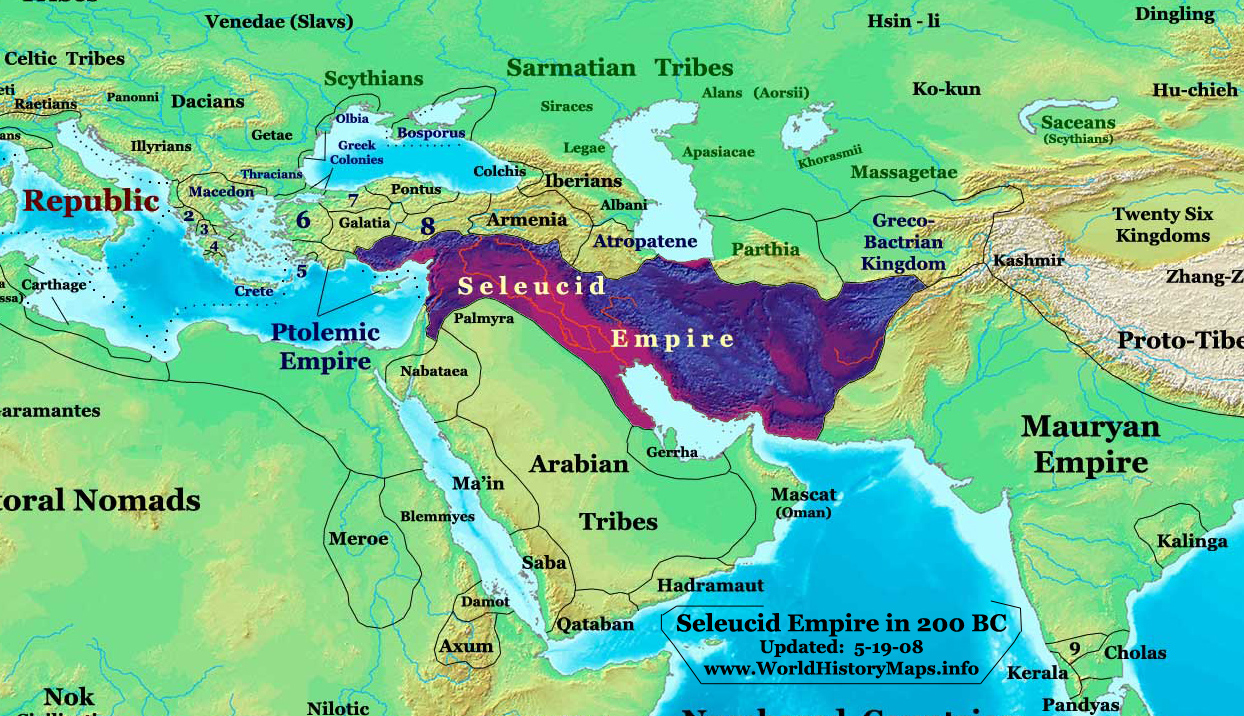


Bringing It All Together
In conclusion, there’s a simple explanation for why
- the phrase “little horn” is used only twice in all of Scripture, for the Antichrist in Daniel 7:8 and for Antiochus Epiphanes in Daniel 8:9;
- the Antichrist is portrayed as waging war against the saints, overpowering them, blaspheming God incessantly, and trying to change times and laws–just like Antiochus did in 168-165 B.C.;
- the 2,300 days of Daniel 8:14 are split between Antiochus Epiphanes and the Antichrist;
- Daniel 8:13,17,19 includes the trampling of the temple underfoot by Antiochus Epiphanes as pertaining to “the time of the end”, despite the Hebrew text of Daniel 9:25-27 indicating a time gap between the 69th and 70th Sevens that must be an exact multiple of 50 years, and despite Daniel 11 having other events occurring between what Antiochus did to the temple in 168-165 B.C. and “the time of the end” (verses 30-32 speak of the former, but “the time of the end” doesn’t start until verse 40);
- Daniel 8:25c could say Antiochus Epiphanes “will even oppose [literally, “stand against”] the Prince of princes, But… will be broken without human agency [literally, “without hand”] (1995 NASB) after the 2,300 evenings and mornings (verse 26), despite the fact that he died after less than half of those evenings and mornings had passed;
- the prophecy in Daniel 9:26 about “the people of the prince that shall come” was fulfilled by Syrian soldiers;
- the Abomination of Desolation was prophesied as being committed by Antiochus Epiphanes (Daniel 11:31) and the Antichrist (Daniel 9:27, 12:11), yet talked about by Jesus nearly 200 years after Antiochus’ time as still future (Matthew 24:15);
- the Antichrist would want “the precious things of Egypt” (Daniel 11:43b 1995 NASB) — including artifacts from the Ptolemaic Kingdom that Antiochus Epiphanes wanted to take over — more than 2,000 years after Egypt’s glory had all but faded away;
- the Antichrist is called “the Assyrian” in Isaiah 14:25;
- both Antiochus Epiphanes and the Antichrist are talked about as portraying themselves as God (compare the meaning of Epiphanes, “God manifest” with 2 Thessalonians 2:3-4); and
- the Antichrist is talked about several times in Revelation as someone who will be back from the dead.
Antiochus IV Epiphanes and the Antichrist are the same person–the former will be resuscitated to become the latter! And he’ll pick up his plans where he left off in 164 B.C.
Ironically, this means that even if we take the phrase “in the days of those kings” as covering all the kings from all the kingdoms in the vision of Daniel 2, from the Babylonian to the Roman Periods, while ignoring the possibility of a future 10-king confederation, Jesus’ return will still happen “in the days of [one of] those kings”: Antiochus Epiphanes.
Another cross-reference worth warning you about is between Daniel 8:23, 11:21,23-27,32 and Revelation 17:12-13,17. If ten kings are ruling the world in the latter passage, none of whom can apparently get a leg up on each other, how on earth will the Antichrist be able to convince all ten of them to give him their kingdom within only 39 days of his resurrection {see HIDMF p. 757-758 for my justification of the “39 days” figure}?! Well, the prophecies about Antiochus Epiphanes in Daniel 11 warned Israelites that smooth talking people into doing what he wants would be his modus operandi (see also Daniel 8:23c). And while he won’t have a glorified body, it’s safe to assume his brain will have the mental capabilities it had before he died in 164 B.C.–which, compared to people today, would be at (if not beyond) the supergenius level! This could also explain how he assimilates into the modern world quickly and skillfully enough to acquire and maintain his control. People living in the 2nd century B.C. were all “on his level” physically and intellectually, so they were able to impose some limits on how much he could get away with (consider how capitalism has historically limited any one person’s wealth by having their greed be kept in check by everyone else’s greed); people living today (with 22 additional centuries’ worth of degradation due to mutations) wouldn’t stand a chance (sure adds a new shade of meaning to Revelation 13:4c, doesn’t it?). Antiochus IV could already run rings around most (though not quite all, per the fulfillments of Daniel 11:27,30) other political figures living 2,200 years ago; once he sees what modern politicians do, I bet he’ll think: “Amateurs.”
All of this adds a layer of meaning to something John Gregory Drummond wrote just a few months ago:
By these actions, Antiochus Epiphanes effectively stepped into the role of the “Little Horn” of Daniel’s visions and became the Apocalyptic Supervillain Archtype that remains within the psyche of the Christian belief system to this day. One could argue that, if Antiochus hadn’t existed, neither would the popular conception of the Antichrist prevalent in certain circles of eschatology.
Apparently, only Antiochus IV himself is even capable of filling those shoes.
But, if you’ll permit me to reinforce that “Mostly” in this post’s title one last time, I can’t be dogmatic that when he does show up (I tentatively predict that he’ll kill the Two Witnesses sometime during Jerusalem’s daylight hours on Tuesday, March 22nd, 2033 {HIDMF p. 757}), he’ll go by the name “Mithradatas”. Even if that hunch of mine ends up being right, I probably won’t get to see any congratulatory emails, since it’s doubtful that I’ll be able to check any electronics from the place of safety (although I could be mistaken about that, depending on where/what the “place of safety” actually ends up being). And honestly, I hope any regular readers of mine will be heading for their place(s) of safety by then, instead of wasting precious time typing an email, comment, or what have you!
P.S.: Practical Advice
In the meantime, you’re probably wondering what you should do in light of this information. A friend of mine has complained that he got nightmares from reading one of my posts, and that he doesn’t want to read about apocalyptic topics if the discussions will always scare him. So I’ve decided I should make up for all the doom and gloom I’ve exegeted as starting by the end of this decade by giving you some practical tips on what you can do to prepare yourself to endure it. And don’t worry, I’m not encouraging you to become a “prepper” (of course, if you personally feel that God’s called you to an increased level of emergency preparedness, I pass no judgment on you; God knows your situation infinitely better than I do, so I’ll let Him do the judging).
Those of us who’ve heard the Gospel, believed it, repented of our sins, confessed Jesus as Lord/Master, & been “submerged… on the basis of the name of Jesus Anointed” (how the Greek phrase in Acts 2:38 literally reads) should remain steadfast by spiritually-preparing ourselves to rely on God through everything that comes our way (trust me, plenty of crazy things will happen before the Apocalypse even starts to give us opportunities to practice that!) {For those who aren’t sure whether they’ve followed the Plan of Salvation properly or not, I go into more detail on that in HIDMF, p. 58-73.} Until the Antichrist shows up, we’re still in the period of time where we can gather oil for our lamps (Matthew 25:1-13; note that verses 6-10 say the 10 virgins started trimming their lamps in response to a cry made at midnight — representing the middle of the Apocalypse — and didn’t have time from that point to buy more oil); so we might as well minimize how much God will have to chasten us (individually) during the Apocalypse by getting a head start on fleeing/overcoming our problem sins (Hebrews 12:5-17), allowing the Holy Spirit to work in us (Romans 12:1-2), and striving to obey the Law of Christ (Matthew 5:3-7:27 — the Sermon on the Mount — is a great place to start!) as faithfully as we can. (A down-to-earth explanation on how to do these is available here.) Oh, and don’t forget to read passages like Isaiah 65-66, Ezekiel 40-48, & Revelation 21-22, to familiarize yourself with what God has promised for His people: God described our inheritance in such great detail because He knows it’s easier for us humans to press on through our struggles when we have something concrete and tangible to strive toward (Hebrews 6:17-19)!6
- Could this also be true of the false prophet? Will it be some prominent ancient magician come back to life (per the mentions in Revelation 13:13-15 & 19:20 of him performing miracles to deceive the Antichrist’s followers)? I see nothing in the text of Revelation to rule out that possibility. But I must also admit that I haven’t put much thought into who it could be, if so. Until I conduct additional research into this, my guess would be Jannes or Jambres (2 Timothy 3:8), whom Jewish tradition names as the foremost magicians who opposed Moses & Aaron in Exodus 7:11-12, 22 & 8:7, and were eventually unable to do so in 8:18. ↩︎
- The same holds true for alleged parallels between Christian and Pagan rituals and practices. As Greg Boyd put it to Lee Strobel:
“As for the suggestion that the New Testament doctrines of baptism or communion come from mystery religions, that’s just nonsense. For one thing, the evidence for these supposed parallels comes after the second century, so any borrowing would have come from Christianity, not the other way around.
“And when you look carefully, the similarities vanish. For instance, to get to a higher level in the Mithra cult, followers had to stand under a bull while it was slain, so they could be bathed in its blood and guts. Then they’d join the others in eating the bull.
“Now, to suggest that Jews would find anything attractive about this and want to model baptism and communion after this barbaric practice is extremely implausible, which is why most scholars don’t go for it.”
{Quoted in “The Case for Christ”. Strobel, Lee. 1998. Grand Rapids, MI: Zondervan. 162. Paragraph divisions by Strobel.} ↩︎ - Note that this phrase negates the idea that the prior sentence shows Irenaeus taught that the fourth kingdom of Daniel 2 & Daniel 7 were both the Roman empire. Furthermore, bear in mind that Irenaeus also taught the doctrine of Chiliasm (as we’ll see in the quote of Irenaeus immediately after this one), which necessitates Jesus’ second coming in the 6000th year after Adam’s first sin. Since most early Christians could read Greek, but not Hebrew, they tended to follow the numbers in the LXX of Genesis 5 & 11 when determining how many years had passed since Adam–and the calculations with those numbers would’ve placed the 6000th year in the early 6th century A.D., only about 350 years after Irenaeus wrote this. This was why so many church fathers talked as if they were living relatively close to that time–and why it was believable to them that the Roman empire might survive until that time. We know now that the numbers in the Masoretic Text must be the correct ones (the Samaritan Pentateuch also has different numbers, but those ones would’ve placed Jesus’ return in the 18th century A.D.!), since the 6000th year by that chronology would still be in the future from this writing (A.D. 2036/7, to be exact!). {HIDMF p. 755-760} ↩︎
- The remark of Justin Martyr “that I and many others are of this opinion, and [believe] that such will take place, as you assuredly are aware; but, on the other hand, I signified to you that many who belong to the pure and pious faith, and are true Christians, think otherwise. … But I and others, who are right-minded Christians on all points, are assured that there will be a resurrection of the dead, and a thousand years in Jerusalem, which will then be built, adorned, and enlarged, [as] the prophets Ezekiel and Isaiah and others declare.” {“Dialogue with Trypho”. Chapter 80.} doesn’t count as a counterexample to my claim, because Justin doesn’t explicitly say that those who “think otherwise” believed that the prophecies had already been fulfilled. As far as the evidence goes, all they “thought otherwise” about was the degree to which the future fulfillments of these prophecies would occur literally (as Justin obviously believed) versus allegorically (a view that no church father promoted until Clement of Alexandria circa A.D. 200; it was molded over the next couple centuries or so by Origen of Alexandria & Augustine of Hippo into full-fledged amillennialism). ↩︎
- It’s significant that this statement comes from the Longer Version of Ignatius’ epistles, because the Shorter Version was Ignatius’ original. Depending on the passage, the edits in the Longer Version were intended to either expand upon what Ignatius was saying, or give seeming early testimony to ideas that were introduced to Christianity over the early centuries following Ignatius’ death. If this edit was in the latter category, you’d think they’d clarify “τῇ κυριακῇ ἡμέρᾳ” as meaning “Sundays in general”, since Sunday worship was being pushed by the Catholic authorities around the time the edits were made (4th-5th century A.D.)–Constantine officially made Sunday the Day of Rest throughout the Roman Empire in A.D. 321, yet Socrates Scholasticus indicated in Book V of his Church History that most of the early Christians worshipped on Saturday when he wrote the following in the 430s, while discussing the period of A.D. 379-395: “Nor is there less variation in regard to religious assemblies. For although almost all churches throughout the world celebrate the sacred mysteries on the sabbath [i.e., Saturday] of every week, yet the Christians of Alexandria and at Rome, on account of some ancient tradition, have ceased to do this [note the phrasing “have ceased to do this”, implying that even the congregations at Alexandria and Rome had done so previously; this takes the wind out of arguments that use the end of Chapter 15 of the Epistle of Barnabas and Chapter 67 of Justin Martyr’s First Apology as evidence that the Apostles changed regular worship to occurring on Sundays–these documents were written from Alexandria and Rome, respectively, and thus didn’t represent early churches in general on this issue!]. The Egyptians in the neighborhood of Alexandria, and the inhabitants of Thebaïs, hold their religious assemblies on the sabbath, but do not participate of the mysteries in the manner usual among Christians in general: for after having eaten and satisfied themselves with food of all kinds, in the evening [i.e., once Sunday has begun by Jewish reckoning] making their offerings they partake of the mysteries.” {Boldface and content in brackets mine. Scroll to the third paragraph of Chapter 22.} Hence, it’s more likely that the editor of Chapter 9 of Ignatius’ Epistle to the Trallians was clarifying what the phrase originally meant, in contrast to what it had come to mean by their time. ↩︎
- This is another problem with the “heavenly destiny” concept. About the most-detailed description the Bible gives us of anything in Heaven is restricted to the Heavenly Court (Revelation 4-5 and the OT passages these chapters take their imagery from). This means a heavenly hope can only be as glorious as whatever someone can imagine–which would paint quite a flimsy and fuzzy picture compared to the tangible details that God explicitly told us! Sure, the real deal will still be undoubtedly better than the picture you can paint in your head with the details God’s given us; but at least it helps you paint a more accurate, higher-quality picture compared to relying solely on your own imagination! ↩︎